Farewell to Jensen Huang: The Best Storyteller in AI Could Not Write His Own Ending. What Comes Next for Nvidia, the AI Industry and Taiwan's Supply Chain
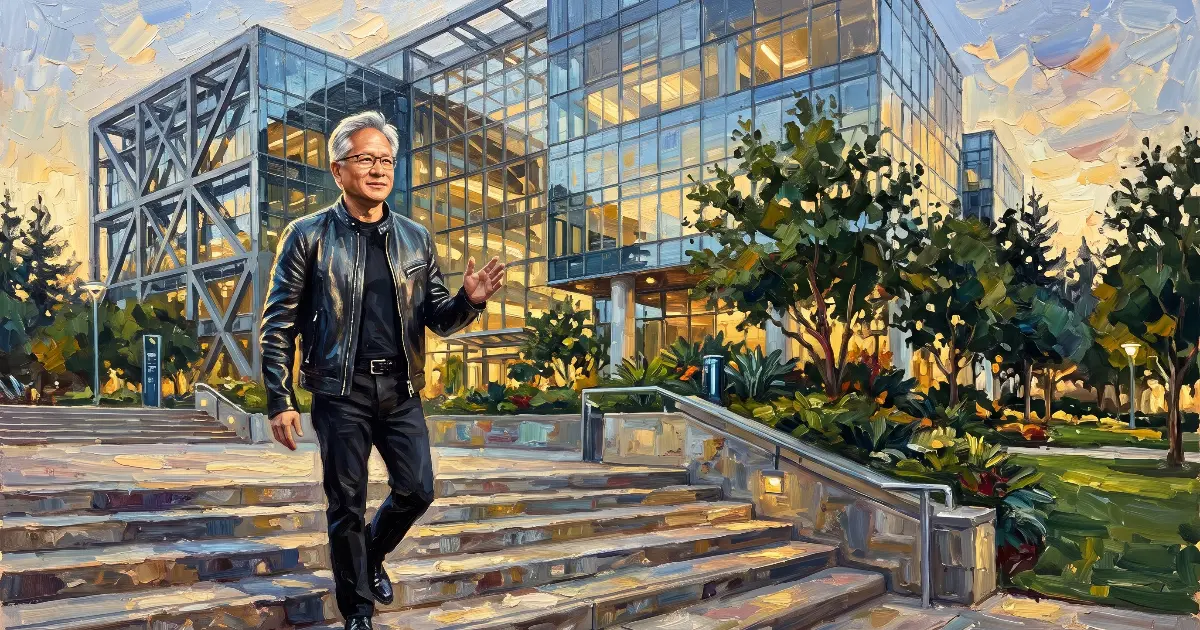
I never expected things to move this fast, or that I would be writing this piece in memory of Jensen Huang so soon.
Late on the night of November 12, Nvidia issued a short press release. Jensen Huang had resigned as president, chief executive officer and director, effective immediately. The release carried a statement from the new chair of the board and a statement from the interim CEO, but not a single word from Huang himself.
It is a cruel contrast. For the past decade, the person who told the AI story best was Huang. Standing on stage in his black leather jacket, he turned terms like "accelerated computing," "AI factories" and "sovereign AI" one by one into industry consensus, and into hundreds of billions of dollars in orders.
Yet when he left the company he founded and led for 33 years, he said nothing. Or rather, he was not given the chance to speak.
One more line in the same press release made me stop and read it again and again: Harvey Jones had been appointed Nvidia's "first-ever Chair of the Board." A company once worth more than US$5 trillion had gone 33 years, from its first day, without a chair, and only on the day it sent its founder away did it need someone to fill that seat for the first time. That one line says everything about Huang's achievements, and everything about his problems.
1. From Tainan to Denny's
Huang was born in Tainan, Taiwan, in 1963. As a child he moved with his family to Thailand, and at nine he was sent to the United States, where he boarded at a school in rural Kentucky. That small, slight Asian boy later worked at a Denny's restaurant washing dishes and busing tables, and in 1993, in a booth at Denny's, he and two partners decided to start a company that made graphics chips.
Nvidia's path was never smooth. Early products failed, and the company came close to bankruptcy more than once. Huang often said later that Nvidia was "always 30 days from going out of business." That was not modesty. It was the road he actually walked.
What I truly admire is his persistence with CUDA. In 2006 Nvidia launched CUDA, aiming to let GPUs, which had been used only for video games, handle general-purpose computing. For nearly a decade afterward, Wall Street did not understand it, the share price stayed depressed for years, and CUDA burned large sums in R&D every year without a clear return.
Then in 2012, deep learning researchers used Nvidia GPUs to train AlexNet, and the door to AI suddenly swung open. Everything that followed, ChatGPT, large language models and hundreds of billions of dollars in data center investment worldwide, was built on that decade-long bet.
To stay on one path for ten years when nobody else believes in it takes vision and willpower. Whatever the manner of his departure today, history should not erase that.
2. He put Taiwan's industry on the world stage
For Taiwan, Huang means more than a successful entrepreneur.
Nvidia's partnership with TSMC began in the late 1990s. Nvidia was still a small company then, and TSMC was not yet the TSMC of today. The two companies built each other up: the vast majority of Nvidia's GPUs are made by TSMC, and TSMC's advanced process technology and CoWoS advanced packaging kept pushing forward on the strength of Nvidia's orders.
In the AI era, that supply chain grew into an entire industrial cluster. Foxconn, Quanta and Wistron assemble AI servers; Delta Electronics and Lite-On make power supplies; AVC and Auras make cooling systems; and there are printed circuit boards, chassis and connectors besides. More than a hundred Taiwanese companies climbed aboard this train. Taiwan's stock market hit record highs as a result, Taiwan's AI server exports kept climbing, and "Taiwan, the AI island" became more than a slogan.
At Computex in 2025, I witnessed a scene I still cannot forget. It was a gathering of the biggest names in Taiwan's supply chain, a room full of entrepreneurs who had dominated Taiwan's industry for decades, including the heads of Foxconn, Quanta and Wistron. Huang did not stand on the stage waiting for people to come and pay their respects. He went from table to table himself, one person at a time, shaking hands and chatting with every Taiwanese supplier, sometimes patting a shoulder, sometimes stopping to talk a little longer.
In that moment, what I saw was not the CEO of a company worth trillions of dollars entertaining customers. It was a son of Tainan who had left Taiwan as a child, back home, paying his respects to a group of old friends who had fought alongside him. Many of these suppliers had been with him since Nvidia was far from the Nvidia of today. Each handshake carried decades of friendship, and a bond between this island and him that contracts and numbers cannot fully explain.
In recent years, every time Huang came to Computex in Taipei, he set off a whirlwind. He visited night markets, ate street food and turned up at restaurants with supplier bosses, and every news item about it was shared wildly. People of my generation in Taiwan long felt that Taiwan's industry was an "unsung hero," manufacturing for others and making money for others, its name rarely seen. Huang made Taiwan's name visible. That gratitude is real, and today's ending is no reason to deny it.
3. We must also be honest: hero worship and a one-man company
Still, remembering someone is not the same as glorifying him. If we remember only his brilliance, we miss the most important lesson of this whole affair.
The first lesson is governance. Nvidia had never had a chair. Several board members had worked with Huang since the 1990s, about 60 senior executives reported directly to him, and almost every major decision was his alone to make. While the company was growing at high speed, this structure was astonishingly efficient: decisions were fast, execution was fast, and there were no layers of bureaucracy.
But it also turned Nvidia into a company with a "single point of failure": once that point has a problem, the whole system shakes. From its high in early October, Nvidia's share price has fallen about 30%, and nearly US$1.8 trillion in market value has evaporated. That is the price.
Many commentators have also pointed out that Nvidia had no public succession plan, and that was what outsiders worried about most.
The second lesson is about ourselves. Frankly, Taiwan's media, myself included, covered Huang in recent years with more enthusiasm than calm, more fandom than scrutiny. Every word he said was treated as an industry prophecy, and every visit to Taiwan was treated as a national event.
Once we turn an entrepreneur into a god, it becomes very hard to examine his decisions, his power and the risks of the company behind him with a clear head.
The third lesson is the concentration risk in Taiwan's industry. There is no denying that part of the boom in Taiwan's AI supply chain was tied to one company, and even to one man's personal relationships. While Huang was there, that was an advantage. Now that he is gone, personal ties will be replaced by contracts, and trust will be replaced by legal procedures. Taiwanese suppliers must recognize that real competitiveness ultimately rests on their own technology and on being irreplaceable, not on any one person's friendship.
Huang's role between the US and China was also always controversial. He lobbied Washington hard to allow chip exports to China, arguing that the United States should not give up the Chinese market. That made commercial sense, but in an era of rising geopolitical tension, this gray zone also put him and Nvidia under growing political pressure.
4. On the scandal
Some parts of the storm that brought him down have been confirmed; others are still only allegations.
According to media reports, Huang has admitted to employees that he was unfaithful in his marriage and has apologized. As for the "Chinese spy" suspicion that draws the most attention, US media have reported that intelligence agencies suspect he was a target of Chinese infiltration, but this has not been proven to date, and China has denied it. Nvidia's board said earlier that it had no reason to believe the company's secrets or national security had been compromised.
The storm began with a New York Times report on October 29, 2026, that US officials suspected Huang was the target of a Chinese intelligence operation. On November 4, three Republican committee chairs in the US House wrote to Huang; on November 8, Huang admitted the affair to employees, and Nvidia's board announced an independent investigation the same day.
Before Huang resigned, events had been escalating. The Wall Street Journal reported on November 11, 2026 that the board was preparing to remove Huang. Bloomberg reported that the board had engaged an outside search firm to identify candidates and was considering naming an interim CEO first.
In addition, on November 10 Nvidia's board retained the law firm Wachtell, Lipton to lead the internal investigation. Three Republican committee chairs in the US House of Representatives asked Huang to attend a closed-door briefing on November 18, 2026. According to CNBC, Huang agreed to testify before Congress after resigning.
I do not want to pass moral judgment here, nor do I think anyone should kick a man when he is down. Private morals are one thing. But for a company that shapes the global AI industry and bears on national security, once the CEO's private life becomes linked with words like foreign intelligence and export controls, it is no longer just a private matter.
The greater the power, the stricter the scrutiny; and a power structure without enough checks makes it easier for one person's mistake to become a crisis for an entire company.
This may be the greatest irony of Huang's life: he built the world's most powerful computing systems, yet never built a system for himself that could check him, and protect him.
5. After Huang: how Nvidia, the AI industry and Taiwan's supply chain will change
Now that Huang has been forced out, what does it mean for Nvidia, for the AI industry and for Taiwan's supply chain?
Let me start with the conclusion. Huang is gone, but demand for AI itself will not change because of one person. The capital spending of the five big cloud providers, about US$800 billion this year and as much as US$1.3 trillion next year, the GB300 and Rubin orders already agreed, and TSMC's fully booked CoWoS capacity will not disappear because of this. What will change is Nvidia's dominance, how the AI pie is divided, and the "goodwill dividend" that Taiwan's supply chain has enjoyed from personal relationships.
My views fall into a few points, in three areas: Nvidia, the AI industry and Taiwan's supply chain.
Nvidia: engineering won't stop, but decision-making will change
First, for Nvidia, what falls in the short term is the "founder premium," not the fundamentals. The product roadmap is locked in for two to three years, and the financial guidance still stands. This quarter's revenue guidance is about US$108 billion, and the CFO expects revenue to grow another 70% in fiscal 2028. Some analysts estimate the market value could lose nearly a third, but that would mainly reflect lower valuation multiples and price-to-earnings ratios.
Second, the biggest medium-term loss is "command capability." Nvidia launches a new product generation every year, while also coordinating the CUDA ecosystem and NVLink Fusion partnerships, investing in OpenAI and various neoclouds (specialized AI cloud providers), and negotiating sovereign AI with governments. In the past, all of this relied on Huang alone to make the call.
Now CFO Colette Kress is serving as interim CEO. With an interim CEO or a professional manager in charge, decision-making will certainly slow down. The interim candidates commentators had named earlier were precisely Kress and Ian Buck, who leads the hyperscale business, but neither is likely to coordinate the whole picture the way Huang did.
The worst case would be if the investigation confirmed leaks of secrets, or illegal exports, such as the Megaspeed transshipment case that outsiders have questioned. In that case, I think, the problem would go beyond replacing a person: there would be fines, tighter regulation, and the possibility of losing the China market entirely.
Megaspeed is a Singapore-based data center company. According to The New York Times and other media, Alice Huang (Huang Le), the woman with whom Huang had an affair, was a senior executive at Megaspeed. Authorities in both the US and Singapore are investigating whether Megaspeed transshipped Nvidia chips to China, while Nvidia has said it found no evidence that its chips were diverted.
Government relations have also been damaged. Huang had been a key figure in negotiating export controls with the Trump administration. With this scandal linked to a "Chinese spy," his influence in this area has been greatly diminished.
All in all, this affair is clearly bad for Nvidia. Both its dominance in the AI industry and its voice in the market will be affected to varying degrees.
The most direct blow is to the share price. In early November, amid doubts about AI capital spending, Nvidia's market value had already been overtaken by Apple's. Since the scandal broke, Nvidia's share price has fallen about 20%. As the scandal widened, its market value closed at about US$4.2 trillion on November 11, 2026, then fell another 8.6% after hours to about US$3.83 trillion, temporarily overtaken by Microsoft (US$3.87 trillion) and dropping to third place. Apple stood at about US$5.17 trillion. On November 12, the day the resignation was announced, Nvidia's shares fell more than 13% at one point in early trading.
Falling from the world's largest market value straight to third is a heavy blow. Moreover, Nvidia is the bellwether of AI. A plunge in its share price amplifies doubts about whether AI capital spending can be sustained, and drags down valuations across AI stocks.
The AI industry: bargaining power shifts, bubble worries grow
Next is the impact on the AI industry. Nvidia's customers will certainly try to diversify their sources of supply. Google's TPU, AWS's Trainium, Meta's MTIA, the chip OpenAI is developing with Broadcom, and AMD will all gain more bargaining chips. Nvidia's gross margin of around 75% is the most likely to come under pressure first.
In addition, the flow of money in AI may tighten. The model in which Nvidia invests in customers who then buy its GPUs has long been questioned. To show prudence, a new CEO is likely to rein in such investments, and the financing environment for neoclouds such as CoreWeave will worsen accordingly.
With Huang gone, AI development has lost its best storyteller. Concepts such as sovereign AI and AI factories were largely sold to the world by Huang himself. Without him on stage in the future, and without him lending his star power to Computex, many people may miss him a great deal.
Taiwan's supply chain: impact at three levels
I would discuss the impact on Taiwan's supply chain at three levels.
The first level, the companies least affected, should be TSMC, ASE and MediaTek. Whether orders flow to Nvidia, to ASICs (custom chips) or to AMD, they all ultimately pass through TSMC's manufacturing and advanced packaging. If customers turn to ASICs, MediaTek, Alchip and GUC may even benefit. MediaTek's cooperation with Nvidia (GB10, NVLink Fusion) may cool, but its ASIC partnership with Google will accelerate.
The second level, the group with higher risk, is the server assemblers and component makers (cooling, power, chassis, PCBs and others) that depend heavily on Nvidia. Much of their capacity allocation has relied on decades of friendship between Huang and companies such as Foxconn, Wistron and Quanta. With an American professional manager in charge, and with Washington pressing for "Made in America," these companies may be affected.
According to Taiwan's Economic Daily News on November 10, 2026, citing data compiled by Bloomberg, Nvidia accounts for 36% of KYEC's revenue, 21% of Wistron's and 19% of TSMC's.
A professional manager taking over from Huang is likely to do three things. First, move more assembly to the US or Mexico. Nvidia has already committed to investing US$500 billion in AI infrastructure in the US, and this should now speed up.
In April 2025, Nvidia announced that over the next four years it would produce up to US$500 billion of AI infrastructure in the US with its partners. These partners include Taiwanese companies TSMC, Foxconn, Wistron and SPIL: Foxconn in Houston and Wistron in Dallas, both in Texas, are setting up plants to assemble supercomputers; TSMC is producing chips in Phoenix, Arizona; and SPIL, together with US-based Amkor, handles packaging and testing in Arizona. So "moving assembly to the US" does not entirely mean Taiwanese companies lose orders, but whether they can quickly follow by moving production lines to the US is another test.
Second, bring in North American contract manufacturers such as Jabil, Celestica and Flex to diversify suppliers. Some people had already begun planning this, and it will now speed up. Third, price negotiations will leave less room for personal relationships. Short-term orders will not change, but in allocating orders from 2027 onward, personal ties will carry less weight.
Recently, Jeffrey Sonnenfeld of the Yale School of Management and others wrote in a TIME commentary that the long-term outside candidates for Nvidia CEO should be Tim Cook and former Google CEO Eric Schmidt. Former Apple CEO Cook is unlikely to take over Nvidia, as he is still Apple's chairman. But comparing Cook with Huang shows a sharp contrast. Cook's approach to Taiwanese suppliers has been to drive prices down, which would naturally be less favorable for Taiwan.
Of course, China's supply chain can no longer be trusted, which differs from the time when Apple shifted its supply chain to mainland China. The US will continue its "non-red supply chain" policy (a supply chain free of Chinese involvement), and the new professional manager will have to choose between Taiwan and other non-red supply chains, though the choices are actually quite few.
At the last level, there is structural risk to consider: scrutiny of "trusted supply chains" will become stricter. The core of this scandal is the Chinese intelligence infiltration that the US suspects. According to the Financial Times on November 9, 2026, Nvidia has asked its data center partners to scale back their dealings with Chinese customers. We can expect Washington to examine supply chains more strictly for cybersecurity, personnel backgrounds and exposure to China, and Taiwanese companies may be asked to explain their factories and staff in China.
In the past, although Huang's Nvidia worked with Taiwanese suppliers through well-standardized processes, the cooperation rested on a foundation of trust. If someone else takes charge, there will likely be more involvement from lawyers and more by-the-book standard procedures, raising the barriers to working together.
There is also an important symbolic meaning. Nvidia's Taiwan headquarters at the Beitou-Shilin Technology Park in Taipei and the annual Computex keynote are the most direct links between Taiwan and Nvidia. After the change of leadership, the halo of a "pride of Taiwan" and the political goodwill toward Taiwan will both be discounted.
Finally, the Huang affair brings new developments every day, and much remains uncertain. I think what deserves the closest attention is, of course, the conclusion of the investigation. Whether the findings involve only personal conduct, or extend to leaks of secrets or illegal exports, will lead to very different scenarios.
Second, whether the permanent CEO is an internal technologist or an outside professional manager. An outside choice would have a bigger impact on Taiwan's supply chain.
Lastly, Huang has resigned from the board. Whether he can continue to take part in products and customer relationships as founder or adviser will also matter greatly for Nvidia's development and for Taiwan's supply chain, and deserves further watching.
6. How we should remember him
In 2024, speaking at Stanford University, Huang said he hoped young people would experience "ample doses of pain and suffering," because greatness comes from being tempered, not from being smart. The audience laughed at the time. Looking back today, the line reads as if it were written for himself.
I think, in recording Huang, we should look at three things separately.
First, his achievements. He saw the future of AI, stuck with his bet on CUDA for ten years, and led Nvidia from a graphics chip company to the infrastructure of the AI era. That is a page of industrial history that will not be rewritten.
Second, his connection with Taiwan. He let the world see the value of Taiwan's supply chain and brought Taiwan from behind the scenes to center stage. Taiwan should remember that contribution, and it deserves gratitude.
Third, the lessons he leaves behind. Heroes make mistakes; institutions are what endure. A company, an industry, even a country, cannot stake its future on one person.
The AI era will not stop because Huang has left. TSMC's capacity is still fully booked, and cloud providers' capital spending is still staggering. But we must also admit that without him, this era would not have begun in this way, or at this speed.
As I write this, I think back on my more than 30 years of covering Taiwan's electronics industry. Taiwan's industry has been through countless tests: the dot-com bust of 2000, the global financial crisis of 2008, the rise and fall of HTC, and the collapse of DRAM, flat panels, LEDs and solar, once known in Taiwan as the "four miserable industries." After each test, Taiwan stood back up. I remain deeply confident in the resilience and recovery capacity of Taiwan's industry.
What stays with me most is still those handshakes at Computex 2025. The trust those handshakes represented was once the most precious asset of Taiwan's supply chain; from now on, Taiwan must learn to make sure that trust no longer hangs on one person.
In bidding farewell to Jensen Huang, we are sending off a man who once lit up an era. What comes next is for us to learn to keep moving forward when there are no heroes.
Related Articles
Why TSMC Is Buying into Both OpenAI and Anthropic: Three Investment Principles from ASML and ARM to AI Model Companies
Samsung's HBM Packaging Expansion Will Raise Demand for TSMC's CoWoS: How Taiwan and Korea Divide the Work in Advanced Packaging
Come Up with a Way! How Former TSMC CTO Chenming Hu Extended the Life of Moore's Law and Showed TSMC How to Overtake Intel