Stronger Models Don't Mean Bigger Profits: Kai-Fu Lee on the New AI Race, Where the US Leads in B2B and China Could Break Through in B2C
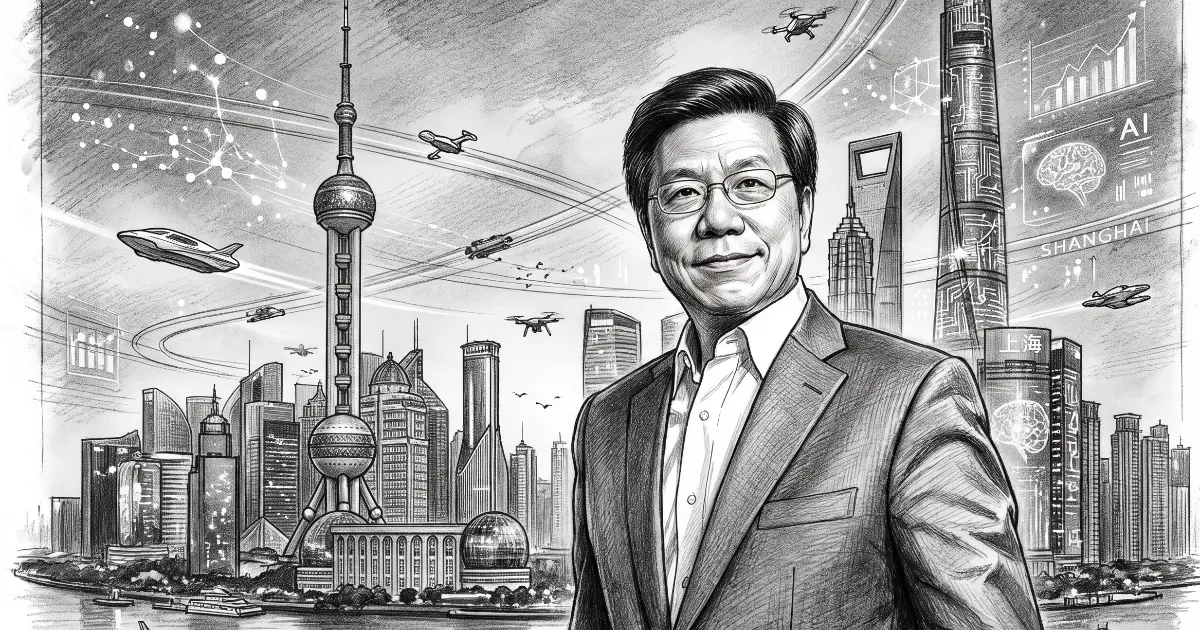
Kai-Fu Lee, founder of 01.AI and Sinovation Ventures, published a new book in August 2026 with Taiwan's Commonwealth Publishing. Its Chinese title translates as "The AI Future Has Arrived: Transformation Strategies for CEOs, Companies and Individuals in a Time of Upheaval"; the English edition is titled AI Native: The Mandate to Transform Your Company. The book answers five key questions of the AI transformation era, including why most companies' AI transformations fail, and what systems and organizational forms companies actually need to make AI transformation work.
The book argues that AI is driving the cost of intelligence toward zero at unprecedented speed. Everyone can afford it and every company is adopting it, yet the vast majority of AI investment fails to show up in revenue and profit. The book also explains why, in this new era, companies must rethink how they learn, how their organizations run, how they manage intellectual property, and how they keep growing.
Lee worked at Apple and SGI early in his career, then served as a corporate vice president at Microsoft and as a Google vice president and president of Google Greater China. Through Commonwealth Publishing, I conducted an online interview with Dr. Lee. He covered US-China AI competition, open-source models and chip export controls, explained how 01.AI is moving into enterprise AI and sovereign AI, and laid out where the AI industry is heading next.
He said AI is entering a new phase of competition. Over the past few years, the global AI industry focused on large language models, computing power, chips and model performance. As model capabilities rise rapidly, the center of competition is shifting from "who can train the strongest model" to "who can actually bring AI into companies and daily life and create commercial value."
Lee believes the US and China have gradually developed different strengths in AI. US companies have a more mature enterprise software subscription market and are good at building enterprise AI. China carries forward the innovation capacity of its mobile internet era and has better opportunities in consumer AI applications.
What he most wants to tell business leaders is that AI should not be just another new tool for the IT department. It should become the core force through which a company rethinks its business model, its organization and its decision-making.
Here are ten key points from the interview.
1. Companies are spending heavily on AI but seeing no results. Where is the problem?
Many companies today share the same problem: they pour large budgets into AI yet never see a clear return on investment.
Lee believes this is because CEOs' understanding of AI is still at an early stage, which is the central point of his book. Many companies hand AI to the CIO (chief information officer), or ask each department to propose its own AI budget and find its own use cases. This approach underestimates what AI can do.
He offered an interesting analogy. Today's AI is like a company suddenly hiring a super-talent with an IQ of 300 and unlimited memory. If the company assigns this super-talent to a single department such as legal or customer service to do local tasks, that is an enormous waste.
The right approach is to let AI understand the entire company: let AI sit in on meetings across departments, read important internal documents and data, understand every sales record and customer communication, analyze customer service calls and customer needs, and integrate the company's internal databases and knowledge systems.
In this way, AI is no longer a tool for one department but a super assistant to the CEO. AI can help senior management grasp information across the whole company, analyze problems, make recommendations, and even help make better business decisions.
Lee believes this is the opportunity most worth taking seriously when companies adopt AI: making AI the intelligence hub of the company, and through it raising revenue, profit and operating efficiency.
2. The US is strong in B2B, China in B2C: two different AI business models
On the differences between US and Chinese AI, Lee believes the thing most worth watching is not the model technology itself but the business models and spending habits of the two markets.
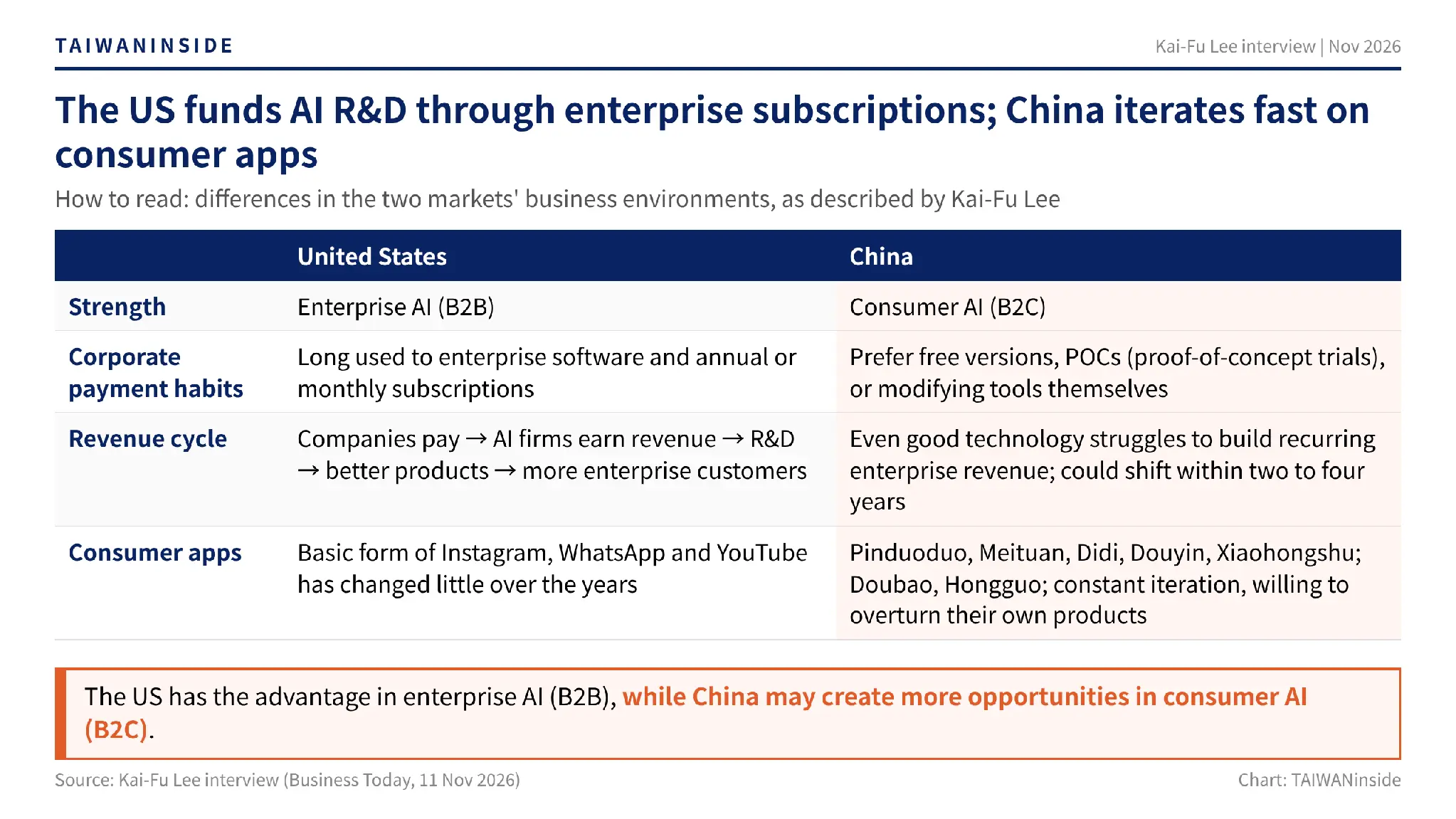
First, in the US, companies are willing to pay, and the B2B business model is mature. US companies have long been used to enterprise software and to paying annual or monthly subscription fees. AI companies can therefore earn stable income from enterprise subscriptions and reinvest it in model development, product improvement and service expansion.
This creates a relatively healthy business cycle: companies are willing to pay, so AI companies earn revenue and keep investing in R&D, then deliver better products, which attract more enterprise customers. In the enterprise software market, the US has a clear advantage.
In China, companies lack the habit of paying, and the B2B market has yet to break through. Chinese companies' demand for AI is not low, but their payment habits differ from those in the US. Many companies prefer to use free versions first, run a POC (proof of concept, a small trial to test whether a technology works), or take a tool and modify it themselves, rather than sign long-term subscription contracts.
As a result, even Chinese AI companies with good technology find it hard to build large, recurring enterprise revenue.
Lee believes that if China wants to build real competitiveness in enterprise AI, it must gradually change how companies pay. He said the market could still shift in the next two to four years.
China's consumer AI, however, has more room for innovation, because China is highly competitive in B2C consumer software. From Pinduoduo (group-buying e-commerce), Meituan (food delivery and local services) and Didi (ride-hailing), to ByteDance's Douyin (the Chinese version of TikTok), and Xiaohongshu (a lifestyle social platform), Chinese companies keep creating new consumer applications and new usage habits.
Lee pointed out that Chinese companies have one important trait: they iterate constantly and are even willing to overturn their own successful products. By comparison, the basic form of large US platforms such as Instagram, WhatsApp and YouTube has changed relatively little over the years.
He therefore believes the US has the advantage in enterprise AI (B2B), while China may create more opportunities in consumer AI (B2C).
This does not mean the US can only do enterprise applications and China only consumer ones. It means the current business environments of the two markets give them different strengths.
3. The US excels at going from zero to one, China at going from one to N. Is that still true in the AI era?
In discussions of technological innovation, people often say the US is good at going from zero to one, creating new technologies and business models, while China is good at going from one to N, scaling technology quickly into large markets.
Lee believes this pattern still has some reference value in the AI era but cannot be applied wholesale. In consumer AI especially, China already has some notable cases.
Examples include ByteDance's Doubao, an AI assistant app, and the short-drama platform Hongguo. These products did not necessarily succeed because their underlying models were the strongest, but because they found ways of using AI that fit consumer needs.
This involves an important product concept: PMF (product-market fit), the degree to which a product matches market demand. A product succeeds not necessarily because its technology is the most advanced, but because it truly meets a market need and consumers keep using it.
During the mobile internet era, Chinese companies accumulated extensive experience in product development, user management and business model innovation, and that experience remains valuable in the AI era.
4. Doubao and Hongguo: two key cases of Chinese consumer AI
Lee used Doubao and Hongguo to show how Chinese AI creates consumption and applications.
ByteDance's Doubao lowers the barrier to using AI through an excellent voice experience. Because its voice input and interaction are so good, many ordinary people like asking it questions. Its strength is not necessarily having the most capable model, but being simple and convenient, meeting ordinary people's everyday need to ask questions.
This takes AI beyond being a tool for tech professionals and brings it into ordinary people's lives. This model of driving adoption through user experience is an important direction for consumer AI.
Doubao's user numbers reflect this. China's National Business Daily, citing data from research firm QuestMobile in February 2026, reported that Doubao had 227 million monthly active users in the fourth quarter of 2025, the most of any AI app in China. ByteDance CEO Liang Rubo said at the company's mid-year all-hands meeting on 6 August 2026 that Doubao has stayed competitive on the consumer side, but that the gap between ByteDance's large language models and the leading overseas models has widened.
The second case is Hongguo short dramas. AI has already changed how content is produced, and Hongguo represents another kind of innovation.
Hongguo is also a ByteDance product, launched in August 2023. According to QuestMobile, Hongguo had 168 million daily active users in July 2026.
Lee said Hongguo brings AI into the entire production process of short dramas, including writing the source novels, writing scripts, producing songs and theme songs, generating text and related assets, and producing the video itself.
AI can sharply cut the cost of making short dramas. He estimates that AI production may cost only one-twentieth as much as a traditional short drama. With lower costs, operators have more resources to spend on promotion, community management and user engagement.
Hongguo's success shows that AI does more than make existing industries more efficient. It may also redefine how the content industry produces and makes money, a direction in Chinese consumer AI worth watching.
5. The rise of open-source models: heavy usage does not mean big revenue
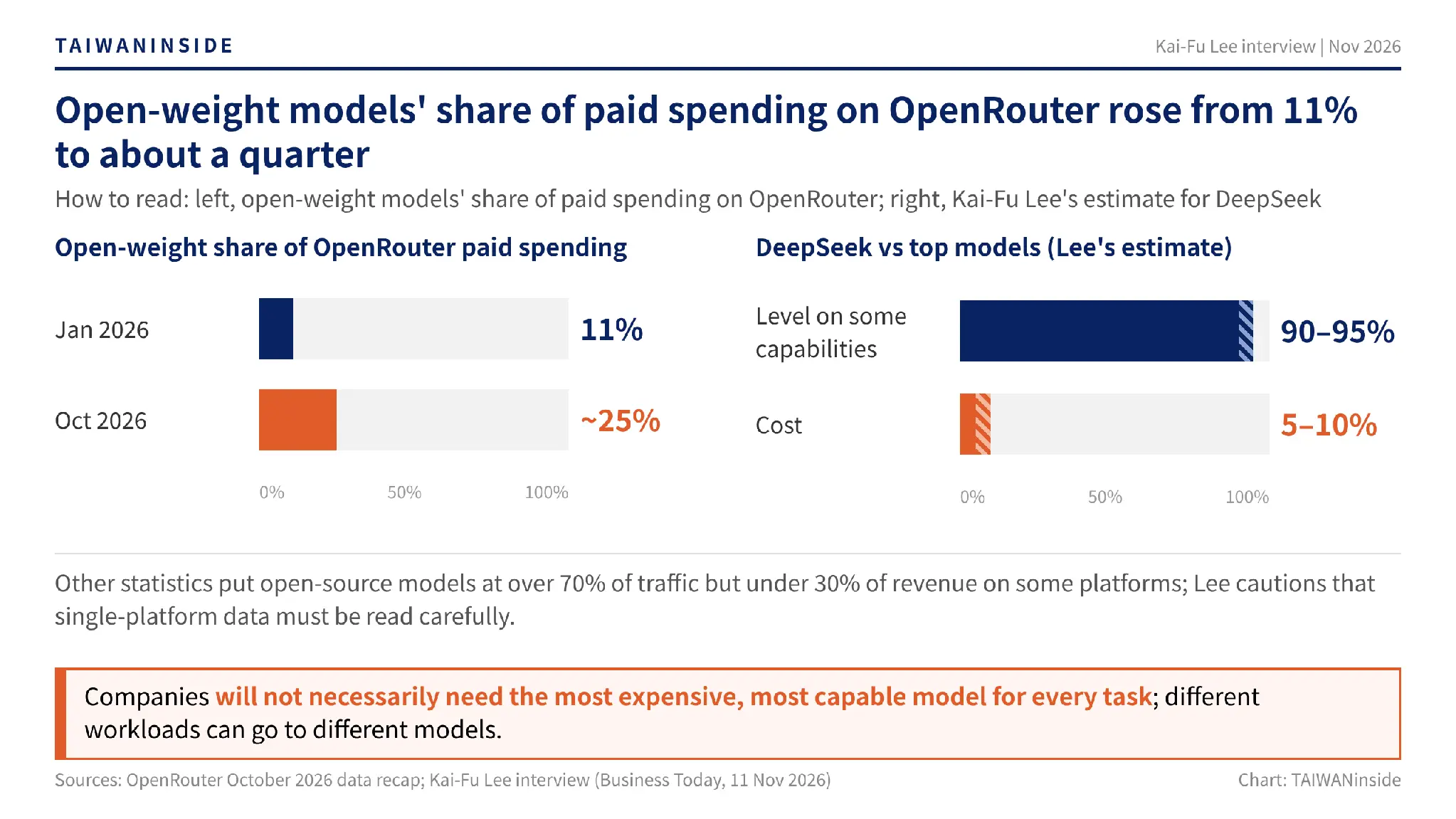
Another notable trend is the rapid growth of open-source models. Statistics have circulated showing that open-source models account for more than 70% of usage traffic on some platforms, yet less than 30% of the revenue. What does this mean?
Lee believes such data must be read with caution. Usage statistics from OpenRouter, a platform that routes developers' requests to many different AI models, only reflect model usage through that platform and do not represent actual usage of all AI models worldwide.
Because OpenAI, Anthropic, Google and others do not fully disclose their total usage, it is hard to directly compare the true global market shares of open-source and closed-source models.
OpenRouter's own October 2026 data recap shows that open-weight models (models whose parameters are published so users can download and run them themselves) account for about a quarter of paid spending on the platform, up from only 11% in January 2026.
Over the long term, though, he believes open-source models will certainly win more market opportunities. When model performance converges but the cost gap remains large, companies will naturally reconsider which model to use.
Lee cited the Chinese AI company DeepSeek as an example. With limited computing resources, Chinese companies work harder to cut costs through engineering, algorithms and resource management. DeepSeek's models can reach about 90% to 95% of top models' level on some capabilities, at perhaps only 5% to 10% of the cost.
Chinese companies will therefore use much lower costs to reach capabilities close to those of the top models.
He also said that for many real-world applications, this performance-to-cost ratio is already good enough. In the future, companies will not necessarily need the most expensive, most capable model for every task. Different workloads can be handled by different models, which will bring more business opportunities to open-source models.
6. Can US chip export controls really contain China's AI development?
US restrictions on exports of advanced AI chips to China have indeed affected Chinese model training. Lee does not deny their effect, but he believes export controls are a double-edged sword.
On one hand, China's ability to obtain advanced chips is restricted, which may reduce its computing resources. On the other hand, this also forces Chinese companies to focus more on cost control, engineering efficiency and technical innovation.
With insufficient resources, Chinese AI companies find ways to use fewer chips and less money to complete work that would otherwise require far greater resources. DeepSeek is the representative case of this mindset.
Lee therefore believes chip export restrictions do have an impact, but that does not mean they can fully stop the progress of China's AI industry.
Computing power is an important condition for AI development, but engineering capability, algorithmic efficiency and application scenarios are equally important factors in determining competitiveness.
US controls have been partly relaxed since late 2025. On 8 December 2025, US President Donald Trump announced that, subject to national security conditions, Nvidia would be allowed to sell H200 chips to approved customers in China, with 25% of the revenue going to the US government; the more advanced Blackwell and Rubin chips were excluded. In May 2026, Alibaba, Tencent, ByteDance and JD.com received purchase licenses, and three more Chinese companies were approved in July. However, according to Taiwan's TechNews on 15 July 2026, US officials confirmed that the number of chips actually delivered to China remained very small.
7. 01.AI's pivot: from building large models to enterprise AI applications
In the interview, Lee also explained 01.AI's strategic shift in recent years. In its early days, 01.AI focused mainly on developing large language models.
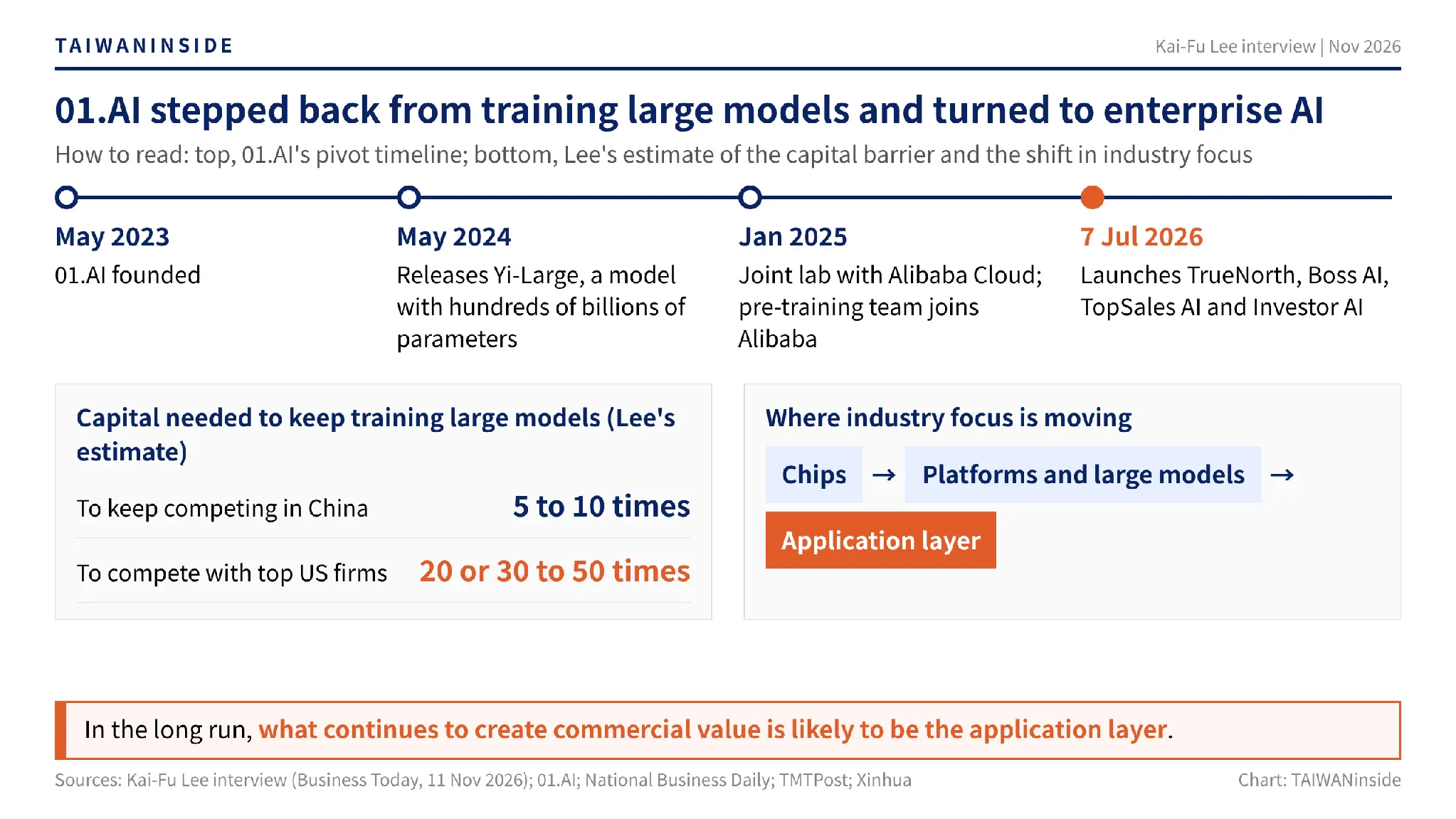
01.AI was founded in May 2023 and released Yi-Large, a model with hundreds of billions of parameters, in May 2024.
At the time, the company achieved good results in China's model market, but Lee gradually realized that continuing to compete with the top US model companies would require enormous amounts of capital.
He estimates that staying competitive in the Chinese market might take five to ten times the capital, and competing with the top US companies might take twenty or thirty times, even up to fifty times.
Given its fundraising capacity and competitive conditions, 01.AI decided to stop making the training of large foundation models its main direction and turned to enterprise AI applications. This is not giving up on AI but changing its competitive position.
In January 2025, 01.AI and Alibaba Cloud set up a joint industrial large model lab. Pre-training of very large models was handed to the joint lab, and 01.AI's pre-training team and infrastructure team joined Alibaba's Tongyi team and Alibaba Cloud respectively.
TrueNorth: helping AI truly understand a company's internal knowledge and data
01.AI's enterprise AI operating system, TrueNorth (Wance in Chinese), aims mainly to let AI master a company's important internal data and knowledge.
It is not just an ordinary chatbot. It aims to understand important internal documents and confidential data, integrate information across departments, reason logically about business problems, provide grounded and explainable analysis, and reduce AI hallucinations to make answers more trustworthy.
The company has also developed applications such as "Boss AI," designed to help business leaders grasp company information, analyze problems and make decisions more efficiently.
TrueNorth and three applications, Boss AI, TopSales AI and Investor AI, were launched on 7 July 2026, covering business management, sales and investment decisions respectively.
Lee believes what companies really need is not a simple AI chat tool but an intelligent system that understands the company and helps it run.
Why not keep competing in large models? Behind this lies an important industry judgment. In the early stage of the AI industry, chips received the most attention; next came platforms and large models; but in the long run, what continues to create commercial value is likely to be the application layer.
01.AI has therefore chosen to put its resources into enterprise applications instead of continuing in the extremely capital-intensive large model arms race. The company's strategy focuses on overseas markets while also serving China, concentrating on B2B business and, for now, not making consumer B2C applications a main direction.
8. Sovereign AI: the next big market is helping countries build their own AI capabilities
Beyond enterprise AI, Lee is also particularly optimistic about another market: sovereign AI.
Simply put, sovereign AI means helping countries or regions build AI systems and application capabilities that meet their own needs. Countries differ in language, culture, regulation, government systems and data security requirements, so they cannot rely entirely on a single general-purpose AI system.
01.AI hopes to help governments develop AI applications suited to their needs, such as helping energy ministries analyze energy demand and policy, helping education ministries manage educational resources and analyze policy, helping government administration process official documents and improve efficiency, and helping parliaments and public governance organize meeting records, policy materials and public information.
Lee believes government agencies and companies have much in common. Both hold large amounts of data, have complex organizational structures, and need to make management decisions based on information. Once AI can master this information, it can help governments improve administrative efficiency and policy implementation.
More importantly, countries share many common needs. In education, energy and government document management, for example, national systems differ, but the underlying AI technology and application architecture may be similar. So the more countries 01.AI serves, the more technology and experience it accumulates, creating economies of scale.
Lee also believes that his experience across AI research, product development, investment, management, entrepreneurship and writing, along with the international influence built by his books, helps 01.AI build partnerships with government leaders. Many heads of state and ministers have read his books and are therefore willing to meet him. This is one of the distinctive features of 01.AI's sovereign AI business.
9. The most important task of the AI era: CEOs must personally lead the transformation
At the end of the interview, Lee returned to why he wrote the book. He believes AI is advancing so fast that many leaders of traditional companies do not yet truly understand its impact on their businesses.
If a company treats AI merely as an IT tool, or leaves it to the IT department, it may miss this important wave of industrial transformation.
Real AI transformation must start with the CEO.
The CEO must rethink: How will AI change the company's organization and management? Which work can be automated with AI? How can AI integrate all of the company's internal knowledge and data? How can AI improve customer service and product development? How can AI take part in business decisions and create new revenue and profit?
Lee also made a point worth noting: he does not want to see all traditional companies replaced by AI-native companies in the future. Many traditional companies have spent decades building industry knowledge, customer relationships, brand value and operating experience, all of which are very valuable assets.
If AI can help traditional companies transform, they can keep their existing strengths and also build new competitiveness. So besides creating a new AI industry, AI companies should also provide tools that help traditional companies transform successfully.
10. Steve Jobs's philosophy of life, and Kai-Fu Lee's own career in AI
At the end of the interview, I also asked Dr. Lee what AI has meant for his rich career.
He cited an idea from Steve Jobs: every important decision in life should follow what you truly want to do in your heart. When you look back at every point you have passed, you will find they connect into a meaningful curve.
Lee feels fortunate to have taken part in many different stages of the AI industry, from scientific research, product development and core technology to AI investment, corporate management, entrepreneurship and commercial sales. He has done all of them. As a Chinese company, doing both B2B and B2C is not easy, and being an author has also given him a way to connect with the international community through his books.
Now he hopes to bring these experiences together to help more countries outside China develop enterprise AI and sovereign AI. For him, this is also the result of the many experiences in his career gradually connecting.
Conclusion: The next phase of AI competition is about who creates real value, beyond who has the best model
The interview reveals several of Lee's key judgments about the future of the AI industry. At the end of the interview, the one thing he most wanted to remind business leaders of was this: "AI transformation is not the CIO's job. It is a corporate strategy the CEO must personally lead."
He believes past technological revolutions usually saw new technologies create new companies; this time, AI may also let traditional companies with deep industry experience regain a competitive edge.
The real winners of the future will not necessarily be the companies with the biggest models, the most chips or the most computing power, but those that best know how to use AI and turn technology into real productivity and commercial value.
Related Articles

Why TSMC Is Buying into Both OpenAI and Anthropic: Three Investment Principles from ASML and ARM to AI Model Companies
Samsung's HBM Packaging Expansion Will Raise Demand for TSMC's CoWoS: How Taiwan and Korea Divide the Work in Advanced Packaging
Come Up with a Way! How Former TSMC CTO Chenming Hu Extended the Life of Moore's Law and Showed TSMC How to Overtake Intel