Come Up with a Way! How Former TSMC CTO Chenming Hu Extended the Life of Moore's Law and Showed TSMC How to Overtake Intel
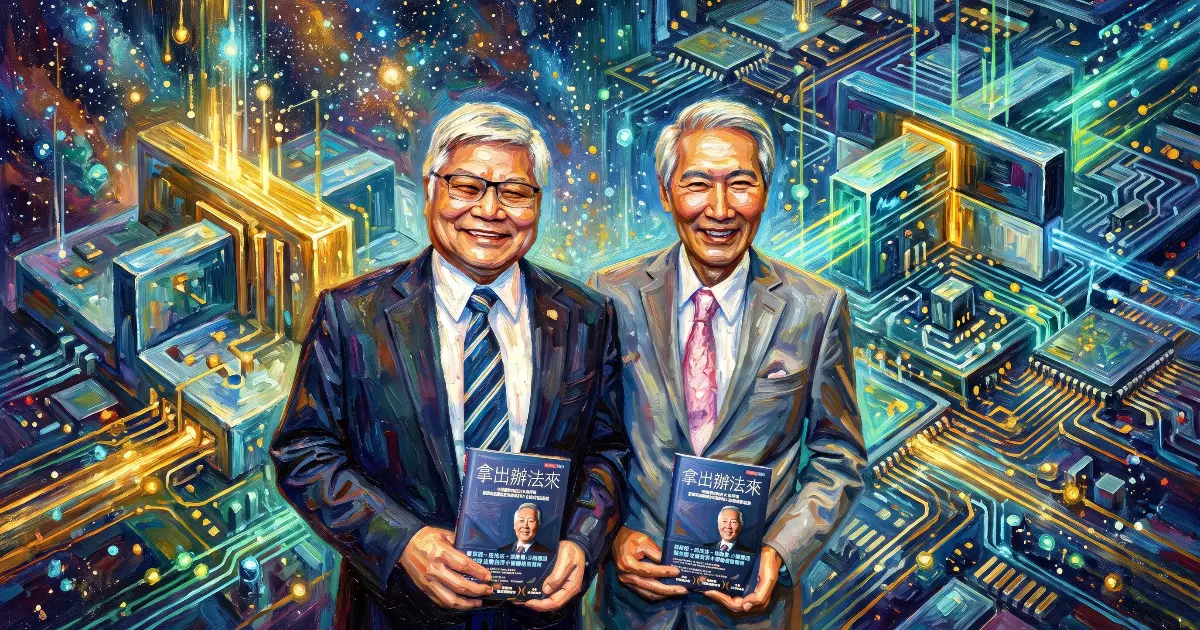
Chenming Hu, known as the father of the 3D transistor, published his memoir, Come Up with a Way (拿出辦法來), in October 2026. In the book, and in an interview with me at the book launch, Hu explained why he once advised TSMC to let Intel be the first to mass-produce the fin field-effect transistor (FinFET), so that TSMC could catch up and pull ahead when the technology changed over. When Intel fell into crisis in 2025, he wrote an article urging the US government to invest directly in Intel and submitted it to four American newspapers, all of which rejected it. He also commented on the yield race among TSMC, Samsung and Intel, and on Elon Musk's Terafab plan to build his own chip fab.
If you were to name a scientist who changed the global semiconductor industry and is also closely tied to Taiwan, Chenming Hu would be near the top of the list.
The fin field-effect transistor (FinFET) he invented extended Moore's Law (the industry rule that the number of transistors on a chip doubles roughly every two years) by more than 20 years. Almost every advanced chip today, in the phones in our hands and in the AI servers in the cloud, contains his invention. He also returned to Taiwan to serve as TSMC's first chief technology officer, planting the seeds that turned TSMC from a follower into a leader.
In October 2026, Hu published his memoir, Come Up with a Way, with a foreword by TSMC chairman C.C. Wei. At the book launch, held at National Tsing Hua University on October 16, leading figures of the semiconductor industry gathered. The book reveals for the first time many stories about Hu, TSMC and Intel. At the book launch press conference, I conducted a short interview with him.
1. From Reliability Research to FinFET
Hu was born in Beijing in 1947 and grew up in Taipei. After graduating from the Department of Electrical Engineering at National Taiwan University, he went to the United States and earned a PhD at the University of California, Berkeley. The teacher of his first course at Berkeley was Andy Grove, who later led Intel. Grove once invited him to join Intel, but Hu chose to finish his studies first and later took the academic path, teaching first at the Massachusetts Institute of Technology (MIT) and then returning to Berkeley.
His early research was on chip reliability: how to use short tests to predict a chip's lifetime over decades. The BSIM transistor model (a mathematical model that lets chip designers simulate how transistors behave on a computer) that he and his team developed later became a global industry standard, and it is still widely used in chip design today.
His reliability research made one thing clear to him: as transistors kept shrinking, the voltage and the thickness of the insulating layer would sooner or later hit their limits, and leakage and heat would stop Moore's Law from going further. In the 1990s, the industry widely believed that transistors would reach the end of the road at a few tens of nanometers.
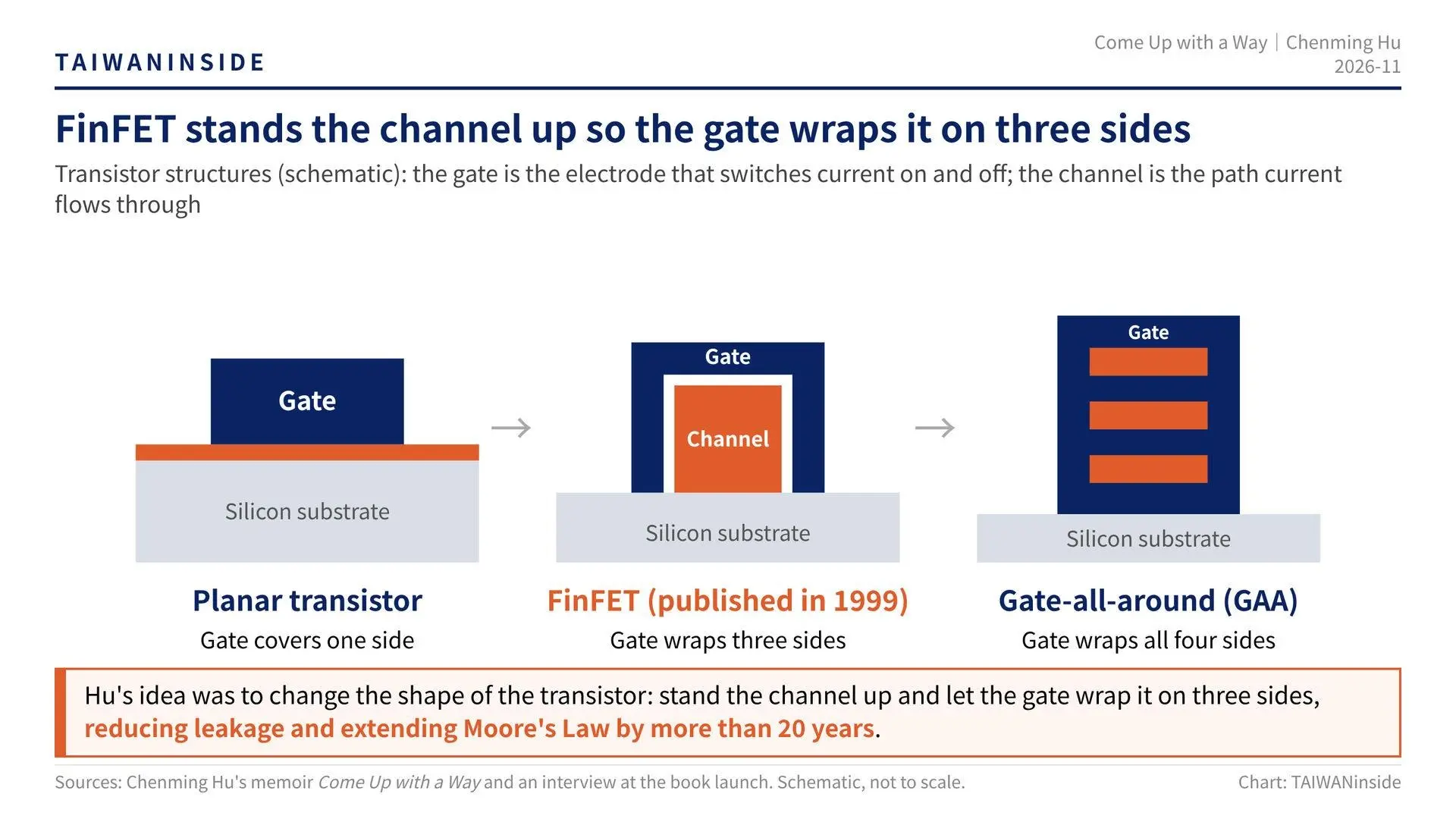
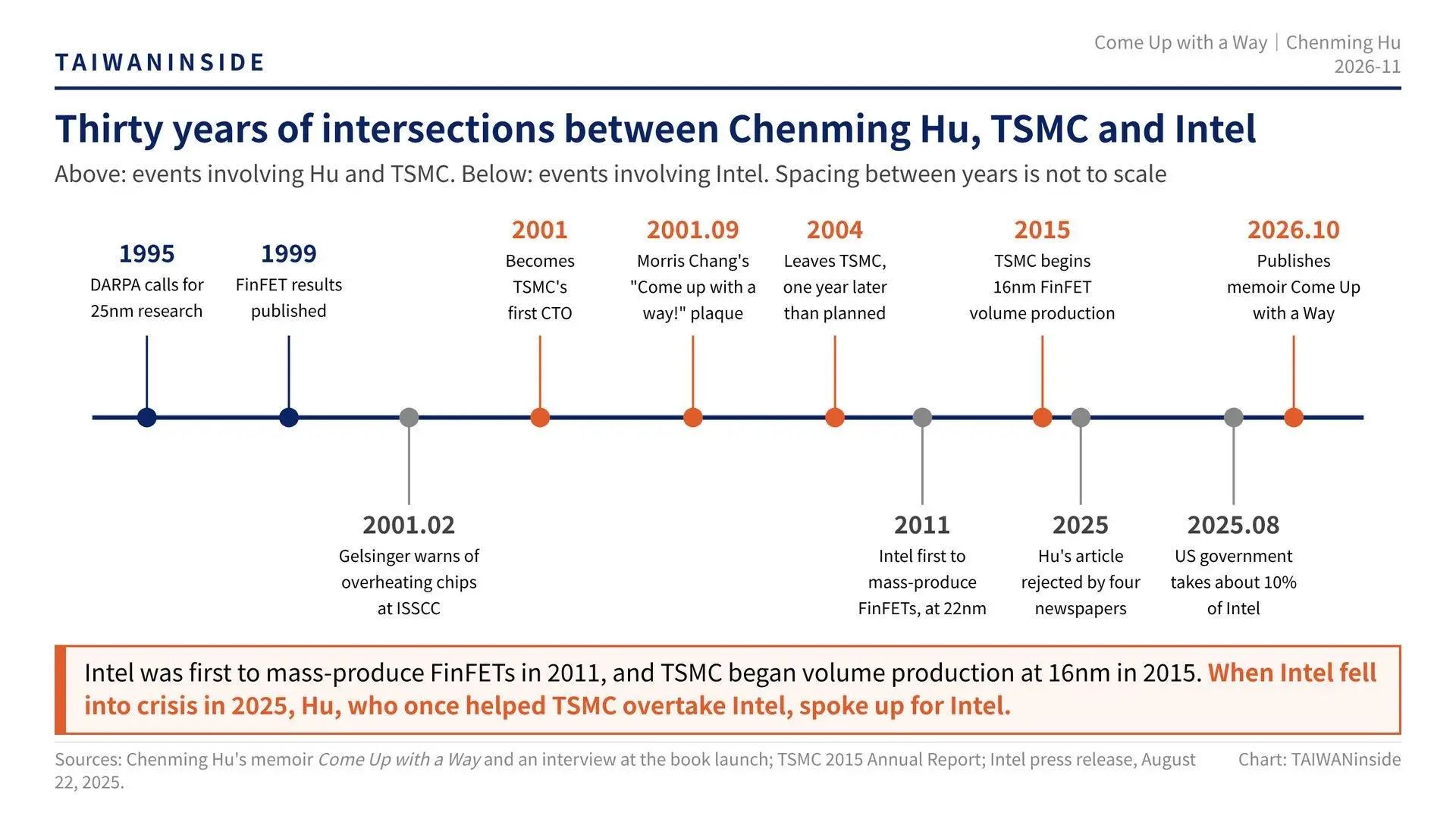
Hu's idea was this: if planar transistors could go no further, then change the shape of the transistor. In 1995, the US Defense Advanced Research Projects Agency (DARPA) called for research that could shrink transistors to 25 nanometers. Hu and his Berkeley colleagues Tsu-Jae King Liu and Jeffrey Bokor proposed a project to "stand up" the transistor's channel (the path through which current flows), like a fish fin, so that the gate (the electrode that switches the current on and off) wraps around the channel on three sides and reduces leakage. This is the FinFET. They published their results in 1999.
2. When Intel Warned That Chips Would Overheat, He Decided to Return to Taiwan
The most dramatic turn came about two years after the FinFET paper was published.
In February 2001, at the International Solid-State Circuits Conference (ISSCC) in San Francisco, Pat Gelsinger, then an Intel vice president and chief technology officer of the Intel Architecture Group (and later Intel's CEO), warned that if things continued on their current path, the heat density of chips would approach that of a nuclear reactor, and even the surface of the sun. Hu was surprised when he heard this. He said his solution had been published several years earlier, and he had already been invited to give talks at Intel three times. He had not expected that a senior technology executive at Intel, then the leader of the semiconductor industry, would still treat this as an unsolvable problem.
Later, he worried that the industry would run into this problem, especially since TSMC, the foundry, had not yet noticed how serious it was. To help TSMC solve its technical problems, and to repay Taiwan for raising him, he wrote an email directly to TSMC founder Morris Chang, offering to serve at TSMC for two years to help with technology development. Morris Chang agreed at once. In 2001, Hu became TSMC's first chief technology officer.
Hu said that when he met Morris Chang, Chang asked him whether it would be a good idea for TSMC, which was looking for a technology partner, to work with Texas Instruments (TI). Hu said he answered that TI was no longer a company with especially strong technology at that time, and that TSMC needed a stronger partner than TI. The options were IBM, Intel, Japan's Toshiba, or developing the technology itself. Chang replied that IBM (its technology licensing fees) was too expensive, and that Intel had no reason to cooperate.
Hu said that perhaps Chang was testing him at the time. In the end, after much consideration, TSMC decided to develop the technology itself, and as a result it gradually caught up with and overtook Intel.
In September 2001, Morris Chang gave him a heavy crystal plaque inscribed with the words "Come up with a way!" The plaque later became the title of Hu's memoir. Chang gave him two long-term goals: turn TSMC from a technology follower into a leader, and improve TSMC's unfavorable position of paying patent licensing fees year after year. What Chang wanted was a way to get it done. A plan alone was not enough.
PAYWALL | Subscriber content below
3. Let Intel Go First, Then Let TSMC Overtake
The strategy Hu gave TSMC was an interesting one.
He judged that the next major turning point for the industry would be three-dimensional transistors such as the FinFET, and that with every technology transition, all companies return to the same starting line. But he did not advise TSMC to race to be first. The reason was practical: TSMC had dozens of customers, and each one had to be persuaded, while Intel and IBM only had to decide for themselves to get going.
So he advised TSMC to invest in R&D early and build up manufacturing and yield experience with three-dimensional structures, and to let Intel go first. When the industry actually made the transition, TSMC would be able to catch up quickly and even pull ahead. Morris Chang approved without asking about the details. According to what Hu said at the book launch, within three years the team pushed experimental FinFET devices from about 35 nanometers to 5 nanometers.
Things turned out just as he expected. Intel was the first to mass-produce FinFETs, at 22 nanometers in 2011, while TSMC introduced the FinFET at 16 nanometers and has led ever since.
The second task Morris Chang gave him was to improve TSMC's unfavorable position of paying patent licensing fees year after year. In other words, TSMC needed to balance its intellectual property income and payments, so that the licensing fees it paid out would not exceed what it took in.
Hu personally gathered about 35 patents and compared them one by one. He found that the problem lay in how the patents were written; there was nothing wrong with the engineers' technology. TSMC's engineers tended to add detailed process conditions, which made the scope of protection too narrow and easy to design around, while the global giants knew how to combine technical elements and write patents with broader scope.
Hu therefore set up a patent management department reporting directly to the CTO, brought in and trained patent engineers, and personally reviewed invention disclosures every week. This fundamentally changed the way TSMC wrote patents and reduced TSMC's international patent disputes.
Hu stayed at TSMC for three years, one year longer than planned, in order to complete the tasks Morris Chang had given him. When he left, Chang made only one request: do nothing that would harm TSMC. Hu agreed, and afterwards he turned down offers from other companies.
4. TSMC, Samsung and Intel: Yield Decides the Contest
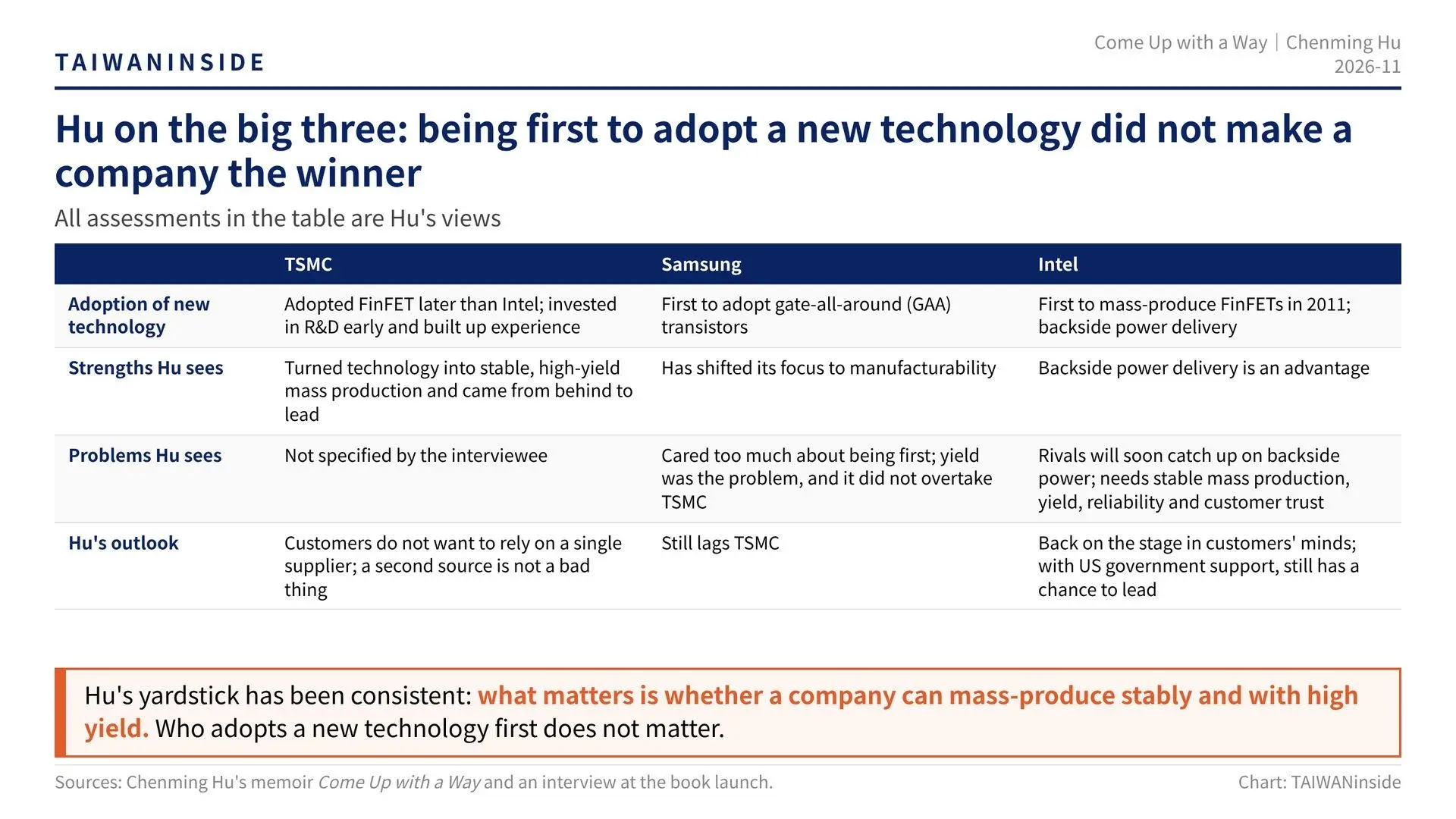
On the competition among the three leading chipmakers, Hu's view has been consistent: what matters is whether a company can mass-produce stably and with high yield. Who adopts a new technology first does not matter.
- TSMC: It came from behind and took the lead by building up R&D experience early and turning technology into stable, high-yield mass production capability.
- Samsung: It was the first to adopt gate-all-around (GAA) transistors (a transistor structure that goes a step beyond the FinFET, with the gate wrapping the channel on all four sides), but this did not let it overtake TSMC, and the problem was yield. He believes Samsung used to care too much about being "first," and has now shifted its focus to manufacturability.
- Intel: Its backside power delivery technology (moving the power lines to the back of the wafer so that the front is used only for signal wiring) is an advantage, but rivals will catch up quickly, and with cross-licensing across the industry, it is hard for any single technology to keep a long-term lead. What Intel really needs is stable mass production, yield, reliability and customers' trust. With the support of the US government, it still has a chance to return to the lead.
He also pointed out that customers never wanted to depend on a single supplier, so having a second source is not a bad thing. Taiwan should hold on to its lead in technology and manufacturing, but it need not see other countries' development of semiconductors as a zero-sum competition.
5. When Intel Was in Danger, He Wrote to Four Major US Newspapers and Was Rejected Every Time
The most moving part is Hu's concern for Intel.
In 2025, Intel's advanced process technology fell into a serious crisis. Hu read in the news that Intel CEO Lip-Bu Tan had said that if Intel 14A (the next-generation advanced process Intel plans to follow 18A) could not find customers, Intel's foundry business would be shut down. Hu knows Tan very well, and the two live close to each other. He felt this was very serious: if Intel could not continue to advance semiconductor technology, it would be quite bad for the United States.
So Hu wrote an article arguing that the problem was not only financial. If Intel gave up advanced manufacturing, its R&D teams would scatter and its talent would leave, and even if the United States later spent far more money, it might not be able to rebuild this capability. He proposed that the US government invest directly in Intel, because Intel needed money and also needed the government's backing, so that customers would dare to give their chip designs and volume production orders to Intel.
Hu also believes that TSMC's customers do not want to be left without a choice. They will certainly want a second source, and Intel's existence is positive for the development of the industry.
Hu first submitted the article to the New York Post and was rejected. He then submitted it to three other major American newspapers, and all of them turned it down. In the end, he could only include the article in his memoir.
Later developments, however, came quite close to his proposal. Donald Trump at one point publicly demanded that Intel CEO Lip-Bu Tan step down, and the situation eased after the two met. In August of the same year, the US government took a stake of about 10% in Intel. Hu said he did not know whether Trump or Tan had seen his proposal, but things did move in the direction he had hoped for.
Today, Intel's technology development is in much better shape. Although it is still some distance behind TSMC, in customers' minds Intel is back on the stage. Samsung also lags TSMC, but a three-way competition has now taken shape. As for newcomers beyond the three leaders, such as Japan's Rapidus (a new foundry company backed by the Japanese government and aiming at 2nm production), it will be hard for them to build comparable manufacturing capability in a short time.
Reporters also asked whether Terafab, the plan by Tesla and SpaceX CEO Elon Musk to build his own chip fabs, has a good chance of success. Hu said that Terafab has talked with both Intel and TSMC about cooperation, and that wafer manufacturing needs experienced people to do it. He also hinted that he has some doubts about Musk's plans to explore Mars, because Mars is simply too far away: "For things that can be done, don't think too far ahead. Get them done first."
Still, he believes that in the semiconductor industry, competition, learning from one another and cross-licensing of patents let everyone find different approaches and catch up from behind, which is very good for the industry. This is unlike the pharmaceutical industry, where companies can sometimes protect a molecular structure with a patent for as long as 20 years. In the past, the International Technology Roadmap for Semiconductors (ITRS) met every year to discuss the next technology node together. When planar transistors could go no further, for example, everyone sought cooperation. No single company could solve it, but everyone discussed cooperation from a scientific standpoint and looked for ways to solve shared problems. That is why semiconductor technology has been able to keep advancing.
A scientist who once helped TSMC overtake Intel spoke up for Intel when Intel was in its most critical moment. What Hu cares about is whether the whole industry, and humanity's technology, can keep moving forward. Which company wins or loses is secondary to him.
6. The Future of Semiconductors Is the Future of the World
Hu often says that semiconductors have reached every corner of our lives. Today's AI, scientific simulation and vaccine design all depend on computing power. In his eyes, the semiconductor is a "democratic technology," because semiconductors ultimately benefit every ordinary person.
He also mentioned that in 1973, when he went to teach at MIT, everyone was talking about the book The Limits to Growth. Published by a research team at MIT's Sloan School of Management, the bestseller was translated into more than 30 languages. Its main argument was that if humanity continued on its habitual path of pursuing economic growth, resources would fall out of balance and collapse, and it predicted that by the middle of this century there would be a sweeping, catastrophic collapse of the environment, economy and society.
Hu said that this prediction about the limits to growth does not appear to have come true, and Musk has even predicted that humanity will enter an age of abundance. He believes the main reason, of course, is that people overlooked the progress of technology, especially the rapid development of semiconductors, which has kept growth going.
He said that when the MIT professors studied the limits to growth, they focused on population growth and on finite resources of the earth such as oil, food and land, but they overlooked the enormous growth potential of semiconductors made from silica sand. In 1973, integrated circuits were still at an early stage of development, but the industry later went through the PC, the internet, mobile phones and now AI, and semiconductors became the key force driving the rapid growth of the human economy and society. In his words, "The future of chips is the future of the world."
Interestingly, more than half a century later, AI has run into new "limits to growth," but this time the bottleneck is electricity, no longer oil or food. Data centers cannot be built fast enough, and computing power is in short supply; this is the biggest constraint on the AI industry today. The answer to breaking through this constraint may still come from semiconductors: more power-efficient chips, more efficient optical communication and more advanced packaging.
But he also warned that the fight to save energy has only just begun. He roughly estimates that technologies such as the FinFET have improved the computing efficiency of chips by about ten times. Without these advances, global data centers would have needed about 4,365 terawatt-hours (about 4.4 trillion kilowatt-hours) more electricity in 2025, equivalent to the annual output of 400 large nuclear reactors.
On the risks of AI, he is cautiously optimistic. He believes technology itself is neither good nor evil; what matters is how people use it, and practices for AI safety may become international norms in the future. He also believes that the goodness in human nature will in the end allow the world to keep the possibility of peace.
Conclusion: The Crystal Plaque from Morris Chang
Looking back on Hu's life, what moves me most is that crystal plaque reading "Come up with a way!"
Facing the end of Moore's Law, he changed the shape of the transistor. Facing the challenge of TSMC catching up with Intel, he chose to build up experience first and did not race to be first. Facing Intel's crisis, he picked up his pen and submitted an article, even though he was rejected four times.
For things that can be done, Hu believes, there is no need to think too far ahead; get them done first. He cited former US President John F. Kennedy as an example. In the early 1960s, Kennedy set the goal of sending a man to the moon within ten years, and did not choose Mars, which is much farther away. The moon was within reach of the technology of the time with a hard push, while Mars was too far. Only by first doing what can be done is there a next step.
This is the same lesson as the crystal plaque Morris Chang gave him: what Chang wanted was a way, and the way Hu offered was to get it done first.
In today's world of drastic change in AI and geopolitics, what semiconductor companies need when they run into difficulties is this same spirit: don't complain, don't give up, and come up with a way.
Related Articles
Why TSMC Is Buying into Both OpenAI and Anthropic: Three Investment Principles from ASML and ARM to AI Model Companies
Samsung's HBM Packaging Expansion Will Raise Demand for TSMC's CoWoS: How Taiwan and Korea Divide the Work in Advanced Packaging
Farewell to Jensen Huang: The Best Storyteller in AI Could Not Write His Own Ending. What Comes Next for Nvidia, the AI Industry and Taiwan's Supply Chain