“AI Knows You Better Than You Know Yourself!” — How Taiwan’s 104 Job Bank’s AI Job-Matching System Tripled Interview Opportunities
Although Taiwan is a critical global hub for AI chips and server manufacturing, with key supply chain players such as TSMC and Wiwynn, the pace of advancement in the “application layer” of AI has not been as prominent as in manufacturing. According to international rankings, Taiwan is only 21st worldwide in AI capabilities, underscoring a gap in software applications and the overall industrial ecosystem. How effectively companies harness AI not only determines individual competitiveness but also serves as a benchmark for national industrial upgrading.
For this reason, I have recently paid special attention to how companies leverage AI technology to address human resources challenges. In late July 2025, I attended a press conference where 104 Job Bank and Taiwan’s Industrial Technology Research Institute (ITRI) jointly released the 2025 Semiconductor Industry Talent Report. The report revealed that Taiwan’s semiconductor job market has continued recovering after the pandemic, with total job vacancies rebounding to pre-pandemic highs by May 2025. However, frontline roles such as “operations/technical/maintenance” remain critically short, with only one applicant for every five job postings, resulting in an overall talent gap of 34,000 positions—a severe problem.
After the event, Pola, a corporate communications officer at 104 Job Bank, shared an internal observation: since introducing an AI-powered job recommendation feature on their platform, data shows that job seekers applying for AI-recommended positions were 3.2 times more likely to be invited to interviews by employers than those who searched and applied manually.
In other words, compared with job seekers browsing postings on their own and submitting resumes based on personal preferences, having AI recommend roles based on complete resumes, behavioral records, and workplace compatibility significantly improves matching efficiency and increases interview opportunities. This phenomenon—“AI knows you better than you know yourself”—represents a breakthrough in Taiwan’s job-matching platforms and prompted me to further explore the mechanisms and outcomes behind it.
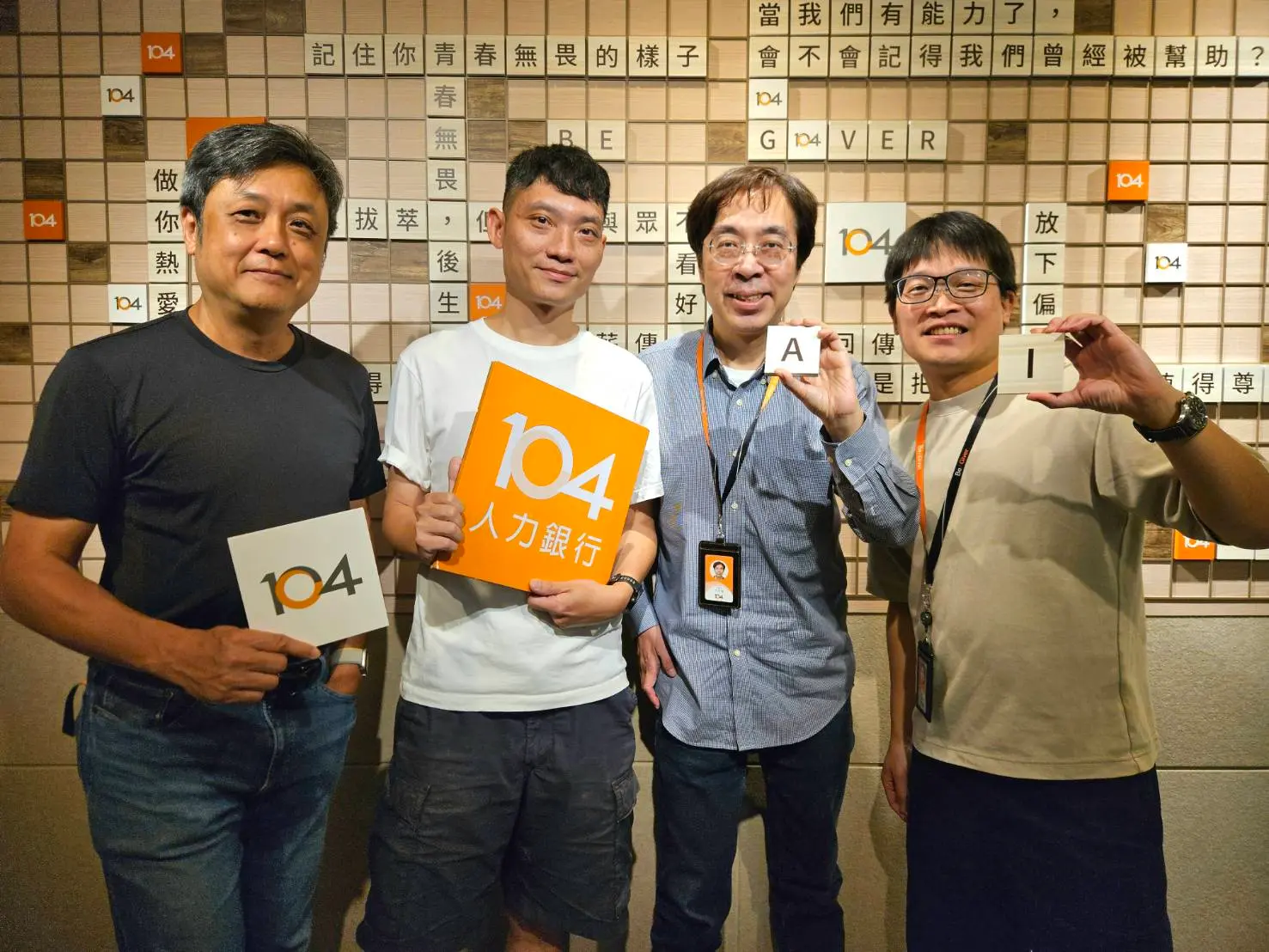
To understand the technical and product-design logic driving AI adoption, I arranged an exclusive interview. On the day, 104 Job Bank sent four senior executives: R&D Associate Manager Chang Shih-Chun, Chief Innovation Officer Tsao Hsun-Chih, Deputy General Manager of Product and Value Operations Division Shen Pei-Hung, and Senior Associate Manager Wang Chih-Lin. Together, they explained how the company has embedded AI across the job-matching process—from technology R&D and user design to corporate applications.
This in-depth conversation spanned a wide range of topics: from real job-seeking scenarios to system architecture design, and then into core technologies such as database management, machine learning applications, and the rapidly developing large language models (LLMs). It revealed 104’s comprehensive deployment and practical application of the AI technology stack.
The executives all emphasized that although Generative AI exploded globally in 2023, AI itself is not entirely new. Since 2006, 104 Job Bank has been investing in offline database construction and data analytics, amassing nearly 20 years of AI experience—well before most companies began their AI transformation.
Over nearly two decades of development, 104 has gradually built key technological infrastructure, including: big data warehouses, distributed computing (Hadoop), machine learning algorithm development, large language model applications, BI (business intelligence) platforms, cloud service integration, and more recently, LakeHouse hybrid data architecture, knowledge graphs, and deep-learning-driven recommendation engines. These efforts laid a solid foundation for AI system integration.
To be frank, I may not be fully versed in all these technical details. But as a journalist long observing Taiwan’s industrial transformation, I know one thing: for any company to succeed in digital transformation, the first prerequisite is mastering the basics of digitalization. At this moment when AI waves are sweeping every industry, whether a company has completed its data infrastructure and cultural readiness will decide its ability to adapt and innovate. 104 Job Bank’s years of groundwork in data systems now enable it to deliver AI services that truly work for both job seekers and employers—proof of its long “horse stance” preparation.
Before diving into technical details, let’s first look at some key statistics to assess the effectiveness of 104’s AI adoption.
According to internal data, the share of jobs filled through AI-assisted matching rose to 39.2% between January and August 2025, up from 24.79% during the same period in 2023—an increase of 14.41 percentage points. This shows that AI features are becoming central to actual hiring processes. At the same time, the proportion of site users adopting AI services rose from 56.5% in 2023 to 85.25% in 2025, a 28.75-point increase. Behind these numbers lies the fact that more and more job seekers are directly experiencing the efficiency and convenience brought by AI.
In reality, compared with online video or e-commerce platforms, job platforms face sharper constraints. Everyone wants to enter the most desirable companies, but openings are limited. In Taiwan, thanks to the global strength of semiconductors and tech manufacturing, top jobs are concentrated in a few companies like NVIDIA, TSMC, and MediaTek. Yet openings at these firms are often already saturated, creating a “one seat per carrot” bottleneck. The result: job seekers crowd into the same postings, competition intensifies, and many excellent candidates are squeezed out, missing other suitable matches.
This is what sets job seeking apart from other digital services. Job hunting is not a consumer transaction—you cannot simply pay or desire your way into an outcome. Hot job postings have a “ceiling effect”: when a flood of applicants targets the same roles at star companies, overall matching efficiency drops.
Since its founding in 1993, 104 Job Bank has accumulated over 30 years of vast data and deep collaboration with top hiring companies in Taiwan’s unique job market. This experience has equipped it with effective strategies to resolve structural issues of “talent concentration” and “supply-demand mismatch.” Its strategic focus is using data analytics and AI tools to help job seekers pivot toward more potential positions, thereby raising overall matching success.
Every year, 104 collects hundreds of millions of user behavior records. With AI modeling, it extracts insights from browsing patterns, industry/job preferences, resume skills and experience, and even personality assessments and cultural fit. This intelligent recommendation system delivers personalized job suggestions, with significantly higher success rates than manual searches and applications.
AI-Powered Precision Matching: Making “Being Seen” the Norm
This is why AI often outperforms job seekers’ own judgments in matching. The platform’s database offers a bird’s-eye view of the labor market, grasping employer demand dynamics and overall competition, while individual job seekers rely only on limited experience and preferences—akin to gambling in a blind box and missing better opportunities.
“As validated by data from the past four to five years, we can confidently say that applying to AI-recommended jobs increases the chance of being invited to interviews by 3.2 times compared with searching manually,” said R&D Associate Manager Chang Shih-Chun.
He added two real examples. Some job seekers believe their resumes are complete but fail to note essential skills required for engineering positions. The AI system instantly compares and highlights such gaps, suggesting updates. Moreover, when preparing to apply, the system can automatically generate tailored cover letters aligned with job requirements, lowering application barriers.
In addition, many job seekers upload self-made PDF resumes. But HR typically relies on structured database fields for screening. If resumes exist only as attachments, they may be overlooked. To address this, 104 uses AI to extract key information from PDF resumes and populate database fields correctly, making resumes more visible to HR. This feature not only saves job seekers time but also significantly improves matching efficiency.
As mentioned earlier, by 2025, 85.25% of site users had adopted AI features—meaning more than 85 out of every 100 visitors actively engaged with AI services.
AI Is Not Just for Engineers—The Whole Company Is a Testing Ground
“By observing the user journey on our platform, we strategically place AI features where they matter most—not just for the sake of adding them,” explained Chang Shih-Chun. This, he said, is why adoption rates soared.
The product team identifies which pages and steps attract the most traffic and clearest intent, embedding AI at those high-interaction points rather than rolling out too many impractical tools. This problem-oriented, user-centered design logic is key to widespread adoption.
But once AI succeeded on the user side, another challenge emerged: should AI remain confined to engineers? At 104 Job Bank, roughly 38% of its 1,013 employees (including managers) are engineers, leaving over 600 non-technical staff. Shouldn’t they too participate in learning and applying AI? To truly integrate AI into daily operations as a shared decision-making tool, innovation cannot remain siloed in tech teams alone.
104 responded with a clear stance: “AI transformation is for everyone.” In 2023, it established a cross-departmental “Innovation Office,” led by Sean Lien, former Managing Director of Google’s Global Search Services and Platforms, to oversee AI implementation and organizational culture change.
Today, Lien oversees 104’s entire technical architecture, AI strategy, and IT planning, spanning platform core, data infrastructure, and product innovation. He both recruits talent with global vision and drives internal process optimization and cultural renewal. His leadership signals 104’s firm resolve to embed AI deeply into its DNA in the generative AI era.
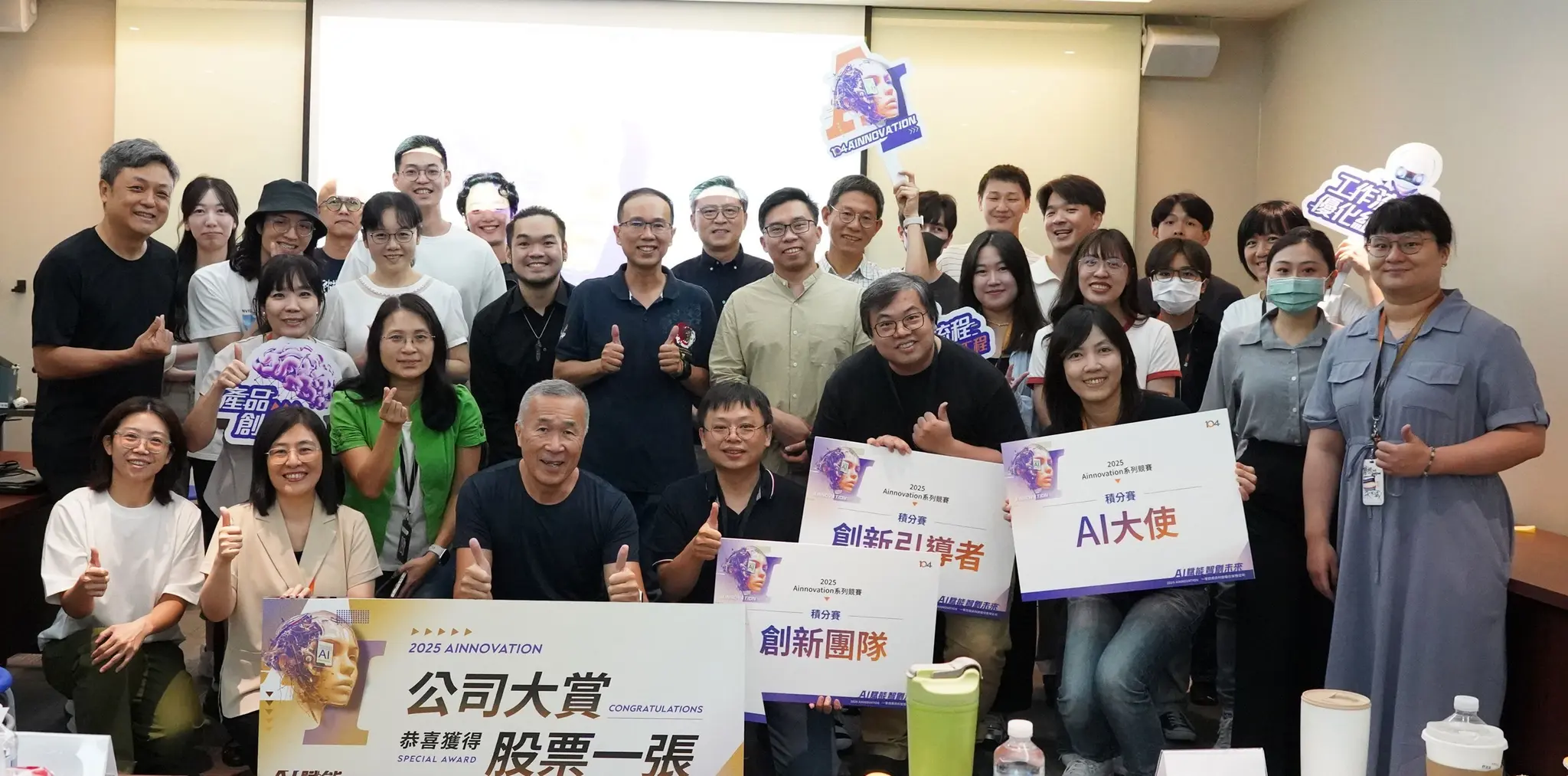
In 2025, 104 relaunched its “AINNOVATION” contest, offering company stock (three shares) and cash prizes. With shares trading above NT$220, the reward value neared NT$1 million (about US$31,000), reflecting tangible corporate support for internal AI innovation.
A total of 25 teams and 75 employees participated. Winners weren’t only engineers: legal staff built an AI knowledge base for HR law, designers turned the company mascot into an AI agent to support job seekers, and product managers collaborated with engineers on an AI resume assistant for HR.
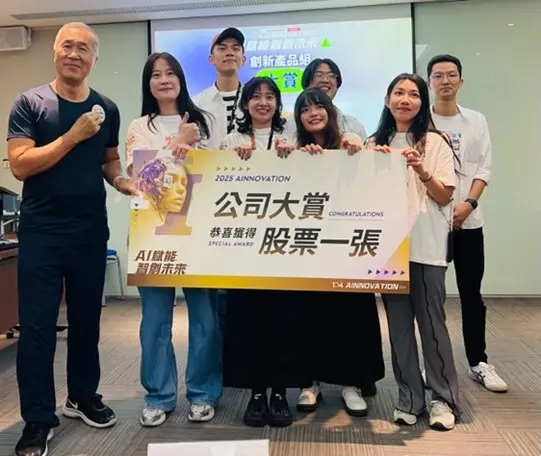
At the annual event, Chairman and Founder Yang Chi-Kuan summarized with “two rounds of applause and one encouragement.” The first applause was for teams who hit must-have user pain points with practical solutions. The second was for teams breaking departmental silos and demonstrating altruistic collaboration. The sole “encouragement” went to those brave enough to challenge the status quo—even proposing ideas that overturned 104’s current business model—reflecting the company’s respect for internal disruptors.
From Newspaper Failure to 104’s Long-Term Persistence and Victory
104 Job Bank was founded in 1993—the same year I began as a reporter at Taiwan’s largest financial daily, the Economic Daily News. Back then, the United Daily News Group launched “UDN Jobs,” an online recruitment platform similar in concept to 104. But it failed to survive, while 104, then still a small startup, steadily grew over three decades into Taiwan’s leading recruitment brand.
I still recall colleagues discussing how United Daily’s print divisions resisted the new online platform, fearing it would “steal business” from lucrative newspaper classifieds. Internal resistance doomed its efforts, sealing the fate of traditional media in online recruitment.
Technology never stops advancing. Yet many companies fail not because they miss change, but because they cannot overcome their own inertia and habits. Digital transformation is never easy. With generative AI opening new application frontiers, fast-changing technologies and high decision costs now further test corporate learning ability and collaboration culture. This elimination round in the AI era has only just begun.
104 Job Bank stands as a Taiwanese case worth studying. From its core in job-matching, it has patiently built data and technical foundations, solidifying warehouses and organizational readiness. When generative AI exploded, its “paddling beneath the surface” revealed true strength. By mobilizing all staff and delivering usable services that create real value for both job seekers and employers, 104 has reinforced its leadership in recruitment. For all companies anxious about transformation, this is a case worth close study and emulation.
Related Articles
Micron Announces Its Largest Rewards Ever. Its Taiwan Union's Demands Expose a Clash of Pay Systems. A strike threat at Taiwan's largest foreign investor, read in three dimensions
TSMC's 3nm rinse comes exclusively from AEMC, a Taiwanese company once withdrawn from the Emerging Stock Board
Taiwan AI Industry Upgrade Forum Series || Event Report:America Wants More Manufacturing. What Does It Take for Taiwan’s Suppliers to Follow?