The Silicon Valley Playbook for "AI Defense" is Here: Why Taiwan's Digital Defense Gap is the Next Big Opportunity for Global Tech
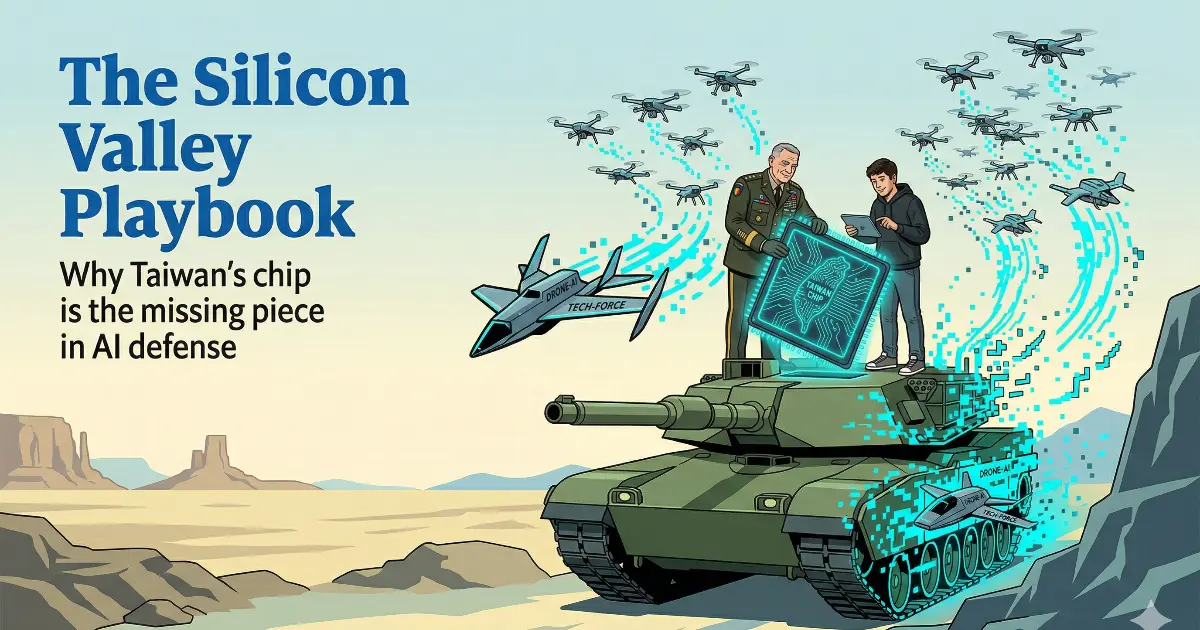
Recent US and Israeli strikes against Iran resulted in the targeted killing of Supreme Leader Ali Khamenei, who had ruled the country for 37 years. Furthermore, over 40 high-ranking military and government officials, including the commander of the Revolutionary Guards and the Defense Minister, were also eliminated. Iran immediately launched retaliatory attacks across the Middle East, targeting US allies and areas hosting American military bases, such as Dubai, Doha, Bahrain, and Kuwait.
The conflict between the US, Israel, and Iran introduces new variables to the global landscape, bringing undeniable economic shocks and surging oil prices. The resulting turbulence in global capital markets will likely persist for some time. However, when viewed through the lens of next-generation high-tech warfare, there is a profound paradigm shift underway. For the US and its Western allies highly dependent on Taiwan's semiconductor supply chain, this is a strategic imperative and a potential opportunity that deeply impacts the defense resilience of the democratic bloc.
The ongoing conflict showcases a completely new form of combat: a digitized war that fully leverages precision strikes, intelligence gathering, and advanced tracking systems, integrated with high-energy lasers, hypersonic weapons, artificial intelligence (AI), and massive cyber warfare.
From "Hardware-Centric" to "Software-Defined": How Silicon Valley Startups are Disrupting the Global Defense Landscape
Historically, the United States has possessed unparalleled technological prowess, but this advantage is now decisively shifting toward the defense and military-industrial sectors. The core focus is leveraging innovative technology, venture capital (VC), and capital markets to fundamentally rewrite the logic and operations of traditional defense contracting.
Take procurement logic as an example. Traditional defense prime contractors (like Lockheed Martin) were accustomed to building the hardware—jets and artillery—first, and writing the software later. Today, that logic is entirely inverted. We are witnessing a transition from a "hardware-centric" approach to a "software-defined" priority. A new generation of defense tech startups, such as Anduril and Palantir, argue that weapons should be defined by software. Hardware is consumable and replaceable, but the core lies in the underlying AI algorithms and system integration.
There is also a massive shift in R&D dominance. Defense contracts used to be the exclusive domain of the traditional "Big 5." Now, VC-backed startups are aggressively eating into this market. Technologies like AI, low-earth orbit (LEO) satellites (e.g., SpaceX's Starshield), and quantum computing, originally intended for commercial use, are now being integrated directly into the defense supply chain, epitomizing the era of "dual-use" technology.
Anduril, which recently closed a funding round in early 2026 valuing the company at nearly $4 billion, has seen its V-BAT drones and Lattice software platform become the core of US military surveillance in the Indo-Pacific.
Palantir, another VC-backed and publicly traded company, has evolved from a pure data analytics firm into the "AI Brain" of the US military. In 2025, it secured a massive Army Enterprise Software Agreement (ESA) worth up to $10 billion, consolidating dozens of fragmented software contracts.
Furthermore, the infusion of new tech has altered the core philosophy of defense technology: the military is no longer solely pursuing singular, exorbitant "boutique" weapons, but prioritizing scale, uncrewed systems, and autonomy.
Instead of relying solely on multi-million-dollar fighter jets, the US military is now looking to flood the battlefield with swarms of cheap, autonomous drones and uncrewed surface vessels—a concept known as the "Hellscape," making it impossible for adversaries to defend against. We saw Iran utilize low-cost Shahed suicide drones, and the US military has adopted similar methodologies for its countermeasures.
This influx of new tech into the defense industry is not just a migration of talent and capital; it is inherently tied to broader macro factors, including the US-China rivalry and shifting geopolitics.
The Rise of American Dynamism: Tech Capital and Giants Pivot to National Defense
In the past, Silicon Valley tech giants and VCs often avoided the defense sector due to "moral considerations." However, with escalating geopolitical tensions, VC investment in national defense technology surged dramatically in 2025. There is a growing consensus that supporting defense tech equates to "protecting democratic values," giving birth to a movement in Silicon Valley known as "The Rise of American Dynamism."
The most fervent supporters of this paradigm shift include top-tier VCs like a16z, alongside companies such as Anduril, Shield AI, and Palantir.
Visionaries like Palantir's Peter Thiel and Alex Karp, Anduril's Palmer Luckey, and Shield AI's Brandon Tseng argue that over the last decade, Silicon Valley focused too heavily on soft consumer apps, neglecting "hard tech" like hardware, energy, and defense. They are now stepping forward to assert that defending democracy is the responsibility of tech innovators.
Two other heavyweights loom large in this shift: former Google CEO Eric Schmidt and Tesla/SpaceX founder Elon Musk.
Schmidt was among the first in Silicon Valley to warn that the US was falling behind China. After leaving Google in 2015, he chaired the Defense Innovation Board, advising the Secretary of Defense. From Schmidt's perspective, the Pentagon’s technology—especially in AI deployment—was severely lagging behind the commercial world. In the board's final 2021 report, Schmidt issued a stark warning: the US must drastically increase investment to win the AI race.
Musk, the world's most high-profile entrepreneur, routinely mocks traditional defense weapons, joking that "some idiots are still building manned fighter jets like the F-35." Meanwhile, his company SpaceX, through its cost-effective Starlink LEO satellite launches, has long become a primary supplier for the US military, upon which even NASA relies heavily.
The Pentagon's "U.S. Tech Force": A National-Level War for AI Talent
Led by these influential Silicon Valley figures, participating in the "U.S. Tech Force" is no longer viewed by young engineers as "aiding the military-industrial complex," but rather as a step to make America great again—reminiscent of the heroism of the 1960s Apollo moon landing.
What exactly is the U.S. Tech Force? On January 27, just before the Lunar New Year, Emil Michael, the Under Secretary of Defense and Chief Technology Officer of the DoD, officially pitched this new talent initiative during a podcast interview.
Michael made a public appeal to Silicon Valley, urging top-tier programmers and AI talent to leave campuses or corporate jobs and join the government for a two-year "digital tour of duty" to combat the intensifying digital arms race.
This initiative marks the Pentagon's official declaration of a talent war in Silicon Valley, signaling a historic turning point in DoD-tech sector relations. The evolution of the global defense industry will send shockwaves through the tech world. For frontline nations in the First Island Chain like Taiwan, the integration of their tech sectors with their defense systems directly impacts overall defense resilience. This is also a systemic risk that the United States and its Indo-Pacific allies must closely monitor when evaluating regional security and technological interoperability.
Spearheaded jointly by the Office of Personnel Management (OPM) and the DoD, the U.S. Tech Force aims to inject top-tier civilian tech capabilities directly into the national security apparatus. It targets elite software engineers, AI specialists, data scientists, and cybersecurity talent. Michael urged graduates and senior engineers to view this fixed two-year term as "serving the country as a technologist" rather than traditional military service.
The government is offering highly competitive salaries ranging from $130,000 to $200,000. While a gap remains compared to Big Tech, this ceiling is significantly higher than standard government roles. Furthermore, the program breaks convention by prioritizing "skills over degrees." Even without a college diploma, individuals who can prove their ability to solve complex technical challenges—via open-source projects or certifications—are eligible to apply.
During the interview, Michael revealed the Pentagon's deep anxiety over its defense strategy. In the global AI arms race, the government is desperate for talent to develop "GenAI.mil" (the DoD’s internal large language model platform) and various autonomous weapon systems.
As the former Chief Business Officer of Uber, Michael knows that civilian tech development vastly outpaces traditional defense contractors. He hopes this influx of external tech talent will bring Silicon Valley's iteration speed to the military, shattering the Pentagon's traditional ivory tower. Participants will even receive a "Medal of Honor," aiming to brand "coding for the government" as a badge of prestige and a credential in the tech industry.
"We want graduates to leave campus and give two years of technical service to their country before going to a big tech firm to optimize ad algorithms," Michael said.
Bridging Taiwan's "Civil-Military Tech Gap": A Strategic Opportunity for Global Capital and the Semiconductor Ecosystem
While this policy underscores evolving geopolitics, the government’s direct recruitment from Silicon Valley has sparked intense internal debate, testing the valley's traditional power structures and values. While many young engineers show unprecedented interest in defense tech, controversies over tech ethics and the "weaponization of AI" have reignited.
Critics fear Silicon Valley could become the "Pentagon's backyard." Internal petitions demand commitments that general-purpose AI models won't be used for missile navigation or target identification. Executives from companies like Anthropic and Google DeepMind continue to express deep concern over the uncontrollability of weaponized AI.
Yet, the undeniable reality is that a fierce talent war is underway. The government is using salary subsidies and equity tax incentives to directly compete with tech giants for top AI scientists.
Looking at the trajectories of Israel and the US, can Taiwan similarly integrate its tech talent into the defense sector? Facing the military threat from mainland China, Taiwan—with its world-class ICT and semiconductor talent pool—is currently debating how to break down institutional silos to achieve digital defense transformation. This is exactly what Washington, international capital markets, and regional allies are heavily scrutinizing. In fact, Taiwan's digital defense evolution directly impacts the technological interoperability and strategic posture of US forces and the broader Indo-Pacific defense network.
Historically, Taiwan's defense industry has struggled to attract top-tier talent. Based on the recent firsthand experience of my son, who just completed Taiwan's mandatory military service, there remains a massive disconnect between the lack of digital mindset in grassroots military units and Taiwan's globally dominant tech capabilities. This is an alarming reality check.
However, from another perspective, this indicates that the military application of Taiwan's massive semiconductor and ICT prowess remains highly untapped. As Taiwan deepens its defense cooperation with the US and international allies, bridging this "civil-military tech gap" will become the most critical direction for strategic partnerships—and a monumental business opportunity.
For global tech giants, VCs, and defense startups, this represents more than just a chance to assist Taiwan in its "software-defined" defense transition. It is the perfect entry point to build deep, structural ties with Taiwan's powerful semiconductor ecosystem, securing a core position in the next-generation dual-use supply chain.
In fact, Taiwanese society has already caught onto this strategic opening. Recently, prominent think tanks, including the Taiwan Institute of Economic Research (TIER) and the Institute for National Defense and Security Research (INDSR), have published numerous reports on this very subject. They strongly advocate transforming Taiwan’s semiconductor and ICT advantages within the "non-red supply chain" into a "golden triangle" of defense autonomy, calling for the establishment of frictionless mechanisms for dual-use technology.
This potential is already being validated in Taiwan's drone industry. Driven by the global wave of "de-risking" from China and the push to build trusted defense networks, Taiwan—armed with a complete component ecosystem and mature electronic manufacturing capabilities—is rapidly emerging as a critical puzzle piece in the US and Europe's "non-red drone supply chain." This shift has even attracted emerging defense giants like Anduril to actively seek tech partnerships and strategic footprints in Taiwan.
How to precisely align global capital and high-tech capabilities with Taiwan's defense transformation needs and hardware supremacy is a critical strategic imperative that demands the immediate attention and investment of global industry, government, and academic leaders.
Related Articles
Micron Announces Its Largest Rewards Ever. Its Taiwan Union's Demands Expose a Clash of Pay Systems. A strike threat at Taiwan's largest foreign investor, read in three dimensions

TSMC's 3nm rinse comes exclusively from AEMC, a Taiwanese company once withdrawn from the Emerging Stock Board

Taiwan AI Industry Upgrade Forum Series || Event Report:America Wants More Manufacturing. What Does It Take for Taiwan’s Suppliers to Follow?