Can the TSMC Myth Be Cloned? Unveiling the "Taiwan Society + Morris Chang" Equation Behind Global Chip Hegemony
Stepping into 2026, from Arizona in the U.S. and Kumamoto in Japan to Dresden in Germany, the world is swept up in a hundred-billion-dollar frenzy of "semiconductor localization." Policymakers and tech titans across the globe are all asking the same critical question: Can the success of Taiwan's TSMC be perfectly cloned?
The key to unraveling this mystery does not lie inside those cold Extreme Ultraviolet (EUV) lithography machines, but is hidden within a profound dialogue spanning nearly 40 years.
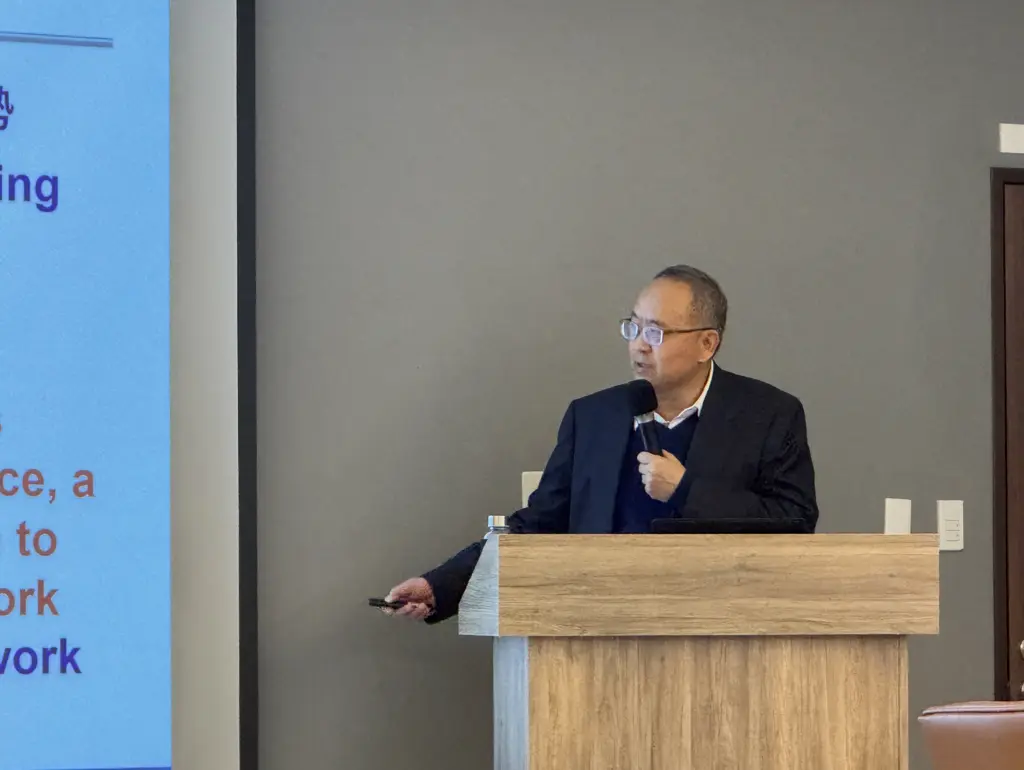
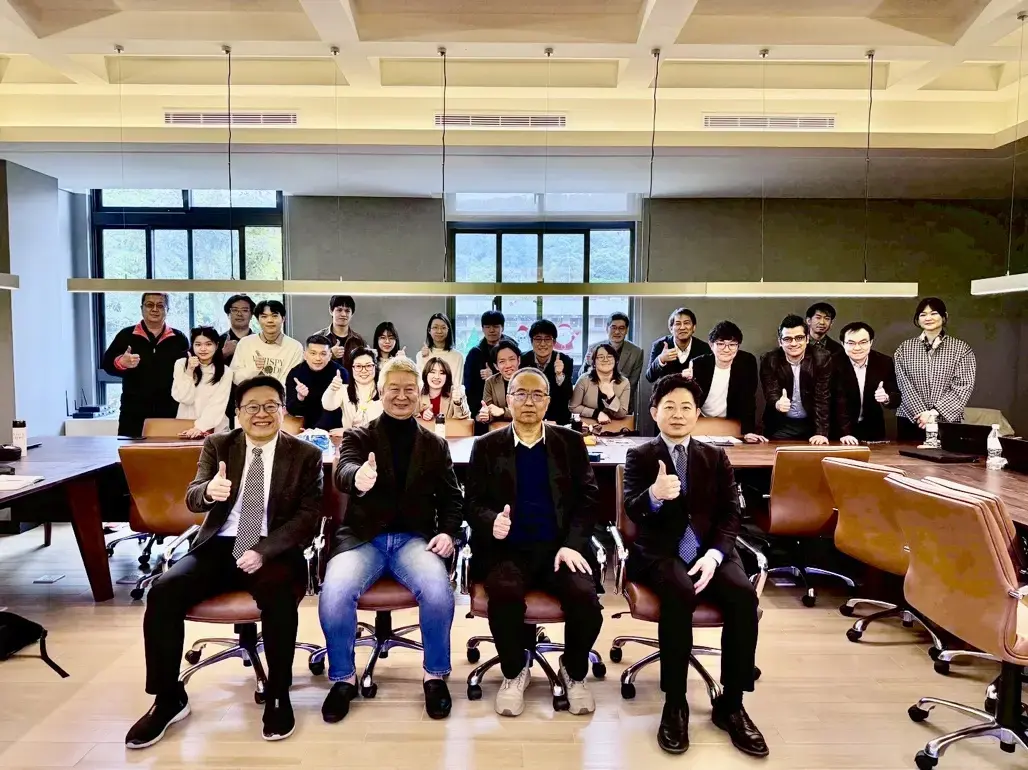
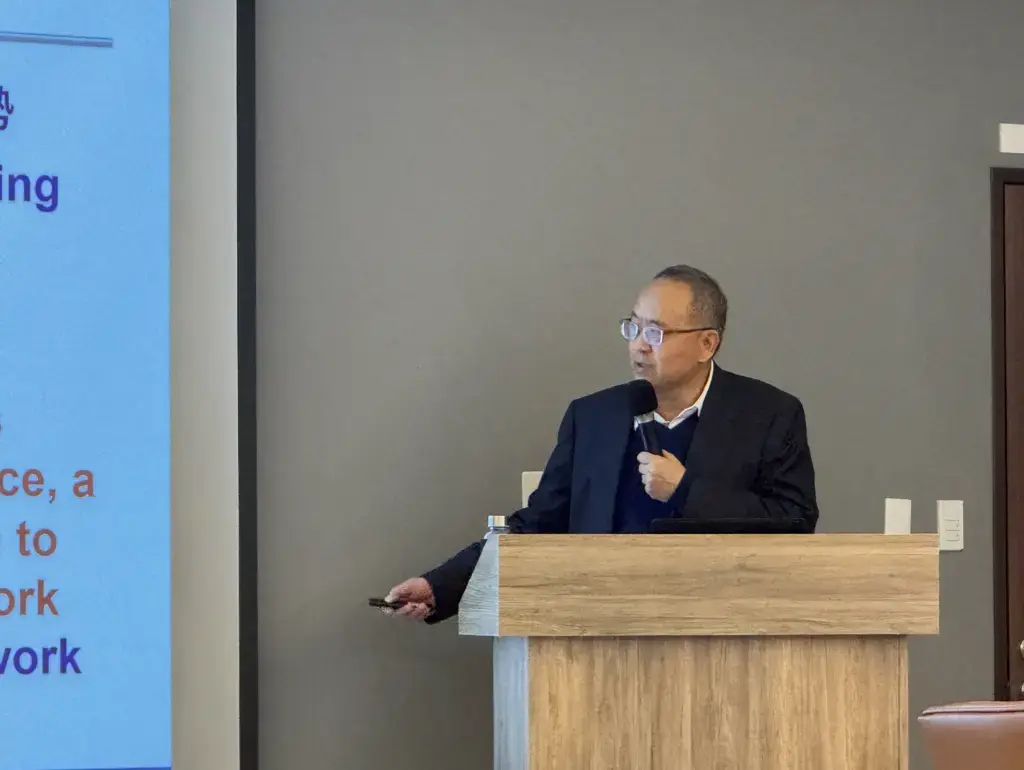
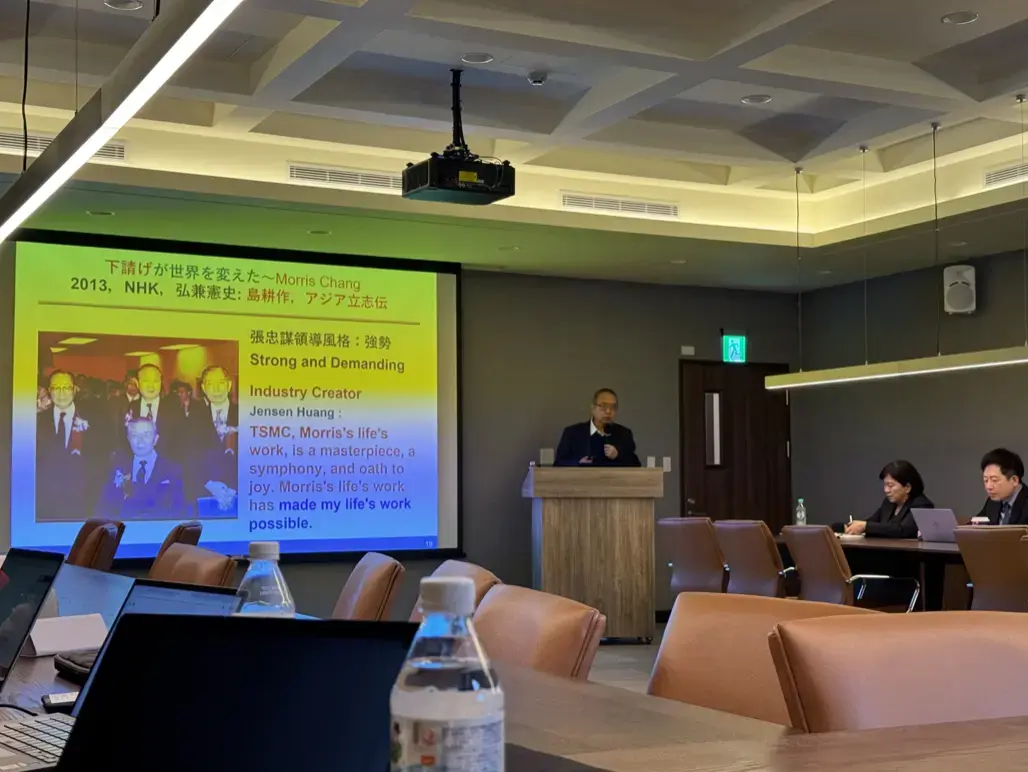
On March 7, I attended a symposium hosted by the Kyushu-Taiwan Future Research Institute at National Chengchi University (NCCU). There, I listened to a keynote by Chen Chien-pang, former Vice President and Employee #009 of TSMC. Titled "The Origin, Ambition, and Myth of TSMC," his speech took us back to the company's inception in 1987, sharing firsthand observations of founder Morris Chang and decoding the "source code" of TSMC's absolute dominance.
Unlike the quintessential success stories of American multinational corporations, the semiconductor empire that now dictates the lifeblood of global AI computing power actually started from a rather humble posture: "obedient, accommodating, and cheap."
Through Chen's retrospective, we witness how Morris Chang used "The Least Evil Choice" to accurately predict the trajectory of an industry for half a century.
While the world attempts to build wafer fabs using the logic of "industry," Chen dropped a paradigm-shifting concept onto the international stage: "Semiconductors are not an industry; they are agriculture. The true essence of TSMC is, in fact, 'Taiwan Society' plus 'Morris Chang'."
From "Cheap and Easy" to Unrivaled Dominance: The 10-Year Incubation Through the Eyes of Employee #009
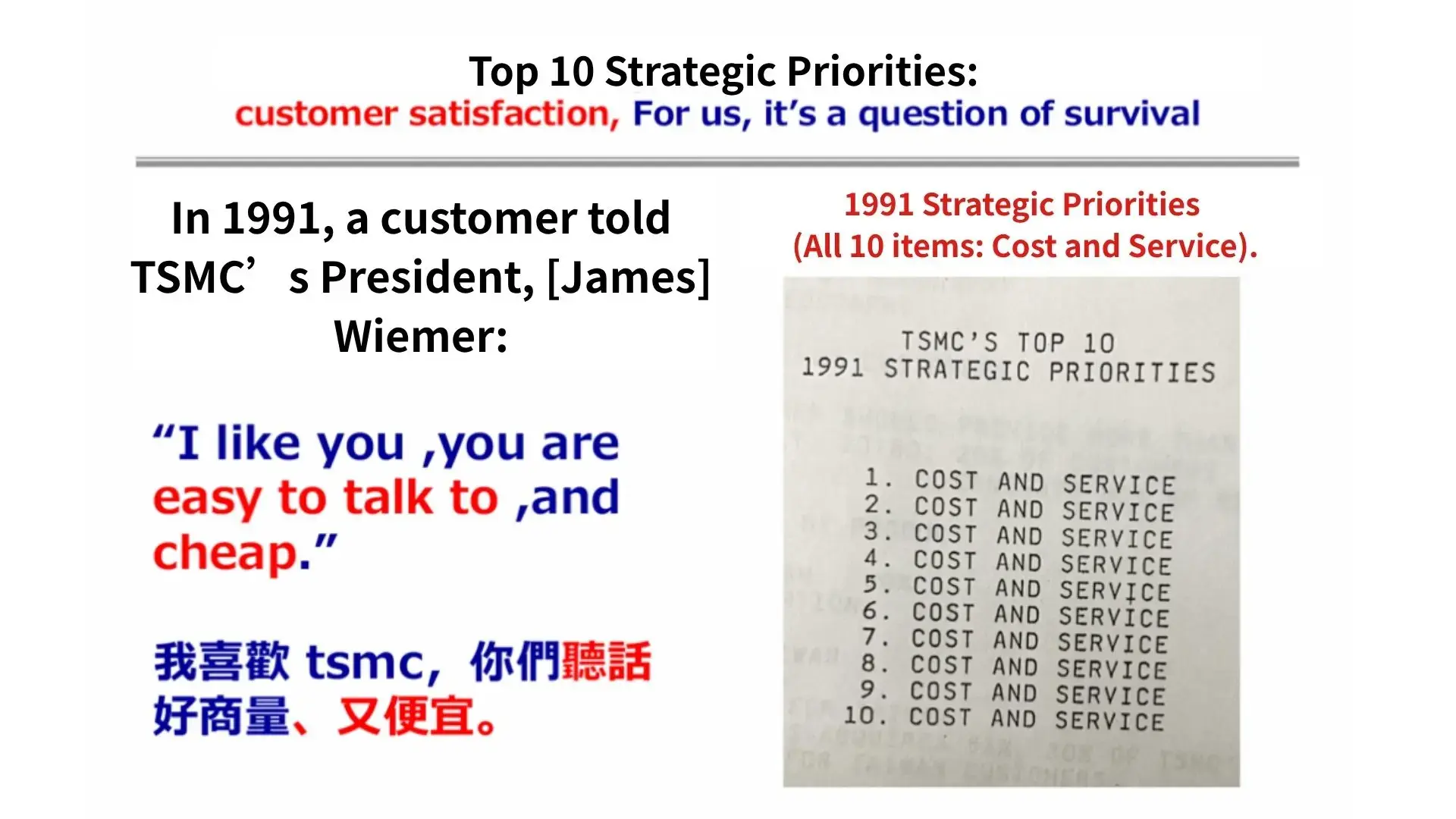
During TSMC's first decade, its first three presidents were all Americans. Chen recalled an anecdote shared by one of these foreign executives, who was told by a client: "I like you, you are easy to talk to, and cheap." In other words, in the eyes of early clients, TSMC was merely an accommodating, easy-to-negotiate-with, and low-cost contract manufacturing partner.
Therefore, when asked about TSMC's primary strategy in those days, Chen revealed that for the first ten years, the company's Top 10 Strategy was simply "Cost and Service." This was no joke. He even displayed a photograph he took back then of the company's strategy board—all ten bullet points were identically written as "Cost and Service." (See Figure 2)
Chen noted that Morris Chang's role at TSMC evolved in stages. When the company was founded in 1987, Chang was concurrently serving as the Chairman of the Industrial Technology Research Institute (ITRI, the cradle of Taiwan's tech industry) and was not fully dedicated to TSMC. For the first decade, he delegated the management to the three American presidents. To the average employee back then, Chang seemed incredibly strict and distant, interacting only with top-tier executives.
It wasn't until TSMC went public in 1994 that Chang began to reveal a grander ambition, determined to technologically surpass international rivals. In 1997, he personally took the helm as Chairman and CEO. The company's strategy officially pivoted from "Cost and Service" to "Technological Leadership and Advancement."
In a 2007 interview with foreign media, Chang candidly admitted that when he founded TSMC, he did not foresee the massive boom of the fabless (factory-less) semiconductor industry. His exact words were: "I can’t tell you that I saw the rise of the fabless industry, I only hoped for it."
Later, in 2014, when discussing why he chose the pure-play foundry business model, Chang described it vividly: "This is The Least Evil Choice, it was the solution waiting for a problem to happen."
This means that Chang essentially built a foundational infrastructure. When market demand (the "problem" of fabless companies needing manufacturing) finally exploded, TSMC was already there, ready to provide the solution. Once the right direction was chosen, what mattered most was unwavering dedication and unparalleled execution. This formed the bedrock of TSMC's "unrivaled hegemony" today.
Chang famously quoted Shakespeare: "The World is My Oyster." To him, the "oyster" symbolized the pearl of success hidden beneath a hard shell, and the "sword" to pry it open was world-class technology. He knew profoundly that only through technological independence—breaking free from early patent reliance on major shareholder Philips—could TSMC wield its sword freely in the global arena.
The Agricultural Paradigm and Ecosystem Symbiosis: Why is TSMC Unreplicable?
Chen divided TSMC's evolution into three pivotal stages.
The first stage (1987-1994) was the "Incubation Period," sprinting forward with just two 6-inch wafer fabs. In 1991, when Chang set an annual revenue target of 10 billion NTD, only about 30 public companies in Taiwan had achieved such a scale.
The second stage was the era of hyper-growth. Chang took direct control and, alongside Vice Chairman F.C. Tseng, aggressively recruited top-tier talent from overseas back to Taiwan. The data is staggering: by early 2025, TSMC's "daily average revenue" had surpassed 10 billion NTD—the very figure that took a whole year to achieve in the 1990s.
Of course, this phase was not without setbacks. Ventures into the DRAM business through Vanguard International Semiconductor, as well as early investments in an 8-inch fab in the U.S., were notable failures. Yet, Chang's ultimate strength was his agility in pivoting. He decisively exited the DRAM industry and halted further expansion of the old U.S. plant, refocusing all resources on the core foundry business.
Entering the third stage, TSMC has established a complete, symbiotic ecosystem collaborating with global upstream and downstream players.
Chen specifically cited a profound observation made in 1983 by Kazuo Maeda, a pioneer of Japan's semiconductor industry: "Semiconductors are not an industry, but agriculture." This "Agricultural Paradigm" dictates that the industrial environment, talent cultivation, legal frameworks, work ethics, social customs, and industrial clustering are the essential "soil" that nurtures semiconductors. TSMC's success is deeply rooted in Taiwan's comprehensive socio-economic soil.
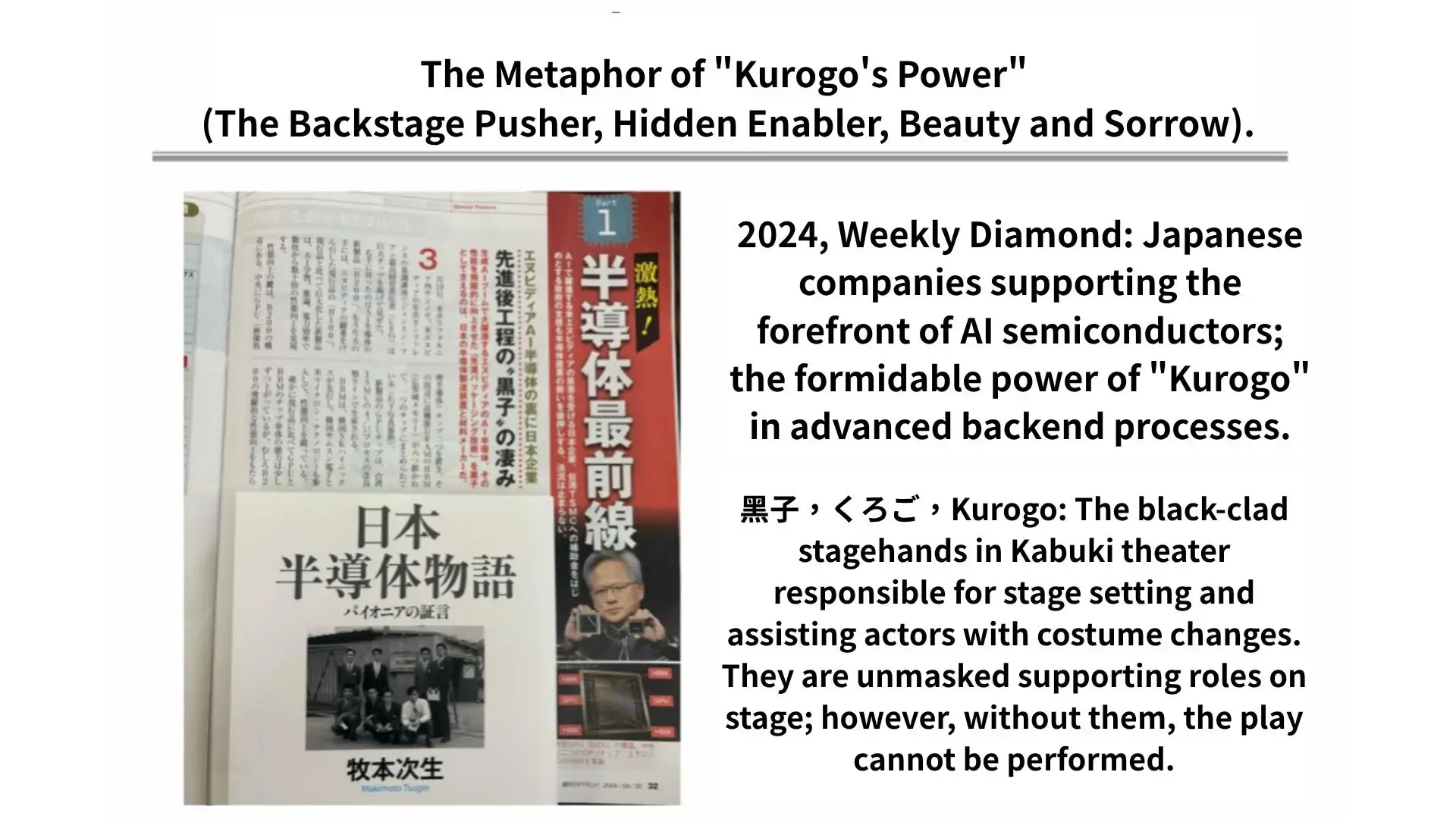
Chris Miller, author of Chip War, analyzed that TSMC's ultimate moat lies in its "Embedding" and "Symbiosis." TSMC has embedded itself so deeply into the global supply chain that it has become an indispensable organ. NVIDIA CEO Jensen Huang hailed Taiwan as the "unsung hero." In 2024, Japan's Diamond Weekly likened TSMC to the "Kurogo"—the invisible stagehands dressed in black in Kabuki theater who facilitate scene changes; without them, the play simply cannot go on. (See Figure)
Even the Oracle of Omaha, Warren Buffett, evaluated that in the IC industry, TSMC "is in a league of its own; there is no competition."
Decoding the DNA: Four Core Competencies and the Traits of Taiwan Society
Chen cited Philip Wong, TSMC's former Chief Scientist and current Stanford University professor, who brilliantly summarized the company: The four letters "TSMC" originally stand for Taiwan Semiconductor Manufacturing Company, but fundamentally, they represent the fusion of "Taiwan Society" + "Morris Chang."
Chen further analyzed three societal traits in Taiwan that incubated TSMC:
- Being Small: Forced the industry to collaborate externally, fostering a tightly-knit clustering effect.
- Being Poor: Early scarcity bred a fierce survival instinct and a resilience to fight to the bitter end.
- Proximity to Japan: In the 1980s, when Japan was number one, Taiwan looked up to Japanese technology, relentlessly playing catch-up until it eventually achieved transcendence.
Furthermore, TSMC wields four unshakable core competencies:
- Integrity and Trust: The ultimate superpower. It ensures that top global design houses dare to hand over their most highly classified blueprints.
- Scale: Massive production volume brings an exceptionally steep learning curve and cost advantages.
- Symbiosis: Forming a tight-knit ecosystem with Japanese equipment/material suppliers (like HOYA and TEL) and Silicon Valley design firms.
- Spirit: Facing the physical limits of nanotechnology with a "we must solve it" resolve, enabling TSMC to officially overtake Samsung and Intel in 2014 by mass-producing iPhone processors.
Concluding his speech, Chen reflected on his own career. His trajectory perfectly exemplifies how the Taiwan government's critical policies to prevent a "Brain Drain" became the foundational bedrock for TSMC's founding team.
When he studied physics at National Taiwan University and National Tsing Hua University, over 90% of his classmates went abroad. He was one of only three who stayed. He chose to join Taiwan's inaugural National Defense Industrial Reserve Service (a state-sponsored R&D conscription program designed to retain top tech talent), serving his time at ITRI. Subsequently, when TSMC spun off from ITRI, this elite group of R&D engineers seamlessly transitioned into TSMC's founding team.
Speaking of his former boss, Chen noted that Morris Chang demanded exceptionally high targets and was notoriously rigorous with financial reports (reportedly reducing several executives to tears). However, Chang also paid salaries two to three times the market rate, forging immense loyalty. Most importantly, Chang maintained absolute "focus." When external voices urged diversification after the company became profitable, Chang outright refused, staunchly defending the pure-play foundry model.
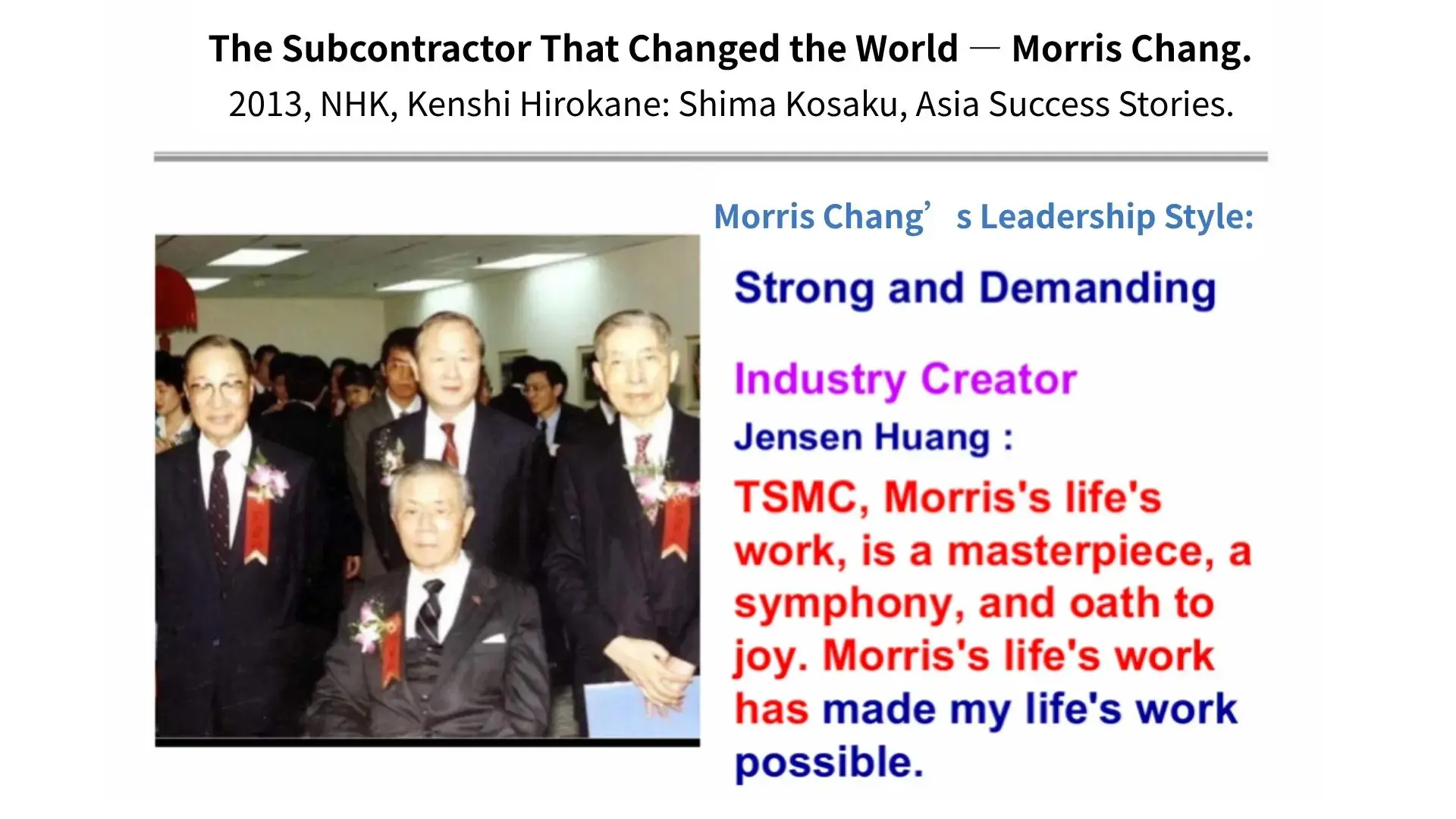
When asked by an audience member if he appeared in the recent documentary Mountain Maker, Chen humorously replied that he didn't make the cut. However, in an old photograph showing a young Morris Chang alongside Sun Yun-suan and Li Kwoh-ting (the principal architects of Taiwan's economic miracle), Chen was standing right behind Chang, with half his face cropped out. "That photo made it into the movie, so that was my only 'cameo'," he laughed. (See Figure)
Related Articles
Micron Announces Its Largest Rewards Ever. Its Taiwan Union's Demands Expose a Clash of Pay Systems. A strike threat at Taiwan's largest foreign investor, read in three dimensions
TSMC's 3nm rinse comes exclusively from AEMC, a Taiwanese company once withdrawn from the Emerging Stock Board
Taiwan AI Industry Upgrade Forum Series || Event Report:America Wants More Manufacturing. What Does It Take for Taiwan’s Suppliers to Follow?