Taiwan AI Industry Upgrade Forum Series | Event Report:What Can AI Agents Do on the Factory Floor? Start with One Workflow the Plant Can Measure
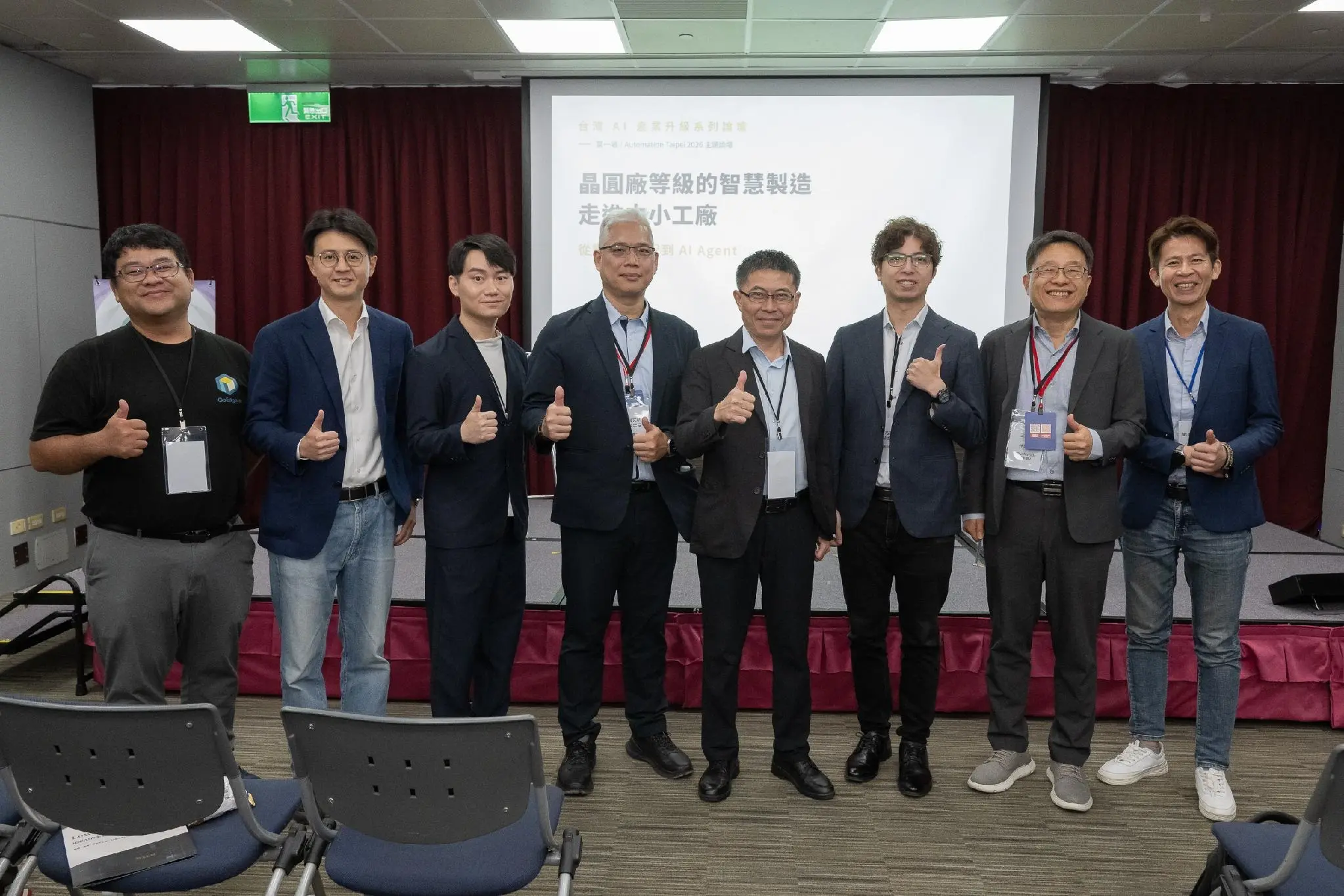
(Speakers and panelists gather for a group photo after the forum. From left: Chen Jianzhi, chief executive of GoEdge.ai; Zhang Zhejia, MICH's vice president for AI solutions architecture; Guo Dongying, chief product and design officer at STARBIT Innovation; Lü Wenbin, CTO of SYMTEK Automation Asia; Guo Zhongren, chairman and CTO of YouThought Corporation; Liu Youcheng, R&D director at Chyi Ding Technologies; TAIWANinside co-founder Lin Hung-wen; and Deng Wanwei, NEAT's chairman.)
On Aug. 20, 2026, the National Innovation and Entrepreneurship Association (NiEA) and the New Economy Alliance of Taiwan (NEAT) held a joint forum in Room 504b on the fifth floor of Hall 1, Taipei Nangang Exhibition Center, with MICH as the lead sponsor: "Taiwan AI Industry Upgrade Forum Series | Fab-Grade Smart Manufacturing for Small and Medium-Sized Factories: From Data and Scheduling to AI Agents." The forum ran alongside Automation Taipei 2026. The National Development Council provided guidance, and the Asia Silicon Valley & AI Strategy Agency (ASVA) took part as a cooperating body. TAIWANinside served as the co-organizing media partner and as the executing organization, and TAIWANinside co-founder Lin Hung-wen moderated.
The program paired two talks with two panel discussions. Zhang Zongyao, chief technology officer of MICH, and Guo Zhongren, chairman and CTO of YouThought Corporation, each gave a presentation. The panelists were Lü Wenbin, CTO of SYMTEK Automation Asia; Chen Jianzhi, chief executive of GoEdge.ai; Zhang Zhejia, MICH's vice president for AI solutions architecture; Liu Youcheng, R&D director at Chyi Ding Technologies; and Guo Dongying, chief product and design officer at STARBIT Innovation. Wu Ruowei, NiEA's chief operating officer, and Deng Wanwei, NEAT's chairman, represented the organizers at the forum.
Most Manufacturing Registrants Are Still Assessing AI
The pre-event survey showed a clear gap. After duplicates were removed, 55 of the 81 respondents said they worked in manufacturing. Of those 55, 35, or about 64%, had either not begun to evaluate AI or were still learning what it does; 17 were trying it in one or a few workflows, and only two said they had rolled it out across multiple workflows or plants. One respondent selected "none of the above" and wrote that they wanted to learn more. Most of the companies at the event have not reached full-scale adoption. They need to understand how an AI agent works before they can judge whether their plants are ready for one.
How Is an AI Agent Different from ChatGPT?
Zhang Zongyao started from the way work actually moves through a plant, then sorted out what generative AI, robotic process automation (RPA) and AI agents are each good for. Generative AI organizes, interprets and produces content. RPA repeats a fixed set of steps under fixed rules. An AI agent works toward a stated goal, using only the data and permissions it has been given: it decides the next step, calls systems such as enterprise resource planning (ERP), manufacturing execution systems (MES) and advanced planning and scheduling (APS) to get the job done, then either sends the result to a person for sign-off or writes it back into the system. For a manufacturer, what matters is putting the agent's judgment, action, confirmation and reporting inside a process the plant can control and audit.
Take a new order. The agent can read the part number, quantity and due date, check stock and material status in ERP, then call APS to build a schedule. If the system turns up a clash over equipment, due dates or materials, the agent can lay out the workable options, hand them to a person to approve, and write the approved version back into ERP or MES. None of this hands the factory over to the AI. The company still has to set the boundaries, permissions, exception rules and the points where a person signs off.
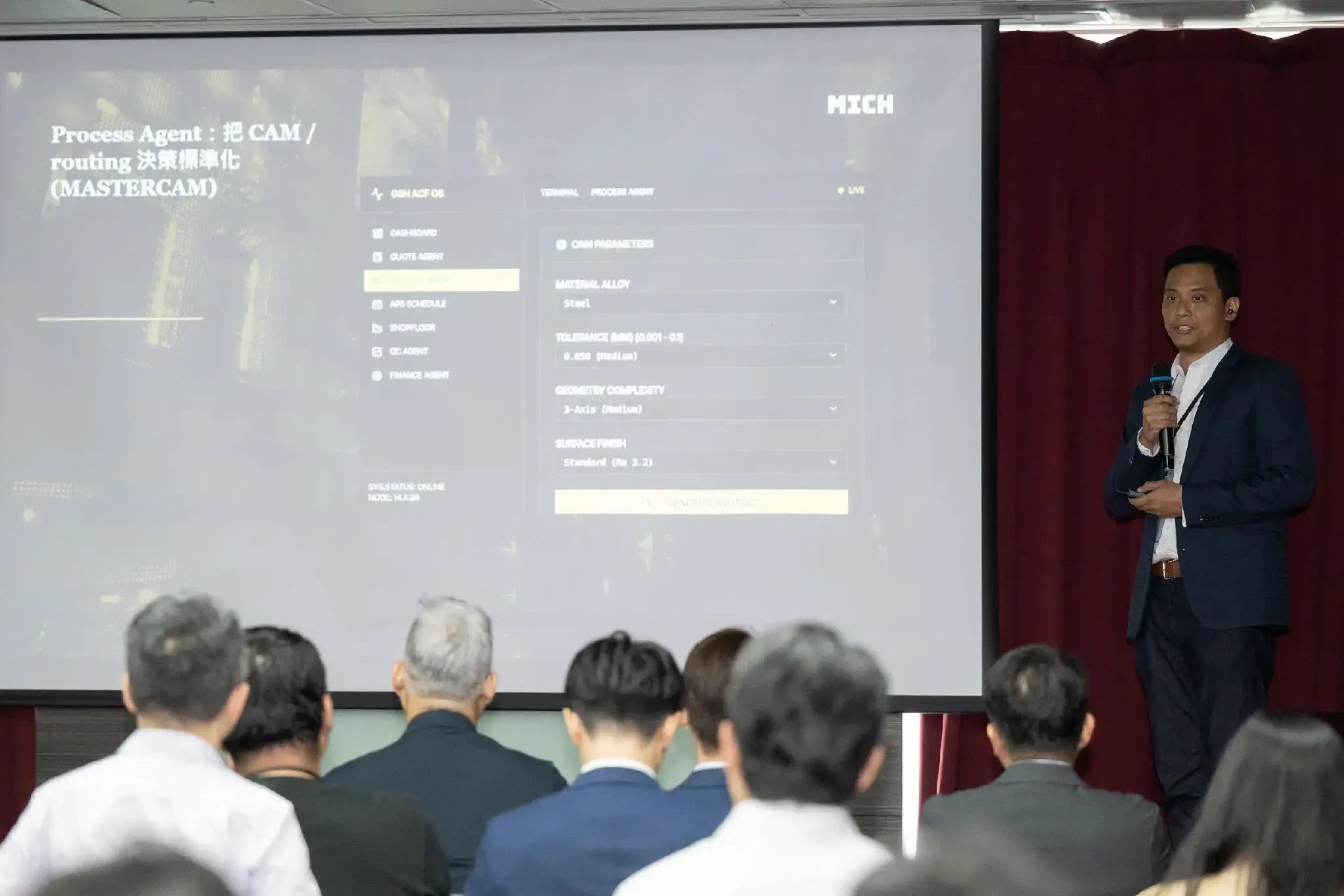
MICH CTO Zhang Zongyao walks through a manufacturing workflow to show how an AI agent connects data, enterprise systems and decision tools.
An AI Agent Still Has to Call the Tools the Plant Already Has
Adopting an agent does not retire the systems around it. Guo Dongying used order and document handling as his example: optical character recognition (OCR) has to turn paper records and unstructured content into structured fields first, or nothing downstream can query orders, stock and production data. Guo Zhongren said a production schedule has to satisfy due dates, equipment, labor, changeovers and materials all at once. APS and the mathematical models behind it still solve those constraints; the agent connects the tasks and moves the information.
Guo Zhongren described a project of 59 steps in which only six used machine learning. The case is a reminder that manufacturers should not turn every step of smart manufacturing into an AI problem. Steps governed by clear rules can stay with the software and the math that already run them. Manufacturers should weigh machine learning only where the data patterns are complex, or where the step calls for recognition or prediction.
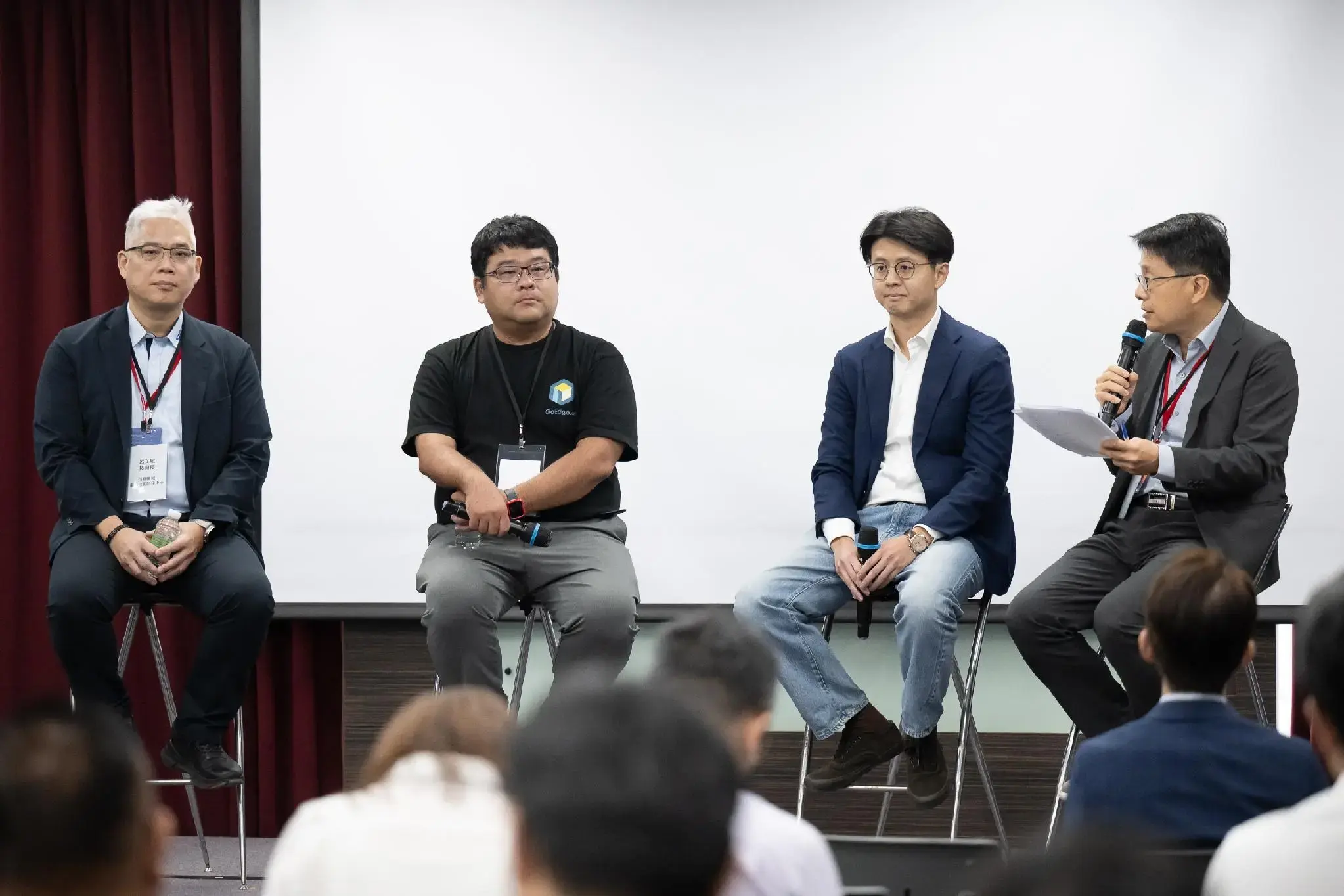
In the first panel, moderator Lin Hung-wen, Lü Wenbin, Chen Jianzhi and MICH's Zhang Zhejia discuss equipment data, shop-floor knowledge and compute choices.
AI Cannot Bypass ERP, MES or Shop-Floor Data
An agent can only finish a task if the data underneath it means the same thing everywhere. Drawing on equipment-connectivity work, Lü Wenbin said operational technology (OT) teams and information technology (IT) teams routinely call the same machine state by different names. If a company does not settle its field names, units and event definitions first, misjudgments are likely in the analysis that follows. Liu Youcheng added that sensor data reports measurements and nothing more: reading chemistry, water, power and process conditions takes engineering knowledge. A company cannot hand raw numbers to a model and expect a reliable answer back.
Chen Jianzhi turned to the problem of passing on shop-floor experience. Senior technicians often judge an anomaly by sound, by appearance, by feel or by what they have seen before; a system cannot use any of that steadily until the company turns it into records and rules it can trace. A company should write down the conditions, the response and the outcome first, then have a cross-functional team confirm which parts can be standardized.
Pick One Workflow the Plant Can Sign Off On
Among the manufacturing respondents, 48, or about 87%, picked "real-world AI use cases and results at small and medium-sized manufacturers" as a topic they wanted covered. Thirty-three, or 60%, chose pre-adoption assessment and cost-effectiveness, and 30, or about 55%, chose in-plant data infrastructure and governance. The responses show that what these companies care about most is whether adoption improves on-time delivery, labor hours, yield or exception handling. The name of the model is not their first concern.
One audience member asked whether a company could skip building an APS system and hand its data straight to an AI system. Zhang Zongyao said a company can start on a single task, but it still has to define its business rules for delivery, quality, price and priority. Without those criteria, an agent has no way to tell which schedule serves the business.
A more workable starting point is a workflow whose inputs, outputs, permissions and acceptance measures can all be pinned down: order entry, shortage checks, dispatch recommendations or exception summaries. A company can compare handling time, error rate, manual interventions and on-time delivery before and after, then decide whether to widen the scope.
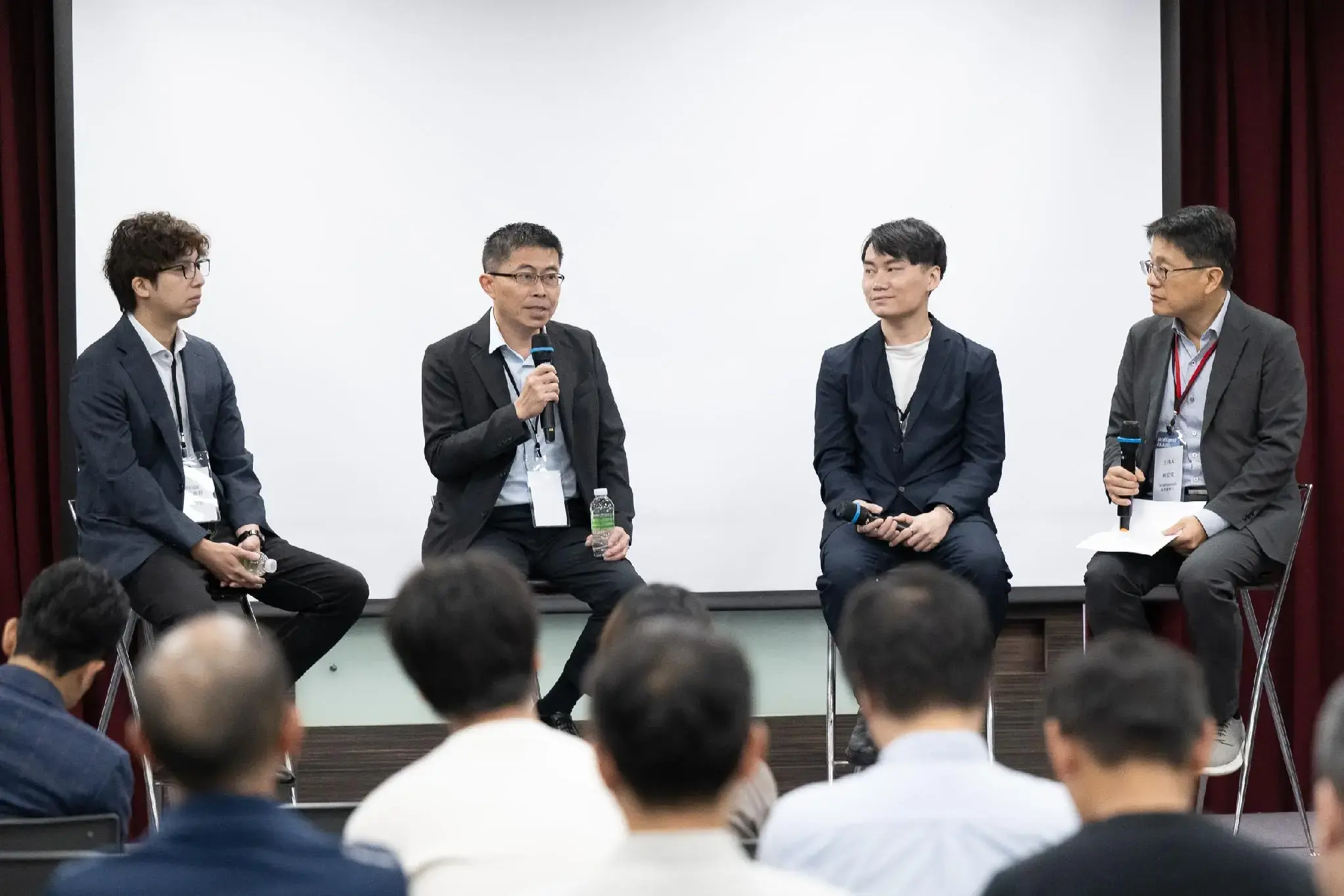
In the second panel, Guo Zhongren, Liu Youcheng, Guo Dongying and moderator Lin Hung-wen take up scheduling, data quality and systems integration.
Size the Workload First, Then Choose Cloud or On-Premises
Zhang Zhejia put the compute decision back on workload, data sensitivity and the ability to run and maintain the system. Cloud services lower the up-front burden when the workload is small, demand swings, or the company has no IT team yet. On-premises deployment pays off when data cannot leave the plant, usage is steady, response times are tight, and the company already has a server room and the people to maintain it. Some manufacturers can also adopt a hybrid architecture: sensitive data and real-time work stay inside the plant, while variable demand runs in the cloud.
On total cost of ownership, a company cannot stop at comparing a hardware price tag with a monthly cloud bill. On-premises brings power, cooling, floor space, maintenance and staff with it. Cloud calls for an estimate of long-run usage, data transfer, access management and reliance on the vendor. A company should confirm its workload first, then compare cost and risk over three to five years.
Organizers Call for Cross-Disciplinary Teams on the Factory Floor
The support a small or medium-sized manufacturer needs, the organizers said at the forum, runs across equipment, data, scheduling, models, compute and daily operations. No single vendor is likely to cover all of it, so a partner team has to walk the plant and confirm the workflow before it proposes an integrated package with acceptance criteria attached. A pilot also has to leave a record of what it achieved, or the manufacturer has nothing to judge the next round of investment against.
The forum did not close by telling every factory to adopt an AI agent. The discussion produced a more practical order of operations: a company first picks a workflow with clear boundaries, obtainable data and measurable results; it then settles what ERP, MES, APS and the equipment data each handle; and only after that does the implementation team choose the model, the compute and the deployment. Whether AI agents make it onto the factory floor still comes down to whether the company has spelled out its processes, rules, data and who is responsible for what.
Survey Methodology
The data in this article comes from the registration survey for the Taiwan AI Industry Upgrade Forum Series, collected through ACCUPASS during the registration period. The survey drew 85 submissions. Duplicate registrations were identified by participant email address; after they were removed, 81 respondents remained, 55 of whom identified themselves as working in manufacturing. Every manufacturing percentage in this article uses those 55 as the denominator. The topic question allowed multiple answers, so those percentages total more than 100%. Participation was voluntary, with no random sampling and no weighting. The results describe the adoption status and concerns of this forum's registrants only and cannot be generalized to Taiwan's manufacturing sector as a whole.
Related Articles
Taiwan Mass-Produces, Japan Supplies Materials and Equipment: From Sony to Drones, Why the Taiwan-Japan Alliance Is Rare
Memory Shortage Could Last Past 2030, and TSMC Is the Unexpected Winner
Musk Admits He Doesn't Know How to Make Chips: The Three Red Lines TSMC Must Hold in Any Terafab Deal