Taiwan Mass-Produces, Japan Supplies Materials and Equipment: From Sony to Drones, Why the Taiwan-Japan Alliance Is Rare
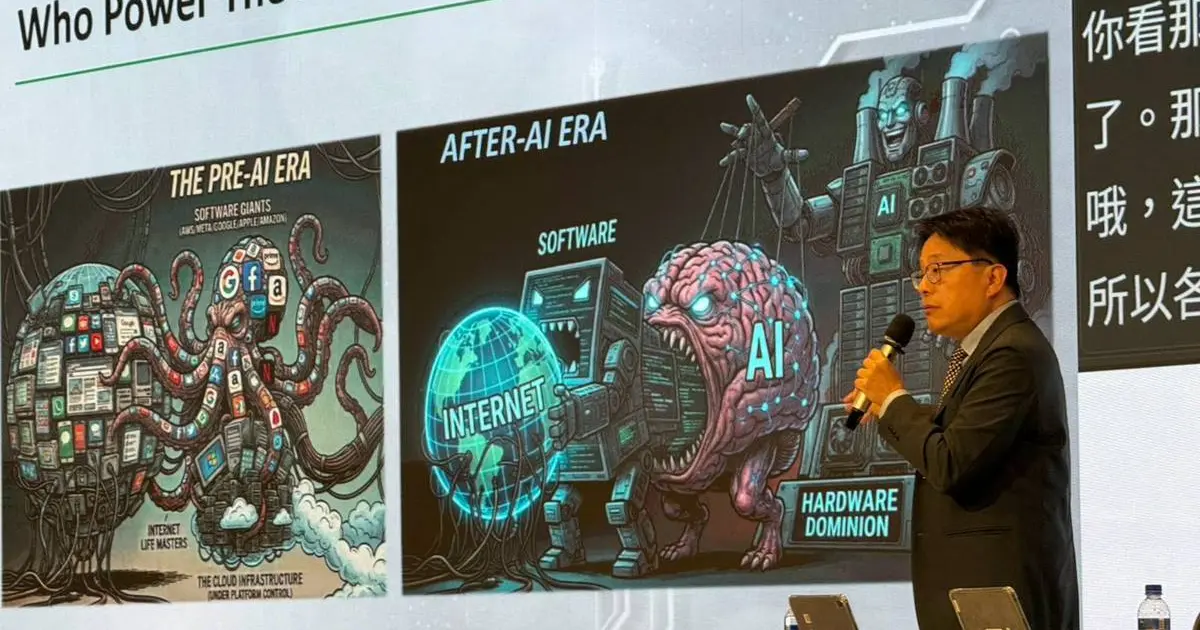
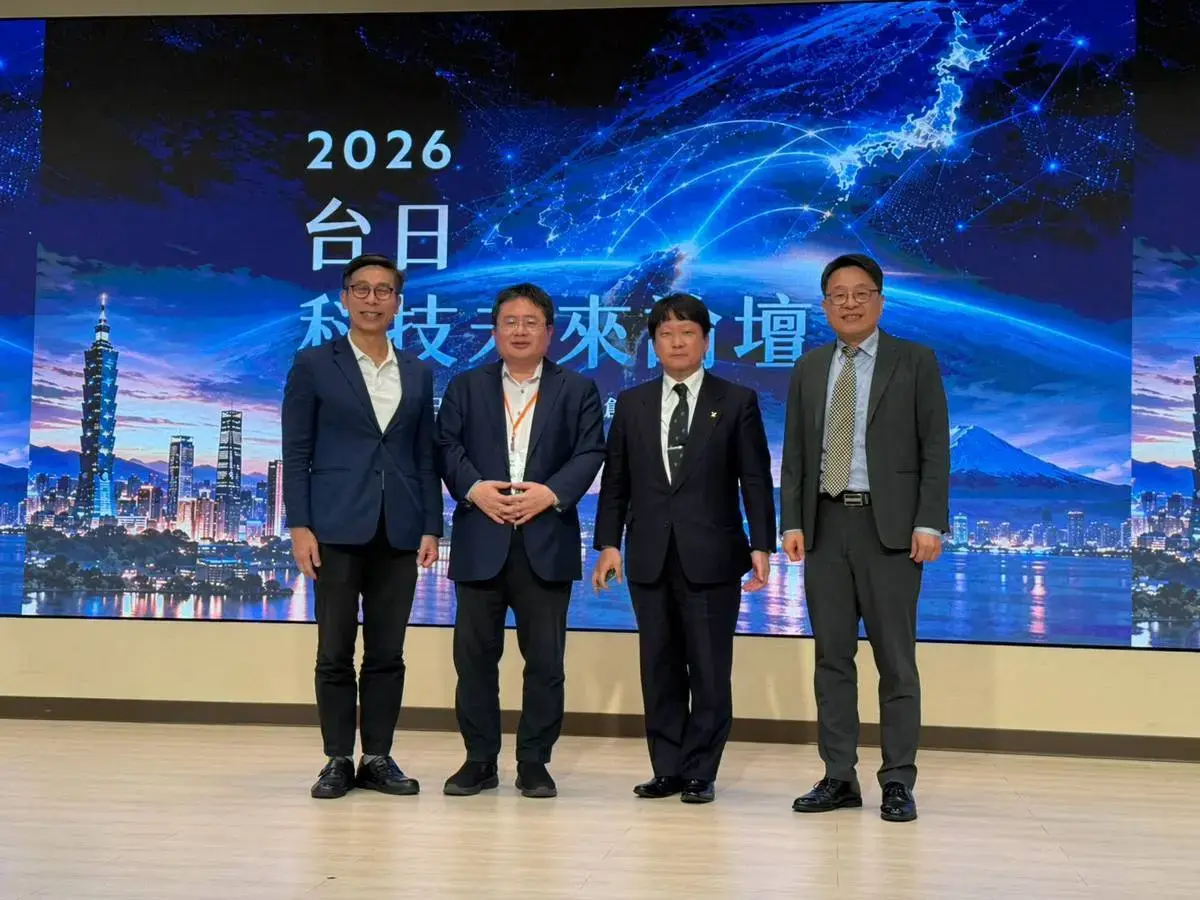
On Sunday, October 11, 2026, I spoke at the 2026 Taiwan-Japan Future Technology Forum, hosted by the Indo-Pacific Thinktank (IPST), a private Taiwanese think tank founded in October 2024 by Akio Yaita, former Taipei bureau chief of Japan's Sankei Shimbun. My topic was "From AI and Semiconductors to Defense: Equal Trust and Complementary Cooperation in the Taiwan-Japan Alliance." It sums up the many Taiwan-Japan alliance forums I have taken part in over the past few years, and it was probably the clearest version of the talk I have given, so I have written it up here.
I began with my conclusion. Many people think Taiwan is very strong now, since it controls 90% of the world's advanced AI chips and AI servers. But in my view, although Taiwan leads in the most advanced chip manufacturing, it needs help from many suppliers, and Japan supplies the most critical upstream materials and equipment. This is a complementary supply chain. Neither side can do it alone, and each needs the other's support.
AI Eats Software, and Hardware Takes Back Power
After the conclusion, I turned to the impact of AI. I used two contrasting charts to show how the industry's order was turned upside down before and after AI.
Before AI, software ate the world, and the cloud giants controlled online life through their platforms. After AI arrived, AI ate software, and the cloud giants had no choice but to pour money into AI so as not to be eaten themselves. What drives AI is chips and servers, so the hardware companies that sell the shovels have risen sharply.
Just over a decade ago, electronics stocks on Taiwan's stock market did poorly, because we all knew hardware as a business with gross margins of just 3% to 4%. Today hardware has become the key to the entire AI and chip value chain, and the stock markets of the US, Japan, South Korea, Taiwan and the Netherlands have all hit record highs, all because they are riding the AI boom.
For each point I made, I gave two examples. The first example was how American AI has penetrated the military and defense sector. Behind US military operations, from helping Ukraine fight Russia to the actions against Venezuela and Iran, stand four big AI companies: Palantir plans operational strategy, SpaceX provides satellite positioning, Anduril supplies attack drones, and Anthropic's models (later OpenAI's) act as the brain.
The US Department of Defense has also recently launched Project Meridian. On September 30, 2026, Defense Secretary Pete Hegseth announced that it would be led by Elon Musk (CEO of SpaceX), Palmer Luckey (founder of Anduril) and Newt Gingrich (former Speaker of the US House of Representatives), with 120 days to identify the key weapons and technologies needed for future wars, so that the US can keep its military edge.
The other example of AI changing the world is physical AI, the idea that AI will grow a body.
Musk recently predicted that the number of humanoid robots in the world will eventually reach 100 billion and they will be everywhere. In other words, if the world's population reaches 10 billion, every person will have 10 robots serving them.
Musk's prediction is startling. To be more realistic, Morgan Stanley and other institutions estimate that by 2050 there will be 1 billion humanoid robots at work worldwide, a market worth more than US$5 trillion.
As for robotaxis, service revenue could exceed US$1 trillion in the 2030s. Tesla has already put most of its resources into Robotaxi and Optimus.
What these numbers mean is that the ultimate vision for humanoid robots is to replace human labor, and the global labor market is measured in tens of trillions of dollars. The ultimate vision for self-driving cars is to replace the entire transport and driving industry, also a market worth trillions of dollars. And every robot and every self-driving car needs chips.
Semiconductors Have Become Strategic Assets
So AI has brought the biggest change in productivity in history, and AI is the most important force driving semiconductor development. The next issue, and the second most important trend, is that semiconductors, which power AI's brains and computing, have shifted from an economic issue to a political and defense issue.
In fact, to judge whether AI and semiconductors have become strategic assets, just look at how countries treat them. Governments now handle AI and chips with the logic of national security, the military and diplomacy. They use export controls and technology blockades, spend astronomical sums on subsidies to win manufacturing, make "AI and chip self-reliance" a head-of-state policy, and even resort to tariffs and government equity stakes.
The idea of a "silicon shield," the argument that Taiwan's semiconductor industry gives the world a reason to protect Taiwan and so deters armed threats, has also spread beyond Taiwan. Countries everywhere now link semiconductors directly to military deterrence and national survival.
The rivalry between the US and China is the clearest example. The US is ahead in the AI model race for now, but China's DeepSeek and Moonshot AI's Kimi are close behind with open-source models. SMIC can already make chips at 7 nanometers and even 5 nanometers, Huawei's Ascend is China's main AI chip, and Cambricon, Moore Threads, Biren and Enflame are following behind.
The US has also classified ASML's EUV lithography machines as strategic assets and banned their sale to China. China, in turn, has restricted exports of rare earths, gallium and germanium, and in January 2026 imposed controls on exports of dual-use items (those with both civilian and military uses) to Japan, as a countermeasure against the US and Japan.
And because China cannot mass-produce chips below 5 nanometers, it has poured money into mature processes and competes on price, which other countries find hard to withstand.
Europe was the second example. With the US and China in all-out confrontation, the EU plays less and less of a role. It faces China's growing low-price dumping and trade deficits, a war in Ukraine that has gone on for four years with no sign of ending, and a clear absence from the global AI and semiconductor battlefield. Europe faces huge challenges in politics, the economy and technology.
I mentioned the 2025 Nexperia incident, in which China restricted shipments from the company's Chinese plants and European carmakers briefly faced production stoppages. The war in Ukraine has also taught Europe the cost of depending on outside energy. So chips, like energy, need to be produced locally.
That is why TSMC set up its ESMC fab in Dresden, Germany. The decision can partly solve Europe's chip shortage, but it is only an insurance policy for Europe's auto and industrial supply chains, not a cure. To revive itself, Europe has to work harder on its own.
The Supply Chain Is Being Rebuilt, and Globalization Is Exiting
Next, I turned to my third theme: "The supply chain is being rebuilt, and globalization is exiting."
I began with a set of numbers. The five big cloud giants' capital spending will reach US$800 billion in 2026 and could hit US$1.2 trillion in 2027. This is the biggest infrastructure investment since the railways.
The US is pouring money into chip manufacturing and AI infrastructure and working hard to attract investment from Japan, South Korea, Taiwan and others. In fact, it is filling a gap left by thirty years of not investing in manufacturing, when companies spent their cash on share buybacks instead.
Countries are also moving away from hyper-globalization, which pursued efficiency and the lowest cost, toward regional development that puts resilience, security and trust first. Sovereign AI and small and medium-sized data centers in each region will follow.
Under this broad theme, I used TSMC's investments in the US and Japan as examples.
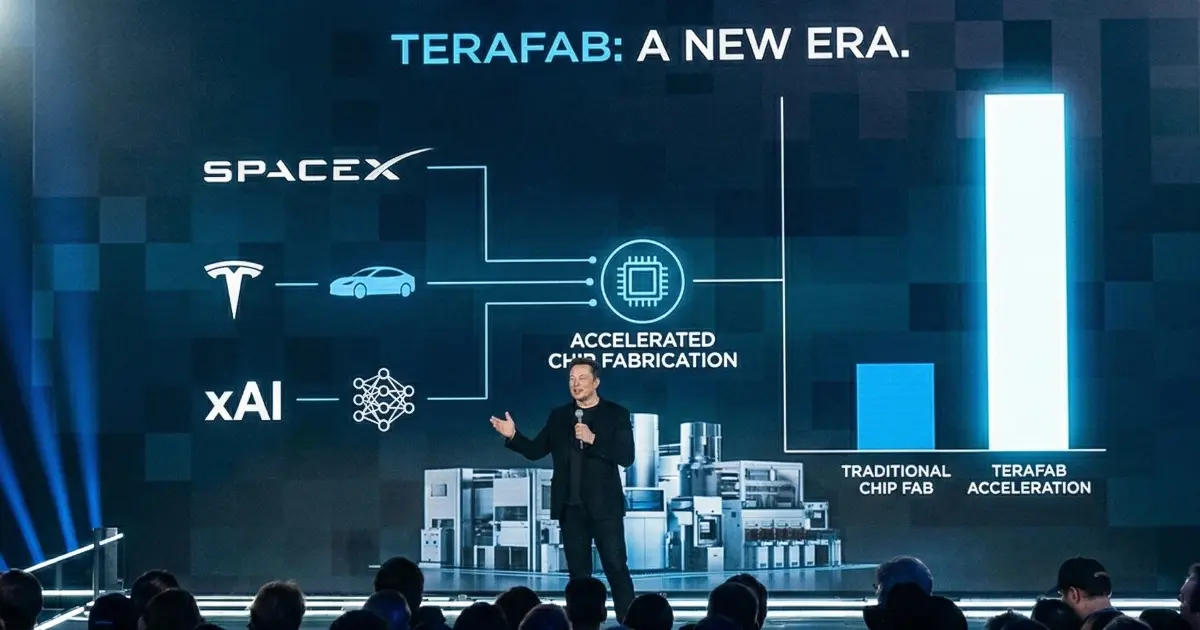
First, there were recent reports that TSMC is evaluating a fab in Texas. TSMC's investment in Arizona has only just begun, so why open a new front in Texas? My judgment is that the reports basically come from Musk. Terafab, the chipmaking project backed by Tesla, SpaceX and xAI, originally sought to work with Intel, and Musk also placed orders with Samsung's Texas fab, but in the end he had to come back to TSMC for talks. I analyzed the background in detail in my October 5, 2026 article, "Musk Admits He Doesn't Know How to Make Chips: The Three Red Lines TSMC Must Hold in Any Terafab Deal."
The most likely form of cooperation is still for TSMC to treat Musk's companies as customers that place orders, just like Nvidia and Apple. A TSMC investment in Texas is not entirely impossible, but if it happens, I suspect the reason will be that there are simply too many AI chip orders and the customers are all in the US. For now, only TSMC can provide capacity with stable yields at a large enough scale.
Kumamoto and Sony: Equal Partners
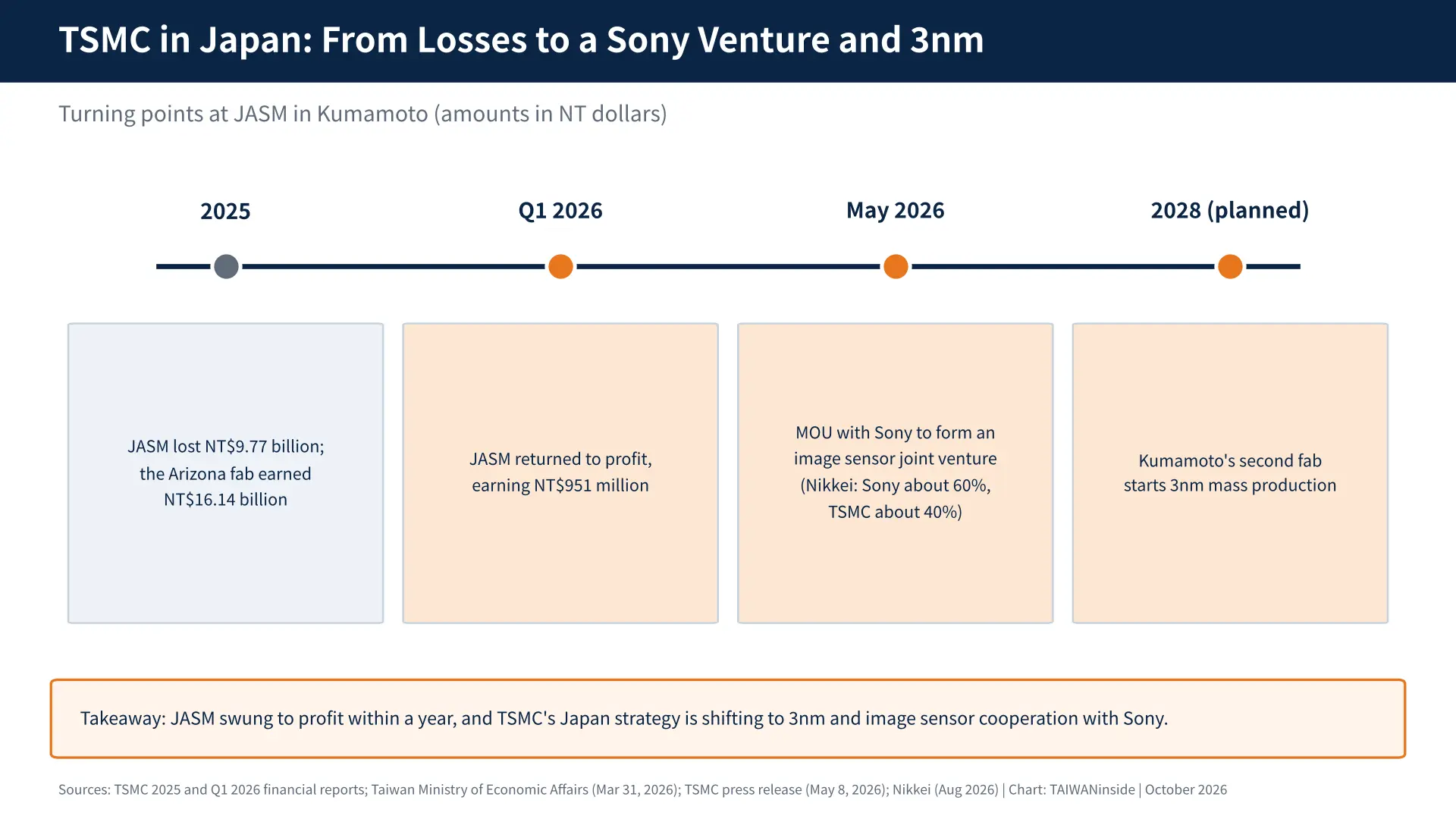
TSMC's presence in Japan is a different story. After JASM's first fab in Kumamoto began mass production, it ran into weak demand for automotive chips and lost about NT$10 billion in 2025, while the Arizona fab earned NT$16.1 billion over the same period.
TSMC's response was to upgrade JASM's second fab to 3-nanometer technology, using a high-value advanced process to improve its cost structure. The second fab is now expected to begin mass production in 2028, and JASM already returned to profit in the first quarter of 2026.
In May 2026, TSMC went further and signed a memorandum of understanding with Sony to form another new joint venture. According to a Nikkei report in August 2026, Sony will hold about 60% and TSMC about 40%. TSMC holds less than half of the joint venture, which is probably the smallest stake TSMC has ever taken in a joint venture with a customer, and it shows how much the partnership matters.
For Sony, the key goal is to lead production of next-generation CMOS image sensors (CIS), aimed at the vision needs that matter most for self-driving cars and robots. Sony's rivals, Samsung and China's OmniVision, both have their own design and manufacturing. Sony would find it hard to win alone and needs TSMC to compete.
Shinji Sashida, CEO of Sony Semiconductor Solutions, the Sony subsidiary responsible for image sensors, also said the investment builds on the trust cultivated through their long collaboration with TSMC. TSMC's reasoning is just as clear. Helping Sony, the most important customer in the CIS industry, not only directly supports smartphone components for Apple, TSMC's second-largest customer, but also helps customers in the fields that will matter most in the AI era, such as self-driving cars and robots. This is help TSMC is determined to give all the way.
So my reading is clear. The two companies are equal, complementary and mutually beneficial partners with a very deep relationship of trust, and that is what made this deep cooperation between a Taiwanese and a Japanese company possible.
Why Taiwan and Japan Are Allies
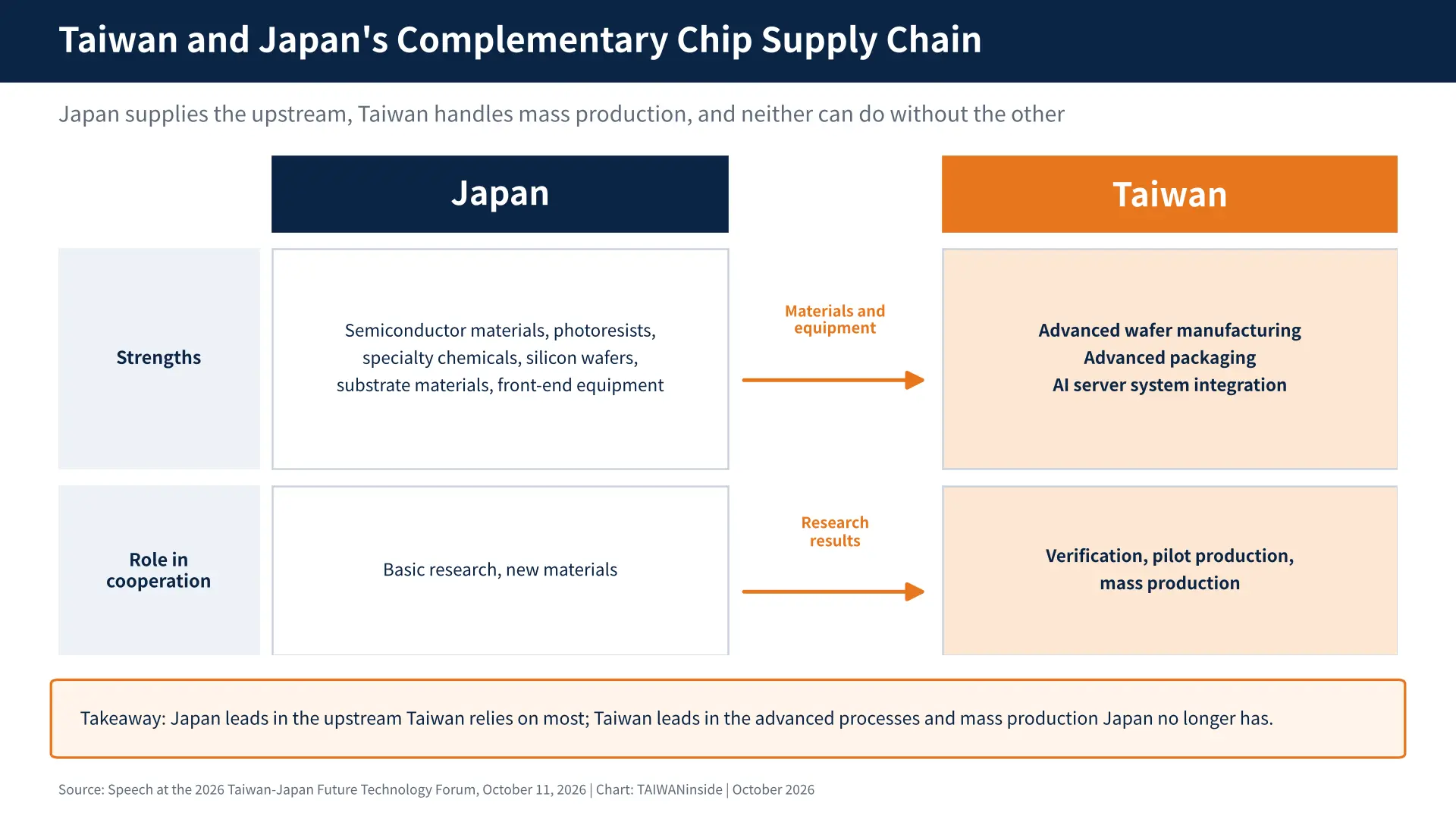
Finally, I came back to the point that the key to Taiwan-Japan cooperation is complementarity. Taiwan's strengths are the most advanced wafer manufacturing, advanced packaging and system integration of AI servers. Japan's strengths happen to be the upstream areas where Taiwan is most dependent and weakest: semiconductor materials, photoresists, specialty chemicals, silicon wafers, PCB substrate materials and front-end chipmaking equipment.
I also stressed that although exports from Taiwan and South Korea keep hitting record highs, Japan's export strength in front-end equipment, materials and chemicals far exceeds that of Taiwan and South Korea.
I also said the Taiwan-Japan alliance is something to treasure, because this kind of relationship is very rare in the world, and I explained why with my own experience of recent years.
I said that in recent years I have traveled to Japan and South Korea many times and met many friends, yet I have almost never heard of any cooperation projects between Japan and South Korea, and cooperation between Taiwan and South Korea is also rare. Only a handful of countries in the world can do AI and semiconductors. China has now decoupled from the rest of the world, and the US has become the leader everyone allies with. So the complementarity, mutual trust and alliance between Taiwan and Japan can be called the only combination of its kind in the world.
This Taiwan-Japan alliance is now gradually bearing fruit, with many real cases. I gave two examples: one from academia, with National Yang Ming Chiao Tung University and Tohoku University, the University of Tokyo and others, and the other on Taiwan-Japan cooperation in drones.
NYCU's "From Lab to Fab" and the Fourth-Generation University
The first case is my alma mater, National Yang Ming Chiao Tung University (NYCU), located next to Hsinchu Science Park. NYCU was the first university in Taiwan to develop semiconductors, and in recent years it has actively expanded exchanges with universities in the US, Japan and elsewhere. Under President Chi-Hung Lin, it has signed agreements with Japanese universities including Kyushu University, Hokkaido University and Kumamoto University, and has begun research cooperation with Tohoku University and the University of Tokyo. This is a concrete example of Taiwan and Japan going from the laboratory to the wafer fab, or "From Lab to Fab."
"From Lab to Fab" matters especially to Japan. Japan has a great deal of cutting-edge research, but it no longer has advanced manufacturing processes, so it needs Taiwan's fabs for verification and pilot production. Taiwan-Japan cooperation can solve Japan's big problem of lacking a place to turn research into production.
For example, Professor Seiji Samukawa of Tohoku University joined NYCU a few years ago to research neutral beam atomic layer technology, and has worked with Taiwanese companies on "From Lab to Fab" projects. After several years, the results are now clearly visible.
In addition, NYCU, the Taiwan Semiconductor Research Institute (TSRI), Professor Satoru Nakatsuji of the University of Tokyo and the startup TopoLogic are working together to develop antiferromagnetic MRAM (AFM-MRAM), a new type of memory that stores data using antiferromagnetic materials.
Another project brings together Hideo Ohno and Shunsuke Fukami of Tohoku University and Kerem Camsari of the University of California, Santa Barbara (UCSB) with NYCU and the Industrial Technology Research Institute (ITRI), Taiwan's largest industrial technology research organization, to study probabilistic computing (p-computing), a new kind of computing that uses randomly fluctuating devices to solve problems such as optimization.
NYCU is also promoting a "fourth-generation university" initiative, in which universities take on more of the work of integrating ecosystems for cross-border industrial alliances. Because universities are more independent, objective and trustworthy than governments or companies, this model has been launched with universities in the US and Japan, and works with TSMC and other semiconductor companies investing across borders, backing Taiwan's international industrial development.
The fourth-generation university plays a different role from those of the past. The first generation of universities taught, the second did research and the third did entrepreneurship. The fourth generation's role is ecosystem integration, with universities linking up cross-border industrial alliances.
Drones: A Supply Chain That Does Not Depend on China
My second case is closer to defense. China dominates the global drone supply chain with low costs, and both Taiwan and Japan are rushing to build a "non-red" supply chain, one that does not use Chinese components. Japan's target is to produce 80,000 drones a year by 2030. Taiwan's is to produce 100,000 a month by 2030, an annual target more than ten times Japan's.
I also cited figures from the Research Institute for Democracy, Society and Emerging Technology (DSET), which show that Taiwanese and Japanese companies, industry groups and research institutes have signed 15 cooperation agreements since 2020. In July 2026, Chen-Wei Chiang (江振瑋, transliterated), executive director of the drone diplomacy task force at Taiwan's Ministry of Foreign Affairs, representing the Global UAV Academy (GUAVA), signed a letter of intent with Kenzo Nonami, chairman of the Japan Drone Consortium (JDC). It focuses on a non-red supply chain and security certification, talent training and international competitions.
At the Japan Drone 2026 exhibition in June 2026, Taiwanese companies such as 御天航太 (Yutian Aerospace, transliterated), 碳基科技 (Carbon-Based Technology, transliterated) and Celxpert also promoted "non-red supply chains, autonomous systems and dual-use designs," actively seeking Japanese partners.
Still, I think Taiwan and Japan have many obstacles to overcome in cooperating on drones and other defense industries. The most urgent task right now is to work more closely so that the non-red supply chain can ramp up mass production quickly. Drones made in Taiwan and Japan must cut costs fast, or it will be very hard to compete with a global drone industry controlled by DJI.
I also used the American Ghost Robotics robot dog shown at the event to illustrate how cheap Chinese robot dogs are. Robot dogs made by China's Unitree cost only a few percent of what a Ghost Robotics robot dog costs. There may be differences in quality and performance, but being able to bring prices down this far is a clear advantage for global sales and mass adoption.
Ghost Robotics was founded by Americans and has now begun working with Taiwan. Taiwan's National Chung-Shan Institute of Science and Technology (NCSIST), the military research institute under the Ministry of National Defense, has brought in its robot dog platform for localized integration in Taiwan, and Ghost Robotics is also evaluating production in Taiwan. The goal, of course, is to cut costs, and there will be more room for Taiwan-Japan cooperation in the future.
Five Things the Taiwan-Japan Alliance Can Do
At the end of the talk, I proposed five directions for the Taiwan-Japan alliance.
The first is joint talent development. I believe the biggest bottleneck in semiconductors is the shortage of talent. Taiwan and Japan can build training and exchange channels together, combining Taiwan's manufacturing experience with Japan's materials science.
The second is joint technology development: investing together in advanced packaging, silicon photonics and new materials for the post-Moore era, pairing Japan's basic research in materials with Taiwan's mass production capability.
The third is a joint supply chain strategy: building fabs together in the US and Europe as a "Taiwan-Japan alliance force" to expand their global voice, rather than each going it alone.
The fourth is jointly building standards and trust mechanisms: defining together the standards for a "trusted supply chain," so that Taiwan and Japan become the most reliable technology supply hub of the democratic camp.
The last is protecting the technology order: in a turbulent and fragmented world, jointly defending a technology order that is "free, open and based on trust."
So the conclusion of the talk is this: AI and semiconductors will shape the next era, and whether Taiwan and Japan join hands will decide whether this era is defined by "trust and democracy" or by "coercion and authoritarianism." My final call was that only a Taiwan-Japan alliance can jointly hold this strategic high ground that will determine future national strength.
Related Articles
Memory Shortage Could Last Past 2030, and TSMC Is the Unexpected Winner
Musk Admits He Doesn't Know How to Make Chips: The Three Red Lines TSMC Must Hold in Any Terafab Deal
The Day Morris Chang Laughed Out Loud: Chenming Hu's New Book and the Talent Network Behind Taiwan's Chip Industry