Musk Admits He Doesn't Know How to Make Chips: The Three Red Lines TSMC Must Hold in Any Terafab Deal
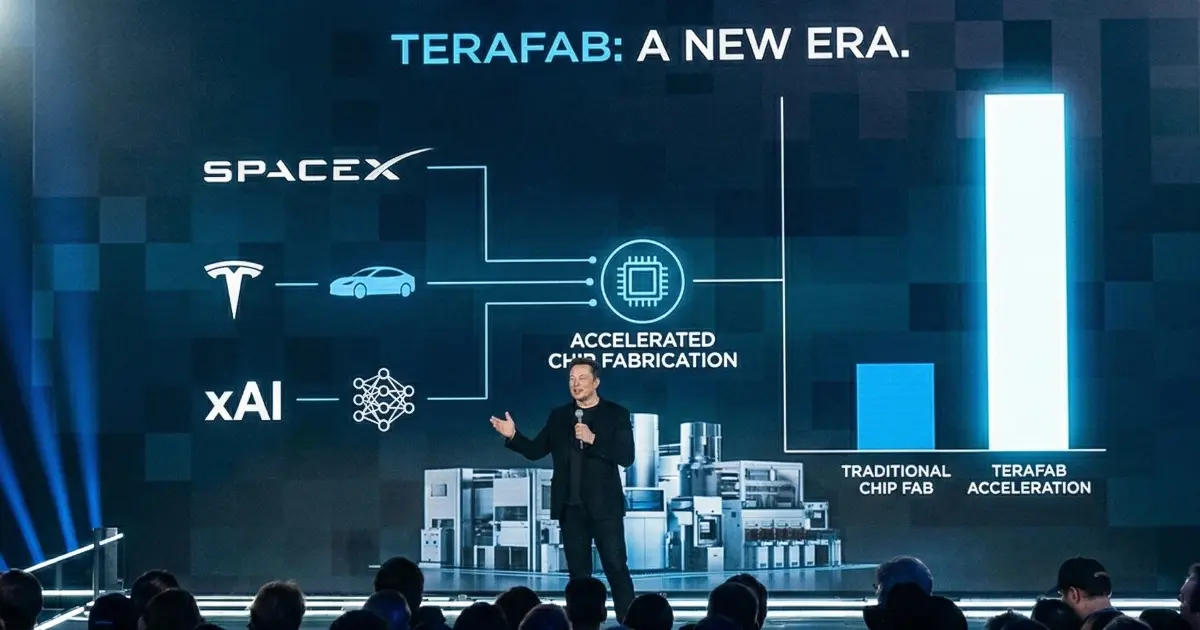
On October 2, 2026, Tim Culpan reported in his newsletter Culpium that TSMC was exploring ways to help operate Terafab's fabs and might make Terafab an anchor client for its new campus in Texas.
Elon Musk, who heads SpaceX, confirmed the report on X on October 3, 2026, though in very guarded terms: "Just discussions, but something may come of it."
SpaceX and Tesla are huge customers for the semiconductor industry, so this is naturally a big business opportunity that TSMC can hardly ignore. Still, the two sides are only in discussions, and there is unlikely to be an outcome any time soon.
I wrote this analysis on October 5, 2026. Two days later, on October 7, Musk went further in a reply on X: he said his companies would build and run Terafab's fabs themselves, and that there should be zero doubt about that; TSMC might sublease part of Terafab if it wanted, but nothing more. Musk also reiterated that Terafab would use Intel's 14A process, and Intel CEO Lip-Bu Tan told Bloomberg that Intel remains part of the Terafab project.
How might the deal evolve? In particular, how would TSMC take the project away from Samsung or Intel? That is a major question worth discussing, and here is my view.
Musk's Talks With TSMC Suggest Intel's Technology Has Run Into Trouble
First, some background on Terafab. It is a chipmaking project backed jointly by Musk's companies Tesla, SpaceX and xAI (which has since merged into SpaceX), located in Grimes County, Texas, with a first-phase investment of about US$16.8 billion and at least 3,000 employees.
Its ambitions are enormous. It aims to be a vertically integrated mega-campus that brings chip design, logic manufacturing, memory, advanced packaging, testing and photomask production together on one site, with the goal of "producing one terawatt of computing power a year" in chips for Tesla's cars, Optimus robots, SpaceX and xAI's data centers.
The first partner reported for this huge project was Intel, and Musk had also placed a large order with Samsung Electronics for its Texas fab. So why is Musk now in talks with TSMC?
I believe the answer is not hard to guess. Intel and Samsung, the partners Musk had approached, have clearly run into problems, held back by poor yields and slow operational progress, and could not satisfy him.
When Terafab was first announced, the plan was to work with Intel and use Intel's 14A advanced process and advanced packaging, though Intel neither took a stake nor invested money. When the news came out, much was made of the US government's nearly 10% stake in Intel and of Musk's good relationship with President Trump. That turned the partnership into an American chip project combining "American manufacturing, American technology and American capital," a national champion of the US semiconductor industry with strong political overtones.
The partnership was also a lifeline for Intel. Intel CEO Lip-Bu Tan had warned that if Intel could not find external customers for 14A, it might "exit chipmaking altogether." Terafab made Tesla "the first heavyweight external customer for Intel's 14A," a key pillar of Intel's foundry ambitions.
Yet Musk is now talking with TSMC anyway, which suggests Intel's technology has run into difficulties. According to information gathered from the market, Intel expects to begin high-volume production of 14A in 2028, a year earlier than its original plan of 2029. It is not that Intel cannot make the technology work; it has made some progress, such as improved defect density and an advancing process design kit (PDK), and according to industry sources, 18A yields are around 80%.
But 14A faces three real challenges. First, although the schedule has been pulled forward, volume production is still not due until 2028. Second, it lacks a confirmed heavyweight customer. Third, Intel's long record of missed deadlines has created a crisis of confidence in its execution. And with 14A not in volume production until 2028, the timetable is simply too slow for Musk, who needs chips urgently.
Before Terafab turned to Intel, Musk had also worked closely with Samsung Electronics. Samsung won a Tesla order worth about US$16.5 billion to be produced at its fab in Taylor, Texas, mainly for the AI6 chip.
However, yields of 2-nanometer chips at Samsung's Texas fab have fallen short of expectations. Although Samsung moved volume production up to 2027, its memory division is highly profitable while its foundry division has lost money for years, which raised concerns about whether it could supply Musk in large volumes. That may well be what made Musk wary of relying too heavily on Samsung and led him to think about diversifying his suppliers.
Joining Terafab Would Put C.C. Wei in a Series of Dilemmas
In fact, Tesla split orders for its previous-generation AI5 chip between Samsung Electronics and TSMC as a safeguard. TSMC first made the chips at its fabs in Taiwan and later moved production to Arizona. Global Unichip (GUC), a TSMC affiliate, is also one of the Taiwanese companies involved in designing Tesla's automotive chips.
The large AI6 order, however, went only to Samsung. Tesla never explained why, but the general view is that TSMC's order book was full and its Arizona fab was packed, and Tesla then shifted to Samsung as its main supplier, so cooperation between Tesla and TSMC cooled for a time.
Musk's desire to build his own vertically integrated Terafab naturally reflects his personality. He clearly wants to be in control and to have his own manufacturing capability. He has also said he worries that chips might one day be unable to leave Taiwan, and anxiety about geopolitical supply security is the main reason he set up Terafab.
But a customer that wants to become its own integrated device manufacturer (IDM), a company that both designs and manufactures its chips, is clearly not TSMC's kind of business. TSMC's ideal relationship is with design customers that place orders with TSMC for production, preferably customers with no fabs of their own, pure product companies such as Nvidia, Apple, AMD and Broadcom.
In the end, Musk wants TSMC in Terafab because TSMC is the strongest chip manufacturer on the planet. Who else would he turn to? But for TSMC Chairman C.C. Wei, this becomes a choice that needs careful thought.
Under Wei, TSMC faces a series of dilemmas. It wants to win Musk as a big customer, but it also has to stay neutral and avoid upsetting existing customers such as Nvidia. It has to avoid offending the US government, because Musk turning to TSMC would mean pushing aside Intel, in which the US government holds a stake. And it has to keep its technology from leaking out. Caught among these dilemmas, the decision is complex and very difficult, and a real test of Wei's judgment.
Consider first the pressure on Musk. After taking SpaceX public in June 2026, he has been integrating it with Tesla, creating huge demand for chips: Tesla's AI5 and AI6 chips, xAI's data center chips, chips for Optimus robots and more. What he needs is semiconductor capacity that is "guaranteed, prioritized and sufficient."
But the foundry orders Musk shifted to Samsung Electronics have clearly not gone as planned, while his competitors that are firmly allied with TSMC, including Nvidia, AMD, Google and Broadcom, continue to get stable supply from TSMC. That is probably the biggest source of pressure on Musk right now.
That is the main reason Musk wants to build Terafab and secure capacity of his own. But Tesla lacks chipmaking experience, which is its biggest weakness. Learning from scratch on its own would take far too long to meet its needs, which is why it wants to borrow TSMC's technology and operating capabilities to get Terafab running quickly and with high yields.
Musk himself admits how hard chipmaking is. On October 10, 2026, appearing by livestream from Austin, Texas, at the X Takeover event of the Silicon Valley Tesla Owners Club, he said he had no idea how to make microchips but that his team would figure it out. He added that he had no idea how to make cars or rockets either. He described semiconductor manufacturing as one of the hardest things to do in the world and said it might take several years. He said that when he visited other chip plants he did not see much custom equipment, while his companies have a lot of experience building custom production equipment; his approach is to start with conventional chipmaking equipment and then modify it to raise production speed.
TSMC Chairman C.C. Wei, answering an analyst's question about Terafab at TSMC's first-quarter earnings conference on April 16, 2026, said that building a new fab takes two to three years, and ramping up capacity takes another one to two years. There is no shortcut.
A report in October 2026 by South Korea's Korea Economic Daily (Hankyung) cited a person familiar with TSMC's internal affairs as saying that Musk might find it easier to send Starship to Mars than to get stable yields out of Terafab. In this person's view, anyone with the money can build a fab; the hard part is consistently producing wafers without fluctuations or errors. In the same report, a Samsung executive said that tuning equipment to the yields needed for mass production takes at least 30 years of accumulated experience.
In Talks With Musk, TSMC Will Hold Three Red Lines
For TSMC, what Musk wants most is technological self-sufficiency. At heart he hopes eventually to control manufacturing himself, which is exactly what TSMC least wants to give. In pursuing this big customer, TSMC will try hard to avoid giving away its technology. I think that in negotiating with Musk, TSMC will try its best to hold three red lines.
The first red line is not locking up capacity for a single customer and not compromising neutrality. TSMC's foundation is that it does not compete with its customers and serves all of them fairly. If it built a dedicated fab tailored to Musk, what would its other big customers, Nvidia, AMD and Apple, think? So TSMC will push hard to steer the partnership toward this arrangement: I build my own fab in Texas, you become a major customer, but the fab also serves others, and I remain a neutral foundry.
The second red line is no technology transfer and protecting its know-how. TSMC's technology cannot leak out. It will never transfer its process know-how to Terafab so that Musk can do it himself later. If they discuss operational help, TSMC will strictly limit it to "I run my process for you, but the technology stays mine," rather than handing the technology over to Terafab.
The third red line is complying with Taiwan's N-1 rule and protecting Taiwan's lead. TSMC's overseas investment is subject to the Ministry of Economic Affairs' requirement that "key processes must be one generation behind Taiwan." So even if there is a partnership, the process node TSMC provides to Terafab will not be its most advanced.
On April 18, 2025, Taiwan's Legislative Yuan, its parliament, passed amendments to the Statute for Industrial Innovation that strengthen prior review of outbound investment to prevent the outflow of key technologies. Taiwan's Ministry of Economic Affairs said at the time that the most advanced processes would definitely stay in Taiwan.
TSMC's negotiating goal should be to absorb this project into a simple form, "my Texas expansion plus Musk as anchor customer," winning a big customer while preserving its neutrality as a pure-play foundry and protecting its technology.
Some may argue, however, that Musk would certainly not be content to be just one of TSMC's many customers, since Terafab's goal is to build his own IDM. A joint venture fab with TSMC, or bringing TSMC in as a shareholder in Terafab, would likely be Musk's negotiating terms.
Moreover, TSMC has already set up several joint ventures with customers, so there are precedents. JASM, TSMC's fab in Kumamoto, Japan, is a joint venture with Sony, Denso and Toyota, and ESMC in Europe was set up with three European customers, Bosch, Infineon and NXP. In May 2026, Sony also signed a memorandum of understanding (MOU), which is not legally binding, with TSMC to form a joint venture, and according to media reports, Sony would hold 60% and TSMC 40%.
In other words, dedicated partnerships between TSMC and customers do have precedents, and this remains one possible direction for TSMC and Terafab. But Terafab looks somewhat different when measured against TSMC's earlier joint ventures.
The key reason is that TSMC can do dedicated joint ventures, but when it does, it chooses specific conditions and fields to make sure its core neutrality is not compromised. In other words, the question is not whether to do a dedicated partnership, but under what conditions.
From the JASM, ESMC and Sony precedents, we can identify several common features of the dedicated joint ventures TSMC is willing to form, and these features can help us judge what form a TSMC-Terafab partnership might take.
A TSMC-Terafab Partnership Would Have Three Features
The first feature is that TSMC's joint ventures with these companies are mostly outside the core of cutting-edge technology competition, focusing instead on specialty processes and specific applications. ESMC, for example, makes mature-process chips for automotive and industrial use at 28 and 22 nanometers, and the Sony venture makes image sensors (CIS). None of these are the most advanced AI logic processes, at 3 or 2 nanometers, that Nvidia and AMD are competing for.
So these joint ventures do not crowd out the scarcest advanced capacity that Nvidia and AMD are vying for, and they do not make Nvidia feel that "TSMC is giving my 2-nanometer capacity to someone else." This is a crucial point: TSMC's dedicated joint ventures deliberately avoid the battleground that would raise concerns among its core customers.
The second feature is that in the earlier joint ventures, the customers typically brought in their own needs or even took the lead, rather than TSMC going after someone else's business. Bosch, Infineon and NXP invested in ESMC to secure their own supply of automotive chips, and the Sony venture is led by Sony to secure sensor production. In essence, these joint ventures are customers binding themselves to TSMC to protect their own supply, and TSMC cooperated at the customers' request rather than actively favoring anyone. That makes it defensible in terms of neutrality, because the customers chose to bind themselves; TSMC is not playing favorites.
Vanguard International Semiconductor (VIS), a TSMC affiliate, opened a new fab in Singapore at the end of September 2026. It belongs to VSMC, a joint venture between VIS and NXP in which VIS holds 60% and NXP 40%, and it was likewise tailored for NXP, producing mixed-signal and power management ICs for automotive, industrial and other applications.
Because TSMC is focusing fully on advanced processes, it has passed some mature-process orders to VIS, but even TSMC's affiliates follow the principles by which their big brother runs its foundry business.
The third feature is that these joint ventures mostly have legitimate geopolitical and localization reasons. ESMC serves Europe's goal of supply chain autonomy and fits EU subsidies and policy; Sony and JASM serve localization in Japan, with Japanese government subsidies. These joint ventures are justified by aligning with local policy and strengthening supply chain resilience, not simply by TSMC favoring a particular customer. That policy legitimacy makes them easier for other customers to accept.
Measured against these three features, Musk's Terafab clearly has legitimate geopolitical and localization reasons, given made-in-America goals, pressure from President Trump's tariffs and supply chain autonomy. But Musk's project does not fit the other points, and that will be the key factor in TSMC's decision on whether to partner.
The Likely Outcome: TSMC in Control, Avoiding Core Conflicts
First, Musk probably wants the most advanced processes. His AI5 and AI6 chips and xAI's data center chips need 2-nanometer-class technology, which steps right into the core battleground that Nvidia and AMD are fighting over. That is different from ESMC's mature automotive processes or Sony's sensors.
Second, Musk's xAI is itself a competitor in AI chips, whereas Infineon, NXP and Sony do not compete in the same arena as Nvidia and AMD. Nvidia would not mind TSMC helping Infineon or Sony, but it would be more sensitive to TSMC helping xAI, a competitor, expand its chipmaking.
Third, and most important, Musk's Terafab aims to become his own vertically integrated manufacturer, driven by his ambition to control manufacturing. Compared with ESMC or Sony, that clearly comes much closer to TSMC's red line on technology know-how.
So, all things considered, I think the most likely outcome is that TSMC will stick to these principles. The best model for TSMC is of course to build its own fab in Texas and make Musk's companies key customers. A joint venture fab with Musk is not entirely impossible, but it would certainly draw on the JASM, ESMC or Sony models to find a form of dedicated partnership that satisfies Musk without crossing TSMC's own red lines.
In my view, the end result may well be a carefully designed partnership, with TSMC in control and core conflicts avoided, forming a dedicated partnership with this American national champion under TSMC's control.
Of course, TSMC joining Terafab and pushing aside Intel, in which the US government holds a stake, is politically sensitive at a time when the Trump administration strongly backs Intel and is pressing for chipmaking to return to the US. Would TSMC beating the American national champion and taking Intel's customer offend the US government? That political concern is where Wei's judgment will be tested most deeply.
But seen from another angle, Intel, which the US has supported with the full weight of the state through equity stakes and subsidies, wants to return to advanced processes and end its dependence on TSMC. Yet even Musk, the standard-bearer of American technology, may in the end turn back to TSMC when he truly sets out to realize his dream of making his own chips.
This shows once again that in semiconductors, an industry where technology and yield decide everything, political will and the aura of a national champion are ultimately no match for TSMC's formidable capabilities, which others cannot replicate. When the whole world wants to reduce its reliance on Taiwan yet cannot do without TSMC, that is the clearest testament to the standing of TSMC, which Taiwanese call their "sacred mountain that protects the nation."
Related Articles
Taiwan Mass-Produces, Japan Supplies Materials and Equipment: From Sony to Drones, Why the Taiwan-Japan Alliance Is Rare
Memory Shortage Could Last Past 2030, and TSMC Is the Unexpected Winner
The Day Morris Chang Laughed Out Loud: Chenming Hu's New Book and the Talent Network Behind Taiwan's Chip Industry