Yesiang, a filter distributor once down to four people, became a chemical filter supplier to advanced-node fabs
When Chuang Shih-chieh returned to Taiwan from Canada in 2005 to take over the family business, Yesiang had just four people left. Twenty years later, its chemical filters are installed in the cleanrooms of advanced-node fabs. On 24 September 2026, its shares traded at NT$681 on Taiwan's Emerging Stock Board. Yet Yesiang's earnings per share fell from NT$10.38 in 2024 to NT$2.64 in 2025. According to Yesiang, more than 20 phases of advanced-node fabs are still under construction. Can Yesiang restore its profitability?
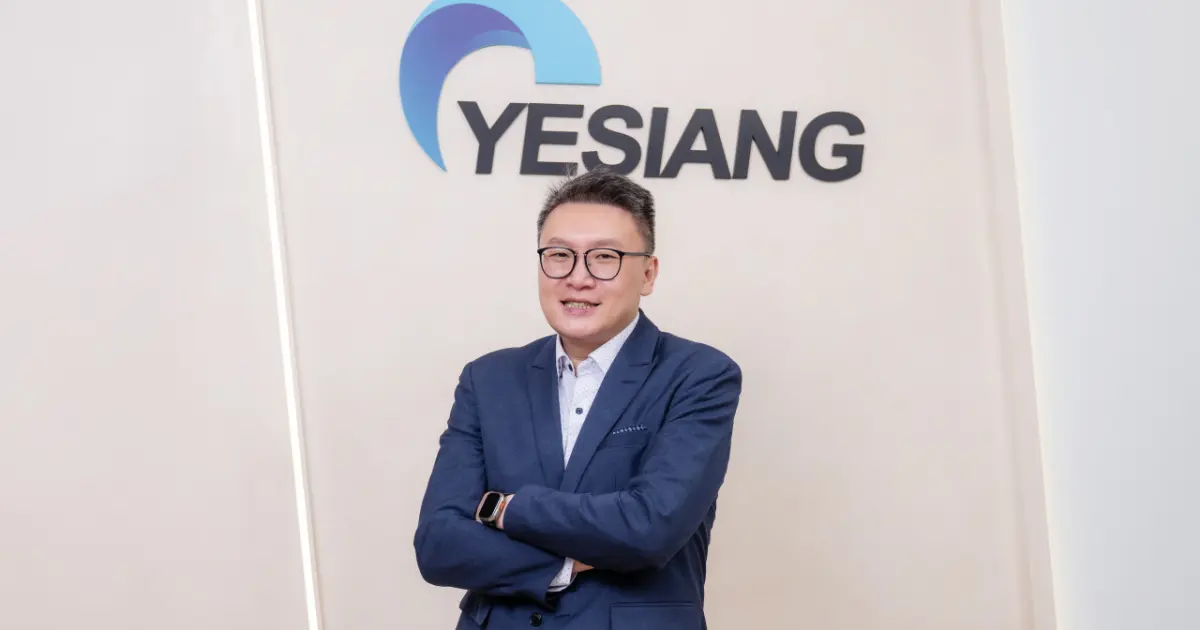
"When I came back to Taiwan, the company was down to four people: my dad, my mom, a secretary and me." In 2005, Chuang Shih-chieh (莊士杰), now chairman and president of Yesiang Enterprise (鈺祥企業), had just finished his master's degree in Canada when his father called him home. He found that the foreign supplier had already withdrawn Yesiang's distribution rights, and annual revenue had fallen to just NT$30 million (about US$940,000). "It turned out my dad hadn't told me the company was about to fold!"
More than twenty years of effort later, Yesiang has become an indispensable chemical filter supplier in the semiconductor supply chain. Yesiang plans to file its application to list on the Taiwan Stock Exchange in early October 2026, and Chuang projects that 2026 revenue could exceed NT$3 billion (about US$94 million). On 24 September 2026, Yesiang's shares traded at NT$681 (about US$21.4) on the Emerging Stock Board.
The Emerging Stock Board is where Taiwanese companies' shares trade before a formal listing on the stock exchange or the over-the-counter market, and it has no daily price limits. Yesiang registered on the board on 25 March 2026, at a reference price of NT$602 announced by the Taipei Exchange, the operator of Taiwan's over-the-counter market.
Chemical filters sit in the air-handling systems of a chip fab's cleanroom and on process tools, removing acidic, alkaline and organic gas molecules that are invisible to the eye. Once these molecules settle on a wafer, they cause defects in the chips.
From a company few believed would succeed, Yesiang has become a guardian of yield for the advanced processes in chip fabs, and one of the big winners in Taiwan's semiconductor ecosystem. How did Chuang's Yesiang get here?
Yesiang started in 1987 distributing chemical filters from a major US company, and lost the distributorship in 2002
Yesiang was founded in 1987 and has a history of nearly 40 years. Chuang's parents started it mainly as a distributor for an American chemical filter brand, selling filters for industrial and petrochemical use. Its customers included Formosa Plastics Group's Sixth Naphtha Cracker complex and the state-owned CPC Corporation, Taiwan. At its peak, Yesiang made the brand the market leader in Taiwan, and the company had more than twenty employees.
In the early 2000s, however, petrochemical production moved out of Taiwan to China, Vietnam and elsewhere, and Yesiang's business began to slide. Some employees learned the trade, left to start their own companies and came back to compete with their old employer. Worse, in 2002 the major US company it represented decided to end Yesiang's distributorship and handle sales itself. Chuang, back in Taiwan to take over the family business, concluded that Yesiang had to make its own products or it had no future.
Chuang studied in Canada for ten years, through high school, university and graduate school, and holds a master's degree in materials engineering from the University of Toronto. When he returned to Taiwan in 2005, the petrochemical industry was leaving, but he saw Taiwan's semiconductor industry rising and decided to develop chemical filters for semiconductors. These filters remove airborne molecular contamination (AMC) from cleanrooms, including acidic gases, alkaline gases and volatile organic compounds (VOCs).
In developing products, Chuang was clear that a technical breakthrough had to start from the filter media itself and extend into material modification, fluid dynamics, process and structural design, and regeneration, in order to integrate these capabilities into better products and technology. "Yesiang's positioning is clear: we want to be the guardian of fab yields."
Yesiang won large orders in Taiwan's southern science park in 2008, but kept failing to get into the supply chains of major chipmakers
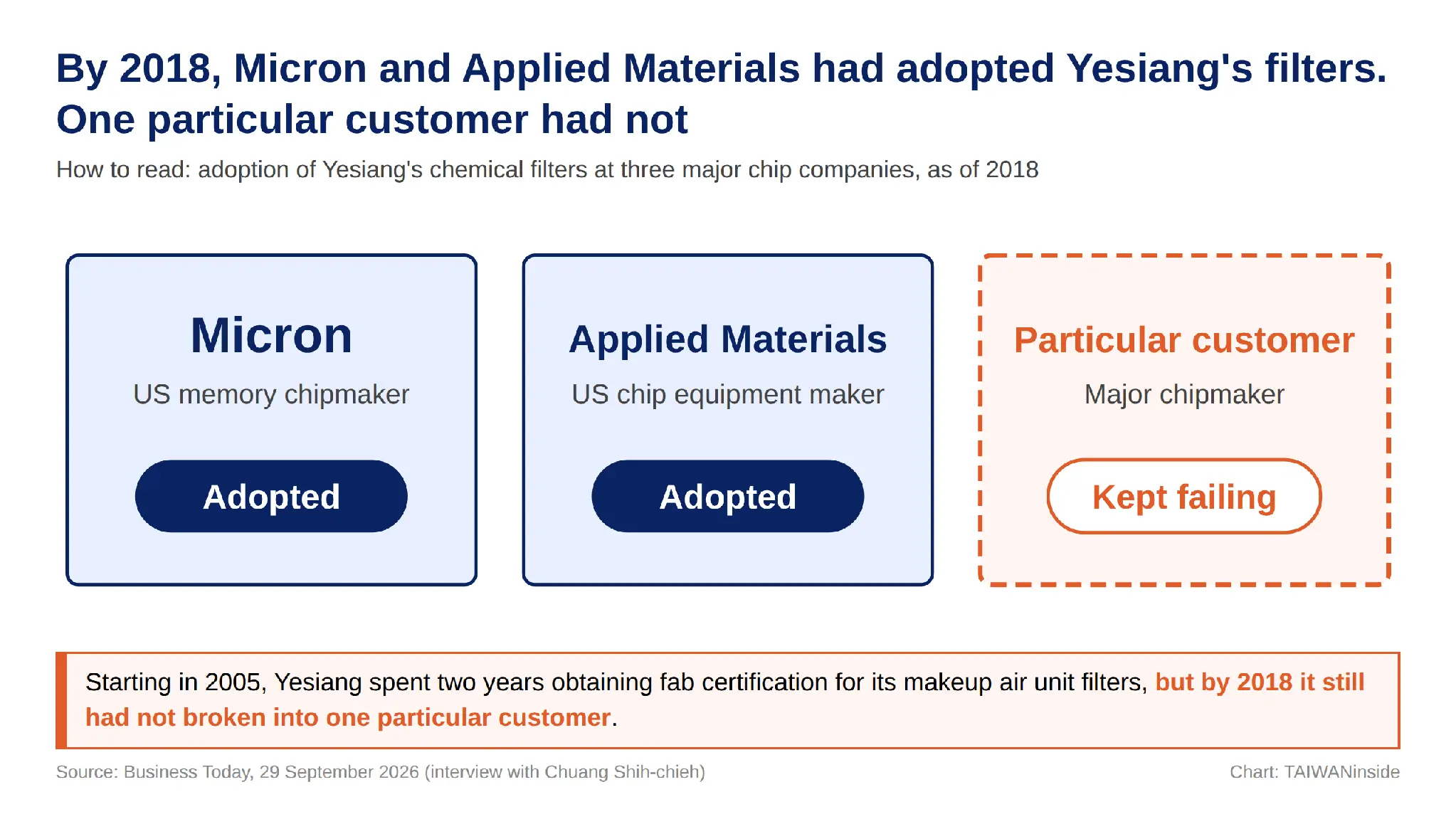
So, starting in 2005, he spent two years obtaining fab certification for MAU (makeup air unit) filtration systems, and orders from some fabs followed. A makeup air unit is the air-handling equipment that cleans outside air before it is sent into the cleanroom. Facing competition from Camfil of Sweden and Greenfiltec (濾能), a local Taiwanese maker, however, Yesiang never made headway in winning major chipmakers. Camfil, founded in 1963 and headquartered in Stockholm, is an air filtration company with 30 factories worldwide; Greenfiltec, founded in 2014 and headquartered in Taoyuan, Taiwan, makes chemical filters and has been listed on the Taipei Exchange since 2021.
Yesiang had a key breakthrough in 2008. According to March 2026 reports by the Taiwanese financial media Anue and the Commercial Times, a chip plant in the Southern Taiwan Science Park in Tainan ran into organic sulfur contamination in 2008, and its yields fell. The foreign-made filters it was using could not handle the problem. Drawing on his materials expertise, Chuang developed a customized filter with 12 times the performance of the foreign product, and Yesiang won a large volume of orders as a result.
For Chuang, 2018 was a pivotal year. By then Yesiang had got its products into Micron's fabs, and Applied Materials, the leading equipment maker, had adopted Yesiang's filters. With one particular customer, however, Yesiang kept falling short. He wondered: "Was it that Taiwanese fabs leaned toward European suppliers' solutions, so Yesiang, which followed the American approach, couldn't get in?"
Chuang recalls: "At the time I had a lot of doubts. It felt like no matter how hard we tried, we couldn't get in."
Premium Members Only
This is a premium article. Please join our membership to read the full content.
Become a member to unlock all in-depth reports and exclusive analysis.
Already a member? Login Now
Related Articles
The Taiwan Government Fund That Backed TSMC Earmarks NT$10 Billion for Biotech: The Upside for Foreign Drugmakers and Investors
Wherever TSMC Builds a Fab, a Taiwanese University Brings Training: NYCU Plans Arizona Courses in 2027 and a U.S. Branch-Campus Application From 2030
Micron Announces Its Largest Rewards Ever. Its Taiwan Union's Demands Expose a Clash of Pay Systems. A strike threat at Taiwan's largest foreign investor, read in three dimensions