Trump’s Hand in the Deal? NVIDIA’s Investment in Intel Won’t Shake TSMC’s Foundry Dominance, but Long-Term Risks Loom
On the afternoon of September 18, I attended the Global Supplier Conference hosted by Taiwan’s leading server manufacturer Wistron. During the evening banquet, news broke that NVIDIA had agreed to invest $5 billion in Intel, taking about a 4% stake, with the two companies set to jointly design personal computer (PC) and data center chips. This major announcement sent Intel’s pre-market shares surging by 30%, while Taiwan stock index futures plunged.
The next morning, Intel closed up nearly 23%, NVIDIA rose 3.49%, and notably, TSMC’s American Depositary Receipts (ADR) did not fall but instead climbed 2.23%, even hitting an intraday all-time high of $270.54. Similarly, AMD, which was expected to take a hit, slipped only 0.78%, showing that the market did not interpret the deal as a short-term shock.
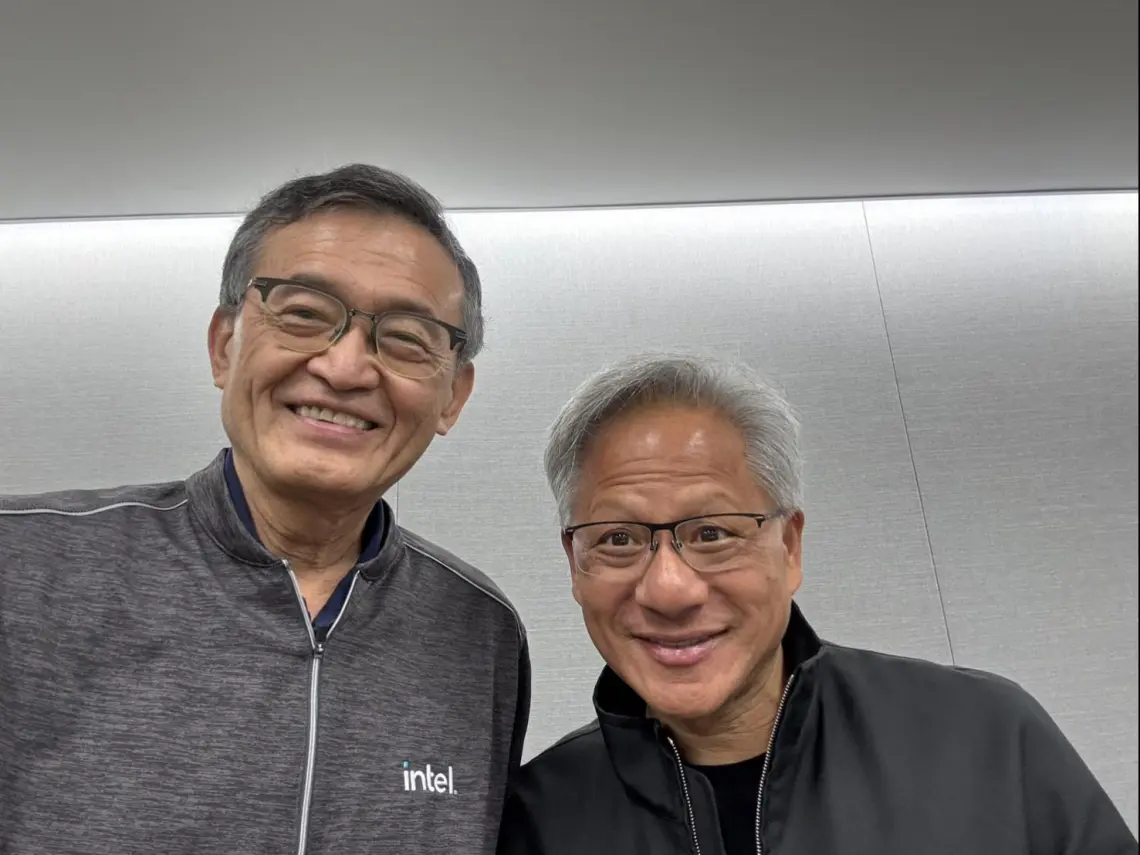
The stock market’s performance reflected how investors viewed the deal in the short term. From the joint online briefing by Jensen Huang, CEO of NVIDIA, and Lip-Bu Tan, CEO of Intel, both sides focused on product and technology collaboration. They also praised TSMC as “outstanding,” stressing that the deal did not involve a manufacturing agreement.
Three Areas of Collaboration: Why NVIDIA’s Stake Matters Most to Intel
Looking first at product cooperation, the two companies outlined three main areas of collaboration.
The first is data center chips. Intel will design customized x86 processors for NVIDIA, which will then be integrated into NVIDIA’s AI infrastructure platform. This partnership will strengthen NVIDIA’s leadership in enterprise AI computing and give Intel a foothold in the fast-growing AI chip market.
The second is PC chips. Intel plans to launch x86 system-on-chip (SoC) products that integrate NVIDIA’s RTX GPU chiplets. This will redefine performance standards for PCs, especially in use cases requiring deep CPU-GPU integration, such as high-performance gaming, creative software, and AI applications.
The third area is the deep technical integration of NVLink with the x86 architecture. By combining NVIDIA’s NVLink technology and AI acceleration expertise with Intel’s CPU capabilities and its vast x86 ecosystem, the companies aim to achieve seamless performance improvements. Such integration promises not only better performance but also more competitive solutions for both data centers and consumer markets.
Naturally, these three areas of collaboration raise concerns about AMD. Its position in the combined CPU-GPU market could be undermined. However, perhaps because of the current bullish sentiment in equities, the market showed little alarm, limiting AMD’s share price drop.
For Intel, however, NVIDIA’s stake carries the greatest significance.
Today, Intel’s shareholder lineup includes the U.S. government, SoftBank, and now NVIDIA. With such heavyweight investors, one has to acknowledge Lip-Bu Tan’s fundraising prowess. Having come from the venture capital world, he has, in just six months as CEO, leveraged capital markets to pull Intel back from the brink.
NVIDIA’s Brand as Endorsement: Global Funds Will Be Forced to Buy More Intel
For Intel, NVIDIA is more than just an investor. As the undisputed king of AI chips, NVIDIA brings not only technical and brand endorsement but also tangible product collaboration. Most importantly, the partnership repositions Intel to re-enter the core battlefield of AI computing, breaking away from its history of lagging behind in GPUs and AI.
The financial boost is equally significant. Intel currently carries $29 billion in debt and loses about $2 billion each quarter. With NVIDIA’s $5 billion injection, SoftBank’s $2 billion, and $8.87 billion from the U.S. government (shifted from subsidies into equity investment), Intel can at least stop the bleeding for now.
More importantly, the future impact will be magnified. With NVIDIA as a shareholder, sovereign wealth funds, pension funds, major U.S. institutional investors, and Middle Eastern family funds will find it difficult to stay away—they will be compelled to increase their stakes in Intel.
Intel’s market capitalization, which had at one point fallen below $100 billion, was unreasonably low compared to other major global semiconductor companies. Now, the capital markets have more reasons than ever to push its stock higher.
But why did NVIDIA agree to this deal? The most direct explanation may be the involvement of U.S. President Donald Trump.
At the time of the announcement, Jensen Huang and Trump were both visiting the United Kingdom. Since the U.S. government had already invested in Intel, bringing NVIDIA in to reinforce the move fits Trump’s style perfectly. For NVIDIA, with its market cap exceeding $4 trillion, committing $5 billion was a light lift. The investment also allowed the company to signal strong support for American industry, handing Trump another opportunity to proclaim his greatness.
With NVIDIA’s $5 billion investment, Intel’s market cap rose by more than $20 billion overnight, substantially boosting the value of the U.S. government’s stake. Trump thus gained another talking point about how much money had flowed into the national treasury. The payoff was enormous.
Not only does the investment itself have political undertones, but the cooperation details also strongly benefit NVIDIA. Beyond gaining access to joint development of PC and data center chips—expanding its reach from cloud to edge markets—NVIDIA secured Intel’s endorsement of its NVLink technology. This move could broaden NVLink’s adoption, extending into Intel’s x86 ecosystem across both civilian and defense industries. For NVIDIA, this marks a significant expansion of its influence.
Limited Short-Term Impact on TSMC, but Long-Term Geopolitical Risks Persist
Finally, what does this mean for TSMC?
At present, the NVIDIA-Intel partnership does not touch on foundry manufacturing. The reason is straightforward: TSMC’s lead is too great. Intel simply cannot close the technology gap within a few short years. As a result, NVIDIA is not about to transfer orders to Intel just because it bought a stake. This is an industry reality.
Instead, the collaboration begins with products. Intel can use NVIDIA’s support to stabilize its own footing, preventing AMD from eroding its share. As for the jointly developed chips, if Intel’s own process technology cannot keep pace, the orders will still flow to TSMC. For the world’s top foundry, the short-term impact is negligible.
Over the longer term, however, risks do emerge. Intel remains a key beneficiary of U.S. government backing, and its strategic goal of advancing process technology will not change. With NVIDIA now a shareholder, it is plausible that Intel could take on more mid- to low-end chip orders. At the same time, the push for onshoring U.S. semiconductor manufacturing is intensifying. In such a scenario, American policymakers are likely to prioritize Intel as the foundry of choice. For TSMC, this means it must remain vigilant against escalating geopolitical risks.
That said, while raising capital is the fastest way to revive a struggling company, the presence of too many powerful shareholders—particularly when political forces are involved—creates its own challenges. With strong-willed investors influencing corporate strategy, Intel may find its long-term management autonomy increasingly constrained.
On the evening of September 18, Wistron’s Global Supplier Conference gathered more than 600 representatives from domestic and international partners. The theme of the event was “Make an Impact.” Wistron Chairman Simon Lin (林憲銘) invited two figures he deeply respects—Shih Chin-Tai (史欽泰), former president of Taiwan’s Industrial Technology Research Institute, and Yen Chang-Shou (嚴長壽), a leading cultural and philanthropic figure—to deliver keynote speeches. Lin urged participants to reflect on how both companies and individuals can leverage their resources to make a greater impact in education, philanthropy, community development, and culture.
He also addressed the broader geopolitical climate, noting that since Trump’s return to power, reciprocal tariffs and supply chain relocation policies have once again come to the forefront, subjecting the global electronics supply chain to unprecedented restructuring pressures. Whereas companies previously had no need to distribute production across multiple regions, such a strategy has now become essential. Lin argued that this shift may represent a major opportunity for Taiwan’s electronics industry, which has the capabilities to adapt and thrive. He expressed gratitude to Wistron’s supply chain partners for their support and encouraged continued collaboration to amplify their collective impact.
Having worked as a journalist for many years, I can say there has never been a year quite like this one, with headline-grabbing developments emerging on a near-daily basis—each with profound and lasting implications. Yet as Lin emphasized, Taiwan’s electronics industry has built unparalleled resilience over decades. That very adaptability will ensure that the challenges ahead ultimately become the island’s greatest opportunities.
Related Articles
Micron Announces Its Largest Rewards Ever. Its Taiwan Union's Demands Expose a Clash of Pay Systems. A strike threat at Taiwan's largest foreign investor, read in three dimensions
TSMC's 3nm rinse comes exclusively from AEMC, a Taiwanese company once withdrawn from the Emerging Stock Board
Taiwan AI Industry Upgrade Forum Series || Event Report:America Wants More Manufacturing. What Does It Take for Taiwan’s Suppliers to Follow?