The View from Taiwan: TSMC’s Bottleneck, Intel’s Resurgence, and the Rise of the "AI Native"— Why the hardware "Ground Zero" sees a shift from demand to allocation in 2026.

【Editor’s Note】Dispatch from the Hardware Epicenter While Wall Street fixates on the daily stock movements of Nvidia and TSMC, a quiet but seismic shift is occurring here in Taiwan's supply chain ecosystem—the physical epicenter of the AI revolution. Reporting from the ground in early 2026, TAIWANinside identifies two critical signals often missed by Western media: TSMC's capacity crunch is creating a "spillover" reality that finally favors Intel, and Meta’s aggressive hardware pivot signals the dawn of the post-smartphone era. Combined with insights from former Google Taiwan MD Lee-Feng Chien on the emergence of "AI Natives," this dispatch offers exclusive intelligence from the manufacturing floor where the future is being built.
Waking up early this morning, two foreign wire reports caught my attention. One discussed the surging AI wave, asking, "TSMC says no to Nvidia: Why is this Intel's golden opportunity?" The other noted, "Meta, currently commanding 70% of the global AI smart glasses market, plans to quadruple its production capacity this year."
These two headlines triggered some reflections on the AI era, which I would like to share with our readers.
The Supply Crunch: When TSMC Says "No," Intel Says "Yes"
The first report comes from the financial news site Benzinga, noting that the AI boom is now hitting its most significant constraint: "You simply cannot meet customer demand." Although demand for AI silicon remains robust, the capacity of the world's leading foundry, TSMC, is now stretched to its breaking point.
Citing a report from The Information, the article reveals that TSMC has informed major clients like Nvidia and Broadcom that it cannot fully satisfy their requirements. In a world where the AI wave is built on the assumption of infinite computing expansion, this is a sobering reality check.
The report analyzes that for years, TSMC has been the undisputed "gatekeeper" of advanced silicon. As long as the design was sound, TSMC could manufacture it. However, the AI wave has changed everything. Capacity at advanced process nodes is finite, lead times are stretching, and every hyperscaler is demanding priority access simultaneously.
When TSMC declares "insufficient capacity," clients don't stop investing in AI; they start looking for alternatives. This creates the backdrop for Intel’s quiet return to the market. Intel doesn't need to dethrone TSMC; it merely needs to serve as the "relief valve" for an overheated supply chain.
The report emphasizes that the advantages of Intel Foundry Services (IFS) are becoming obvious: ample capacity, geographic diversity (aligned with US and EU industrial policies), and reliability. For clients facing multi-quarter delays, "available and reliable capacity" is far more valuable than "top-tier but backlogged."
Therefore, this isn't a question of Nvidia abandoning TSMC, but a dilemma caused by severe supply shortages. The workloads for custom chips and AI accelerators simply cannot afford to wait.
Intel’s Renaissance: Geopolitics and the Allocation Economy
For Taiwanese investors who closely follow the electronics industry, this report is hardly news. The market here has long understood that the global electronics sector is in a state of severe shortage. Scarcity leads to price hikes, driving stock rallies across the board—from semiconductors and PCBs to power supplies, memory, and passive components—propelling the Taiex (Taiwan Stock Exchange) to new highs.
The most interesting point in this news is the observation that "AI development is shifting from a 'Demand' economy to an 'Allocation' economy." TSMC's capacity constraints haven't weakened the AI boom; they have intensified the trend.
In this scenario, Intel's opportunity arises. If "manufacturing capability" begins to rival "chip design" in importance, then Intel's long-undervalued foundry plans may no longer look like a desperate gamble, but rather a genuine "Renaissance."
Stock performance corroborates this. Intel is benefiting from the spillover effects of this super-shortage. Closing at $48.72 yesterday (January 14) in US trading, Intel hit a two-year high. The wafer shortage allows TSMC to enjoy pricing power, but it also allows second-tier players like Intel and Samsung to benefit from the overflow orders of unsatisfied customers.
The Post-Smartphone Era: Meta’s Smart Glasses Bet
The second piece of news comes from Bloomberg, mentioning that Meta, which already holds a 70% share of the global AI smart glasses market, plans to quadruple production in 2026. The market is on the verge of an "unprecedented explosive phase." This benefits not only Meta but also brands like Google, Samsung, and Taiwan’s HTC, along with the broader hardware supply chain.
The report notes that last year, Meta’s smart glasses shipments (in partnership with EssilorLuxottica) reached approximately 5.5 million units. Now, both parties are actively evaluating expansion, projecting annual capacity to rise to 20 million units, with future plans to reach 30 million. This bullish outlook suggests that this year will be the "Year One" of the AI smart glasses explosion.
As Meta aggressively attacks this market, institutional investors point out that Taiwan’s optical and hardware supply chain—companies like HTC (VR/XR hardware), Yingchi, Young Optics (optical engines), and Genius Electronic Optical (lens modules)—stands to be major beneficiaries.
The report mentions that Meta is currently scaling back other hardware projects to concentrate resources on its AI smart glasses division. In the past, CEO Mark Zuckerberg poured billions into his "Metaverse" strategy, but VR headsets struggled to crack the mass market.
Now, with a strategic pivot, Zuckerberg has shifted his focus to AI, positioning smart glasses as a carrier with more realistic market potential—one that can deliver AI capabilities in a form factor that consumers are more willing to accept.
This Meta report is fascinating. It is well known that in the AI model arms race of "The Magnificent Seven," Meta is currently the underdog. However, Zuckerberg’s reorganization of his AI team and his refusal to give up the race—while focusing on his strength in hardware "outputs" like smart glasses—is a development worth watching.
From Touch to Voice: The Rise of the "AI Native"
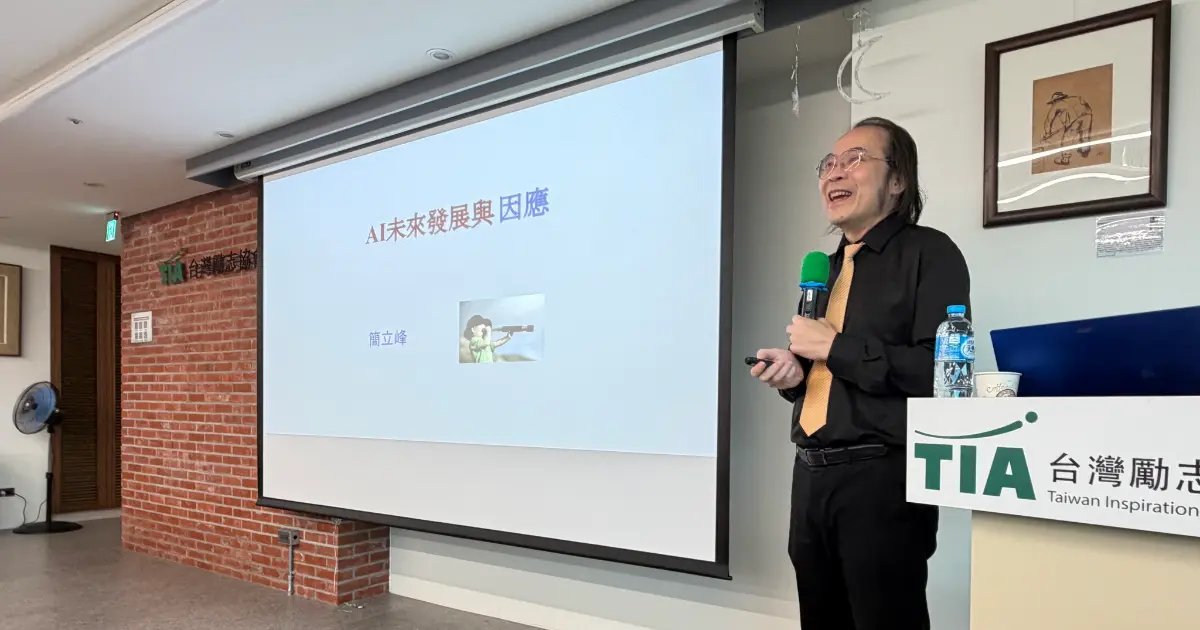
Meta’s new layout reminds me of a recent talk by Lee-Feng Chien, the former Managing Director of Google Taiwan. He discussed how the emergence of AI is triggering a paradigm shift in human-machine interaction (HMI). AI smart glasses are likely to be the breakout application in this new paradigm.
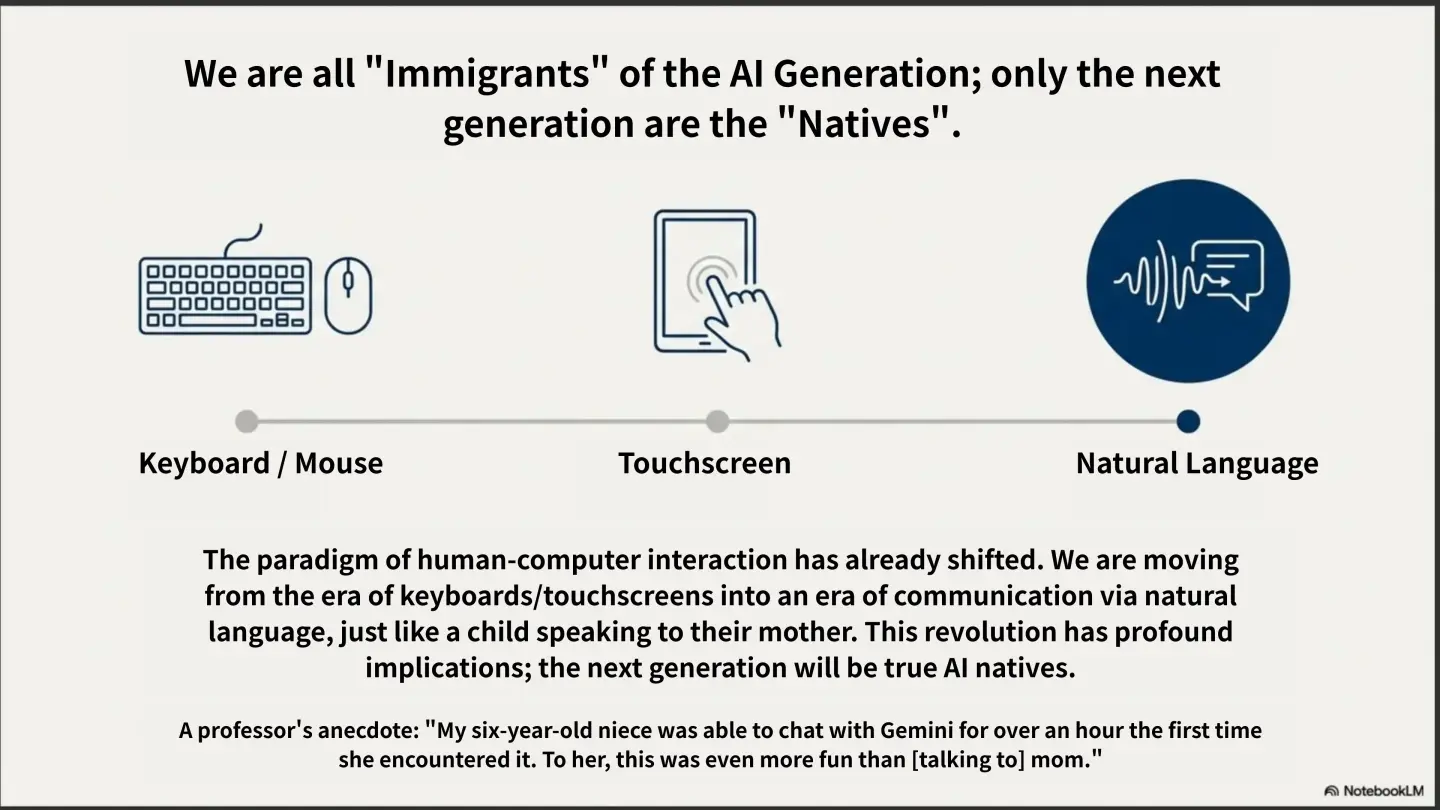
Past generations (the PC generation) were accustomed to keyboards and mice. The younger generation (the Mobile generation) is used to touchscreens. But the newest generation—children born just a few years ago—will be accustomed to "speaking," communicating with platforms and products using natural language.
Therefore, Chien argues that existing generations are merely "AI Immigrants," while the next generation will be true "AI Natives." He cited an example of a professor friend’s six-year-old niece who, upon her first contact with Gemini, chatted with it for over an hour. For her, talking to the AI was more fun than talking to her mother.
Indeed, the new generation can converse directly with AI without handwriting or touching screens. AI will become their most important source of knowledge and likely a new tool for raising the next generation. Their process of acquiring knowledge from AI may be smoother than human conversation.
Conclusion: A Paradigm Shift Beyond the Hardware Boom
I feel this generational gap is distinct. I am of the old generation that uses keyboards and mice; my children are clearly more comfortable with phones and touchscreens. But the future generation will demand radically different interfaces and product designs.
AI smart glasses are clearly a product of this trend. They have no keyboard and do not rely on traditional touch. In environments spanning AR (Augmented Reality), VR (Virtual Reality), MR (Mixed Reality), and XR (Extended Reality), the interface relies heavily on voice control. For AI Natives, this is the intuitive choice.
In conclusion, compared to past industrial revolutions, the impact of AI is colossal. Its explosive growth has triggered a massive shortage in semiconductors and electronic components, creating room for price hikes and offering second-tier manufacturers a chance to breathe and enjoy spillover benefits.
However, the boom effects driven by price hikes won't last forever. If second-tier players don't seize this opportunity to make rapid technical progress, they may return to square one when the tide recedes.
The real shift to watch is how AI changes the way we use products. New HMI devices like AI smart glasses are likely to become the indispensable tools of a new era—products we will rely on even more heavily than the smartphone.
Related Articles
Micron Announces Its Largest Rewards Ever. Its Taiwan Union's Demands Expose a Clash of Pay Systems. A strike threat at Taiwan's largest foreign investor, read in three dimensions
TSMC's 3nm rinse comes exclusively from AEMC, a Taiwanese company once withdrawn from the Emerging Stock Board

Taiwan AI Industry Upgrade Forum Series || Event Report:America Wants More Manufacturing. What Does It Take for Taiwan’s Suppliers to Follow?