“My Sons Won’t Be CEO”: Advantech Founder KC Liu’s Succession Homework — and the Challenge Facing Taiwan’s Manufacturers
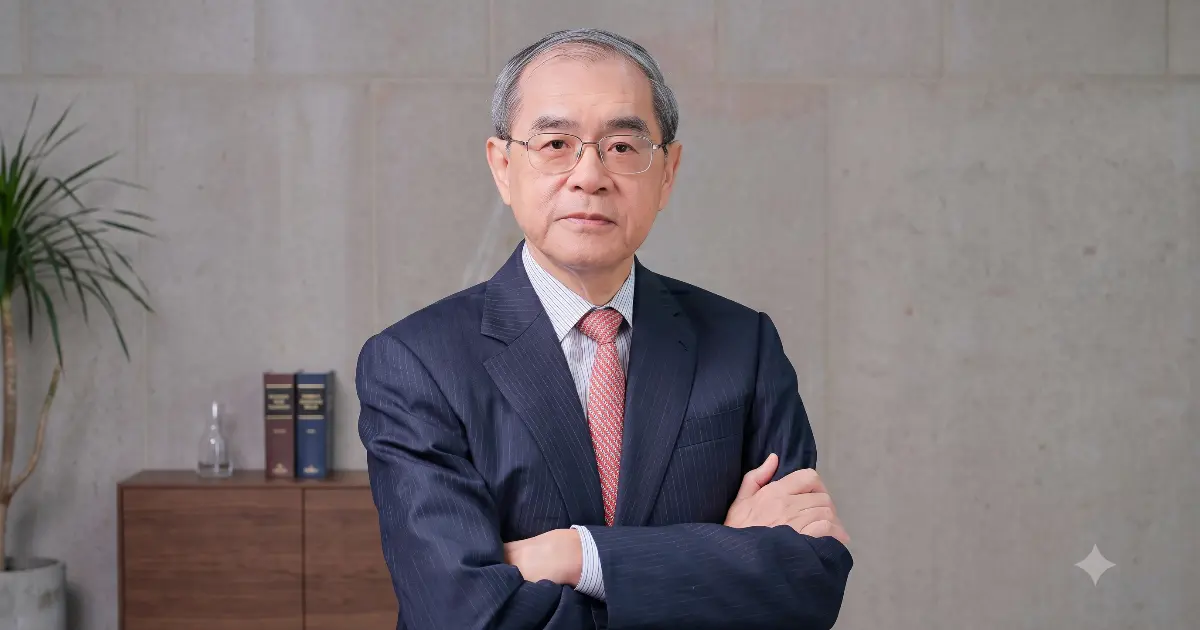
I recently attended the launch of The Great Handover Era, the new book by Allen Tsai, founder of the Taiwan Institute of Directors. The book-launch panel paired Advantech chairman KC Liu with Fred Yang, CEO of the Min-Sheng healthcare group — one a first-generation founder handing over, the other a second-generation successor — and the discussion ranged across every kind of obstacle a company meets on the way to succession. It was a remarkable session.
Liu said he began thinking about succession at sixty. Over the twelve years since, he has read every book on the subject he could find, in Chinese or otherwise, and sat through countless talks and seminars. His conclusion after all that study: every corporate handover is a case of its own — no theory can simply be copied, because no two companies are alike. But he did arrive at one firm principle: the single most important thing in family succession is getting the equity structure right.
“People need far less money than you think,” Liu said. “Beyond a certain level it stops being useful. Making your heirs too rich — where spending it becomes the daily preoccupation — is not a good thing. So the first task of family succession is to plan the shareholding properly, so it doesn’t get sold off lightly.”
Advantech was founded in 1983 by KC Liu, Huang Yu-min and Chuang Yung-shun, three former Hewlett-Packard engineers. The other two co-founders have long since retired or built businesses of their own; Liu has been the principal driver — and chairman — from the start. Today Advantech’s market value is close to NT$470 billion (≈US$14.5 billion). The Liu family has never sold a share: it still holds roughly 25%, a stake worth about NT$117.5 billion (≈US$3.6 billion).
Liu is clear-eyed about what happens next. After a few generations, he said, family members will inevitably sell, and the shareholding will naturally scatter. Human nature contains good and bad, but people incline toward grabbing — history is full of family fights over companies. That is why equity design matters so much. Advantech is now held through a close company — a Taiwanese corporate form whose shares carry transfer restrictions — so the family stake cannot be sold off casually.
His two sons, Liu said, will not become CEO. Advantech now employs nine thousand people; making a son CEO “doesn’t add up” — the job should go to professional managers. Both sons work at Advantech today, as deputy directors of human resources and of investment and corporate finance respectively — functional departments, not front-line business units. Over the next five years Liu will accelerate the handover: by the end of this year he will pass the CEO role to a professional manager, and within one to two years he will codify the details of succession into a formal system.
Will a son take over as chairman? Liu says even he doesn’t know yet. He has two sons — does one inherit the chair? Do they rotate? He hasn’t thought it through. Which is exactly why, he says, every company is its own case.
In a nice touch, Liang Mao-sheng, chairman of equipment maker C SUN who joined the same book launch, laughed from the side: “I have only one son” — C SUN’s current president Liang Yu-wen — “so he gets it. My handover decision is much simpler.”
Liu has also studied family offices abroad, and found that the successful handovers are all altruistic. Many enduring families channel themselves into philanthropy, and a large share of Advantech’s succession will likewise go to public good — “that gives the next generation the most meaning, and the greatest blessing.”
Among all the cases he examined, Liu found Merck and Hermès the most instructive. This year he formally established a family office: a family investment company now sits above Advantech as its controlling holder. The Liu family is still small, but it may number dozens or over a hundred members in the future; through regular family meetings it will elect directors onto Advantech’s board to exercise oversight.
A family office needs an internal team, he said, but many highly specialized functions cannot be built in-house and must be bought. He was blunt: Taiwan has few professionals who genuinely understand family offices. He is the sort who is willing to pay for expertise — and families, he argued, will need subscription-style access to professional services.
Set against the cases in Tsai’s book — failed successions like Tatung and Taisun, and model students like Formosa Plastics, Uni-President, Taiwan Cement and Delta Electronics, each with its own reasons for failure or success — Liu joked that the book won’t sell many copies, since not many readers have a family-succession problem of this scale. But he recommends keeping it as a reference manual: pull it off the shelf when you need it and you will always find something.
Liu has always been strikingly direct, and he brings his own considered system to management questions — including succession, which he has researched with a thoroughness rare in Taiwan’s electronics industry. He studies institutional models at home and abroad, and he is willing to share what he has thought through. That alone makes Advantech an indispensable case in any account of tech-industry family succession — worth, perhaps, another bestseller from Mr. Tsai.
I went home from the launch more shaken than I expected. Thinking back over the many entrepreneurs I have interviewed — whatever the state of their businesses — most are now in the middle of handing over. Some transitions have gone tolerably well. Many are, frankly, a mess. Getting family succession right is a discipline of its own.
Which brings me to the two cases Liu cited, Merck and Hermès, both covered in The Great Handover Era. I wanted to understand this for myself: how has the Merck family stayed the owner for more than 350 years and still hold about seventy percent? How has the Hermès family, nearly 190 years in, still kept about two-thirds? How is that done?
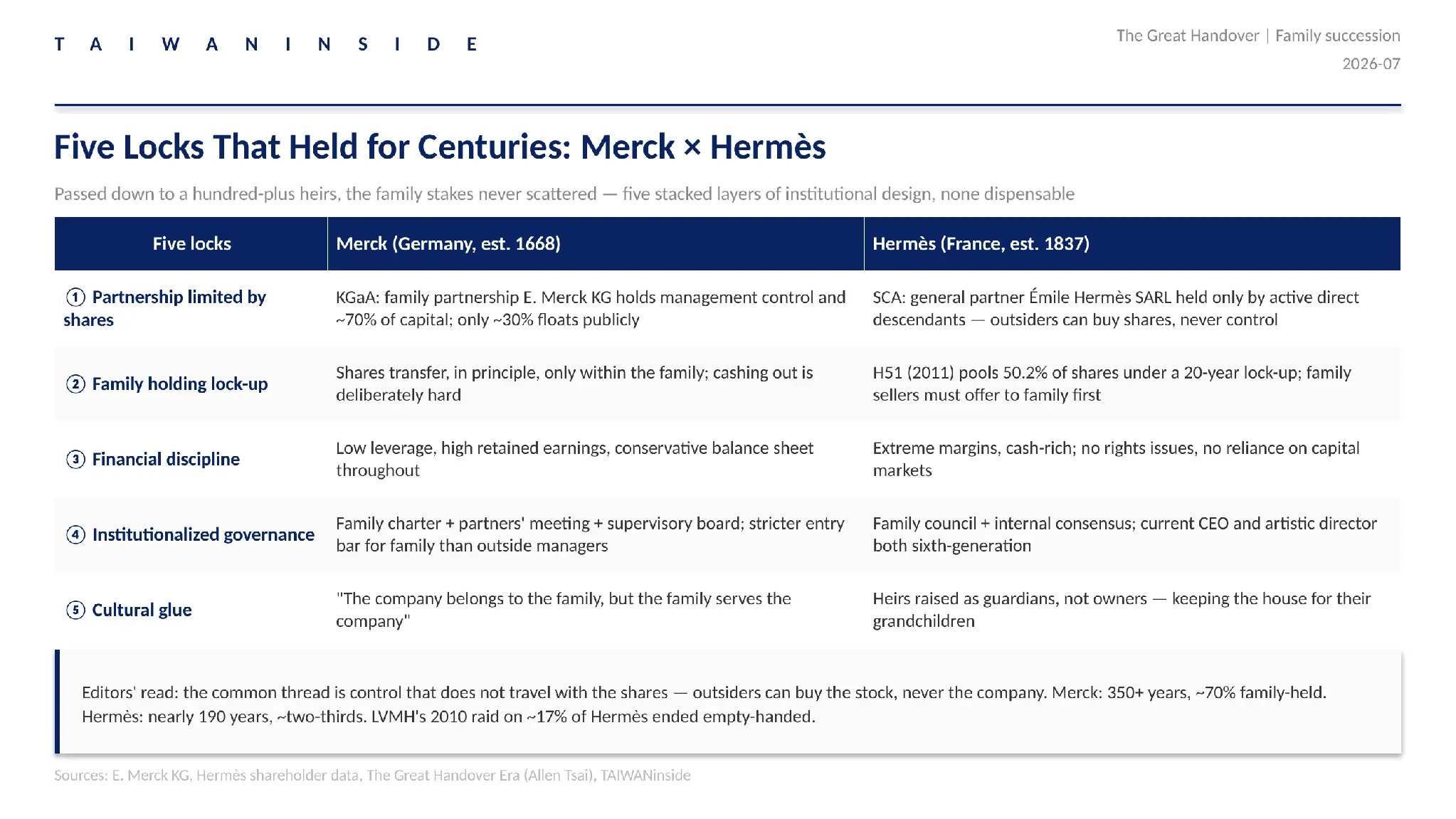
I dug into the record. What has carried these two families across centuries — through a hundred-plus heirs without the shareholding scattering — is not luck. It is a set of precision-engineered institutions, and the two families’ designs overlap to a striking degree.
The first lock: a “partnership limited by shares” that separates ownership from control
This is the core move. Both families independently adopted similar legal structures: Germany’s Merck is a KGaA (Kommanditgesellschaft auf Aktien, a partnership limited by shares); Hermès is a French SCA (société en commandite par actions).
A partnership limited by shares is a hybrid of a joint-stock company and a limited partnership. It combines one or more partners who bear unlimited joint liability for the company’s debts with many shareholders whose liability is capped at their capital contribution. Taiwan’s Company Act has no such form, but in Germany and other European jurisdictions the KGaA is well established.
The elegance of the structure is that management power sits with the general partner — and general-partner status is reserved for the family. At Hermès, the general partner is Émile Hermès SARL, whose shares can be held only by direct descendants active in the group. However much stock an outsider accumulates on the open market, management control is simply not for sale.
Merck’s structure is similar. About thirty percent of listed Merck KGaA floats publicly, but real control sits with the family partnership E. Merck KG, through which a family of roughly 300 members holds about seventy percent of the economic interest and all of the control.
In 2010, LVMH — the world’s largest luxury group — under Bernard Arnault used derivative instruments to ambush its way to roughly 17% of Hermès, stunning the market. LVMH ultimately walked away empty-handed, in large part because the SCA structure meant it could buy the shares but never the company.
The second lock: a family holding company with a long lock-up
After the LVMH raid, the Hermès family went further, creating the holding company H51 in 2011. A majority of the family’s shares were pooled and locked inside it, with a twenty-year commitment not to sell — and any family member who wants out must first offer the shares to the others.
Merck likewise stipulates that shares transfer, in principle, only within the family; cashing out is deliberately difficult. This answers the most common failure mode of family firms: one branch wants liquidity, shares leak out, and control erodes step by step.
The third lock: financial discipline — no outside capital
The most common cause of dilution is raising capital. Both houses deliberately run low-debt, high-retention, organic-growth models: almost no large acquisitions, no rights issues, growth funded from their own earnings. Hermès runs extraordinary margins with cash to spare and simply doesn’t need the capital markets; Merck, even as a global pharma-and-chemicals giant, keeps its leverage conservative. If you don’t need other people’s money, you never have to give up equity.
The fourth lock: institutionalized family governance
Both families run formal family charters and family councils governing succession, shareholding, dividends and the conditions under which family members may work in the firm. A Merck family member faces a higher bar to join the company than an outside professional; most family members are shareholders, not managers, and the family exercises oversight through the partners’ meeting and the supervisory board.
Hermès keeps family members in key posts — the current CEO and the artistic director are both sixth-generation — but under equally strict internal consensus mechanisms.
And a final layer of cultural glue
Beyond the institutions, both families cultivate identity. The name is on the door. Heirs are raised to see themselves as guardians, not owners; shares are a responsibility to pass on, not an asset to cash in. Hermès family members like to say they are keeping the company for their grandchildren; the Merck family’s self-definition is that “the company belongs to the family, but the family serves the company.”
To sum up: a legal architecture that locks in control, a holding company that locks up the shares, financial discipline that prevents dilution, governance institutions that manage human nature, and cultural identity that holds consensus together — five locks, stacked in layers, none dispensable. Contrast the failed successions: families that reach the second or third generation held together only by blood and sentiment, which shatter at the first real conflict of interest. Without those institutional locks, it is genuinely hard.
But push one step further: can Taiwanese companies copy what these European houses have built?
The short answer is that a direct copy is legally impossible — the statutes don’t allow it. Taiwan can approximate the effect with substitute tools, but the strength of the locks differs by an order of magnitude.
Why impossible? Taiwan’s Company Act does contain a form called the “unlimited company with limited liability shareholders” — nominally the same two-tier idea. But it is a different animal from the German KGaA: the Taiwanese form cannot issue shares, therefore cannot list, and in practice almost nobody uses it.
The essence of the KGaA is the hybrid: the company can list and issue shares while management stays reserved for the unlimited-liability partners. Taiwan’s Company Act has no such “partnership limited by shares.” If you want to list, a company limited by shares is the only road.
And once a company goes public in Taiwan, it is locked into one-share-one-vote. The 2018 Company Act amendment did open up multiple-voting preferred shares and veto (“golden”) shares — but only for non-public companies. Public and listed companies cannot use them.
So the dual-class structures of Google and Meta; the Merck/Hermès design where you can buy the stock but never touch control; even Alibaba’s Hong Kong listing, where the “Alibaba Partnership” holds the exclusive right to nominate a majority of the board — weighted voting rights (WVR) that let a founding team steer strategy on a modest stake — none of these can be done by a listed company in Taiwan.
What Taiwanese families do instead
I put the question to an AI as well. Without the big KGaA lock, Taiwanese families have developed several layers of substitutes. The first is the close company as a family holding platform.
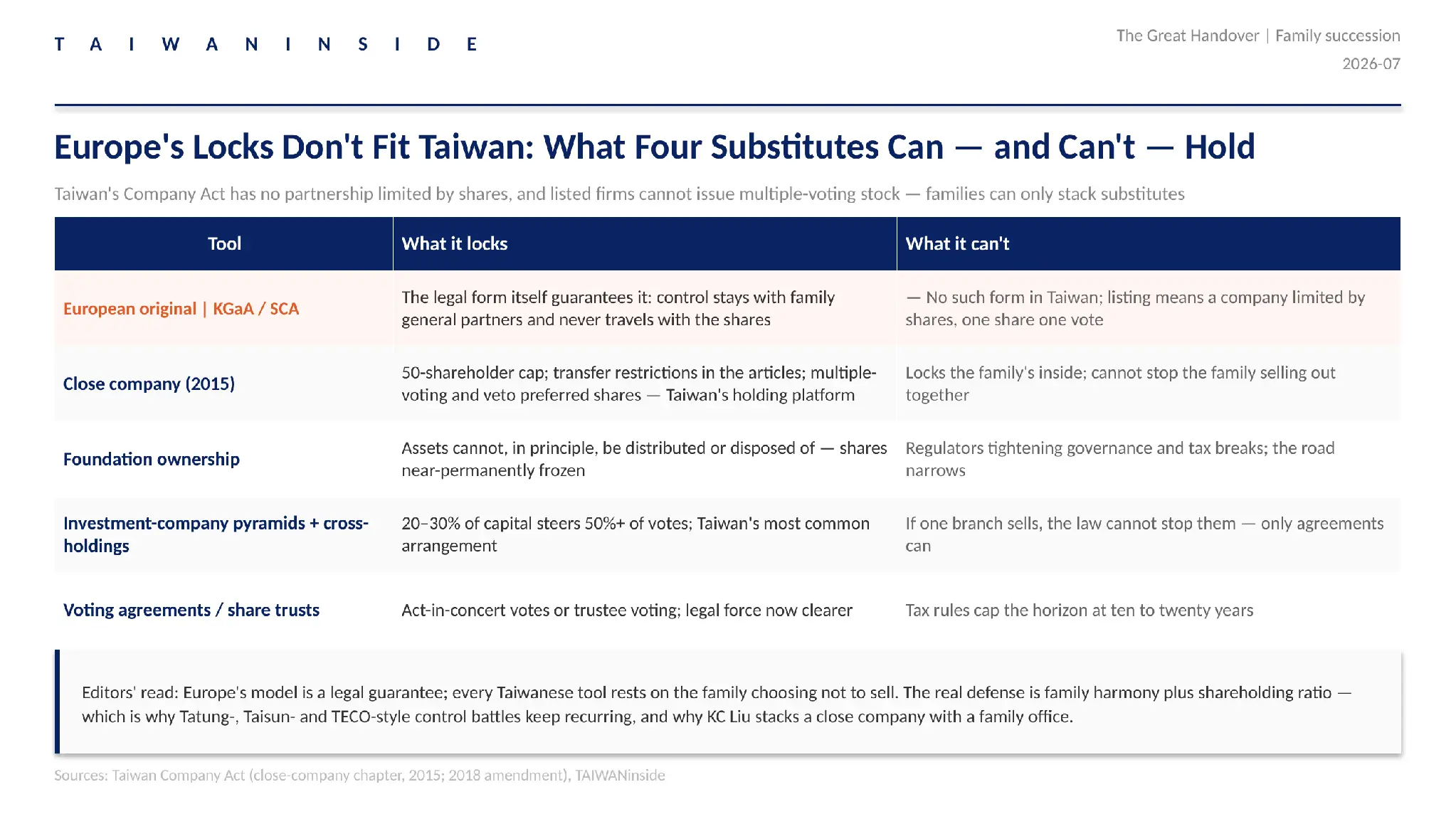
Introduced in 2015, this is the closest thing Taiwan has to the spirit of the Merck model: a cap of fifty shareholders; articles of association that can restrict share transfers (for example, transfers only to family members, with other shareholders holding a right of first refusal); and the ability to issue multiple-voting and veto preferred shares. The play is to pour the family’s entire stake in the listed company into one close holding company, and solve the locking, vote-pooling and entry-exit rules at that level — conceptually a Taiwanese E. Merck KG or H51. In recent years families like Largan Precision’s founders have moved to this architecture.
The second is foundation ownership. The classic case is Formosa Plastics: the Chang Gung Medical Foundation is a major shareholder of the four Formosa companies. A foundation’s assets cannot, in principle, be distributed or freely disposed of — effectively freezing a large block of shares within the family’s sphere of influence. But regulators have been tightening both the governance and the tax privileges of foundations that hold listed shares, and this road is narrowing.
The third is investment-company pyramids and cross-holdings. Families amplify control through layers of investment companies, steering 50%-plus of the votes with 20–30% of the capital. It is Taiwan’s most common arrangement — and it doesn’t actually lock anything. If one branch decides to sell, the law cannot stop them; only agreements can.
The fourth is voting agreements and share trusts: shareholders sign act-in-concert pacts, or place shares in trust with a trustee voting them as one. After amendments to the M&A Act and the Company Act, such contracts are on firmer legal ground. But trusts in Taiwan are hemmed in by tax treatment (gift and estate taxes) and lack the Anglo-American infrastructure of century-long family trusts; ten to twenty years is usually the practical horizon — nothing like the hard lock of Hermès’s H51.
Set the two toolkits side by side and the difference is fundamental.
The Merck–Hermès model is a legal architecture that itself guarantees control does not travel with the shares: outsiders can buy all the stock they want, to no effect. Every Taiwanese tool, by contrast, is built on the premise that the family chooses not to sell. A close holding company locks the family’s inside; it cannot stop the family as a whole from being talked into selling. Pyramids and pacts can be unwound at any time. Taiwan’s line of defense, at bottom, is family harmony plus shareholding ratio — and when one branch falls out or wants cash, you get the Tatung-, Taisun- and TECO-style battles for control that Taiwan knows so well.
This is why scholars and practitioners have urged Taiwan to open dual-class share structures for listed companies — at minimum matching Hong Kong’s and Singapore’s WVR regimes for innovative companies. Regulators, citing minority-shareholder protection, remain conservative. Until the rules loosen, what a Taiwanese family can do is stack the tools it has — close holding company, trust, family charter — and approximate the effect as best it can.
Set the statutes aside, though, and Taiwan’s family successions are still early on another curve — one where Europe’s old houses have the most to teach. Taiwanese families put ninety percent of their succession attention on “who takes over, and how the shares are split.” Merck, Hermès and Sweden’s Wallenbergs run the logic in reverse: first build the family’s governance and value system — the charter, the family council, the family assembly — then talk about the business and the equity.
Europe’s families also cut the knot Taiwan struggles with: they fully separate the role of shareholder from the role of manager. Taiwanese families carry a fixation that succession means the chairman’s seat or the CEO’s office, and that an eldest son who doesn’t take it has failed. Of the Merck family’s roughly 300 members, only a handful work in the company — and they face a stricter bar than outside managers. Most play the role of the responsible owner: not managing, but knowing how to supervise, how to vote, and how to ask the right question at the partners’ meeting.
These are habits worth learning, and I believe Taiwanese companies can. Whichever family changes its thinking first may be the first to escape the old curse — shirtsleeves to shirtsleeves in three generations.
Related Articles
The arbitration damages of about NT$4 billion expose the real profit cushion of Taiwanese drugmaker PharmaEssentia

Same Market, Opposite Risk: Qualcomm's Data Center Revenue Is Still Zero, MediaTek's 2028 Chip Goes to Intel Packaging

Korean regulation is the main reason memory stocks fell in late July