The arbitration damages of about NT$4 billion expose the real profit cushion of Taiwanese drugmaker PharmaEssentia
PharmaEssentia (TWSE: 6446) is the first Taiwanese company to sell a self-developed new drug directly into the United States, Europe, and Japan, and in June 2026 PharmaEssentia became the first Taiwanese biotech stock to trade above NT$1,000. On August 7, an arbitration that PharmaEssentia had fought in Europe for nine years produced a quantum award ordering PharmaEssentia to pay Austrian partner AOP Health about NT$4 billion. On the afternoon of August 8, PharmaEssentia told the market that the award carries no material impact on the finances or the operations of PharmaEssentia. The credibility of the August 8 statement depends on which denominator an analyst chooses.
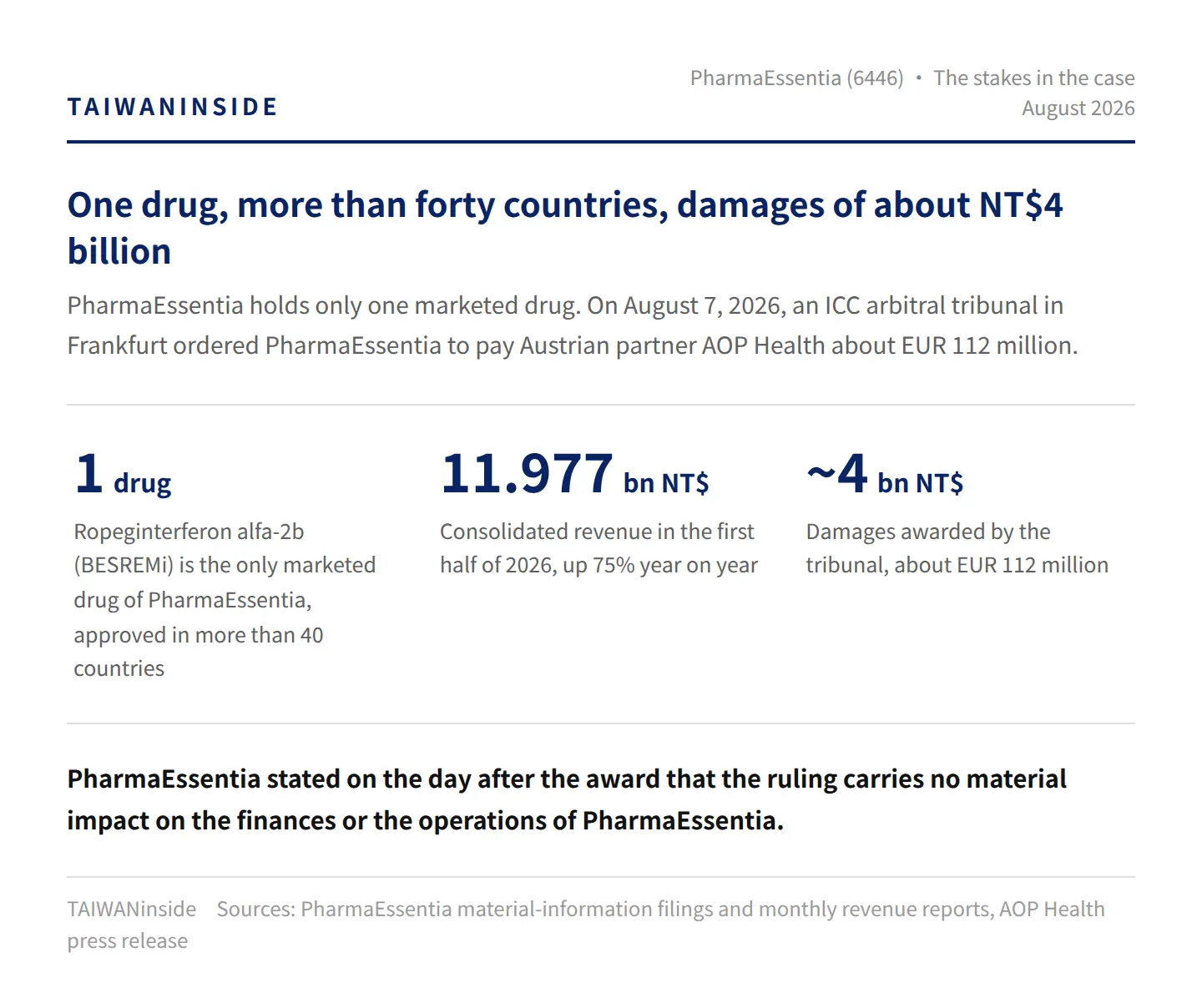
On August 7, an ICC (International Chamber of Commerce) arbitral tribunal seated in Frankfurt issued a quantum award against PharmaEssentia, the largest biotech company in Taiwan by market capitalization, ordering PharmaEssentia to pay AOP Health a total of about EUR 112 million (about NT$4 billion). PharmaEssentia and AOP Health disclosed the award on August 8. The tribunal had already found that PharmaEssentia breached the contract willfully, in a first-stage partial award issued in February 2025, and the August 7 award settles only the amount.
PharmaEssentia responded to the tribunal award by immediately convening a material-information press conference in Taiwan. PharmaEssentia said that PharmaEssentia had received the second-stage partial arbitral award from the ICC International Court of Arbitration in the arbitration between PharmaEssentia and AOP Health, and that the partial award carries no material impact on the finances or the operations of PharmaEssentia. PharmaEssentia added that PharmaEssentia is preparing to seek annulment of the partial award.
PharmaEssentia is a Taiwanese new-drug developer headquartered in Taipei and founded in 2003, and PharmaEssentia is the first Taiwanese company to sell a self-developed new drug directly into the United States, Europe, and Japan. The share price of PharmaEssentia passed NT$1,000 in June 2026, which made PharmaEssentia the first Taiwanese biotech stock to trade above NT$1,000. Global investors know Taiwan for semiconductors, and the pharmaceutical sector of Taiwan is small by comparison, since no Taiwanese pharmaceutical company has yet reached the global top 100 by revenue. PharmaEssentia has spent years in commercial arbitration with European partner AOP Health of Austria. The new award from Frankfurt has revived the interest of the capital markets in how the European business of PharmaEssentia is actually performing and in how far PharmaEssentia has progressed in the United States and other major markets.
The standing and the influence of PharmaEssentia within the new-drug industry of Taiwan have indeed grown quickly over the past few years.
On June 17 this year, at the finals of the first PharmaEssentia Innovation Award in Shibuya, Tokyo, PharmaEssentia chairperson Ching-Leou Teng, chief executive officer Ko-Chung Lin, and TECH-Tokyo executive director Jorge Cortell judged the eight finalist teams, chosen from nearly 40 entries by Taiwanese and Japanese startups. The competition carried total prize money of US$200,000, an unusually large purse among Taiwan-Japan biotech startup competitions. PharmaEssentia chief strategy officer Yen-Po Chin brought in Jorge Cortell together with Satish Tadikonda and William Marks of Harvard Business School, and PharmaEssentia also invited Academia Sinica academician Pei-Jer Chen to complete the judging panel. Three Taiwanese teams and two Japanese teams took the prizes among the eight finalists.
The innovation competition run by a private company differs from the startup competitions that government bodies have organized in Taiwan in the past, and the competition marks a first for the biotech industry of Taiwan.
Ko-Chung Lin said that attention to startups helps PharmaEssentia find the next promising new drug, and that PharmaEssentia committed the US$200,000 in prize money out of a wish to give back to society. "The people who raised up Taiwan's early semiconductor industry worked to put down roots for Taiwan rather than to make money, and we hope the biotech industry of Taiwan can pass the same spirit down," Ko-Chung Lin said.
PharmaEssentia has existed for 23 years, and PharmaEssentia spent more than the first ten years on research and on ceaseless fundraising. Ko-Chung Lin now speaks with confidence, and shortly after Ko-Chung Lin made the remark, the stock of PharmaEssentia reached a market capitalization of NT$500 billion (about US$15.5 billion) in early July. PharmaEssentia became not only the first Taiwanese biotech stock ever to trade above NT$1,000 but also the lead name drawing Wall Street attention to Taiwanese biotech stocks.
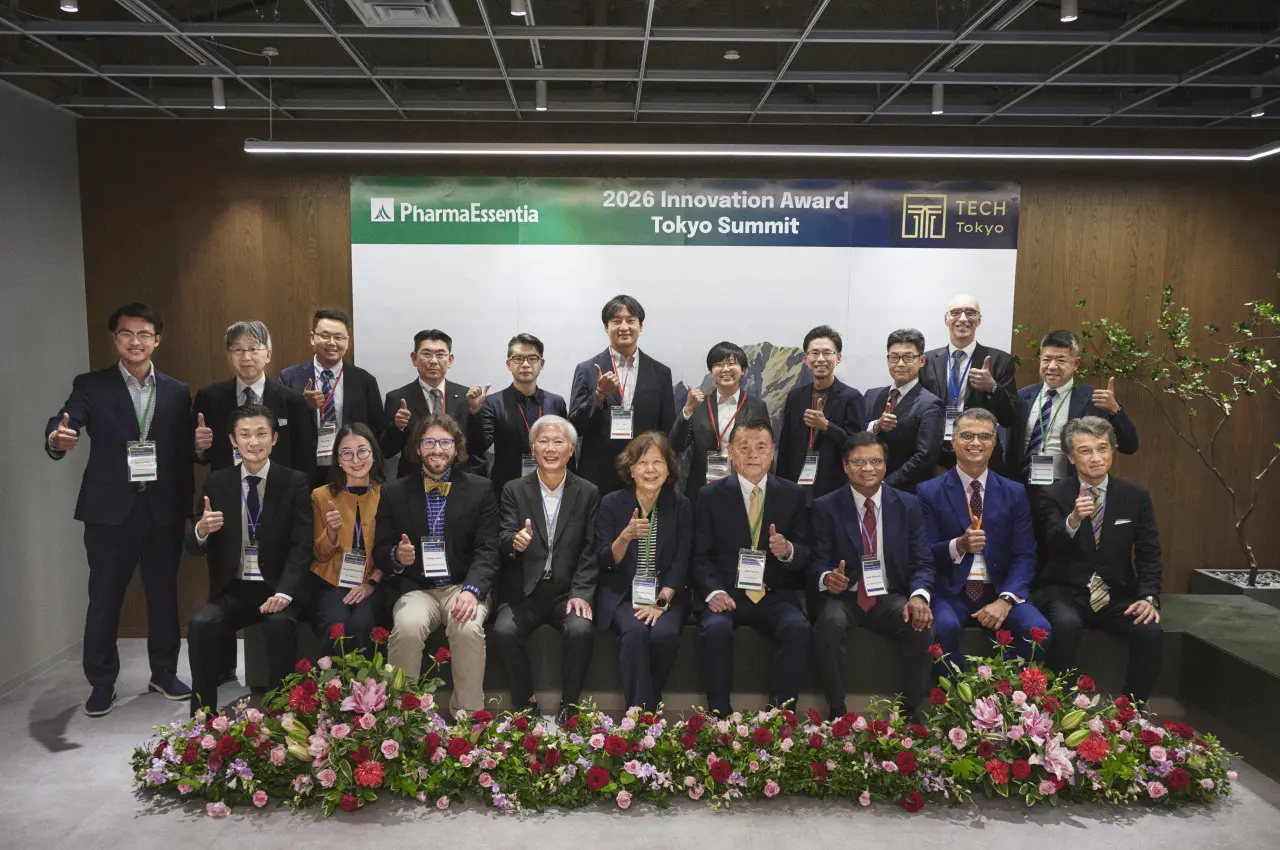
PharmaEssentia held the PharmaEssentia Innovation Award in Japan in June this year and invited a panel of expert judges to take part. (Photo courtesy of PharmaEssentia)
PharmaEssentia breaks the Taiwanese new-drug ceiling by adding sales to research and manufacturing
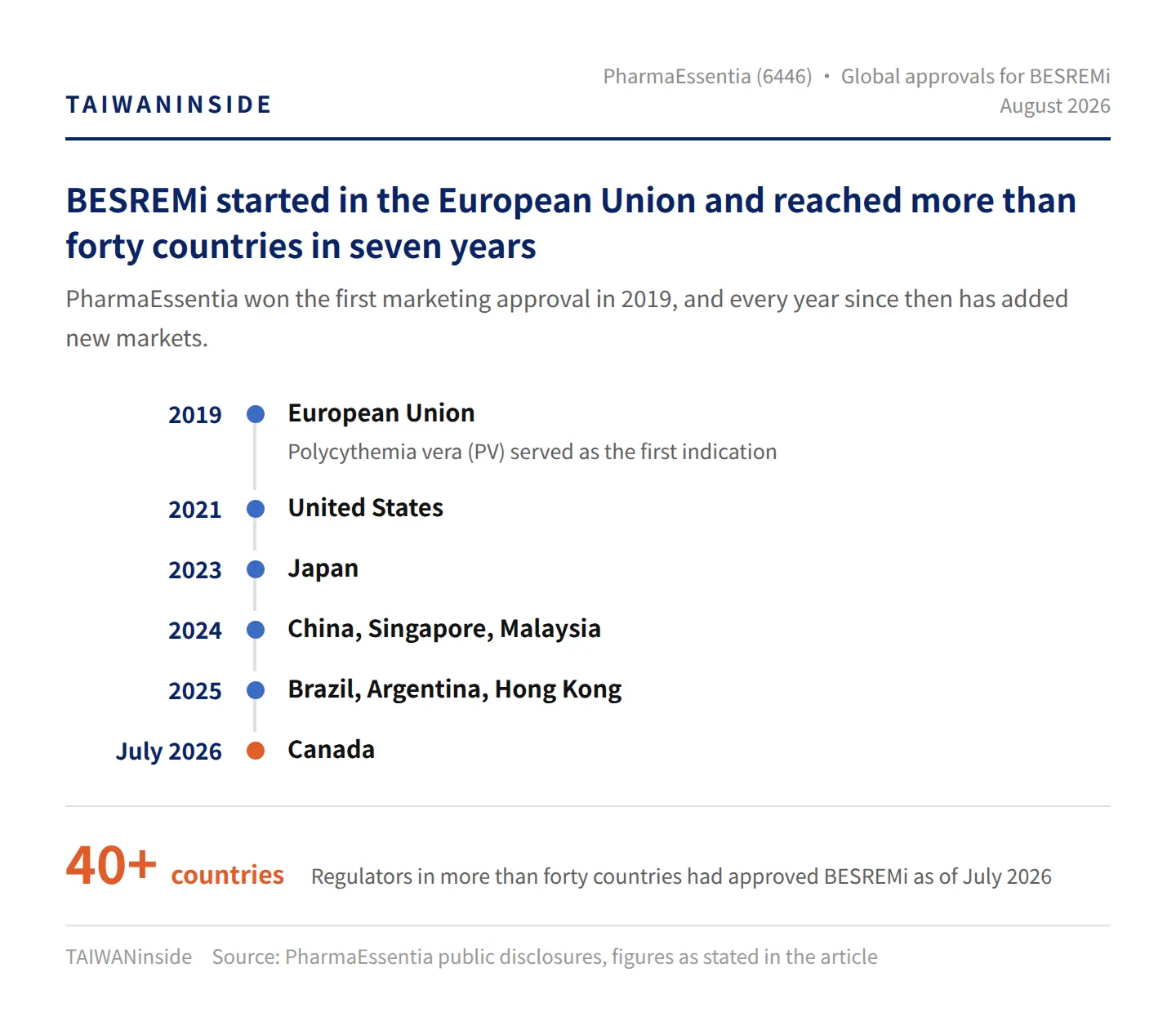
In 2019, ropeginterferon alfa-2b (BESREMi), the innovative long-acting interferon that PharmaEssentia had spent more than a decade developing as the core drug of PharmaEssentia, won marketing approval in the European Union, with polycythemia vera (PV) as the first indication. Approvals followed in the United States in 2021, in Japan in 2023, in China, Singapore, and Malaysia in 2024, in Brazil, Argentina, and Hong Kong in 2025, and in Canada in July 2026. Regulators in more than 40 countries have now approved BESREMi, and the territory of PharmaEssentia keeps expanding. (See Figure 1.)
BESREMi differs from earlier interferons because BESREMi exists as a single isomer (P1101), an innovative structure that gives BESREMi good tolerability and a long half-life and allows subcutaneous injection once every two weeks. BESREMi is the first interferon therapy that the FDA has approved specifically for polycythemia vera, and BESREMi is also the first PV drug that physicians may use regardless of prior treatment history.
BESREMi targets myeloproliferative neoplasms (MPN), a family of blood cancers that covers three main indications. PharmaEssentia has already secured polycythemia vera, and essential thrombocythemia (ET) and myelofibrosis (MF/PMF) lie ahead, so revenue growth at PharmaEssentia should accelerate further.
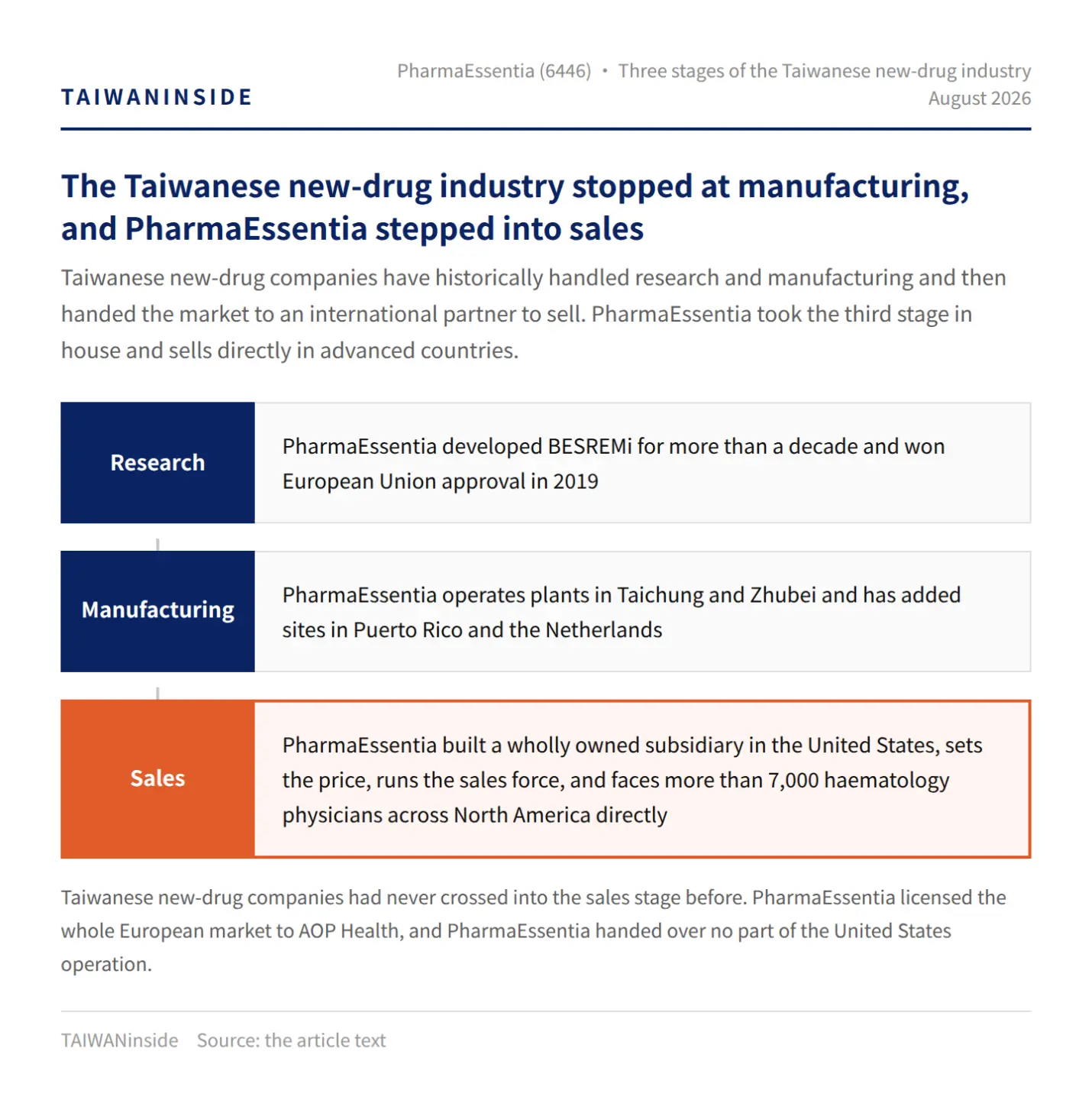
The more important move by PharmaEssentia breaks the ceiling of the Taiwanese new-drug industry, because PharmaEssentia has added sales to new-drug research and manufacturing, and PharmaEssentia sells directly in advanced countries, a barrier no Taiwanese company had ever crossed. Taiwanese companies that discovered new drugs have historically licensed those drugs to Western partners and left the selling to the partners, since a sales organization in the United States or Europe demands capital and experience that a small Taiwanese drugmaker rarely holds. (See Figure 2.)
Building a market in advanced countries such as those of Europe, the United States, and Japan is of course difficult. The European campaign of PharmaEssentia ran straight into a wall, because PharmaEssentia and Austrian licensing partner AOP Health fell into a licensing dispute and an international arbitration battle that has lasted nearly ten years. PharmaEssentia and AOP Health have been through two ICC arbitrations and two annulment proceedings in the German courts, and four of the outcomes went against PharmaEssentia. PharmaEssentia won back half of the ground only in 2021, when a German court struck down the calculation of the damages. AOP Health argued that PharmaEssentia had breached the contract willfully and that the damages carry no cap, the arbitral tribunal issued the quantum award in August 2026, and PharmaEssentia is now preparing to apply for annulment.
Ko-Chung Lin also said that the financial constitution of PharmaEssentia has been transformed over the past few years and that PharmaEssentia is no longer the perpetually loss-making small company of a decade ago. Ko-Chung Lin estimated that even a final award against PharmaEssentia would amount to at most one or two months of revenue and would not greatly affect PharmaEssentia.
Whether the estimate of Ko-Chung Lin holds depends on how much of the money on the books of PharmaEssentia the sales organization will actually collect, and on whether the do-everything-in-house model that PharmaEssentia runs in the United States can carry the weight.
Premium Members Only
This is a premium article. Please join our membership to read the full content.
Become a member to unlock all in-depth reports and exclusive analysis.
Already a member? Login Now
Related Articles
Taiwan Mass-Produces, Japan Supplies Materials and Equipment: From Sony to Drones, Why the Taiwan-Japan Alliance Is Rare
Memory Shortage Could Last Past 2030, and TSMC Is the Unexpected Winner

Musk Admits He Doesn't Know How to Make Chips: The Three Red Lines TSMC Must Hold in Any Terafab Deal