Same Market, Opposite Risk: Qualcomm's Data Center Revenue Is Still Zero, MediaTek's 2028 Chip Goes to Intel Packaging
Qualcomm closed a 3.9 billion dollar software acquisition on July 29 and reported the same day that handset revenue fell 20 percent and net income fell 25 percent, with no data center revenue booked at all. MediaTek raised its custom AI accelerator share target on July 31 and confirmed that its second chip will use Intel's EMIB-T packaging, in volume production in 2028. Both companies have entered the same market. The risks each one carries are not the same.
New York, 2:15 pm Eastern, June 24, 2026. Qualcomm chief executive Cristiano Amon announced a data center CPU agreement with Meta and a 3.9 billion dollar acquisition of the software company Modular. Qualcomm shares closed 3.29 percent lower that session and rose about 15 percent after hours. Five weeks later, on earnings night, investors sold the stock down close to 8 percent after hours. Two days after that, MediaTek raised its AI accelerator share target and reported a 2.9 point drop in gross margin. Both companies pushed into markets they did not previously serve. Why are the numbers moving in opposite directions?
Qualcomm fell 3.29 percent in the session and rose 15 percent after hours on investor day
New York, 2:15 pm Eastern, June 24, 2026. Cristiano Amon took the stage and put two announcements into a single investor day: a multi generation data center CPU supply agreement with Meta, and a 3.9 billion dollar acquisition of the software company Modular. In the regular session Qualcomm shares fell 3.29 percent to close at 197.41 dollars. After hours, the same shares rose about 15 percent.
One set of announcements, one afternoon, two directions.
The term I use in Chinese for what Qualcomm is doing is lou gwo gaai, a Cantonese expression for reaching past your own boundary to take business that belongs to someone else. It now describes most of the chip industry.
Qualcomm led global chip design four years ago and slipped to third in 2025
By TrendForce's count, Qualcomm was the world's largest fabless chip designer in 2022, was passed by Nvidia in 2023, and fell to third in 2025 when Broadcom's design revenue reached 39.7 billion dollars. TrendForce counts chip design revenue only, a basis that does not match how each company recognises revenue in its own filings, so the ranking should not be read against reported financials.
In the third quarter of fiscal 2026, Qualcomm's handset revenue of 5.09 billion dollars was about 60 percent of the 8.50 billion dollar QCT chip segment and about half of the 9.95 billion dollar company total. Chief financial officer Akash Palkhiwala told the same earnings call that non-handset revenue will pass half of QCT in fiscal 2027 and reach roughly two thirds by fiscal 2029, which puts handsets at about one third. Counterpoint Research forecast on May 31 that global handset shipments will fall 13.9 percent in 2026 to 1.08 billion units, the steepest annual decline on record.
Qualcomm's strongest market is shrinking, and the revenue AI is generating currently sits with Nvidia, Broadcom and the cloud providers. Qualcomm does not have it yet.
Qualcomm is building the whole stack itself and carrying all four layers of cost
The scale of the move shows in the product line. Dragonfly is the umbrella name for Qualcomm's data center portfolio, spanning connectivity, CPUs, AI accelerators and custom silicon.
The lead product, the C1000, uses a chiplet design, which splits what used to be one large die into several smaller ones made separately and then packaged together, lifting yield and holding cost down. The C1000 carries more than 250 Qualcomm-developed Oryon cores, clocks above 5GHz, and by Qualcomm's own claim delivers more than twice the performance per watt of mainstream server CPUs today. Volume production is set for the second half of 2028. Electricity in a data center is a cost that recurs every year, so performance per watt is a real argument with buyers whose power budgets are already binding.
The second line is the AI300 inference accelerator, built on the second generation of Qualcomm's high-bandwidth compute architecture. The design lifts the compute die off the SoC and places it beneath a stack of memory, connected by through-silicon vias, which shortens the distance data has to travel. The stack uses LPDDR, the low-power memory found in phones and laptops, which costs far less than the high-bandwidth memory that AI accelerators normally carry. The arrangement also removes the silicon interposer an HBM design requires, the expensive slab of silicon that connects the dies to each other.
On the same day in New York, Qualcomm bought Modular for 3.9 billion dollars. Modular's platform runs AI applications efficiently across different chip architectures, and the trade press read the deal plainly: Qualcomm wants its own CUDA. CUDA is Nvidia's software platform, and once developers have learned to write for it they do not move to another vendor's silicon easily. It is the layer of Nvidia's business that is hardest to displace.
Four product layers and one acquisition point the same way. Qualcomm intends to build the entire stack itself, and to carry the cost of every layer itself.
Dragonfly also needs hardware partners to exist as physical racks. When Qualcomm published the roadmap it named more than 35 ecosystem partners, ten of them Taiwanese.
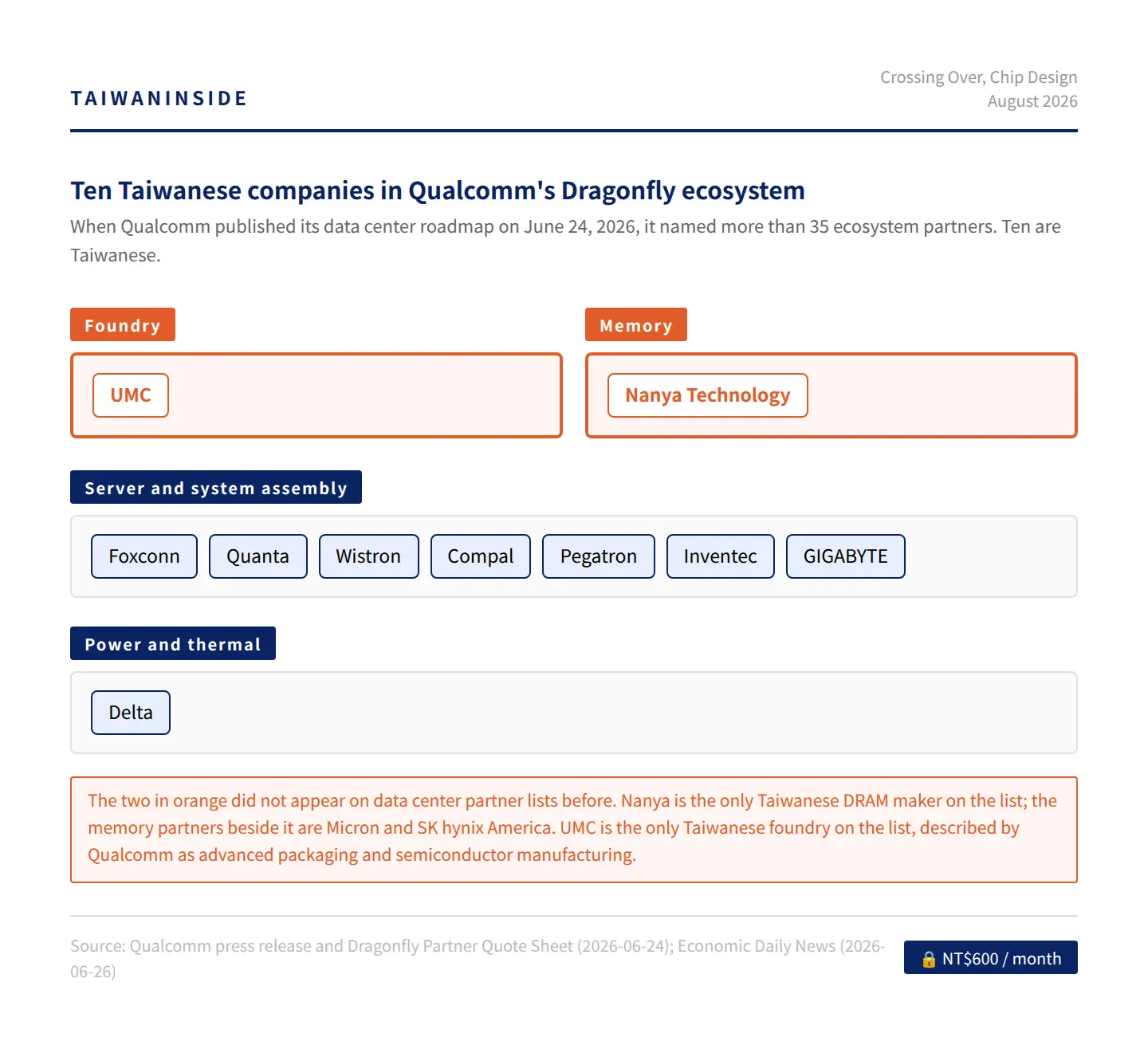
Most of those ten sit in one layer, server and system assembly, the business of turning other people's silicon into finished racks. Foxconn, Quanta, Wistron, Compal, Pegatron and Inventec build the machines that hyperscalers install; GIGABYTE builds boards and systems; Delta supplies power and thermal. The two names that do not belong to that layer are the interesting ones, and they are the reason this list matters more than a normal partner announcement.
MediaTek is one tenth Nvidia's size, and its scale decided that it would not compete with its customers
MediaTek is the world's fifth largest fabless chip designer, with 2025 revenue of 19.1 billion dollars on TrendForce's count, roughly half of Qualcomm and about one tenth of Nvidia. It ships more smartphone chips by volume than any other company, and until recently that was the whole story about MediaTek.
On the July 31 earnings call, vice chairman and chief executive Rick Tsai described how the company builds custom AI accelerators: deep design-technology co-optimization with TSMC, close work with key advanced packaging partners, and experience in advanced node design such as 2nm applied to very large high-performance ASICs, using both CoWoS and EMIB-T. The first chip enters production in the fourth quarter of this year. The second uses EMIB-T, and Tsai said its yield and reliability are tracking to plan for high volume production in 2028.
EMIB-T is Intel's packaging technology. MediaTek is running two advanced packaging routes in parallel, and the 2028 chip runs on Intel's. As far as I can find, no publication outside Taiwan has reported this.
At 19.1 billion dollars of revenue, building a full hardware and software stack of the kind Qualcomm is attempting is not realistic. MediaTek therefore does not sell a branded accelerator of its own and does not compete with its customers. That choice has a local precedent that needs no explanation in Taiwan: TSMC has held the same line for three decades, refusing to design chips that compete with the companies whose chips it manufactures, and it is the most profitable position in the industry. MediaTek is applying the same discipline one layer up the stack.
On the same call MediaTek raised its 2027 market share target for the custom AI accelerator serviceable market from 10 to 15 percent up to 15 to 20 percent, and put 2026 data center revenue above 2 billion dollars. The denominator matters here. The share is of the custom AI accelerator market, not the AI server market, and the 80 billion dollar figure for that market is MediaTek's own estimate rather than a third party's.
So two companies walked into the same market from opposite ends. Qualcomm is paying for every layer. MediaTek is designing to order and letting the customer carry the product risk. Both were about to report, two days apart at the end of July. To read what those two sets of numbers actually mean, one thing has to be settled first: where has each company placed the risk of moving into a market it did not own?
🔒 Subscriber content below
NT$600 per month, NT$6,400 per year (NT$533 per month)
Unlocks the rest of the article, including four readings of server CPU market share, the two companies' July results side by side, and the risk structure quadrant
Qualcomm booked no data center revenue in the third quarter and needs non-handset growth to go from 24 percent to above 60 percent
Qualcomm went first, on July 29, exactly five weeks after New York.
The call opened at 1:45 pm Pacific. Amon said the whole industry was still absorbing memory prices and manufacturing costs at levels he had not seen before. Minutes later Palkhiwala said purchase orders from two hyperscale customers were in hand and wafers had already started. On the same call Qualcomm described data center revenue that begins to be recognised only in the October to December quarter, and handset revenue that had already fallen 20 percent.
After the call ended, the selling began. The shares fell close to 8 percent after hours.
That move reflected a lack of confidence in the path Qualcomm has chosen. The immediate triggers reported at the time were an earnings miss and guidance below expectations, and that guidance still contains no data center revenue.
The quarter itself: revenue 9.95 billion dollars, down 4 percent; handsets 5.09 billion, down 20 percent; automotive 1.59 billion, up 61 percent; net income 2.00 billion, down 25 percent; diluted earnings per share 1.87 dollars. Data center revenue for the quarter was zero, with two unnamed hyperscale customers starting to contribute in the October to December quarter.
In the same release Qualcomm lifted its target for non-handset revenue growth from 24 percent in fiscal 2026 to more than 60 percent in fiscal 2027, and set fiscal 2029 non-handset revenue at close to double, 40 billion dollars, with data center above 15 billion.
The quarter's handset number is already fact. Qualcomm has promised more than 15 billion dollars of data center revenue by fiscal 2029 and so far has booked none. What investors are waiting for is the first appearance of that number in a filing, which comes in the December quarter.
Qualcomm is competing on performance per watt and on total cost of ownership, meaning purchase price plus power plus maintenance over the life of the machine, rather than on peak throughput, which is where Nvidia is strongest. Copying that route requires three things at the same time. The first is years of power-optimisation work in mobile, of the kind that carried Oryon cores from a phone into a 250-core server CPU, and that experience cannot simply be bought. The second is a willingness to substitute cheap LPDDR for expensive HBM and to absorb the cost of redesigning the whole package around it. The third is a software layer, because a hyperscale customer ultimately wants an environment it can develop in, not a chip.
The third is the hardest. CUDA took Nvidia more than a decade. The 3.9 billion dollars Qualcomm paid for Modular, closed on July 29, is the down payment on that layer.
Intel is both a loser in this fight and the packaging supplier to Taiwan's largest chip designer
One number is quoted constantly: Intel's server CPU share has fallen to 54.9 percent. That figure is a UBS estimate for the first quarter of 2026, it counts units, and its denominator includes Arm. Three other readings of the same question hold at the same time.
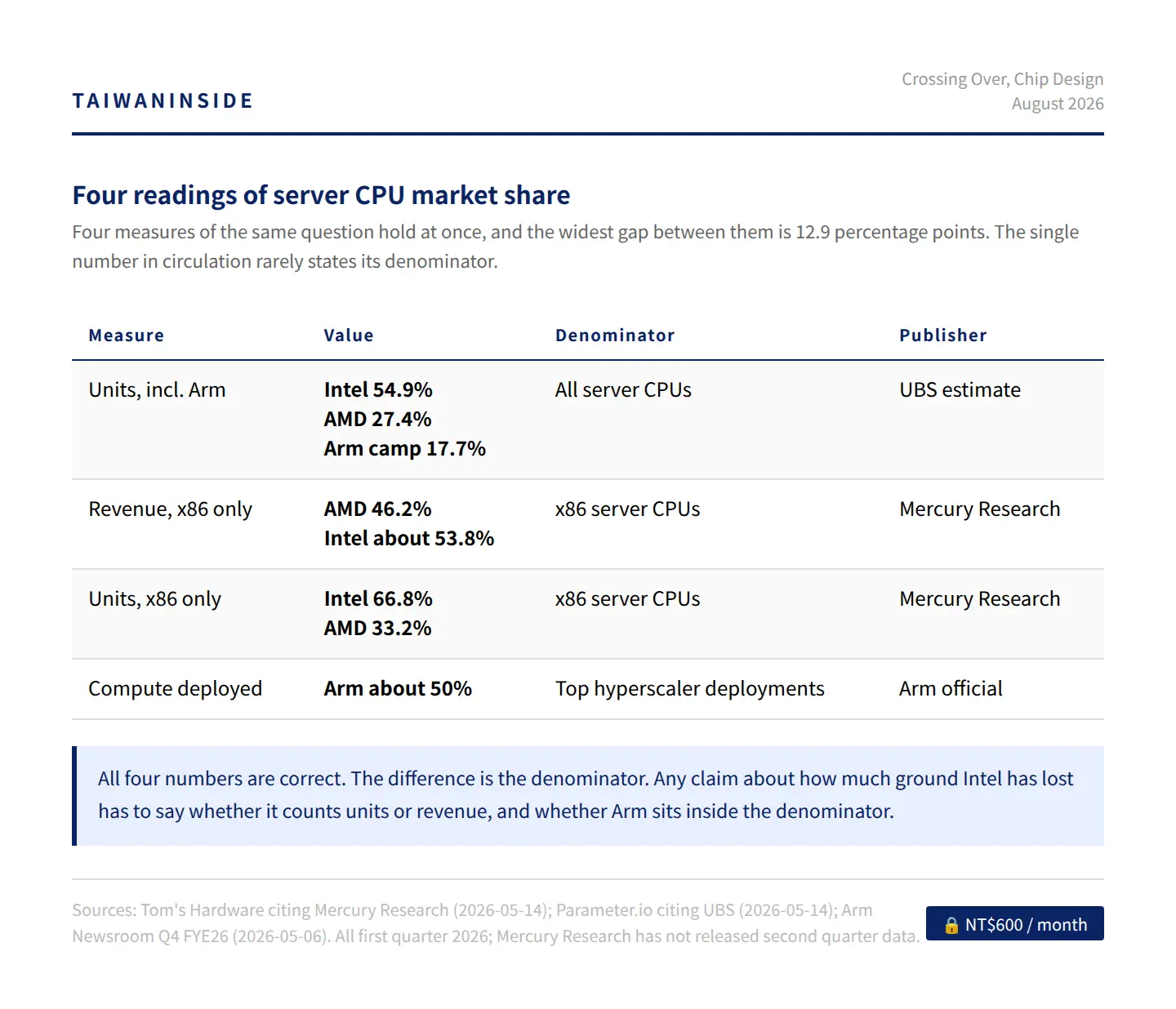
All four numbers are correct. The difference is the denominator. Any claim about how much ground Intel has lost has to say whether it counts units or revenue, and whether Arm sits inside the denominator. Each of these four has appeared in coverage over the past three months; putting them in one table is what makes them useful.
Intel also has a second role in this fight. MediaTek has confirmed that its custom AI accelerators use both TSMC's CoWoS and Intel's EMIB-T, and that the 2028 chip runs on the Intel route.
An accelerator carrying HBM has to connect to its SoC through a silicon or RDL interposer, which means some form of 2.5D heterogeneous packaging is unavoidable. Needing 2.5D is not the same as needing CoWoS. By running both routes, MediaTek has shown that the alternative is ready for a production part.
Qualcomm's first wave named ten Taiwanese companies: Compal, Delta, Foxconn, GIGABYTE, Inventec, Nanya Technology, Pegatron, Quanta, UMC and Wistron. In Qualcomm's own partner quote sheet, UMC's role is advanced packaging and semiconductor manufacturing. Nanya's quote refers to supporting the growing demands of AI and next-generation data centers, and the memory partners listed alongside it are Micron and SK hynix America. A Taiwanese DRAM maker appearing on an AI chip company's official partner list is unusual. The Taiwanese memory firms that got there before it were module and controller makers: ADATA and Phison entered Nvidia's supply chain list at Computex in 2025.
I have been hearing a great deal lately about new memory designs looking for low-cost process solutions. NEO Semiconductor's 3D X-DRAM proof-of-concept chip was built on mature 3D NAND processes with existing equipment and materials, positioned as a cheaper substitute for HBM. If designs like that become mainstream, mature-node foundries acquire a class of memory customer they could not previously serve.
MediaTek's gross margin fell 2.9 points while foreign price targets spread from 6,800 to 10,000 New Taiwan dollars
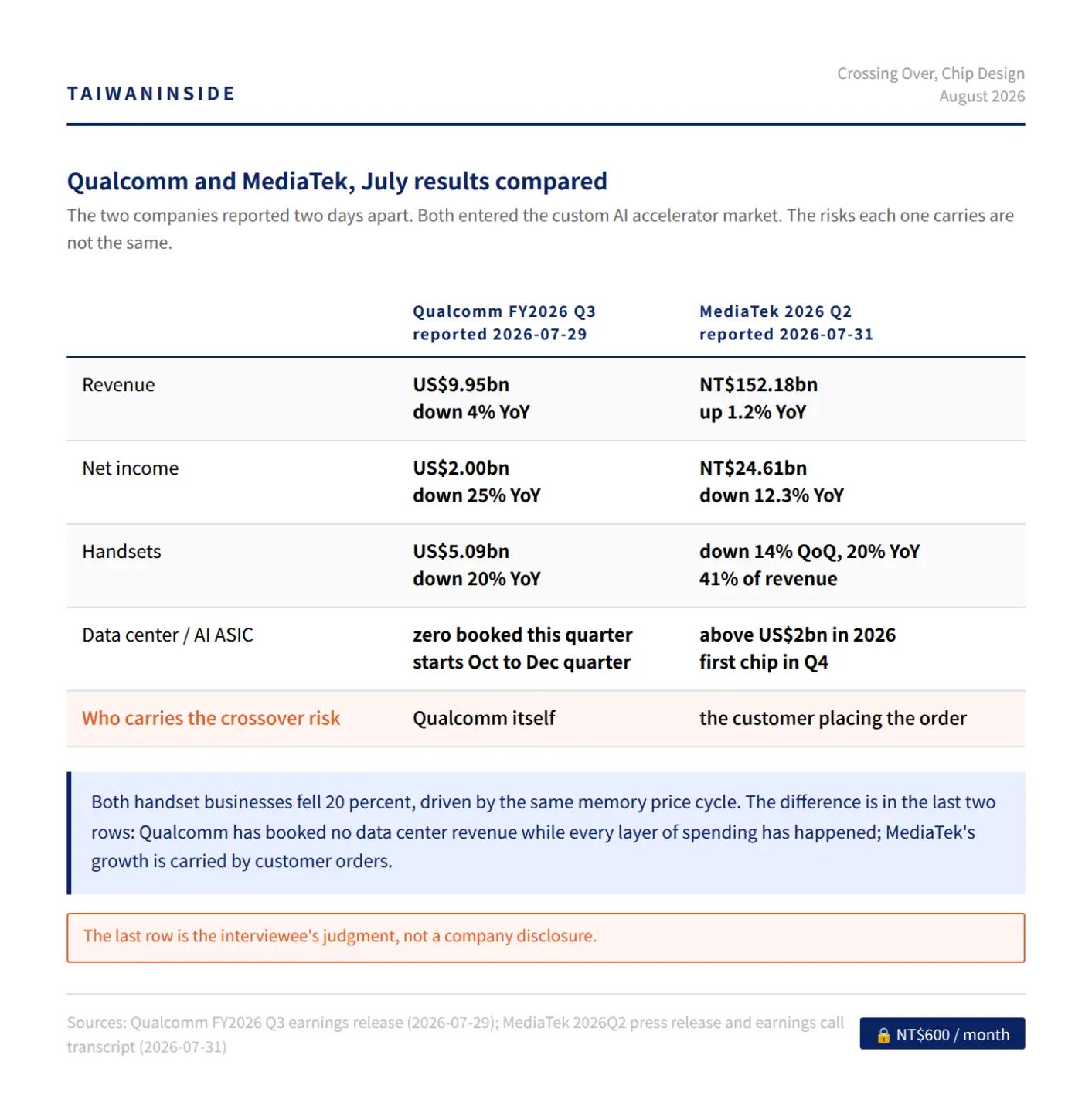
Both companies' handset businesses fell 20 percent, driven by the same memory price cycle. The difference is in the last two rows.
Qualcomm has not begun recognising data center revenue, but the spending has all happened: four Dragonfly product layers, a 3.9 billion dollar software acquisition, and custom data center silicon that will dilute QCT gross margin by 1.5 to 2 percentage points in its early stages. MediaTek's margin decline comes from the margin structure of the ASIC business itself, while its revenue growth is carried by customer orders.
What keeps each structure viable? For Qualcomm, data center revenue has to climb the path it has set, 5 billion dollars in fiscal 2027 and 15 billion in fiscal 2029, before the C1000 reaches production in 2028. For MediaTek, customer order volume has to keep growing, and the margin decline has to stay smaller than the revenue growth.
What would change each structure? For Qualcomm, if no third hyperscale customer appears after the December quarter, the two-year gap becomes a cash flow problem. For MediaTek, if the customer reallocates orders elsewhere, the revenue growth loses its support.
Macquarie raised its MediaTek price target from 5,850 to 10,000 New Taiwan dollars on June 29. Goldman Sachs set 6,800 on July 2. MediaTek's intraday high for 2026 is 4,970, reached on June 2, a session that opened at its high and closed at 4,525. The spread between the highest and lowest target is 3,200 dollars, and the highest target is twice the best price the stock has actually traded at this year. Foreign brokers do not agree on how long this contract model can run.
The shares themselves are swinging hard. MediaTek touched an intraday low of 2,990 on July 29, then hit the daily limit up twice, on July 31 and August 3, closing at 3,865 on August 4. Across six sessions the stock rebounded 37 percent from low to high.
Two risk structures, two timelines for proof
My view is that this round of crossing over will not be decided before 2028. Qualcomm's C1000 reaches volume production in the second half of 2028, and MediaTek's second ASIC also lands in 2028. The real variable over these two years is who wins a second and a third hyperscale customer.
There are already signs, and they come from a direction that was not on the list. TF International Securities analyst Ming-Chi Kuo's supply chain survey in early May 2026 reported that OpenAI's planned AI agent phone had talked to both Qualcomm and MediaTek, and that MediaTek was the most likely partner, with production as early as the first half of 2027. In the same period OpenAI and Broadcom launched Jalapeño, OpenAI's first in-house AI inference chip, taken from design to manufacture in nine months under Richard Ho, formerly a core leader of Google's TPU programme and now OpenAI's head of chip hardware. The contract design route is attracting a second class of customer, and that class is not the cloud giants. It is the model companies.
The easiest thing to misread right now is the margin decline. MediaTek's second quarter gross margin was 46.2 percent, down 2.9 points, and ASIC margins are indeed thinner. Foreign brokers, though, forecast 2027 revenue growth of 93 to 95 percent, far larger than the margin decline, so total profit still rises. Thin ASIC margins do not matter; what matters is how far the revenue can grow. A company in transition cannot be judged on a single metric.
The conditions for success are also different. MediaTek runs contract design, the risk sits with the customer placing the order, and that customer's ecosystem and TPU position are on solid ground today, so my judgment is that MediaTek cannot easily lose over these two years. Qualcomm is the opposite, and either outcome will be extreme. Building an entirely new ecosystem from nothing would be formidable if it works, and the challenge before it works is very large.
As for whether Qualcomm moved too late, my view is that it did not. The AI wave is less than four years old counting from the end of 2022, and building a new ecosystem in an industry this size in a little over three years is not late. Qualcomm's handset business is shrinking but still profitable. Qualcomm led fabless design for years and is good at winning markets from the architecture up, so I am not surprised it chose the harder road. Its opponents include Broadcom's acquisition machine and Nvidia. This is not an easy fight.
Widening the frame to Taiwan, my view is that a startup like OpenAI succeeding would help Taiwan's supply chain more than Apple has. Most of Apple's supply chain now sits with Chinese suppliers, for historical reasons that accumulated over years, and Apple will find that hard to change while it needs to keep selling in China. In the current standoff between the United States and China, though, a new entrant will commission a non-China supply chain to build its competitiveness, and orders reaching Taiwanese firms will increase. MediaTek has an opportunity, and so does the rest of the handset supply chain. Qualcomm naming ten Taiwanese partners in its first wave, Nvidia coming to MediaTek for PCs, Google coming to MediaTek for TPUs: all of it follows the same logic.
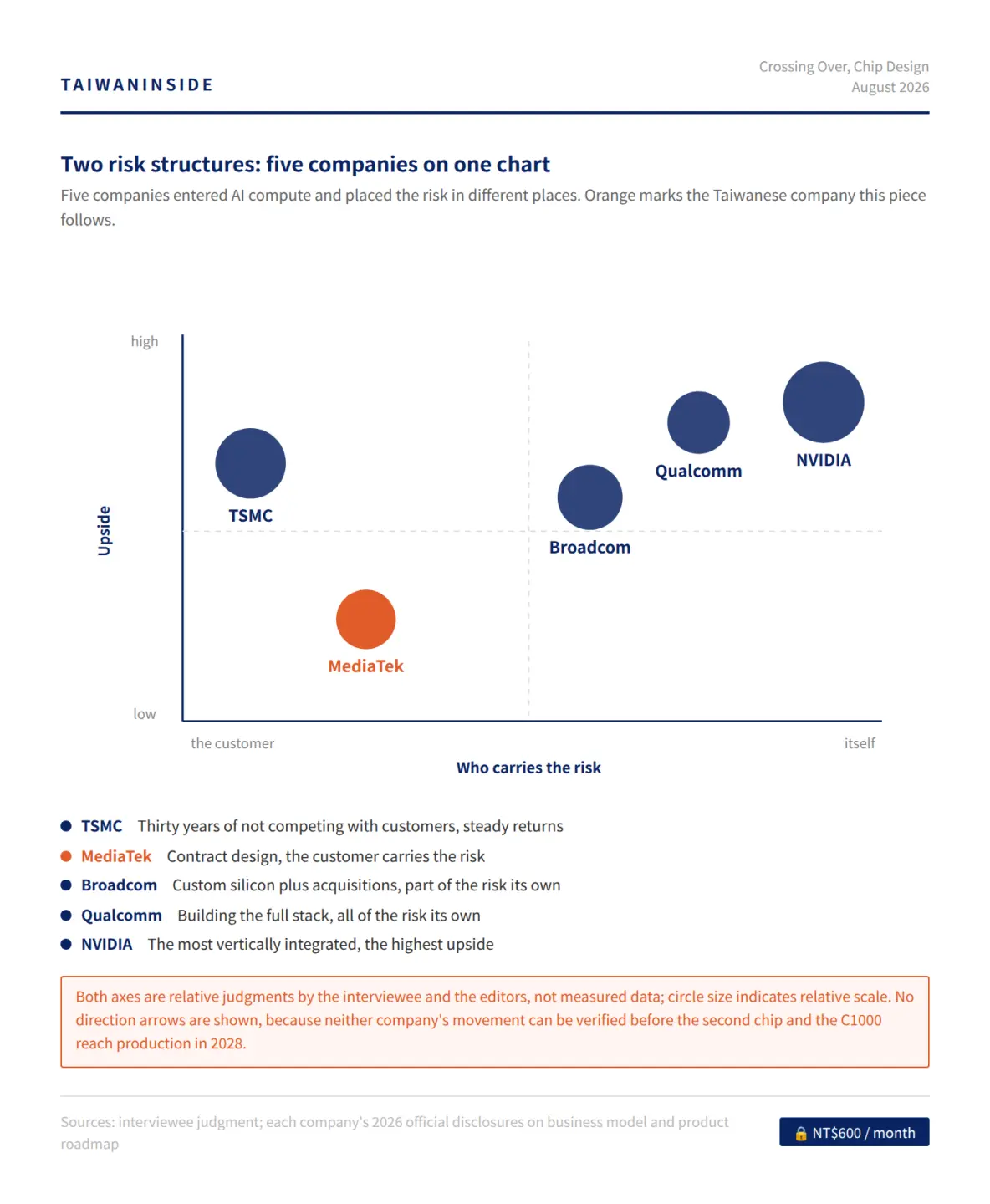
Three judgments worth taking away.
First, to judge whether a design company's move across the line will work, look at who carries the risk. A company that places the risk with its customer grows at the pace of that customer's orders, and the customer absorbs more of the loss if it fails. A company that carries all the risk itself earns more if it succeeds and has no one to share the cost if it does not.
Second, a gross margin in a transition year means nothing on its own. What matters is which is larger, the revenue growth or the margin decline. That comparison can be redone every quarter.
Third, a question with no answer yet. The contract model hands the risk to the customer, and the same act hands over control of price and schedule. MediaTek said on the July 31 call that confidentiality prevents it from disclosing customer names, project content or the timing of revenue contribution, and the 15 to 20 percent share target for 2027 rests on MediaTek's own 80 billion dollar estimate of the serviceable market. Before that, on the June 3 call, Broadcom president and chief executive Hock Tan acknowledged for the first time that Google would have diversity of supply. The question worth asking is what conditions would cost MediaTek its control over price and schedule. It will not be answered before the second chip reaches production in 2028, but whether MediaTek starts disclosing customers and revenue timing on each quarterly call is a signal that can be watched.
Related Articles
Taiwan Mass-Produces, Japan Supplies Materials and Equipment: From Sony to Drones, Why the Taiwan-Japan Alliance Is Rare
Memory Shortage Could Last Past 2030, and TSMC Is the Unexpected Winner
Musk Admits He Doesn't Know How to Make Chips: The Three Red Lines TSMC Must Hold in Any Terafab Deal