Same Leverage, Opposite Outcomes: Korean Stocks Fell 40%, Taiwan’s Fell 17%, and the Difference Is Where the Borrowed Money Sat
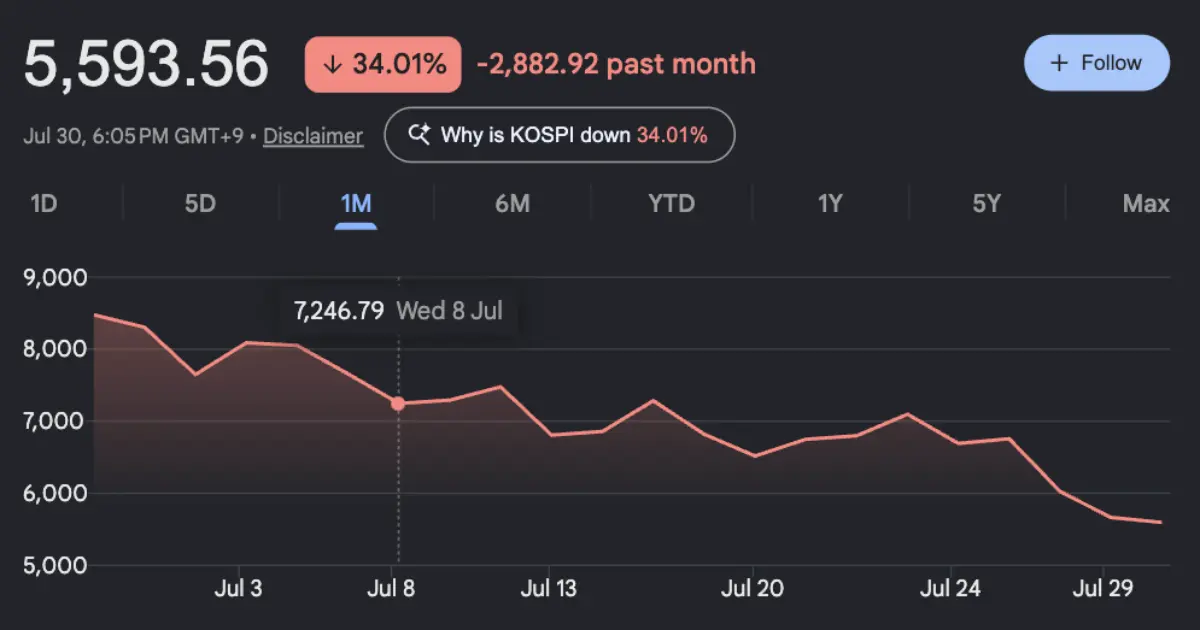
In late June, retail investors in Taiwan and South Korea each owed their brokers roughly NT$800 billion; the two figures were almost identical. A month later, the KOSPI had fallen nearly 40% from its peak and some 350,000 accounts had been liquidated by their brokers. Taiwan’s market fell about 17%, and no cascade of forced selling followed. Two markets rode the same trade with the same amount of borrowed money, and ended more than twice as far apart. This is what separated them, and how a channel that opened only in July carried Seoul’s selling into Taipei.
In June, the Taiwanese and South Korean stock markets set record highs five days apart.
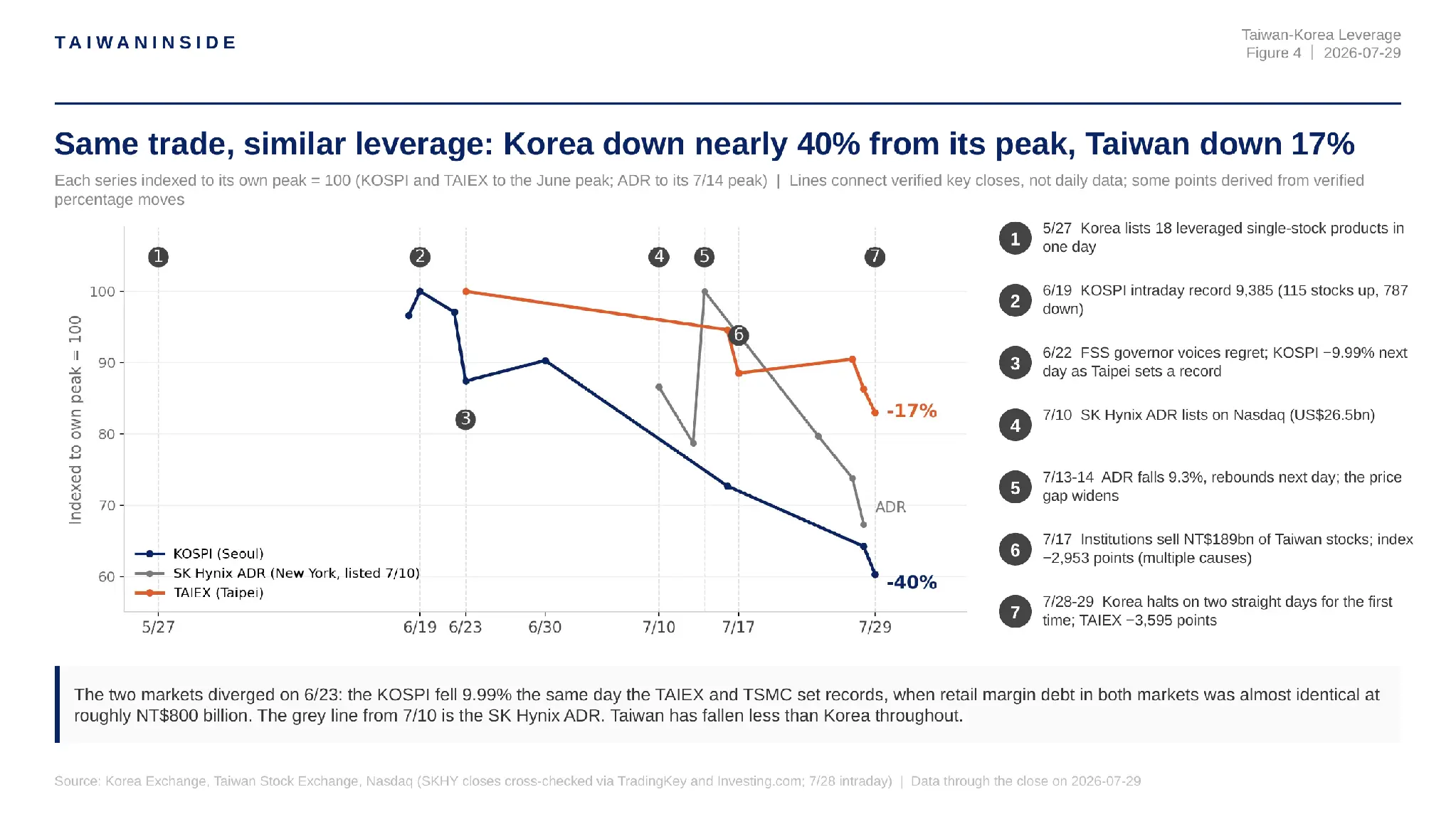
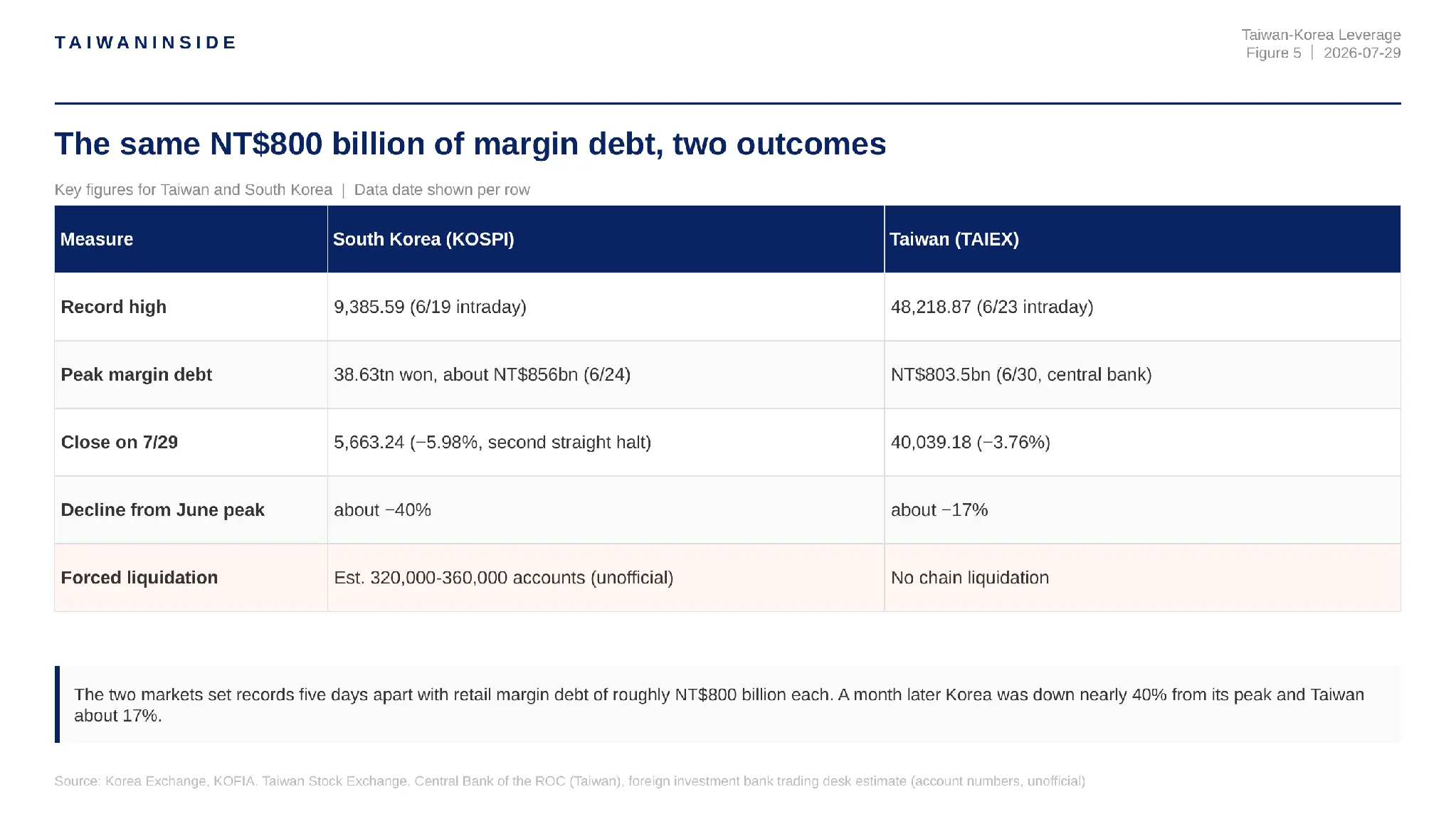
On June 18, the KOSPI closed above 9,000 for the first time, at 9,063.84. The next day it touched 9,385.59 intraday, an all-time high. The index had started the year near 4,300; it had more than doubled in six months. Five days later, on June 23, Taiwan’s TAIEX reached 48,218.87 intraday and TSMC hit NT$2,535, both records.
The same trade lifted both markets: semiconductor demand driven by artificial intelligence. Taiwan had TSMC, the world’s leading contract chipmaker. South Korea had the memory manufacturers Samsung Electronics and SK Hynix.
TSMC alone accounts for more than 40% of the total value of the Taiwanese market and is the world’s most valuable semiconductor company. The TAIEX rose more than 60% in the first half of the year, among the best performances of any major market.
A month later, both markets were falling. But Taiwan held up far better, and the gap between them widened to more than two to one.
On July 29 the KOSPI closed at 5,663.24. The day before, it had dropped 10.84% in a single session and triggered this year’s eighth circuit breaker, halting all trading for 20 minutes. On the 29th it fell another 5.98% and tripped the breaker again. For the first time in the market’s history, both of South Korea’s exchanges halted trading on two consecutive days. Roughly 921 trillion won (about US$644 billion) in market value evaporated over the two sessions, equivalent to about a third of South Korea’s annual output. From its June high, the KOSPI has lost close to 40%. July alone erased more than 30%, exceeding the worst monthly decline of the 2008 financial crisis.
Taipei was hit hard as well. The TAIEX fell 2,030.83 points on July 28, its third-largest single-day point decline on record, then another 1,564.18 points on the 29th to close at 40,039.18, briefly slipping below 40,000 during the session. The two days together cost the index 3,595 points. TSMC closed at NT$2,215. From its June peak, the TAIEX is down about 17%.
Over the same month, according to estimates from a foreign investment bank’s trading desk, more than 1.2 million leveraged retail accounts in South Korea received margin calls through July 13, as share prices fell below the collateral levels their margin loans required. Of those, roughly 320,000 to 360,000 accounts were liquidated outright by brokers, who sold the shares and recovered the loans. These are estimates; South Korean regulators have published no official count. But the scale of the deleveraging is far beyond an ordinary correction.
Here is what does not add up. In late June, retail margin debt in the two markets was almost identical, at roughly NT$800 billion each. The same weight of leverage left one market down nearly 40% with several hundred thousand accounts wiped out, and the other down about 17%. Where does the difference come from?
July 17, Taiwan’s largest one-day fall: the seller was foreign institutions
To answer that, start with what happened in Taipei on July 17.
The TAIEX closed down 2,953.71 points that day at 42,671.27, the largest single-day point decline in its history at the time. TSMC fell NT$180, or 7.29%, to NT$2,290. Foreign institutional investors sold a net NT$189 billion (about US$5.8 billion) of Taiwanese shares, the largest single-day figure ever recorded.
A drop like that is exactly what sets off a chain of forced liquidations. Prices fall, the collateral behind margin loans loses value, accounts that breach the maintenance level are sold out by their brokers, and that selling pushes prices down again, catching more accounts. South Korea had been running through precisely this loop since late June.
Taiwan did not. Margin debt on the exchange fell NT$41.6 billion (about US$1.3 billion) in a single day, also a record, so leveraged positions were certainly unwinding. But the market-wide maintenance ratio stayed well clear of the statutory 130% threshold, and Taiwan’s liquidation procedure builds in a delay of its own: when an account falls below 130%, the broker issues notice only after the close, the investor has two business days to top up, and only if the deadline passes without payment and the ratio has not recovered does the broker sell the collateral on the following session.
Taiwan’s margin positions were shrinking, but they were not collapsing. The selling that day came from foreign institutions trimming positions, not from retail investors being liquidated.
So why did foreign institutions dump Taiwanese shares on that particular day? The trail leads back to Seoul.
Reading this storm: margin debt, Korea’s two braking mechanisms, and the second layer of leverage nobody counts
Margin debt is the total amount investors have borrowed from brokers to buy shares and have not yet repaid. The larger it is, the more of the market is being held up by borrowed money, and the greater the forced selling pressure when prices fall. In late June, Taiwan’s margin debt stood at roughly NT$800 billion; South Korea’s, converted, was almost the same.
In Taiwan, brokers extend margin loans and securities finance companies supply the funding. Investors can borrow up to 60% of a stock’s market value. The maintenance ratio is calculated on a whole-account basis, combining an investor’s long margin positions and short positions in one figure. Below 130%, the broker must issue a margin call. The most important difference from South Korea is that Taiwanese stocks can move no more than 10% in either direction in a single session, so collateral cannot lose 30% of its value in a day.
South Korea’s market has two distinct braking mechanisms. The first is the sidecar: when KOSPI200 futures move 5% from the reference price and hold there for a minute, the exchange suspends program-trading orders for five minutes. Because it blocks only automated orders, ordinary investors keep trading and the market itself never stops. The second is the circuit breaker: an 8% decline in the index sustained for a minute halts all trading for 20 minutes, and nobody can buy or sell.
Between January 2 and July 24 this year, the sidecar was triggered 41 times, more than the 26 recorded in all of 2008. The circuit breaker is the more serious measure: since it was introduced in 2000, it has been triggered 15 times in 26 years, six of those in the first 25 years and nine in the past seven months, more than the entire preceding quarter-century combined. On July 28 and 29 it fired on consecutive days, and with the smaller-cap KOSDAQ market halting alongside, the two exchanges stopped together on back-to-back sessions for the first time.
Margin debt is also not the whole of the leverage. Both markets carry a second layer of share-backed borrowing that never enters the credit-trading statistics: in South Korea, loans secured against depositary receipts; in Taiwan, brokers’ unrestricted-purpose lending and bank loans against shares pledged by major shareholders. This hidden layer moves both markets too.
With those three things clear, return to the original question: with the same NT$800 billion of borrowed money, why did one market lose several hundred thousand accounts while the other merely corrected?
Premium Members Only
This is a premium article. Please join our membership to read the full content.
Become a member to unlock all in-depth reports and exclusive analysis.
Already a member? Login Now
Related Articles
The arbitration damages of about NT$4 billion expose the real profit cushion of Taiwanese drugmaker PharmaEssentia
Same Market, Opposite Risk: Qualcomm's Data Center Revenue Is Still Zero, MediaTek's 2028 Chip Goes to Intel Packaging
Korean regulation is the main reason memory stocks fell in late July