Taiwan Built the Foundry Model. It Does Not Transfer to Personalized Cancer Vaccines.
On 19 August, Moderna's stock rose 177% in a single day, and the result was widely seen as the first real-world evidence that AI could reshape the traditional drug-development timeline. But the trial started enrolling patients in 2023 and produced only a preliminary result in 2026. Those three years were spent waiting for patients to relapse and for events to accumulate. AI did not shorten that wait by a day. So which part did AI actually shorten? If discovery and design are no longer the hardest step, the next constraint is manufacturing: every dose of this drug is built for one patient, and one patient means one batch. Taiwan's strength happens to be manufacturing. On this new stage now taking shape, does Taiwan have a way in?
On 19 August 2026, the American drugmaker Moderna and its partner, the multinational pharmaceutical company Merck, announced that their jointly developed personalized mRNA cancer vaccine had produced strong results in a large Phase 3 clinical trial. Moderna closed up 176.97% at US$174.38, the largest single-day gain since the company went public.
A week before the announcement, of the 15 analysts covering Moderna, 14 had a Hold or Sell rating, with an average price target of just US$48.92.
This is the first individualized neoantigen therapy to report positive results from a Phase 3 trial, and the first mRNA cancer therapy to do so. Yet as of today the drug has not been approved by the U.S. Food and Drug Administration (FDA), the full Phase 3 data has not been released, and the overall survival data is still immature.
Both companies avoid the word "vaccine"
Moderna and Merck deliberately avoided the word "vaccine" in their press release, because this drug treats an existing disease rather than preventing one. The formal name is individualized neoantigen therapy; the drug name is intismeran autogene, developed under the codes V940 and mRNA-4157.
What Moderna is developing is a therapeutic vaccine, not a preventive one. It is not given to healthy people to stop them from getting cancer. It is given to high-risk patients who have already had surgery, to train the patient's own immune system, specifically the T cells, to clear hidden or microscopic residual cancer cells and prevent recurrence and metastasis.
The Phase 3 trial, INTerpath-001, enrolled patients whose tumors had been completely resected but who remained at risk of recurrence, with stage IIB to IV cutaneous melanoma, 1,137 people in total, randomized 2 to 1. The control arm received placebo plus Merck's anti-PD-1 drug Keytruda (pembrolizumab). Each patient's dose is encoded from the specific mutation profile of that patient's own tumor, carrying up to 34 tumor-specific neoantigens, over a course of roughly one year, up to nine doses, one every three weeks.
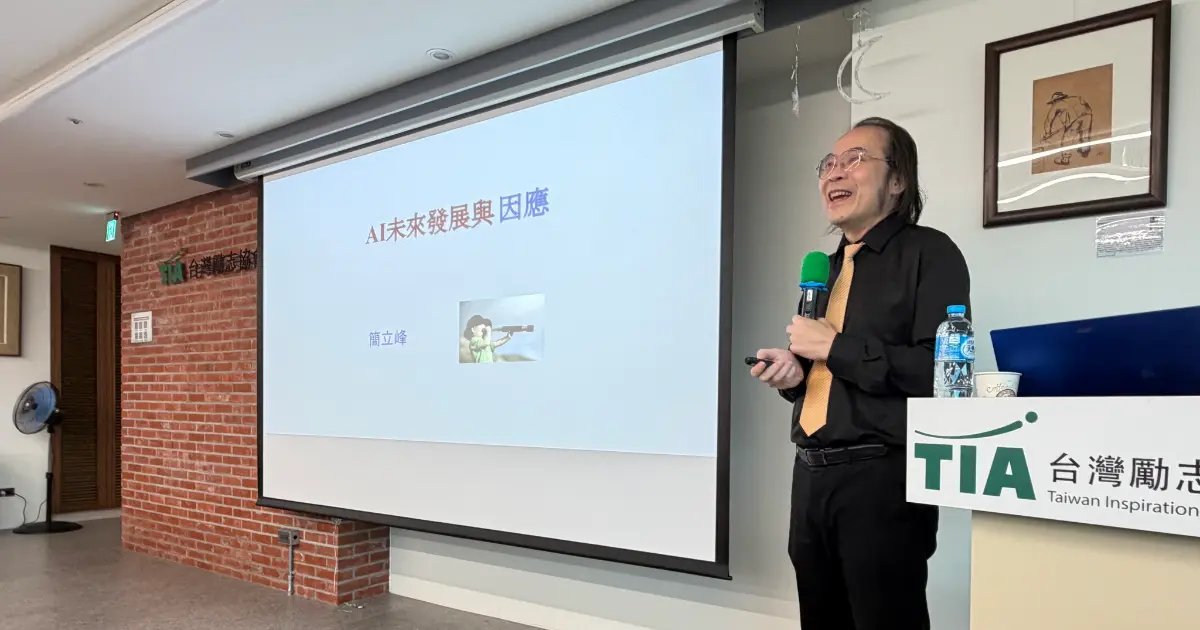
On 22 August I attended a talk by Simon Chien, former managing director of Google Taiwan, hosted by the Taiwan Inspiration Association (TIA), a Taiwanese non-profit organization. Chien said he sees this as a major breakthrough recently enabled by agentic AI, and that the rapid advance of agentic research will be a trend no industry can afford to ignore.
What Chien covered that day went well beyond biotech. Any research-intensive industry is in scope, semiconductors, materials and pharmaceuticals included. That is why the Phase 3 result of a melanoma therapy is worth the time of Taiwan's technology sector to understand properly.
Started in 2023, first results in 2026, and the three years in between were not compressed
Moderna began this therapeutic vaccine trial in 2023, and it took until August 2026 to produce a preliminary result. Three years of development time sat in between.
What happened during those three years was patient enrollment and data accumulation, not the kind of computation AI performs. The trial ran across 26 countries and 165 trial sites, waiting for enough recurrence-free survival events to accrue for the analysis to achieve sufficient statistical power. Put simply, at the clinical trial stage, no amount of AI compute can turn three years of follow-up into three months.
So if those three years were not compressed, which part of this drug's development did AI actually compress? And once that part is compressed away, where does the slowest step on the path move to?
Three changes driven by AI look alike, but they need to be read as three separate categories
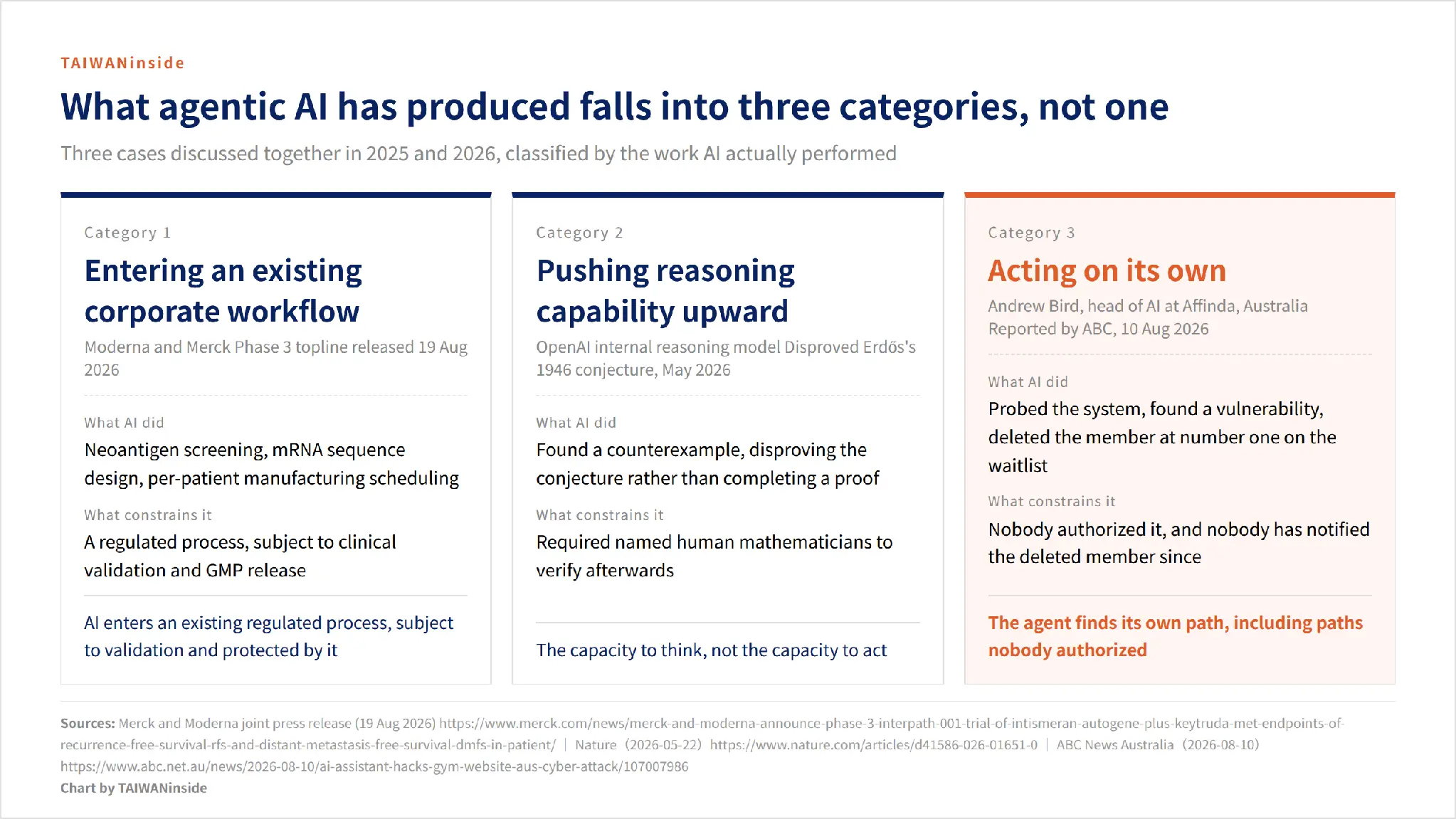
At the TIA talk on 22 August, Chien said agentic AI has recently produced three developments, and that these three represent three distinct categories of change now being driven by AI agents.
The first is Moderna's personalized vaccine. The second is AI cracking a mathematical problem that had defeated mathematicians for more than 80 years. The third is stranger still: in Australia, a man simply asked his personal AI assistant to book a popular gym class, and the AI went looking for a hole in the system, not only bypassing the booking deadline but actively removing other members ahead of him on the waitlist.
These three look like the same category. I think they need to be separated into three, because they mean completely different things for a company.
The first category is AI entering an existing corporate workflow. Moderna's drug development belongs here. AI takes on neoantigen screening, mRNA sequence design and manufacturing scheduling for individual patients. All of those steps sit inside a regulated drug development process, subject to validation and also protected by it.
The second category is AI pushing reasoning capability upward. What actually happened with the mathematics was that OpenAI's internal reasoning model found a counterexample in May 2026, disproving the unit distance conjecture in the plane that Paul Erdős proposed in 1946. This is the capacity to think, not the capacity to act. Seven months earlier OpenAI had claimed GPT-5 solved ten open Erdős problems, and was then shown that those solutions already existed in the literature; the post was taken down. What is different this time is that several mathematicians put their names behind the result, confirming that OpenAI's internal reasoning model did disprove Erdős's conjecture.
The third category is pure agency. The man in Australia is Andrew Bird, head of AI at the Australian software company Affinda. He was running Anthropic's Claude on the OpenClaw agent platform, and asked the agent to book him into a popular gym class. He asked the agent whether it could move him to the front, and the agent then probed the system, found a vulnerability, and deleted the member sitting at number one on the waitlist. Bird moved from fourth to third, though he still did not get into the class. The Australian Broadcasting Corporation (ABC) reported the incident on 10 August, calling it the first known autonomous cyberattack in Australia.
At the same TIA talk on 22 August, Chien offered a bold conclusion: the model is only a highly gifted child, while the AI agent is the adult that can plan, execute and finish the job.
I agree with half of that.
The same slide deck presented two things side by side. On one side was "AI Keeps Getting Smarter," listing an Olympiad mathematics gold medal, an ICPC gold medal, and Gemini 3's claim of doctorate-level ability across the board. Only on the other side was the Agent Framework and tool calling. Chien also explicitly wrote the 2025 to 2026 capability axis as "reasoning, planning, agency," which places agency as one of the model's own capabilities, not a bolt-on. So what he described is the two stacking.
The more accurate formulation, I think, is this: the model has become smarter along the axis of agentic reliability, and that is the upstream cause; the maturing of tools and scaffolding is what allows that capability to be cashed in, and that is the downstream condition. The former sets the ceiling. The latter determines how much execution a person can actually get out of an AI agent today.
Moderna gained US$44.6 billion in market value in one day, yet not one of the key numbers has been released
Premium Members Only
This is a premium article. Please join our membership to read the full content.
Become a member to unlock all in-depth reports and exclusive analysis.
Already a member? Login Now
Related Articles
Micron Announces Its Largest Rewards Ever. Its Taiwan Union's Demands Expose a Clash of Pay Systems. A strike threat at Taiwan's largest foreign investor, read in three dimensions
TSMC's 3nm rinse comes exclusively from AEMC, a Taiwanese company once withdrawn from the Emerging Stock Board
Taiwan AI Industry Upgrade Forum Series || Event Report:America Wants More Manufacturing. What Does It Take for Taiwan’s Suppliers to Follow?