Micron Announces Its Largest Rewards Ever. Its Taiwan Union's Demands Expose a Clash of Pay Systems. A strike threat at Taiwan's largest foreign investor, read in three dimensions
Since August, the union at Micron's Taiwan operations has been preparing to strike, and the labor dispute has drawn wide attention. On Friday, September 11, 2026, Micron announced the largest bonus program in its history, covering more than 60,000 employees worldwide, including those in Taiwan. A strike campaign by a union at a foreign company in Taiwan is rare. The dispute involves at least three dimensions, and how it unfolds and ends is worth examining closely.
Start with the latest bonus program. In its statement, Micron said the payout is the largest in the company's history and reflects its commitment to letting every team member share in the results they helped create.
In Taiwan, every employee who joined before August 29, 2025 will receive a cash bonus of NT$1 million (about US$32,000); employees hired during fiscal 2026 will receive a prorated amount. An entry-level engineer in Taiwan now averages NT$2.9 million (about US$92,000) a year in cash compensation, rising to NT$3.4 million (about US$108,000) once stock-account awards are counted.
This unprecedented distribution comes right after record results driven by global demand for AI and memory. Micron's fiscal 2025 revenue grew 49% to US$37.4 billion, and revenue in the first three quarters of fiscal 2026 has already reached US$78.6 billion, roughly three times the same period a year earlier.
Even so, the Taiwan union that has been preparing to strike is still holding out for structural reform: a bonus pool equal to 15% of operating profit, paid quarterly rather than annually.
This labor confrontation at a foreign technology company in Taiwan is the first strike campaign of its kind in years. Micron employs 15,000 people on the island and has invested more than NT$1.6 trillion (about US$51 billion) there, both the largest figures of any foreign company in Taiwan. With the semiconductor and AI cycle at its hottest, at least three angles are worth unpacking. I set them out here for discussion.
A fight over systems: Asian profit sharing versus American long-term equity incentives
First, this bonus dispute is, at bottom, a fight over systems. In short, it is a clash between the profit-sharing model familiar in South Korea, Taiwan and other parts of Asia, and the global total-rewards structure used by multinational American companies.
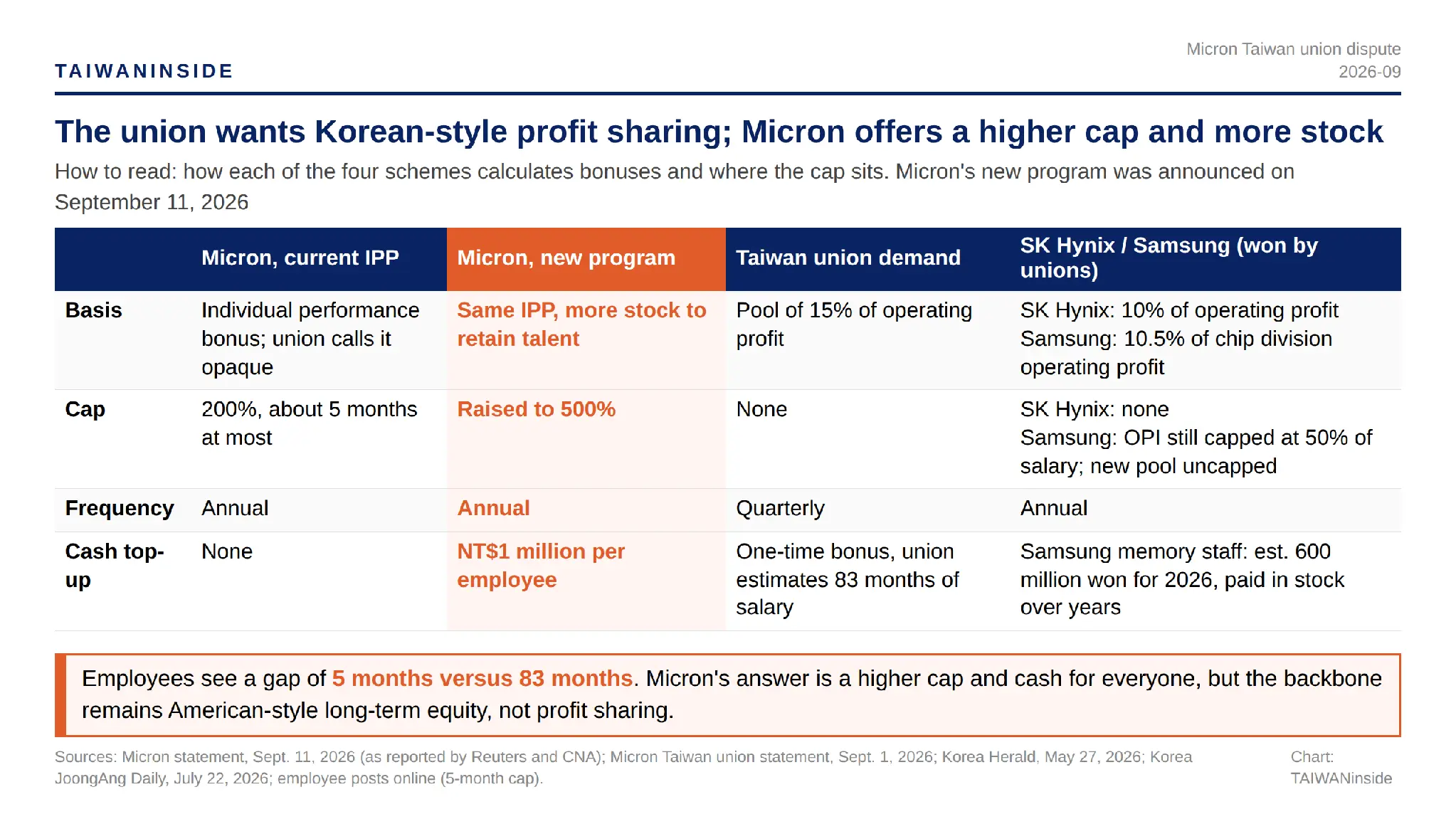
The union's headline demand is simple and easy to grasp, which is why it quickly drew media and public attention. The union wants Micron to scrap its current Incentive Pay Plan, or IPP, the annual performance bonus that the union calls opaque in its calculation and capped by a ceiling, and replace it with a fixed profit-sharing formula modeled on Samsung and SK Hynix in South Korea, setting the total bonus pool for all employees at 15% of operating profit.
On top of that, the union is demanding a one-time special bonus for fiscal 2026. By the union's own calculation, each Taiwan employee would receive the equivalent of 83 months of salary, to make up for what the current bonus system fails to reflect in a year of very high profits.
The union is plainly taking its cue from SK Hynix and Samsung. Unions at both companies have won bonus pools tied to operating profit: 10% of operating profit at SK Hynix, and 10.5% of the chip division's operating profit at Samsung. Samsung's existing excess-profit bonus (OPI) remains capped at 50% of annual salary, while the new special bonus pool has no ceiling. Under the agreement and current profit forecasts, a Samsung memory employee stands to receive bonuses worth roughly 600 million won (about US$400,000) for 2026, paid largely in stock over several years. These comparisons have become the core of the Micron union's case.
According to employees posting online, the current IPP caps the annual performance bonus at 200%, or at most five months of pay. Those same posts set this against the Korean rivals, and even against Taiwanese memory makers Winbond and Nanya Technology, which they say paid the equivalent of 40 and 36 months respectively. Among rank-and-file employees, the sense of relative deprivation has grown sharply.
From the employees' point of view, then, a pool of 15% of operating profit, as the union proposes, could be worth as much as 83 months of pay. That gap, five months against 83, is the root of the anger. In fairness, the original gap was very large, and it is easy to understand why employees found it unacceptable.
Micron has clearly taken the union's demands seriously and responded with care. Headquarters sent Chen Yufeng (陳玉鳳, transliteration), chief of staff to the chief executive, from the United States to work alongside Micron Taiwan chairman Donghui Lu, and on September 11, Micron in the United States and Micron Taiwan simultaneously announced the largest bonus program in the company's history.
The new program raises the ceiling on the IPP annual performance bonus from 200% to 500%. Micron stresses that, beyond delivering the cash portion in full, it wants to use longer-term stock awards to keep talent.
Large American companies rarely run a pure all-employee profit-sharing scheme. Where profit sharing exists in the United States, it usually takes a deferred form, as contributions to retirement plans. Like most multinational American companies, Micron uses a global total-rewards structure: base salary, an individual performance bonus (the IPP), restricted stock units (RSUs), and an employee stock purchase plan (ESPP) with a 15% discount. Micron has run this framework for many years.
The defining feature of this system is that it replaces large cash profit-sharing payouts that surge and collapse with the cycle with financial discipline plus long-term equity. That is how Micron has bound talent over time, survived one cycle after another, and still found room to make acquisitions and compete with the two Korean memory giants.
The Korean formula of roughly 10% profit sharing is indeed simple and clear, and employees may well feel it is more transparent and fair. The problem is that memory is a cyclical business. In a good year you share 10% of the profit; in a bad year there is no profit and nothing to share. Everyone should still remember how brutal 2023 and 2024 were for this industry. The current upturn in memory prices only began in the middle of 2025.
Some ask: does TSMC not pay out 12% every year? But memory and logic are different businesses. TSMC turns 40 next year. In 39 years it has never had a loss-making year, and over the long run its profits have kept growing, so paying out about 12% each year causes no controversy, because employees see their cash rewards grow with it. Memory is not like that. There are years of heavy losses, and insisting on profit sharing is not necessarily good for employees.
This is also one reason unions are so strong in Korea. A union naturally pushes for bigger bonuses while the company is profitable, but in a downturn profit sharing yields nothing, because there is no surplus to distribute. Would the union then turn around and ask the company to grant stock instead?
In fact, granting stock to employees in a loss-making year is enormously beneficial to them. According to Micron Taiwan, in 2023, the worst year of the downturn, Micron granted stock to employees at about US$56 a share. Against the closing price of about US$975 on September 11, that stock has gained roughly 17-fold. Some employees may have sold long ago, but those who held on have benefited.
So neither system, Asian profit sharing or the American mix of cash and stock, is inherently superior. They reward different things and produce different results.
Profit sharing is tied to the current year's profit. It is simple and clear, but in a lean year employees get nothing, and the company may face an exodus of talent. The American system is tied to long-term value. With this record bonus, Micron is adding cash to retain people, but it also wants to use longer-term equity to persuade high-potential employees to stay, become shareholders, and share in the long-term value of the stock.
Competing with the two Korean giants, Micron now also faces the forceful rise of Chinese memory makers
Second, the Micron Taiwan strike must be viewed within the global landscape of competition and cooperation in the memory industry. This is a long war fought at once on technology, capital and talent retention. How Micron holds on to Taiwan, its most important ally, and builds a system that can survive the cycle has become a decisive battle.
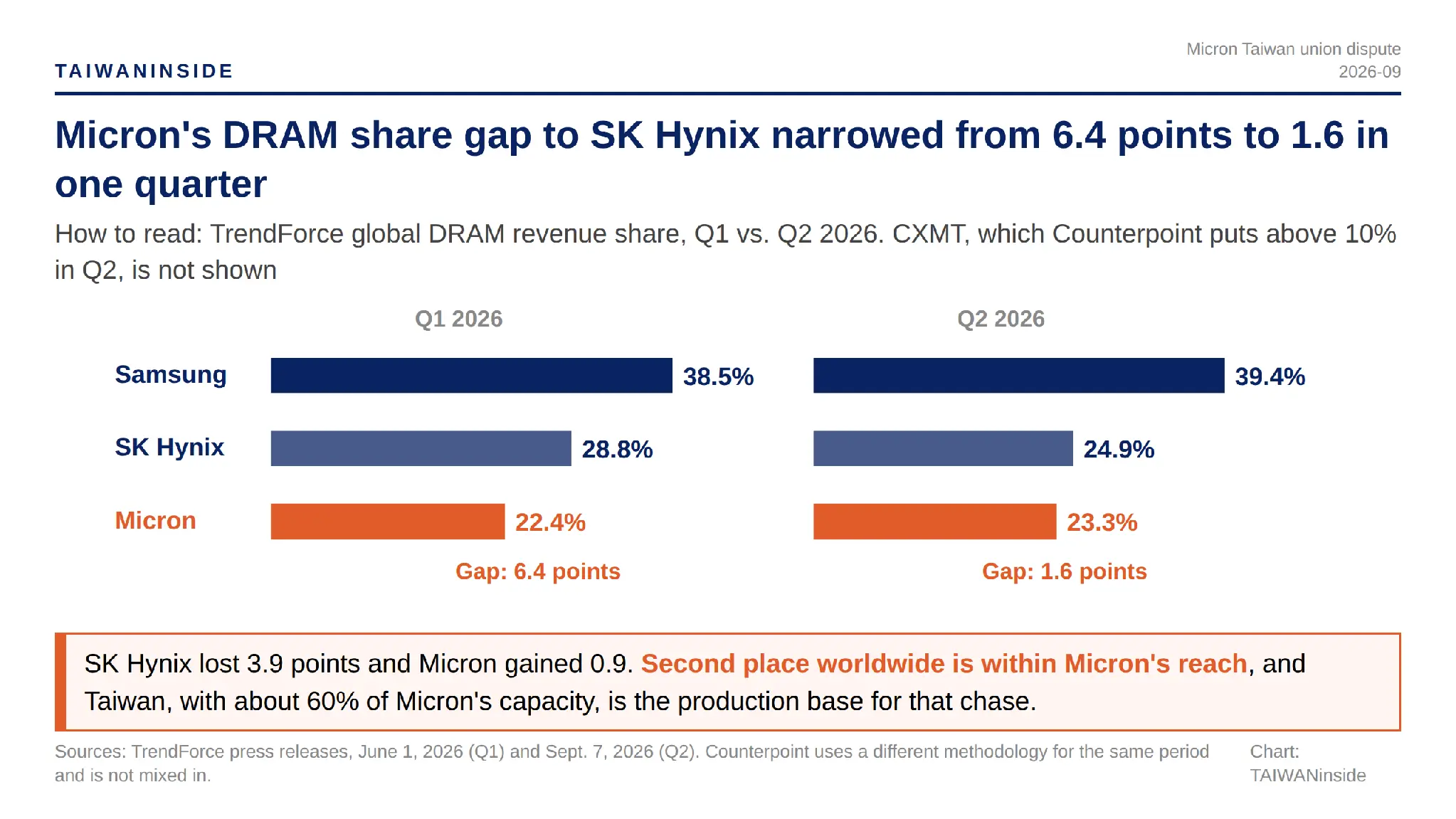
According to TrendForce's figures for the second quarter of 2026, Samsung held 39.4% of the DRAM market by revenue, SK Hynix 24.9% and Micron 23.3%. Micron's gap to SK Hynix narrowed from 6.4 percentage points in the first quarter to 1.6 points in the second, putting second place within reach.
HBM, the high-bandwidth memory stacked next to AI processors, is the decisive battleground. In 2026 all three suppliers have HBM4 in Nvidia's supply pipeline: Samsung shipped first, and in mid-March 2026 Micron announced volume shipments of HBM4 designed for Nvidia's Vera Rubin platform. According to the Korea Economic Daily, Nvidia's initial HBM4 allocation was roughly in the mid-50% range for SK Hynix, the mid-20% range for Samsung and around 20% for Micron.
Then there is CXMT, the Chinese DRAM maker ChangXin Memory Technologies, which listed in Shanghai in July 2026 and whose market value briefly ranked first among all A-share companies. CXMT is the new variable in global DRAM. TrendForce put CXMT's share of global DRAM revenue at 7.6% in the first quarter of 2026; by Counterpoint's count it passed 10% in the second quarter, fourth in the world, and pushed the big three's combined share below 90% for the first time, about two years earlier than the market had expected. Nomura projects CXMT reaching 18% by the end of 2028, and the investor Dan Niles has argued that Chinese makers could take 30% of global DRAM by 2030.
China's NAND flash maker YMTC, Yangtze Memory Technologies, overtook Kioxia of Japan and Micron in shipments in the second quarter of 2026 to become the world's third-largest NAND supplier by volume, with about 14%, behind Samsung at 25% and SK Hynix at 22%, according to Counterpoint. YMTC still trails Kioxia and Micron in revenue, but over the longer run, YMTC moving ahead looks like a matter of time.
So the full-scale offensive by China's memory industry is what Micron really has to worry about. Just as AI is driving a boom in memory, Micron has to compete with the two Korean incumbents and, on top of them, with Chinese makers that enjoy the full backing of Beijing. In a contest between the two superpowers, Micron has to combine with other forces to answer China, and at the center of the non-China supply chain is Taiwan.
For Micron, Taiwan is without question its most important production base. Its 15,000 Taiwan employees are 25% of a global workforce of 60,000, and Taiwan accounts for about 60% of Micron's global production capacity. From Taoyuan and Tongluo to Taichung and Tainan, Micron has folded in fabs that once belonged to Inotera Memories, Powerchip (PSMC), Rexchip Electronics and the display maker AUO, absorbing Taiwan's memory manufacturing base into Micron's heaviest production hub anywhere in the world.
That is why headquarters treated the Taiwan strike threat so seriously; the reasons were already there. Micron weighed the realities in Taiwan and Asia, adjusted parts of its cash-plus-stock bonus system, and came up with a record program for all employees worldwide. Seen that way, the logic behind the move is easy to understand.
I believe no system is perfect. Samsung, SK Hynix and even TSMC are all now thinking about how to bring in longer-term stock-based programs to retain employees, because equity produces a longer-lasting incentive than cash.
As for Micron adding cash to its existing bonus system, the goal is of course to keep its Taiwan employees and build up the Taiwan production base, so that the American system can survive the cycle. My judgment is that Micron's response to market demands will lift competition in global memory to another level, and Micron may well take on a leading role in how the industry pays its employees.
Micron and Taiwan as a community of shared fate: narrowing Taiwan's trade deficit with Korea
Third, Micron is of paramount importance to Taiwan, and that is the deeper point in this dispute. The bond between Micron and Taiwan is, I believe, the closest and least separable relationship in today's global semiconductor race, and it is equally important to both sides.
Frank Huang, the former chairman of Powerchip whose funeral was held on Saturday, September 12, sold Micron the Rexchip fab in Taichung and, later, the Tongluo fab. At a meeting with Micron CEO Sanjay Mehrotra, he said: "I am Taiwanese. I am willing to sell my fabs to Micron because I hope you can help us beat the Koreans."
Huang's earlier company, Powerchip Semiconductor, had been badly beaten by Samsung, and was driven into NT$120 billion (about US$3.8 billion) of debt and delisting. That he said this to Micron's CEO surprises no one.
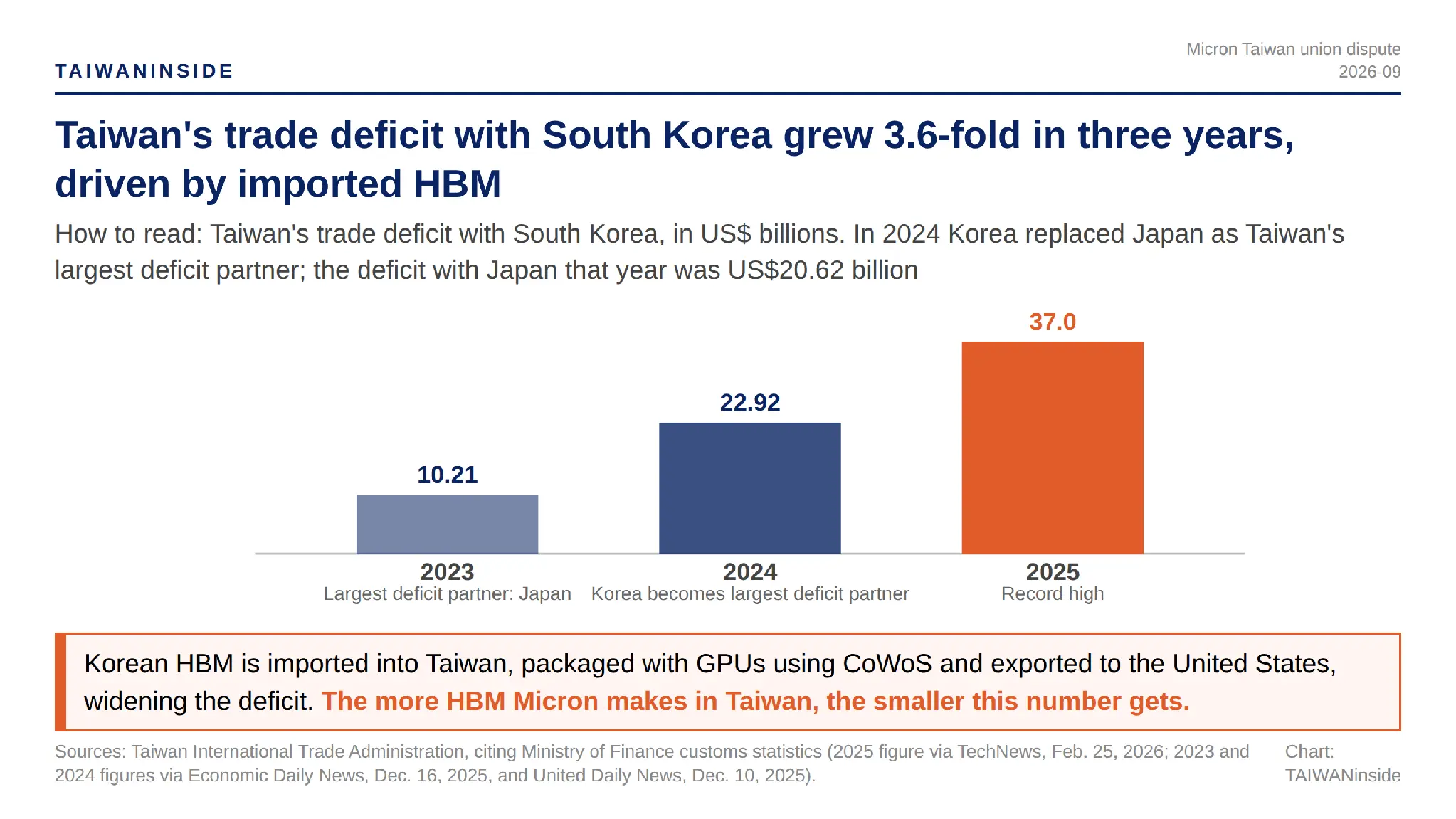
Taiwan lacks a memory maker of real scale. That is the weakest link in Taiwan's semiconductor structure. AI needs huge amounts of HBM, and with critical production scale now in Taiwan, Micron also plays a key role in narrowing Taiwan's trade deficit with South Korea.
For years through 2023, Japan was the country with which Taiwan ran its largest trade deficit. In 2024 that changed to South Korea: the deficit with Korea reached US$22.9 billion in 2024 and US$37.0 billion in 2025. The reason is that large volumes of Korean HBM are imported into Taiwan, packaged together with GPUs using CoWoS, TSMC's advanced packaging technology, and then exported to the United States. The more HBM Micron produces in Taiwan, the smaller Taiwan's deficit with Korea. That was Frank Huang's hope, and probably what many in Taiwan's industry think too.
Once Micron's program is in place, with an across-the-board cash bonus of about NT$1 million for each Taiwan employee plus a bigger IPP and more stock, employee income will rise markedly, and so will tax revenue for Taiwan.
By Micron Taiwan's estimate, its employees' personal income tax next year could reach NT$4 billion to NT$12 billion (about US$127 million to US$380 million). At the midpoint of NT$8 billion, that is about 0.9% of Taiwan's total personal income tax receipts of about NT$873.7 billion in 2025; at the high end of NT$12 billion, about 1.4%. For a single company, that is a significant fiscal contribution.
There is more. Mark Liu, the former chairman of TSMC, had long pushed for a deep alliance between Micron and TSMC; after retiring he joined Micron's board, keeping the relationship between the two companies alive. K.C. Hsu, who left TSMC to serve as chairman of Micron Taiwan and then returned to TSMC, now leads advanced packaging technology development and silicon photonics there, and is likewise pushing the two companies toward closer cooperation.
Beyond HBM, Micron has bought, refitted and built many fabs in Taiwan, working closely with local fab-construction contractors such as United Integrated Services, L&K Engineering, Marketech International and Yankey Engineering, and it has taken these partners abroad, to Singapore, Hiroshima in Japan and its sites in the United States.
In July 2026, Micron announced up to US$3 billion to strengthen the U.S. semiconductor ecosystem, including a 10-year silicon wafer supply agreement with Taiwan's GlobalWafers and US$500 million in strategic financing to support GlobalWafers' new fab in Texas.
Micron is helping Taiwan's semiconductor supply chain onto the world stage. That relationship of trust is Taiwan's most important asset in the global semiconductor industry today, and the key to keeping Taiwan competitive. I hope the Micron Taiwan union and Micron's management can find a workable solution and bring this conflict to a good end, so that Taiwan, an island of trust, keeps shining in the world.
Related Articles
TSMC's 3nm rinse comes exclusively from AEMC, a Taiwanese company once withdrawn from the Emerging Stock Board
Taiwan AI Industry Upgrade Forum Series || Event Report:America Wants More Manufacturing. What Does It Take for Taiwan’s Suppliers to Follow?
Taiwan Built the Foundry Model. It Does Not Transfer to Personalized Cancer Vaccines.