TSMC's 3nm rinse comes exclusively from AEMC, a Taiwanese company once withdrawn from the Emerging Stock Board
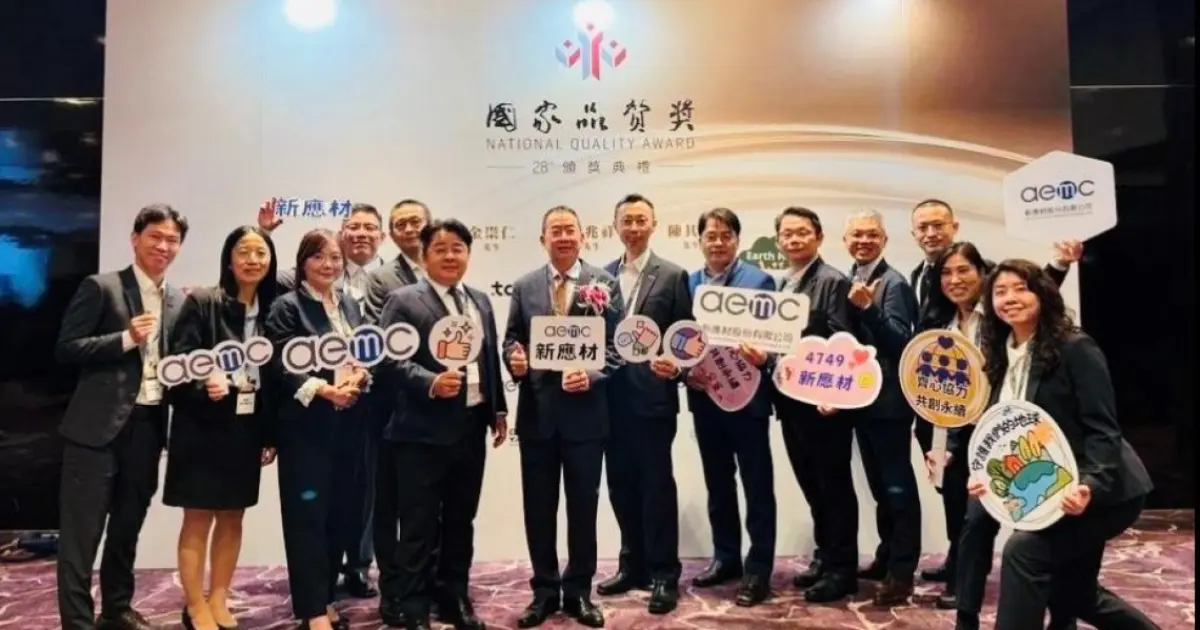
TSMC has pursued local procurement for years. In 2024, 65% of the indirect materials it bought for its Taiwan operations came from local suppliers, and the target for 2030 is 68%. Among those materials, the specialty chemicals used in leading-edge processes have until recently come almost entirely from large American, European and Japanese companies. Advanced Echem Materials (新應材, AEMC) is one of the few Taiwanese companies to have reached the most advanced nodes. AEMC is the sole supplier of rinse for TSMC's 3nm process. For another photolithography material, chairman Vincent Chan says the company submitted samples more than 1,400 times over more than six years, ultimately winning an order for the 2nm process. As of September 2026, the search of English-language financial media conducted for this article found no report on TSMC's switch from an American supplier to a Taiwanese one for this material. This article follows how AEMC went from being withdrawn from Taiwan's Emerging Stock Board in 2011 to where it stands today, and how far the same method has carried its affiliate e-Ray Technology, which registered on the Emerging Stock Board in August 2026. It offers two things: an account of how TSMC's Taiwanese supply chain was built, and a way of reading a supplier newly registered on the Emerging Stock Board, by how hard the supply relationship is to replace rather than by the first-day price jump.
On 28 August 2026, e-Ray Technology (昱鐳應材) registered for trading on Taiwan's Emerging Stock Board at a reference price of NT$168 (about US$5.3) and closed the day at NT$395, 135% above the reference price. The Emerging Stock Board is the market where Taiwanese companies trade before a formal listing on the main board or the over-the-counter market. Few investors had heard of e-Ray, but a look at its shareholder register shows that its largest shareholder, with 25.08%, is AEMC, the sole supplier of the rinse (a surface-conditioning chemical) that TSMC's 3nm process requires. AEMC itself was withdrawn from the Emerging Stock Board in 2011. How did a company pulled from the board end up, nine years later, on TSMC's 3nm line, riding the global surge in AI demand?
AEMC's chairman, Wen-Hsiung Chan(詹文雄), who goes by Vincent, took the post in 2018. In his second year, TSMC came to audit the plant for the first time.
Recalling 12 May 2019, Chan says: "That morning, a little after ten, TSMC called and said they would bring people to visit the plant at two o'clock that afternoon."
It was a Sunday, and Mother's Day, Chan says. He had gone home to Yanchao in Kaohsiung, in southern Taiwan, to have lunch with his mother. When the call came, he thought: what was coming had finally come. He phoned every manager and told them to be there, then went straight to the high-speed rail to get back to Taoyuan. It was a holiday weekend and the train was full; he stood the whole way.
That day, J.K. Lin (林錦坤), then a senior vice president at TSMC, arrived with the heads of research and procurement. At two o'clock sharp they said they wanted to see AEMC's factory first, giving the company no time to prepare. The point of walking the plant unannounced was to see for themselves whether AEMC's factory management was in order.
After the tour, Lin sat down with Chan and the AEMC team for a long conversation. The advice he offered at the end was that AEMC should concentrate on rinse. The company did not have many people, so it could only focus on one product, and TSMC at that time badly needed a local supplier for this one. He told AEMC to go straight to developing it for the needs of the 3nm line.
Rinse is a cleaning solution used in the photolithography step. Photolithography is the stage of chipmaking in which the circuit pattern is transferred onto the wafer; in Taiwan it is called the "yellow light" process, because the work areas were lit with yellow lamps in the early days. Photoresist is the light-sensitive material used in this step: it is coated onto the wafer, and after exposure and development the circuit pattern remains in the resist, leaving residue on the surface. The role of the rinse in the process is to clean that surface without damaging the pattern that has just been formed, while also conditioning the wafer surface so the next step can proceed.
At that time AEMC had only 40 people in research and development. Chan assigned 30 of them to semiconductors, eight of whom worked on CIS (image sensor) materials for VisEra, TSMC's affiliate. As he puts it: "With limited people, you have to focus. Go after TSMC and nothing else."
From that day, AEMC's semiconductor business was locked onto one customer and one product. The catch was that the customer, TSMC, is the world's largest contract chipmaker, and the 3nm process was still under development in 2019; it would not reach volume production until the end of 2022.
TSMC's 3nm rinse supplier switched from the American company 3M to the Taiwanese company AEMC
Starting in 2019, AEMC began working with TSMC, sending samples several times a week. This went on for more than a year without any response from TSMC. Repeatedly sending samples without any feedback got to the point where employees asked, "Boss, do we really keep sending?"
Chan says his judgment at the time was this: "They hadn't responded, but they hadn't refused delivery either. I told the staff, I believe they are testing every one. Chemical materials take extensive procedures and resources to process afterward. If they haven't refused delivery, that means they are testing them. Everyone please keep going."
He recalls one photolithography material that AEMC started sampling at 5nm. By the 3nm process its performance matched DuPont's. "TSMC said, you have no production track record, so I'll use DuPont's for now. Then they asked me, are you going to keep going?"
"Of course we keep going, we've already submitted samples five or six hundred times!" Chan says. At 2nm, AEMC finally won TSMC's order for the photolithography material. "Now, more than six years in, we've submitted samples more than 1,400 times!"
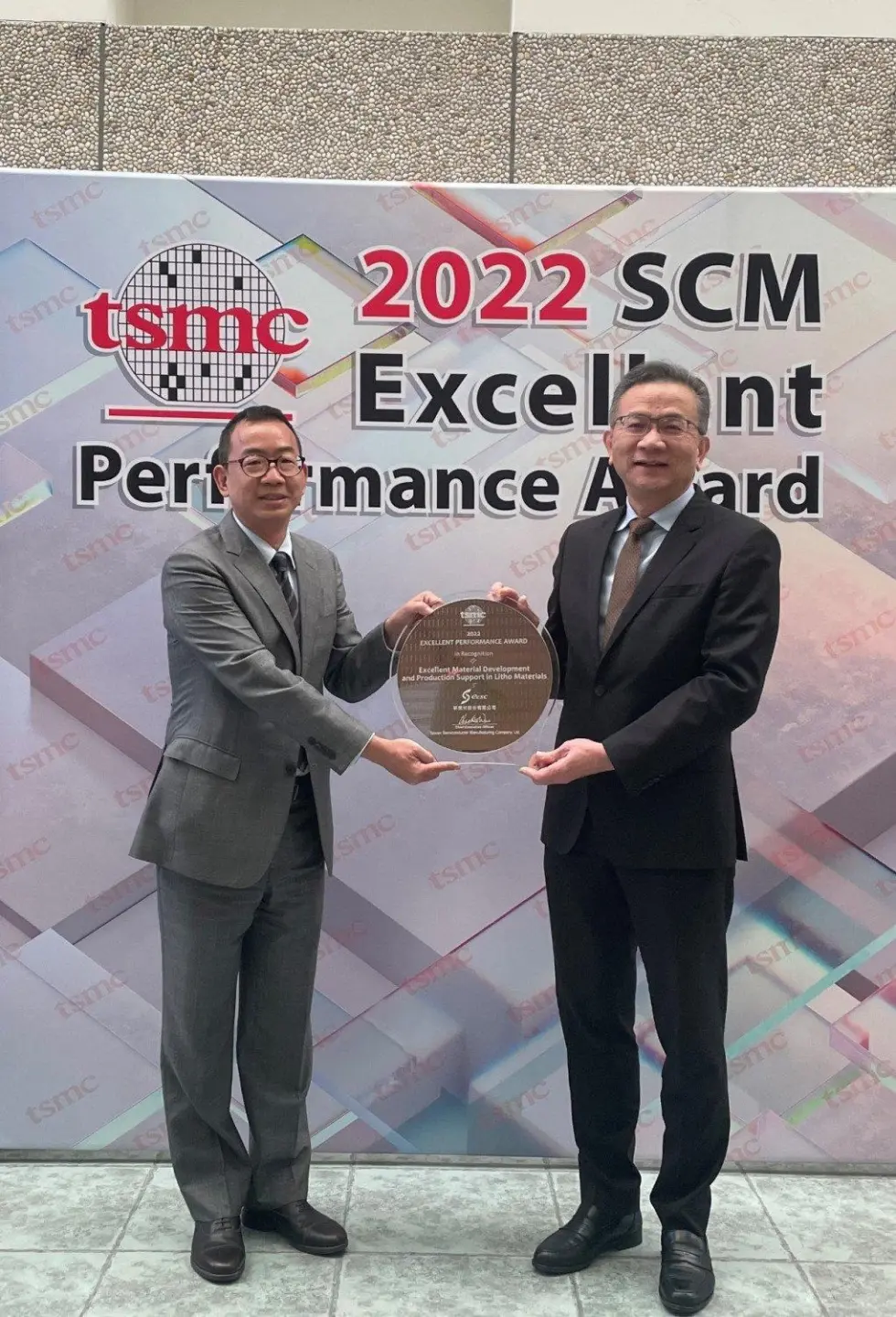
The results of AEMC's focus on rinse were substantial. By Chan's count, TSMC's rinse supplier from 40nm to 4nm was 3M; from 3nm on, it became AEMC. In 2022, TSMC gave AEMC its outstanding supplier award.
The number before "nm" is the process node. The smaller the number, the finer the circuit lines and the harder they are to manufacture. The 3nm, 2nm and 1.4nm nodes are TSMC's three most advanced generations, which the industry calls leading-edge processes; nodes such as 40nm that have been in mass production for years are called mature processes.
In terms of industry position, AEMC is a company that cannot be ignored in TSMC's specialty chemicals supply chain. Only a very few Taiwanese companies today are able to co-develop photolithography materials with TSMC at the leading nodes of 3nm, 2nm and even 1.4nm; AEMC is one of them, and it is also a case of a small maker of photoresist for flat-panel displays transforming itself into a semiconductor supplier.
Replacing an American supplier with a Taiwanese one: as of September 2026, the search of English-language financial media conducted for this article found no report on it.
Vincent Chan, from the securities industry, judged that AEMC had to move from display photoresist to semiconductor materials
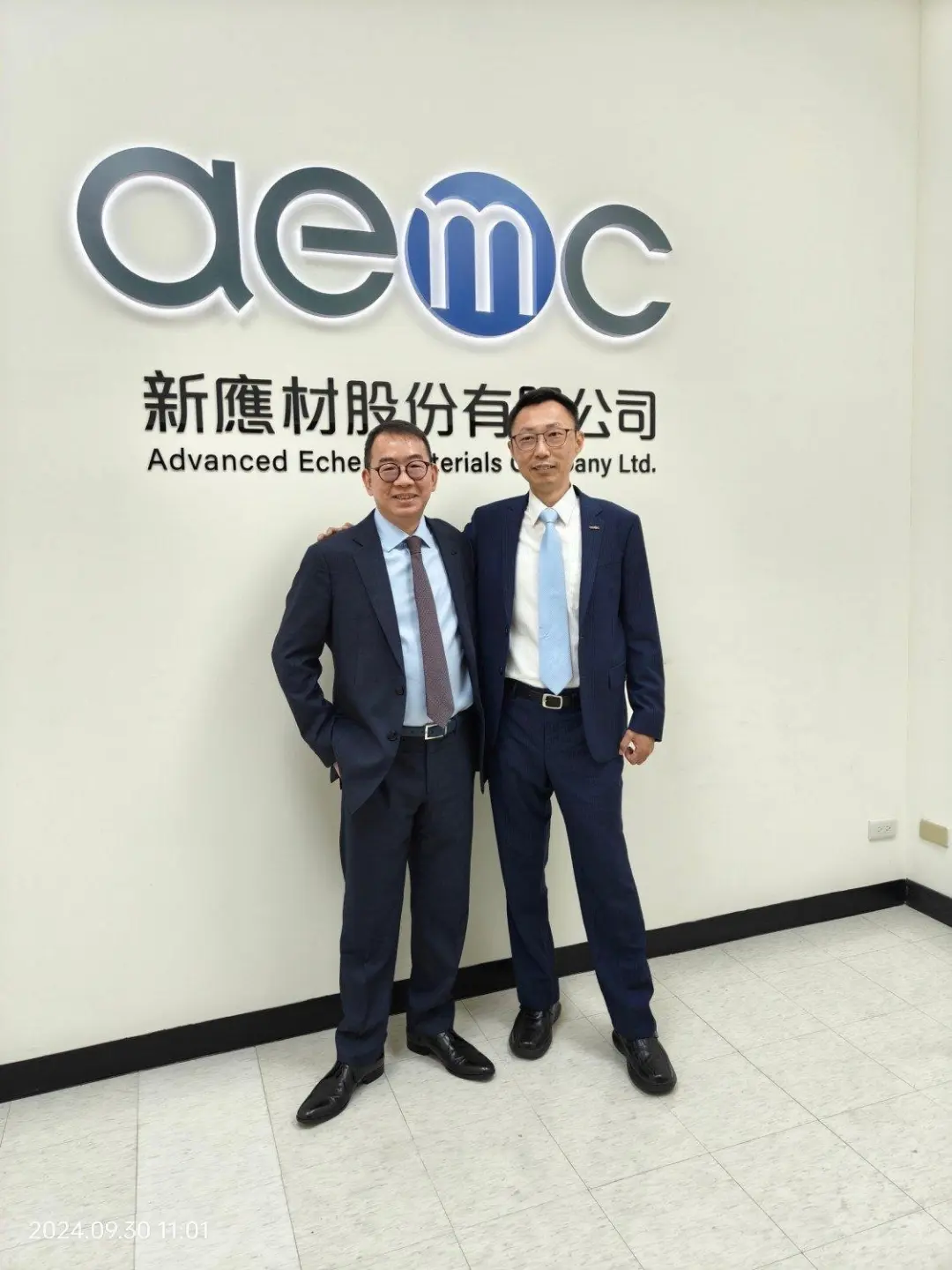
Chan, who drove AEMC's transformation, graduated from the aerospace engineering department of National Cheng Kung University and the Graduate Institute of International Business at National Taiwan University. He worked at a securities firm (倍利證券) and a fund company (華頓投信), then moved into venture capital, taking part in the management and restructuring of companies such as GiantPlus (a panel maker) and iCatch (an IC design house). In 2012 he met Yang Chih-sheng (楊智勝), then AEMC's chairman, and the two hit it off; Chan invested in AEMC.
AEMC's main business at the time was photoresist for display panels, the light-sensitive material used in making LCD panels. But its core business had lost money for four consecutive years from 2008. The company faced layoffs, a possible sale, and a team that was thinking of leaving. In 2011 its shares were withdrawn from the Emerging Stock Board. The losses had two causes: the panel industry's declining competitiveness, and the failure of a touch-panel business AEMC had invested in China after 2008.
Drawing on his experience investing in the panel and IC design industries, and on the practical experience of chairing several technology companies, Chan gradually came to see that AEMC urgently needed to transform, because Taiwan's panel industry was losing its competitiveness while the rise of semiconductors offered another direction worth moving into.
He also observed that AEMC was one of very few companies in Taiwan with the capability to develop specialty chemical materials. He decided to back the team led by general manager K.L. Kuo (郭光埌). At the end of 2016 he joined AEMC's board, took part in a capital increase and raised his stake, and from 2018 he served as chairman, pushing the company into semiconductor materials.
Chan's case for moving into semiconductor specialty chemicals rested on several important judgments. One was that around 2017, TSMC's 7nm process was ahead in development; it entered volume production in 2018, putting TSMC ahead of Intel in process technology for the first time. Once TSMC led, its demand for local procurement was bound to rise. The other was that Taiwan's panel industry was by then almost certain to lose to China, so if AEMC kept investing in specialty materials such as panel photoresist, its chances of winning were slim.
"Only by moving into semiconductors and focusing on TSMC do we have a chance to win." That is what Chan told the board and the team at the time. He was also explicit that the market for specialty materials in mature processes was already occupied by international majors and Taiwanese firms would struggle to compete there. "Only by locking onto the leading-edge processes, where the technical barrier is higher, do we get a chance to leapfrog the established competitors."
The insight on the other side of that judgment was that even if AEMC could make a mature-process material, the customer would have no reason to switch.
After half the board resigned, Chan set AEMC's capital expenditure at NT$1.5 billion
The transformation faced many challenges. When Chan took over, some directors thought the company should stay in panel materials. "When I became chairman, almost half the board resigned. They were worried Vincent would run the company into the ground."
The original shareholders disagreed about the company's direction, and morale inside the organization sank. Many employees, seeing that Chan came from the securities industry, doubted whether he could lead the company out of its difficulties.
Facing that skepticism, Chan spent three months speaking with team members one by one, building consensus and laying out the transformation's goals and vision. He was candid too: "The worst outcome is failure. But even if we fail, the team will have learned how to develop leading-edge process materials, and that is experience the industry badly needs."
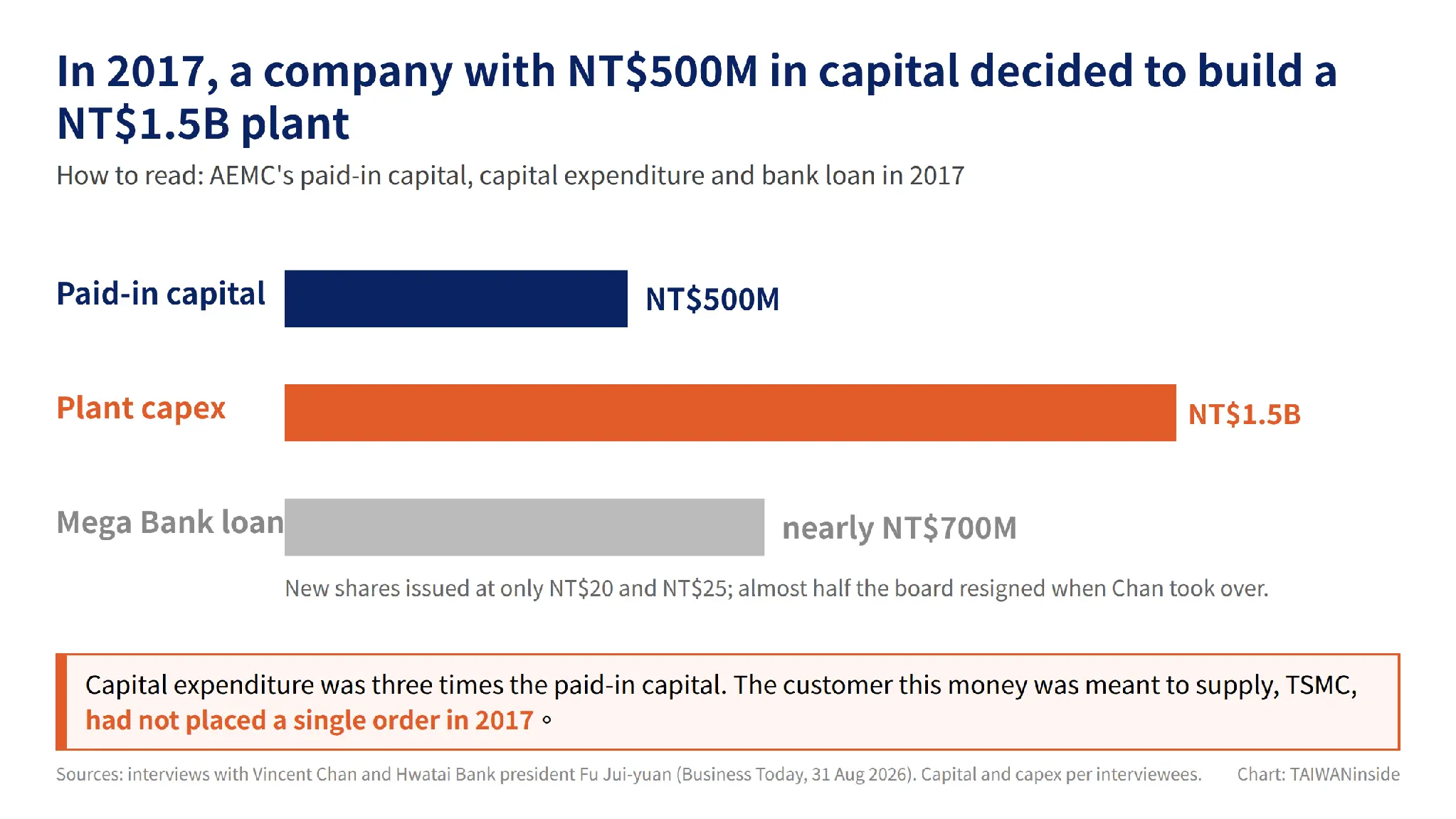
The other big challenge was the funding gap. In 2017 Chan pushed through a capital reduction at AEMC so that shareholders unwilling to keep investing could exit, and brought in new investors. Because the business was weak and the balance sheet poor, the company could only raise capital in stages at NT$20 and NT$25 a share, and the amounts were limited. AEMC's paid-in capital at the time was NT$500 million (about US$16 million), while capital expenditure for a new plant and other items came to NT$1.5 billion (about US$47 million). In the end he gritted his teeth and approved the investment.
Facing that funding need, Chan went from door to door and in the end persuaded Mega International Commercial Bank, one of Taiwan's state-controlled banks, to provide nearly NT$700 million (about US$22 million) in loans, a show of commitment to the transformation.
Fu Jui-yuan (傅瑞媛), who was at Mega at the time and is now president of Hwatai Bank, says the nearly NT$700 million loan to AEMC looked like a big risk, but the bank had done a careful internal assessment. She pulled out the notes she had written at the time: "One, panels had bottomed and the company needed to transform. Two, the big customer, meaning TSMC, wanted to nurture local suppliers. Three, AEMC was seeking to move into semiconductor specialty chemicals. Four, the government had launched a support program for small and medium enterprises. And most important, the management team showed real determination to reform. That gave us the basis to approve the loan."
Looking back now, she says, she feels a real sense of accomplishment, seeing not only AEMC succeed but also carry other companies such as e-Ray through their own transformations. "We were not wrong. We helped Taiwan build an important semiconductor supply chain. Chairman Chan really is a formidable turnaround operator."
So, seen from the outside, AEMC's situation at the time was this: a company with NT$500 million in paid-in capital had taken nearly NT$700 million in bank loans to build a NT$1.5 billion plant, to supply a customer that had not yet placed an order.
AEMC shipped its first batch in October 2020; the second, in November, could not be delivered
The collaboration with TSMC was another long process. Behind the transformation are many stories of a team holding on through a drawn-out fight.
Huang Chia-neng (黃嘉能), founder of the semiconductor packaging materials group Chang Wah, was invited by Chan onto AEMC's board at the time, and Chang Wah Electromaterials later subscribed to nearly 10% of AEMC's shares. He says the period before 2020 was AEMC's hardest. Now retired, he draws on his own experience running companies: "If you work with the strongest company in the world, the result is usually either very good or very bad. Great companies are demanding. If you don't deliver, it can put you out of business."
Chan decided to go for it, and Huang says that in hindsight the outcome was of course very good, but at the time even his own judgment was: "Don't invest, and you wait to die. Invest, and you go looking for death."
Even so, Huang decided to back Chan all the way. AEMC's borrowing terms with the banks were poor at the time, so he asked Chang Wah's finance department to introduce banks it had worked with for years. He also put the word out to other wavering shareholders: "If anyone wants out, come to me. I'll take all your shares." He wanted Chan to be able to push ahead with no worries behind him.
Before volume shipments began, every test was a test of how much AEMC could take. In October 2020, AEMC finally shipped its first batch, worth NT$40 million (about US$1.25 million). In November, the purity of the material slipped out of control and the batch could not be delivered. After adjusting the formulation and the process, AEMC shipped another batch in December. The gross margin was only 10%. Yet four key strategies would carry the company, six years later, to a secure place in TSMC's leading-edge supply chain, and the story is also a rare window into the distinctive way TSMC works with its supplier ecosystem.
Premium Members Only
This is a premium article. Please join our membership to read the full content.
Become a member to unlock all in-depth reports and exclusive analysis.
Already a member? Login Now
Related Articles
Micron Announces Its Largest Rewards Ever. Its Taiwan Union's Demands Expose a Clash of Pay Systems. A strike threat at Taiwan's largest foreign investor, read in three dimensions
Taiwan AI Industry Upgrade Forum Series || Event Report:America Wants More Manufacturing. What Does It Take for Taiwan’s Suppliers to Follow?
Taiwan Built the Foundry Model. It Does Not Transfer to Personalized Cancer Vaccines.