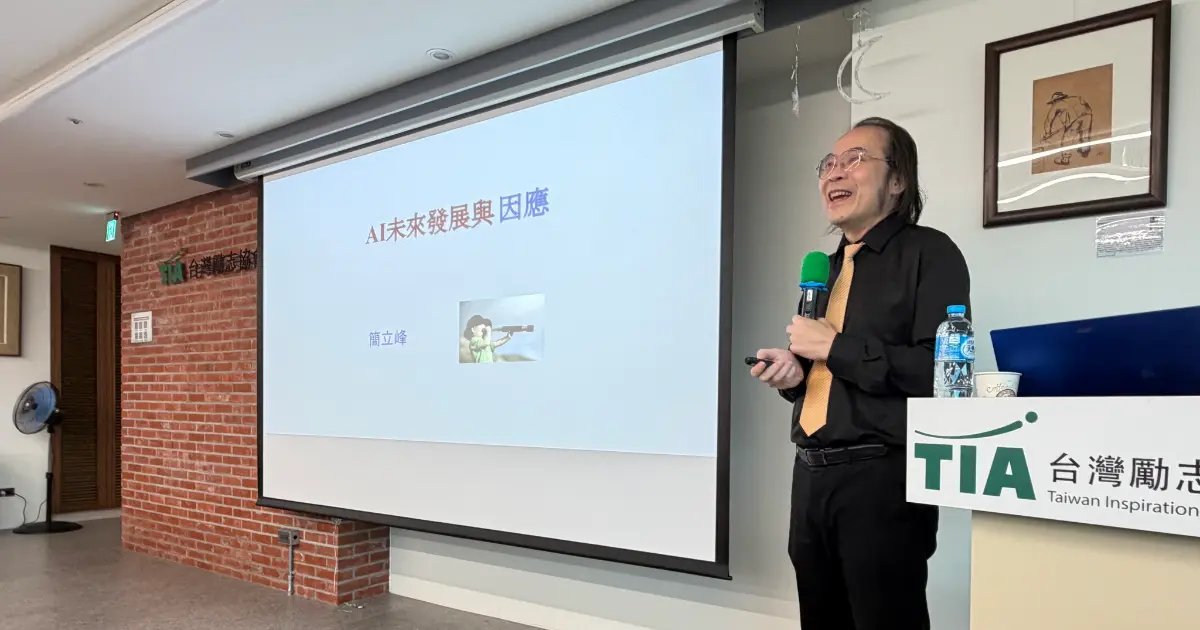
TSMC in Kumamoto Sparks Debate Over Japan’s Global Engagement: Experts Say ‘Look to Taiwan’
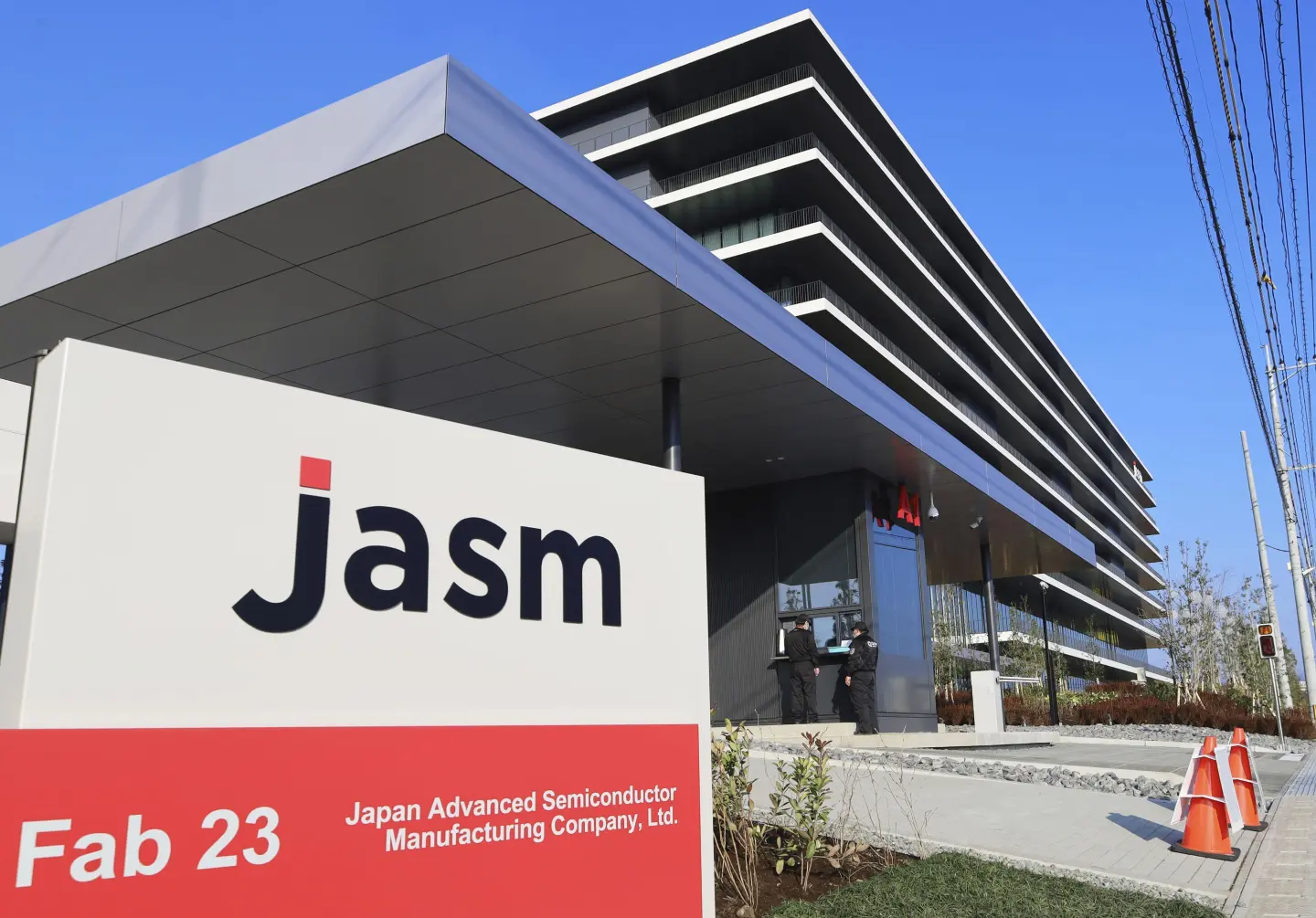
On May 12, 2025, I attended the Taiwan-Japan Forum held in Fukuoka, Japan. Organized by the Kyushu-Taiwan Future Institute, the event focused on future developments in industrial cooperation and talent cultivation between Kyushu and Taiwan. The forum featured several prominent figures from Japan’s academic and business communities. Representing Taiwan, I joined Professor Lee Shih-hui(李世暉), Chairman of the Taiwan Institute of Japanese Studies and a professor at National Chengchi University. I gained many valuable insights during the event and would like to share them here.
The Kyushu Taiwan Future Research Institute, founded by longtime regional talent development advocate Naoki Kumamoto, is dedicated to fostering dialogue and collaboration between Kyushu and Taiwan in industry, education, and regional revitalization. Since its establishment in 2022, the institute has hosted multiple Taiwan-Japan forums and has emerged as a key think tank promoting cross-strait engagement in southern Japan. On the Taiwanese side, the Taiwan Institute of Japanese Studies, affiliated with National Chengchi University, is one of the few academic centers focusing on Japanese policy and society, offering research-based policy insights and platforms for international dialogue.
Mr. Naoki Kumamoto(隈本直樹), founder of the Kyushu-Taiwan Future Institute and organizer of the forum, has long been in charge of talent development at KAIL(碧樹館), a program under the Kyushu Asia Management School. He has dedicated himself to supporting local companies in Kyushu by training young professionals from the region.
In 2018, Mr. Naoki Kumamoto made his first visit to Taiwan. He was deeply impressed by the rapid development of Taiwan’s high-tech industry and its agile responses to various challenges, which he believed offered valuable lessons for Japanese companies. As a result, he relocated the Kyushu Asia Management School’s training program to Taiwan on four separate occasions, each time leading dozens of students there to learn firsthand.
With TSMC establishing a plant in Kumamoto, the economic ties between Kyushu and Taiwan have become even stronger. Mr. Naoki Kumamoto invited me twice to serve as a lecturer in his training programs, hoping that I could share the spirit of innovation driving Taiwan’s tech industry with young people in Japan. He believed that learning from Taiwan’s real-world experiences would inspire them and help further develop Kyushu, a region long regarded as peripheral in Japan.
TSMC’s Kumamoto plant, officially known as Japan Advanced Semiconductor Manufacturing (JASM), is located in Kikuyo, Kumamoto Prefecture. It is a joint venture between TSMC, Sony, Denso, and the Japanese government. Phase one construction began in April 2022 and was completed by the end of 2023. On December 23, 2024, the Kumamoto government and TSMC jointly announced the start of mass production. The facility produces 12 to 28-nanometer mature-node wafers for applications such as automotive electronics and image sensors. The first phase of the plant has a monthly capacity of 55,000 wafers. A second phase is scheduled to begin construction in 2025 and enter production in 2027, expanding into 6 to 7-nanometer processes. Combined, the two phases are expected to reach a total capacity of 100,000 wafers per month. JASM marks a significant starting point for Taiwan-Japan collaboration in the semiconductor industry and served as a key backdrop for the organization of this forum.
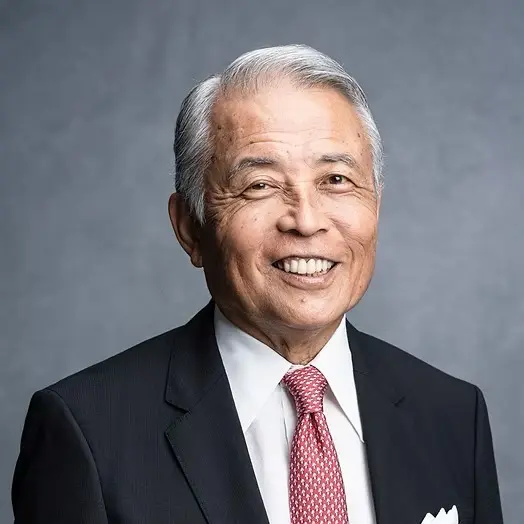
The first speaker at yesterday’s forum was Mr. Yutaka Aso(麻生泰), the younger brother of former Japanese Prime Minister Taro Aso. He currently serves as Chairman and Representative Director of Aso Corporation and is also the Honorary Chairman of the Kyushu Economic Federation.
Japan’s Declining Global Standing and a Society Slow to Awaken
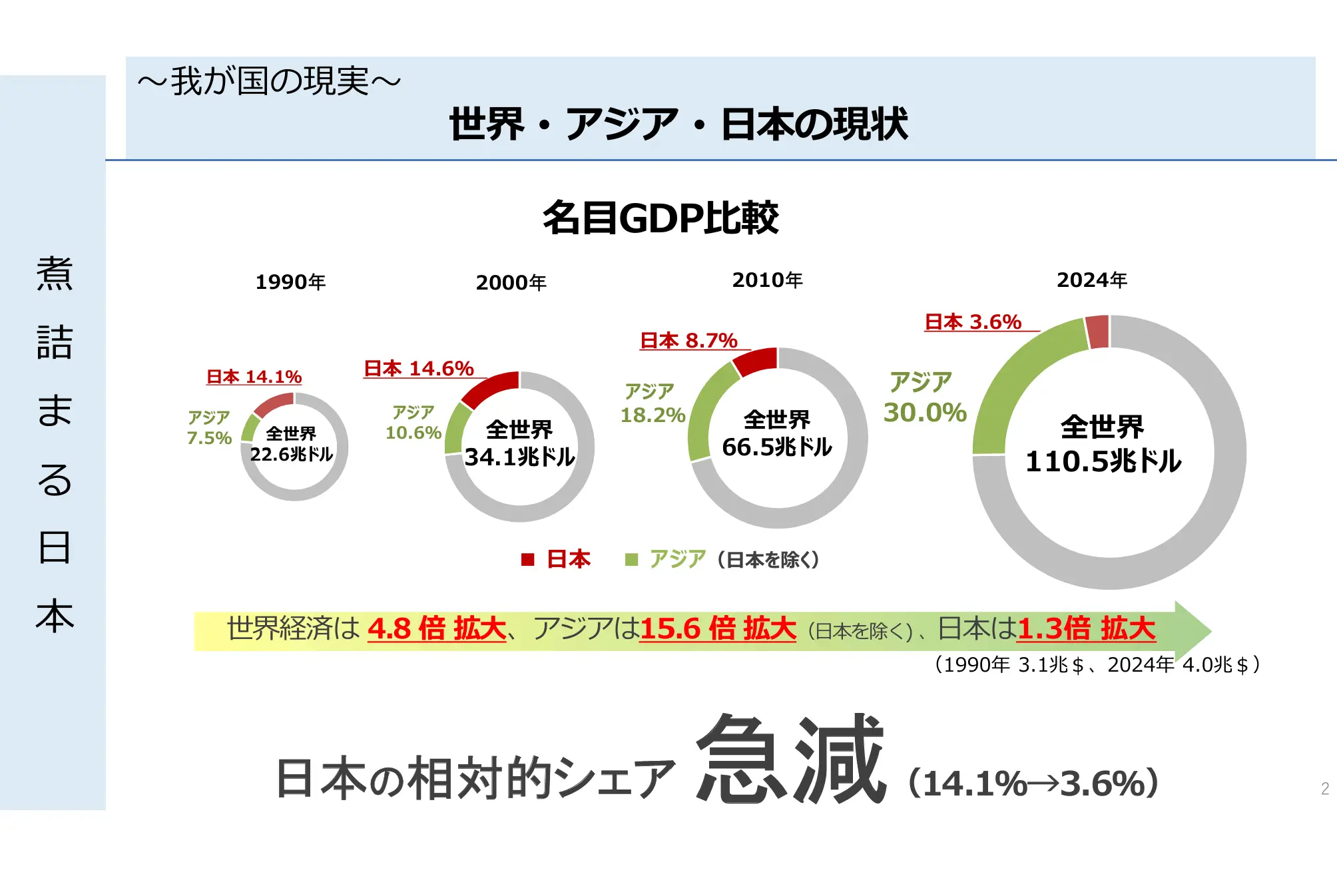
In his speech, Mr. Yutaka Aso expressed deep concern over Japan’s declining international standing in recent years. Since 1990, Japan’s share of global nominal GDP has steadily decreased—from 14.1% in 1990 to just 3.6% last year. During the same period, global nominal GDP expanded by a factor of 4.8, with Asian countries growing by 15.6 times. In contrast, Japan’s growth was only 1.3 times.
He also presented data showing that Japan’s government debt ratio is currently higher than that of Greece. In terms of English proficiency, Japan’s average TOEFL score is only 73, significantly lower than China’s 90, Taiwan’s 87, and South Korea’s 86.
Perhaps most striking is that Japan, with a population of 123 million, has a passport ownership rate of just 17.5%—meaning only one in six people holds a passport. In contrast, South Korea’s rate is about 40%, the United States about 50%, and Taiwan as high as 60%, making Japan’s figure exceptionally low. Consequently, Japan’s overseas travel rate is only 15.8%, far behind Taiwan’s 71.9% and Hong Kong’s 174.4%.
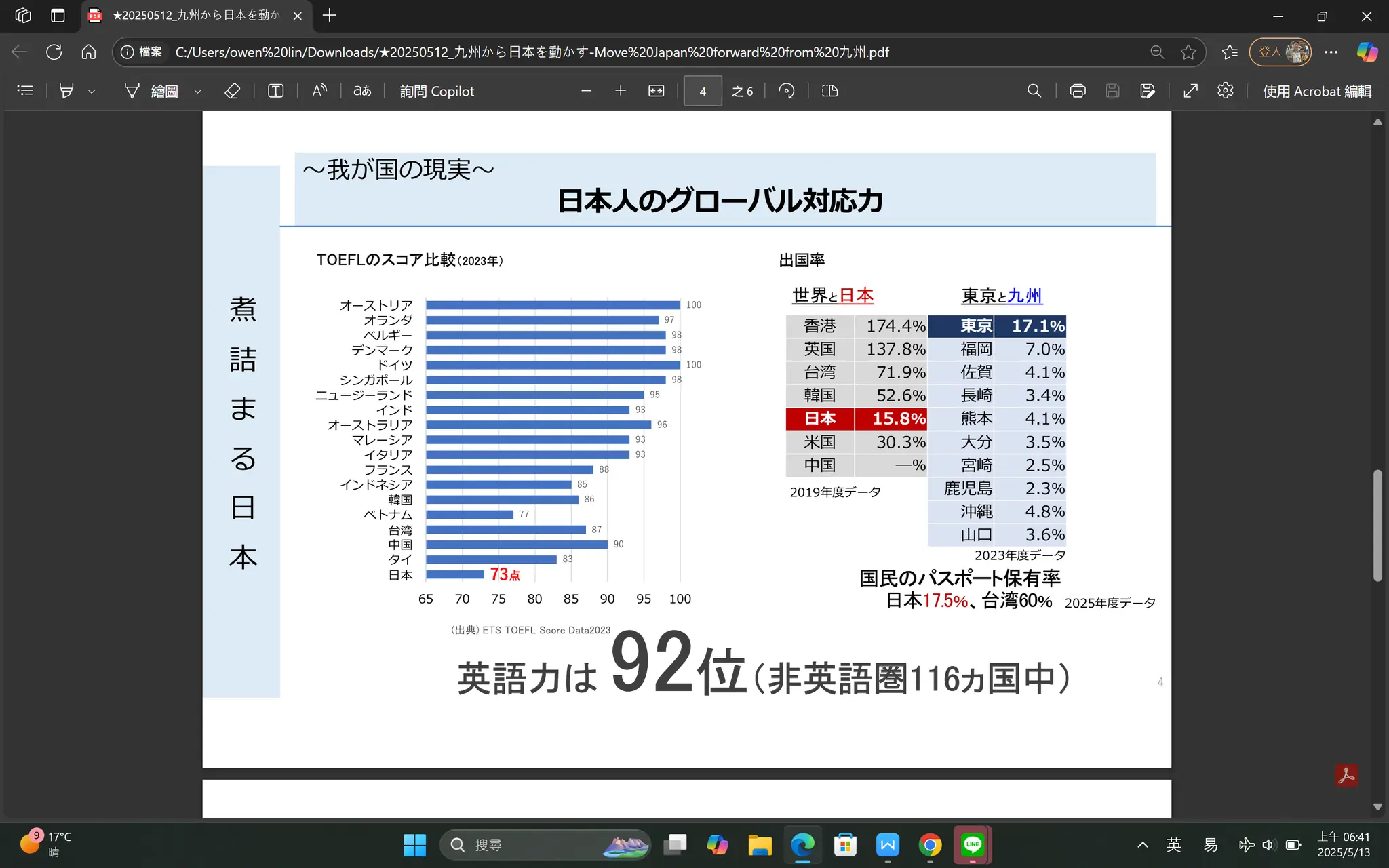
Mr. Yutaka Aso noted that many Japanese people today are unwilling to travel abroad, feeling too comfortable staying within Japan and showing little interest in the outside world—a situation he finds deeply troubling. He added that outbound travel rates in Kyushu’s prefectures are notably low; even Fukuoka, the highest among them, has a rate of just 7%, significantly behind Tokyo’s 17.1%.
He stated that these alarming statistics already reveal the path of decline that Japan may be heading toward.
He also urged business leaders in Kyushu to set clear goals for what they want to accomplish in three or five years. As for himself, he noted that although he is advanced in age, he still has many aspirations to fulfill, including his ambition to establish the best hospital in all of Japan, right in Kyushu.
Speaking about Taiwan, he noted that his family is in the cement business and previously collaborated with Taiwan Cement Corporation (TCC), which gave him the opportunity to visit Taiwan multiple times. He emphasized that Taiwan is geographically close to Japan and has experienced remarkable growth in recent years, making it a valuable model for Japan to learn from.
Mr. Yutaka Aso comes from a family of six siblings. While his brother, who once served as Japan’s Prime Minister, is undoubtedly the most well-known, Yasushi himself is among the few Japanese who studied at the University of Oxford in the UK. He is also known for his exceptionally fluent English.
He also joked in private that he is the only “mixed-blood” sibling in his family, explaining with a laugh that during his studies abroad in France, he was involved in a car accident and received a blood transfusion in the hospital — “that’s how I got mixed blood,” he said.
He remarked that nowadays, many foreigners speak of Japan in the past tense, often reminiscing about its former glory. He added that young Japanese people also seem to believe that life today is already comfortable enough, so there is little need to strive further.
“When foreigners visit Japan today and see that a bowl of ramen costs only 800 yen, they’re amazed at how cheap it is. Japan’s quality is so high—so why are the prices so low?” said Yutaka Aso, expressing deep concern about the country’s current situation.
At 79 years old, Yutaka Aso remains full of energy when speaking with young people. During the panel discussion, he attentively listened to insights shared by much younger experts. Mr. Kumamoto also invited several veteran educators from high schools and universities to exchange views on talent development and educational practices.
One of the speakers was Shohta Tsuji(辻正太), principal of FC Imabari High School’s Satoyama Campus. This private high school was established just two years ago and now has over 100 students across two academic years. Named after the professional football club FC Imabari, the school is also notable for having Japan’s renowned coach Takeshi Okada(岡田武史) on its teaching staff.
He explained that ten years ago, Takeshi Okada chose a scenic plot of land near the school, nestled between mountains and the sea, and built a football stadium for just 4.2 billion yen—a bargain compared to the 90 billion yen typically required for such facilities. Because of the school’s remote location, Okada had to fly each time he visited, totaling 167 flights in a single year, making him the most frequent flyer on All Nippon Airways that year. Shohta Tsuji himself also flew 100 times last year.
Principal Shohta Tsuji, who is in his early forties, shared that in the school’s first year, only about 30 students enrolled due to its lack of recognition. By engaging deeply with both students and parents to explain the school’s philosophy, he was able to build trust, and the second year saw full enrollment with 80 students. One-third of the students did not play football but enrolled because they admired Takeshi Okada.
The school’s educational philosophy emphasizes encouraging students to solve problems independently and offers them opportunities to intern at local businesses. There are only three core rules for students: First, do not harm yourself; second, do not harm others; and third, do not interfere with others’ learning.
Another speaker, Koji Inoue(井上弘士), is Vice President of Kyushu University, as well as a professor at the Institute of Information Science and the Director of the System LSI Research Center. Kyushu University serves as a major hub for semiconductor talent development in Japan, with many TSMC Kumamoto plant employees being alumni. However, since science and engineering students account for only about 10% of the student body, the university has introduced numerous courses to help students from non-STEM backgrounds acquire semiconductor-related knowledge.
Koji Inoue also shared his experience in talent cultivation. He is in charge of a short-term exploratory program at Kyushu University for junior and senior high school students. He observed that when students were divided into groups of five, leaders would emerge naturally, and the teams would collaborate effectively. Within just five days, from attending classes to completing their assignments, the students consistently produced impressive results. He emphasized that when young people are given a platform and opportunities, they will naturally showcase their potential.
When the discussion turned to national competitiveness, participants widely agreed that it is closely tied to talent development. The forum also explored differences between Japan and Taiwan in terms of human resources and industrial structure.
Professor Shih-Hui Lee from National Chengchi University in Taiwan pointed out that there are significant differences between Japan and Taiwan in terms of talent composition and work environment. In Taiwan, a large number of top students choose to study in science and engineering fields, whereas in Japan, the proportion of such students is relatively low—only around 10 to 20 percent of the total student population.
In addition, there are differences between Taiwan and Japan in terms of hiring practices. Taiwan’s electronics industry almost exclusively recruits graduates with science and engineering backgrounds, and due to the industry’s high concentration, it faces a persistent labor shortage. In contrast, Japanese electronics companies, faced with a smaller pool of science and engineering graduates, often hire liberal arts majors and provide on-the-job training to equip them with the necessary skills.
As a result, Japanese companies place significant emphasis on employee training, with new hires typically undergoing three to six months of onboarding programs. In contrast, many Taiwanese companies expect new employees to be job-ready and begin working immediately, with relatively little investment in formal training. This may be related to the high job-switching rate in Taiwan. Overall, Japanese companies offer more stable career paths, with around half still maintaining a lifetime employment system.
Lee also pointed out notable differences in talent demand between Taiwan and Japan. He noted that graduates with bachelor’s degrees in Taiwan’s information and electronics sectors are generally unwilling to work in Japan due to significantly lower salaries in the Japanese electronics industry. For example, TSMC employees earn much more than their counterparts in Japanese semiconductor firms, and even TSMC’s employees in its Kumamoto plant are paid less than those at the company’s Taiwan headquarters.
However, liberal arts graduates in Taiwan who study Japanese are more likely to seek employment in Japan, as their starting salaries in Taiwan are generally low—even lower than those of their counterparts in Japan.
Shared Challenges and Future Pathways in Semiconductor Talent Shortages between Taiwan and Japan
The shortage of talent is not limited to Taiwan’s electronics industry. With TSMC’s recent investment in its Kumamoto plant, the talent pool in the Kyushu region has also become increasingly strained.
According to the latest survey released at the end of March by the Kyushu Semiconductor Human Resource Development Consortium, approximately 27,000 students graduate annually from science and engineering departments, technical colleges, and industrial high schools in the Kyushu region. However, only about 9%, or roughly 2,400 graduates, enter the semiconductor industry. The industry’s current demand stands at around 3,400 people, indicating a talent shortfall of over 1,000.
The survey also revealed that only about 54% of science and engineering graduates in Kyushu chose to work in the local semiconductor industry last year, totaling around 1,300 people, or 4.8% of the total graduates. Meanwhile, approximately 46%, or 1,100 graduates, sought employment in semiconductor industries outside of Kyushu, mainly in large cities like Tokyo and Osaka, accounting for 4.2%. Due to this significant outflow of talent, the actual labor shortage in Kyushu’s semiconductor sector may be even more severe than the numbers suggest.
As a result, the shortage of semiconductor talent has become a shared challenge for both Taiwan and Japan’s Kyushu region. Addressing this issue has become a key focus for the Kyushu Taiwan Future Research Institute.
However, the challenges go beyond just the talent shortage. Some Japanese employees working at TSMC have expressed feeling significant pressure, even hesitating to request time off, with some supervisors reportedly reluctant to approve leave. This may reflect the company’s high-intensity work culture, which can be difficult for some Japanese workers to adjust to.
Naoki Kumamoto noted that although Japan and Taiwan are geographically close, they had remained emotionally distant for a long time. However, after the Great East Japan Earthquake, Taiwan’s generous and selfless donations moved many in Japan and brought renewed attention and awareness to Taiwan.
He added that Taiwan, like Japan, frequently faces natural disasters such as earthquakes and typhoons. However, Taiwan has learned to coexist with crises, always staying alert and highly responsive to market changes and emerging opportunities. These qualities, he emphasized, are ones that Japan can learn from.
He pointed out that Taiwan’s strengths are precisely where Japan is currently lacking. In fact, Japan once had a development path similar to Taiwan’s, but it has gradually forgotten the lessons of its past. The establishment of TSMC’s plant in Kumamoto offers Japan a renewed opportunity to learn and transform. This is also the direction that the Kyushu Taiwan Future Research Institute is striving toward. Looking ahead, he hopes that Kyushu and Taiwan can work together to deepen exchanges and collaboration, making Kyushu the fastest-growing region in Japan.
The shortage of semiconductor talent has become a shared challenge for both Taiwan and Japan’s Kyushu region. Addressing this issue has now become a central focus for the Kyushu Taiwan Future Research Institute, which is actively seeking solutions through dedicated research.
The shortage of semiconductor talent has become a shared challenge for both Taiwan and Japan’s Kyushu region. Addressing this issue has now become a central focus for the Kyushu Taiwan Future Research Institute, which is actively seeking solutions through dedicated research.
Naoki Kumamoto remarked that although Japan and Taiwan are geographically close, they had long remained emotionally distant. However, after the Great East Japan Earthquake, Taiwan’s generous and selfless donations prompted the Japanese public to take notice of Taiwan and gain a deeper understanding of the island.
He noted that Taiwan, like Japan, frequently faces natural disasters such as earthquakes and typhoons. Yet, Taiwan has developed a way of coexisting with crises, always staying alert and highly responsive to market shifts and emerging opportunities—qualities that Japan could learn from.
He pointed out that the strengths Taiwan demonstrates are precisely what Japan currently lacks. Many of the challenges Taiwan has overcome mirror those Japan once faced, but the lessons from those experiences seem to have been forgotten in Japanese society. With TSMC’s new plant in Kumamoto, Japan now has another opportunity to learn from Taiwan. This aligns with the mission of the Kyushu Taiwan Future Research Institute, which seeks to promote closer cooperation between Kyushu and Taiwan, aiming to transform Kyushu into the fastest-growing region in Japan.
Tags
Related Articles
Micron Announces Its Largest Rewards Ever. Its Taiwan Union's Demands Expose a Clash of Pay Systems. A strike threat at Taiwan's largest foreign investor, read in three dimensions
TSMC's 3nm rinse comes exclusively from AEMC, a Taiwanese company once withdrawn from the Emerging Stock Board
Taiwan AI Industry Upgrade Forum Series || Event Report:America Wants More Manufacturing. What Does It Take for Taiwan’s Suppliers to Follow?