At age 80, Acer’s founder is still launching startups and pushing for governance reforms in Taiwan’s business sector

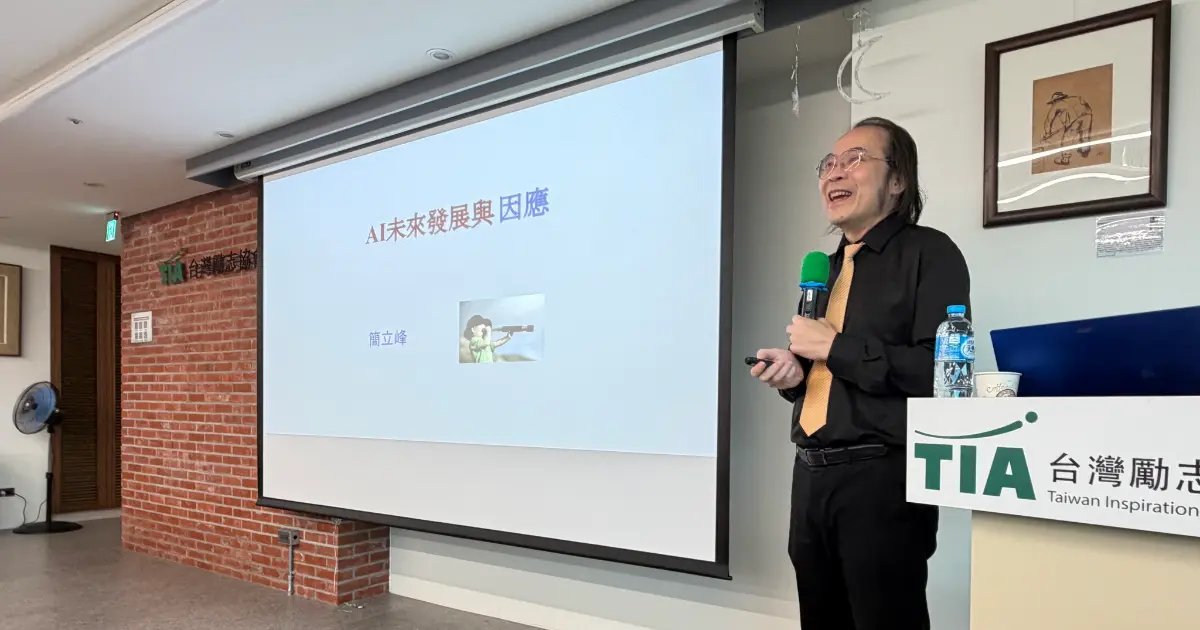
On Saturday, July 5, 2025, I was invited to speak at the 20th annual “Silkworm Metamorphosis” conference hosted by the National Innovation and Entrepreneurship Association. I had the opportunity to listen to three excellent presentations, engage in deep conversations with past startup role models, and hear insightful commentary on industry development and strategy from Stan Shih, the founder of Acer. Here are some of the key insights I’d like to share.
The forum featured four keynote speakers. Wen-nan Chan(詹文男), Dean of the Digital Transformation Academy, spoke on “Digital Empowerment and Innovative Transformation.” Dr. Chien-Chung Chu(曲建仲) presented “NVIDIA’s Three-Trillion Miracle and the AI & Semiconductor Revolution.” Chih-Jen Chen(陳志仁), Deputy General Manager of Nomura Research Institute Taiwan, discussed “Ten AI Application Case Studies.” My talk focused on “TSMC and Taiwan’s Next Move Under Trump 2.0.”
Dean Wen-nan Chan’s speeches are always both witty and philosophical. He gave an example: “Lin Chi-ling(林志玲)—an internationally known Asian model and actress—played a young lady in her early career, a mother in her middle age, and a grandmother in her later years. Would you call that a transformation?”
When he posed this question to the audience, the reaction was rather muted. So he followed up by saying, “But what if Lin Chi-ling started as a young lady, then played a mother in middle age, and later became a director—wouldn’t that be a more accurate example of transformation?”
He also remarked that even religious temples are actively embracing digital transformation. One notable example is Beigang Wude Temple—one of Taiwan’s most revered and popular religious centers—which has been vigorously developing AI applications. It has purchased three NVIDIA GPUs and adopted software company solutions to analyze visitor flows, identifying itself as the most visited temple in Taiwan. Furthermore, the temple uses AI to interpret Luanwen—texts delivered by deities to devotees during religious rituals—offering worshippers the most fulfilling and personalized spiritual experience possible.
This brings to mind my private conversations over the years with past recipients of Taiwan’s Startup Role Model recognition. The National Innovation and Entrepreneurship Association—a public-sector initiative in Taiwan dedicated to innovation and startup support—was founded in 1972 and began selecting Taiwan Startup Role Models in 1978. Over forty cohorts have been recognized since then, and many of these companies have grown into leading Taiwanese enterprises, spanning from traditional industries to electronics. Among them are 18 companies under Daxin Semiconductor Holdings, part of TSMC’s supply chain. The association is now led by Ming-Chien Chiu, chairman of Gudeng Precision, who is also the founder of Daxin Semiconductor Holdings.
However, in the face of rapid environmental change, some startup role model companies have successfully adapted and continued to grow. Yet, more than half of the early honorees no longer exist. Many of these companies failed to keep up with dramatic external shifts and missed the window for necessary transformation—ultimately being eliminated from the market.
Beyond the topic of transformation, many attendees were also concerned about tariff policies under President Trump. However, the tariff rate on Taiwanese goods has yet to be announced. While neighboring countries like Japan and South Korea have already been hit with a 25% tariff, Taiwan’s status remains unclear. As a result, discussions on the issue lacked a clear focus during the event.
How Taiwanese Companies View America’s Tariff Wall
From my conversations with startup role models, I sensed that the electronics industry tends to take a rather philosophical or hands-off approach toward tariff levels. On one hand, companies recognize that they have no power to change government policy. On the other, even if tariffs are announced, they still need to pursue growth. With AI and semiconductors continuing to offer vast opportunities and a large global market, what matters most for these businesses is fulfilling orders and shipping products as quickly as possible.
Traditional industries, on the other hand, are feeling more anxious, as they face intense pressure from homogeneous competitors across multiple countries. However, one startup role model shared that even if a 20% tariff were imposed, his business—supplying auto parts for the North American aftermarket—could still withstand the cost. Hearing such confidence was genuinely encouraging.
In addition, Stan Shih offered incisive commentary on the four speakers’ presentations, sharing many insightful perspectives that are well worth sharing.
When I spoke about the competition between TSMC and Samsung, Stan Shih recalled a statement he made more than two decades ago: “Taiwan is the friend of the world; South Korea is the enemy of the world.” His point at the time was that Taiwan’s industry operates through a division of labor, serving as a key part of global supply chains, whereas South Korea’s vertically integrated model puts it in direct competition with global companies—effectively making it everyone’s rival.
He further added, “At the time, I also said, ‘Japan is the world’s lesson; China is the world’s opportunity.’”
His statement that “Japan is the world’s lesson” refers to the country’s gradual decline after reaching its industrial peak in the 1980s and 1990s—a long-term observation of what he calls Japan’s “Lost Three Decades.”
Shih believes that Japan’s excessive pursuit of perfection—striving for zero-defect product development—slowed its response time and made it unable to adapt quickly to market changes. He also argues that the country’s vertically integrated industrial structure became a limitation as global division of labor took hold, eroding its competitiveness. In addition, Japan’s conservative and closed attitude toward technology further weakened its corporate vitality.
He therefore emphasized that countries around the world should learn from Japan’s development experience.
More than two decades ago, China was indeed seen as a global opportunity. It was not only a massive consumer market but also gradually became the world’s factory, benefiting many foreign and Taiwanese businesses. Even after the rise of the “Red Supply Chain,” Stan Shih consistently emphasized that Taiwan and the rest of the world should leverage China’s ascent strategically, rather than succumb to fear or confrontation.
However, the situation has changed significantly. Stan Shih now believes that China’s development model and ambitions have shifted dramatically compared to twenty years ago. As a result,
When China’s Rise Turns from a Global Opportunity to a Threat
This was the first time I had heard Stan Shih say something like this. Although he didn’t offer much explanation, with rising geopolitical tensions, technological competition, and concerns over supply chain security, China’s use of state power and policy subsidies to flood global markets with low-cost products has indeed made it “a threat to the world.”
As for Taiwan, its role has remained unchanged—it is still a friend to the world. Despite the ongoing U.S.-China conflict, Taiwan’s industrial sector continues to act as a supply chain partner to global clients, and this mutually beneficial, win-win relationship remains steady.
However, in response to the changing landscape, Stan Shih believes that Taiwan must also adjust its strategy. He pointed out that beyond the U.S. and China, there exists a vast “third-world market”—including regions like Europe and Japan—where many countries also rely on Taiwan. The combined growth potential of these markets, he said, is no less than that of the U.S. or China.
Therefore, Shih encourages Taiwanese companies to actively seek opportunities in non-U.S.-China markets to reduce dependence and mitigate risk. The third-world market has strong demand for AI applications in smart healthcare, smart transportation, and smart agriculture—areas where Taiwan excels in offering integrated hardware-software solutions.
Although Taiwan has a relatively small domestic market, it holds clear advantages in technological integration and supply chain responsiveness, making it an ideal testing ground for AI applications. These innovations can then be exported to global markets.
Stan Shih described Taiwan as the core of the “Silicon Civilization of the East.” With semiconductors and computing industries now in the global spotlight, he believes Taiwan should leverage this position to create new value in third-world markets.
Vertically Integrated Industries Worldwide Will Eventually Be Replaced by Vertical Specialization
Stan Shih began his entrepreneurial journey at the age of 28 and was recognized as a recipient of the fourth Startup Role Model Award. He not only built Acer into a major player in the information electronics industry but continues to innovate at age 80, founding two pioneering companies: Cruise10, a “car company that doesn’t build cars,” and Polimar, a “ship company that doesn’t build ships.” Over the years, Shih has offered deep insights into Taiwan’s industrial development and strategic direction, frequently proposing practical and actionable solutions.
He also pointed out that vertically integrated industries around the world are gradually being replaced by vertical disintegration models. The PC industry, for instance, took 20 years to transition to such a model—with Taiwan playing the most crucial role in driving this shift. The semiconductor industry underwent a similar transformation over 30 years, again led by Taiwan.
As for the automotive industry, Stan Shih estimates that the transition from vertical integration to vertical disintegration could take 40 to 50 years. He admitted he wasn’t sure how long it would take and joked, “By then, I probably won’t be around.” Nevertheless, he firmly believes that the automotive industry will undergo the same kind of transformation, and Taiwan must find ways to position itself and seize opportunities within this broader trend.
In my speech, I also shared a recent experience from a trip to South Korea, where I discussed corporate governance practices of Taiwanese companies. I noted that one of the key concerns behind the so-called “Korea discount” is the “chaebol discount.” A typical example is Samsung Electronics, where Chairman Lee Jae-yong is not a member of the company’s board of directors—a situation that illustrates the weaknesses in South Korea’s corporate governance.
I also mentioned that in the past, it was rare for Taiwanese companies to have more independent directors than regular board members. However, that has changed. Today, companies like TSMC, Accton Technology, Acer, Innolux, AUO, and Chunghwa Telecom all have boards where independent directors outnumber regular directors.
In addition, Advantech, a company invested in by AUO, held a board election this year and now also has more independent directors than regular ones. Interestingly, I happened to come across another small company called Hualing, whose name is the reverse of Advantech’s Chinese name, Linghua. Surprisingly, this company too has a board dominated by independent directors.
By the end of last year, more than 170 listed companies in Taiwan had appointed at least four independent directors. However, cases where independent directors outnumber regular board members remain relatively rare. For many business leaders, granting more seats to independent directors than to regular ones is a difficult decision, though the trend toward increasing their presence is expected to become clearer in the future.
Additionally, companies with a state-owned background and subject to heavy regulation—such as Chunghwa Telecom—tend to have a higher proportion of independent directors. This suggests that Chunghwa Telecom is at the forefront of corporate governance. Similar companies in Taiwan, like Taiwan High Speed Rail and China Airlines, should also move in this direction going forward.
On the topic of corporate governance, Stan Shih has offered several unique insights. He advocates for employees to directly purchase company shares, which he believes is more effective than the American-style stock option system. By becoming actual shareholders, employees are more closely aligned with the company’s interests.
In the past, Shih has also shared numerous views on board governance, such as the need for boards to balance stakeholder interests, the importance of independent directors, and the role of family ownership as a foundation for the stability of the management team.
Shih also advocates that major shareholders and corporate boards should uphold a value system of mutual prosperity and coexistence with employees. For example, during his tenure on the board of TSMC (台積電), he proposed that when government policies led to a reduction in employee stock bonuses, board compensation should also be cut in half—demonstrating a spirit of solidarity with employees.
He is also strongly opposed to the “winner-takes-all” culture prevalent in many American corporations, where executives receive high salaries even when company performance is poor. Shih believes that a more equitable and rational compensation system should be established.
In discussions about how companies grow from zero to one, and then from one to one hundred, Stan Shih offered a particularly insightful perspective.
He pointed out that there are many ways to reach “1,” but the key is whether you can achieve it through a more innovative approach. Just as important is choosing which “1” to pursue—whether it has the potential for sustainability and long-term growth. Choosing the wrong path—a “negative 1”—can lead to exhausting efforts and make further growth impossible.
For the past two years, I’ve attended the annual convention of the National Innovation and Entrepreneurship Association, and I hold deep respect for this community of role-model entrepreneurs. The event, titled “Silkworm Reborn” and hosted in rotation by the northern, central, and southern regions of Taiwan, brings together entrepreneurs from across the island. Stan Shih attends every year. The mutual encouragement and collective resilience among these pioneers in facing environmental shifts and digital transformation challenges represent a vital strength of Taiwan’s business ecosystem. Many other local associations and organizations could learn from this spirit.
Related Articles
Micron Announces Its Largest Rewards Ever. Its Taiwan Union's Demands Expose a Clash of Pay Systems. A strike threat at Taiwan's largest foreign investor, read in three dimensions
TSMC's 3nm rinse comes exclusively from AEMC, a Taiwanese company once withdrawn from the Emerging Stock Board
Taiwan AI Industry Upgrade Forum Series || Event Report:America Wants More Manufacturing. What Does It Take for Taiwan’s Suppliers to Follow?