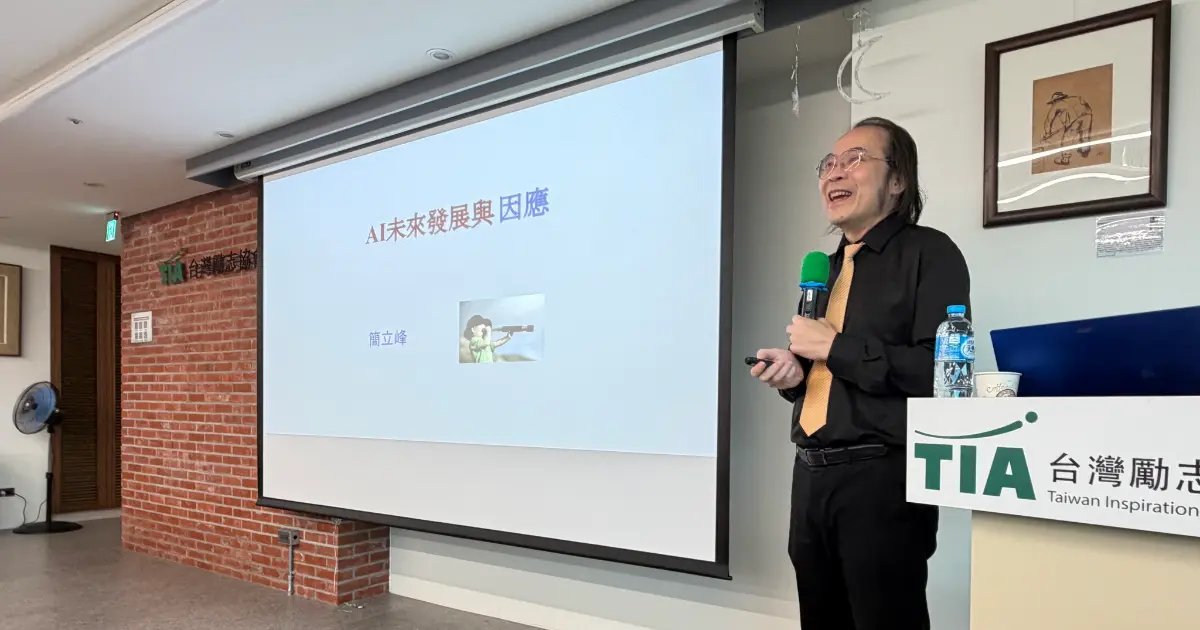
America’s AI Gamble: Trump’s Deregulation Strategy and the Rise of Taiwan as a Critical Supplier
While recent public attention has focused on Trump’s tariff policies, last Wednesday (July 23), former President Donald Trump unveiled a new initiative titled the “America’s AI Action Plan.” The plan emphasizes “light-touch regulation and innovation,” with Trump declaring, “The United States launched the AI race and will stop at nothing to become the world’s AI leader.”
This AI action plan is expected to become another far-reaching industrial policy following Trump’s tariffs, with strong linkages to Taiwan’s industrial development. It warrants close analysis.
Let’s first take a look at the core of the AI Action Plan. This is a comprehensive, national-level strategy encompassing more than 90 individual policy measures, aimed at securing U.S. leadership in the global AI race.
One of the core objectives of the action plan is to accelerate AI innovation and deployment. This includes removing burdensome regulations, encouraging companies to rapidly adopt AI technologies, and revising federal procurement guidelines to ensure that the government only works with suppliers free from ideological bias.
The second objective is to build AI infrastructure. This includes opening up federal land for the construction of data centers and power facilities, and expediting the permitting process for semiconductor fabs and supercomputers.
The third objective is to promote the export of AI technologies and establish global standards. The Department of Commerce and the State Department will collaborate with industry to offer allied nations a comprehensive AI export package—including hardware, models, software, and standards. In addition, chip export controls will be tightened, with geolocation verification features introduced to prevent technology leakage.
In summary, Trump’s AI Action Plan is built on three key pillars: accelerating AI innovation, building AI infrastructure, and assuming a leadership role in global AI governance.
Additionally, this plan differs from previous policies in at least four key ways. First, it prohibits the federal government from procuring AI technologies embedded with so-called “woke” ideology—namely, models that incorporate diversity, equity, and inclusion (DEI) principles. Instead, it promotes language models that are free of ideological bias.
Second, the plan seeks to standardize federal regulations by weakening state-level authority over AI governance, thereby minimizing regulatory fragmentation and promoting a centralized model of oversight.
Third, the plan relaxes energy regulations by allowing high-carbon energy sources to power AI data centers and eliminating environmental reviews to accelerate infrastructure development.
Fourth, the plan introduces a value-based certification system for AI models, establishing a new “American Values AI Model” standard as a prerequisite for federal procurement.
Trump’s AI Governance: A Clear Break from Biden
As the above analysis makes clear, Trump is deliberately emphasizing the contrast between his policy approach and that of former President Biden. While Biden has leaned toward tighter regulation, Trump prioritizes “light-touch regulation and innovation,” asserting that “America will stop at nothing to secure AI dominance.”
As a first step, Trump’s AI Action Plan includes lifting restrictions on AI chip exports, streamlining the approval process for building new facilities, and using policy and financial instruments to support investments across the AI industry supply chain.
This policy shift signals that the U.S. government is pivoting toward an industry-driven approach, aiming to build a comprehensive AI ecosystem encompassing chips, servers, power infrastructure, software, cybersecurity, and end-user applications.
From an investment perspective, the plan’s focus on deregulation and reinforcing U.S. leadership in AI is expected to drive broad-based growth in capital expenditure and demand across the AI supply chain. In the short term, regulatory easing will accelerate AI chip exports, cloud infrastructure development, and cybersecurity investment. In the long run, it will help establish sovereign supply chains and computing power networks.
According to an analysis by CTBC Securities Investment Consulting, U.S. companies such as NVIDIA, AMD, Microsoft, and Palantir are poised to directly benefit from policy support and market expansion. Meanwhile, Taiwan’s supply chain—thanks to its strengths in manufacturing and hardware integration—will emerge as a key partner for U.S. orders. Companies like TSMC, Quanta, Delta Electronics, Foxconn, and ASE Technology are all positioned for clear growth momentum.
Moreover, given Taiwan’s critical position in the global AI supply chain, it is certain to be one of the most essential partners as the U.S. pushes forward with AI innovation and infrastructure development.
As the U.S. and Taiwan join forces to build the AI supply chain, key industries and companies are expected to benefit significantly. From semiconductors and cloud servers to energy, software, cybersecurity, and end-user applications, a broad spectrum of sectors stands to gain across the board.
For example, in the semiconductor sector, the plan is already showing clear impacts in both the short and long term, with early short-term effects beginning to emerge.
One concrete example of a short-term impact is the recent approval for NVIDIA’s H20 chip to be exported to China. This move reflects Trump’s revocation of the “diffusion rule” on AI chip exports, which expands flexibility in shipments to U.S. allies and parts of the Chinese market. As a result, U.S.-based IC design companies have begun releasing more orders.
In addition, executive orders that streamline the construction process for semiconductor fabs have accelerated the building schedules of companies like TSMC, Intel, and Samsung Electronics in the United States.
As a result, U.S. Treasury Secretary Scott Bessent stated on the 26th that TSMC’s $40 billion wafer fab under construction in Arizona may only meet 7% of U.S. chip demand. He attributed the delays to building inspectors and bureaucratic red tape, and urged state regulatory agencies to expedite approvals for the TSMC project.
The acceleration of fab construction by TSMC and others benefits not only TSMC itself, but more importantly, underscores the U.S. government’s renewed emphasis on domestic semiconductor manufacturing. Key beneficiaries also include U.S. IC design companies such as NVIDIA and AMD, which stand to gain the most.
Recently, AMD CEO Lisa Su stated that her company has become the first customer for chips produced at TSMC’s Arizona fab. Despite production costs being 5% to 20% higher than in Taiwan, AMD is willing to accept the price premium.
Beyond short-term effects, in the longer term, the U.S. is actively promoting onshore chip manufacturing and fostering a “trusted supply chain” composed of the U.S. and its allies. Taiwan, as a critical foundry partner for the U.S., stands to be one of the biggest beneficiaries.
While Taiwan’s manufacturing leadership is critical, it also introduces geopolitical risk, particularly due to rising cross-strait tensions with China. For the U.S., this reinforces the importance of deepening bilateral cooperation not only in supply chain execution, but also in shared security frameworks, investment guarantees, and dual-sourcing strategies. Recent moves such as the CHIPS and Science Act and TSMC’s expansion into Arizona are part of this broader hedging strategy.
Of course, President Trump’s deregulatory approach and relaxation of ESG standards help lower barriers to fab construction. However, they also carry potential risks of public backlash and environmental lawsuits—factors that warrant continued monitoring going forward.
In addition to semiconductors, one of the industries expected to benefit the most is cloud computing and AI servers.
With the significant easing of restrictions on data center construction, demand for servers and networking equipment is expected to surge. In the short term, the federal government plans to release federal land and expedite approval processes to support the development of data centers required for AI training.
As a result, cloud platforms such as Amazon’s AWS, Microsoft’s Azure, and Google Cloud are expected to benefit from expansion initiatives. Starting in Q3 of this year, the U.S. is projected to see a wave of large-scale data center construction projects. Demand for servers, power systems, cooling, and storage is expected to surge across the board, with Taiwanese contract manufacturers like Quanta, Foxconn, and Delta Electronics poised to benefit in tandem.
Recently, reports have surfaced regarding the “Stargate Project,” an initiative launched by President Trump to advance sovereign AI infrastructure. According to sources, disagreements between OpenAI and SoftBank over key terms such as site selection have stalled progress, with little movement since the project was announced six months ago. However, OpenAI promptly issued a statement announcing a new agreement with Oracle to jointly develop an additional 4.5GW Stargate data center—equivalent to roughly one-quarter of the total current data center capacity in the United States.
Therefore, despite differing views among stakeholders, the Stargate Project clearly remains poised for execution. The strategic vision of expanding U.S. data center infrastructure is unchanged. While some participants may shift, the project is expected to continue moving forward.
The Next Battleground: AI Compute and Energy Sovereignty
In the long term, the United States is planning to build a “national AI compute network” that integrates edge computing with core cloud platforms. Additionally, major U.S. cloud service providers will export technologies to allied nations, positioning the U.S. AI stack as the global standard.
Additionally, in the energy sector, the massive electricity demands of AI applications are expected to drive a revival of power grid and generation infrastructure. In the short term, the U.S. government plans to invest $70 billion to strengthen energy supply by building power plants for data centers and upgrading the national grid. Grid equipment, energy storage systems, and renewable energy integration are expected to become key areas of investment focus.
The United States is aiming for energy independence and stable supply, with future investments expected to focus on domestic power generation and smart grid infrastructure. Taiwanese companies such as Delta Electronics and Lite-On Technology are poised to benefit from growing demand in North America for energy storage, power supply, and distribution equipment.
In addition to surging demand in the power and energy sectors, AI is also driving the development of next-generation cybersecurity architectures, with the U.S. positioned to lead in setting global security standards. In software and AI platforms, the trend is toward deregulating large models and legalizing open-source frameworks, paving the way for broader commercial expansion. Meanwhile, end-use applications such as autonomous vehicles, AI robotics, and medical AI are entering the phase of practical testing.
In conclusion, AI represents a major growth trend for the coming decade, and the United States will be at the forefront of this transformation. For Taiwan, the direction is equally clear: its core electronics manufacturing and contract production industries are increasingly aligned with U.S. investment and development goals. As the U.S. pursues its strategy to bring manufacturing back onshore, Taiwanese companies are poised to serve as its most vital and proactive partners.
That’s because Taiwan possesses the world’s most extensive experience in manufacturing and supply chain management. Over the past 30 years, it played a central role in helping China become the world’s factory. Now, as the U.S. seeks to rebuild its manufacturing base, it once again finds itself relying on Taiwanese companies.
Moreover, from a competitive standpoint, Chinese companies have already been sidelined from major supply chains due to escalating U.S.-China tech tensions. In contrast, Taiwan—more focused on semiconductors and ICT than its Japanese and South Korean counterparts—is well-positioned to capitalize on the U.S. manufacturing renaissance. If Taiwanese electronics firms align closely with this trend and concentrate their efforts, the coming decade holds significant growth potential.
At the same time, countries like India, members of ASEAN, and the European Union are also investing aggressively in semiconductor and AI infrastructure to secure their own strategic autonomy. For Taiwanese firms, while aligning with U.S. goals remains central, diversifying partnerships across these regions may prove critical for sustaining long-term growth and resilience.
Related Articles
Micron Announces Its Largest Rewards Ever. Its Taiwan Union's Demands Expose a Clash of Pay Systems. A strike threat at Taiwan's largest foreign investor, read in three dimensions
TSMC's 3nm rinse comes exclusively from AEMC, a Taiwanese company once withdrawn from the Emerging Stock Board
Taiwan AI Industry Upgrade Forum Series || Event Report:America Wants More Manufacturing. What Does It Take for Taiwan’s Suppliers to Follow?