Recruitment and Revolution: Anduril Industries Founder Palmer Luckey’s New Tech-Driven Defense Vision for Taiwan
On August 15, Palmer Luckey, founder of Oculus and Anduril Industries, delivered a compelling speech at National Taiwan University, sharing the powerful story behind his transition into the defense industry. He also announced that Anduril has opened an office in Taiwan and is actively recruiting local talent to drive innovation in defense technology.
Anduril, the company founded by Luckey, is redefining the traditional defense industry and making a profound impact on Silicon Valley’s tech talent.
Luckey’s speech in Taiwan delivered a powerful message and posed a critical challenge for the country: As Taiwan seeks to develop its defense industry, how can it, like in the past with its electronics sector, fully integrate with Silicon Valley’s innovation strengths and leverage its ability to “do more with less”? This may be the most crucial question facing Taiwan’s defense industrial development today.
Now 33 years old, Luckey began experimenting with high-voltage projects between the ages of 11 and 16. He built his own computers, repaired and resold broken iPhones, and even worked as a sailing coach and boat repairman—clearly embodying the spirit of a hands-on maker.
Luckey had a deep interest in virtual reality (VR) and was highly dissatisfied with the high latency and narrow field of view of early gaming headsets. At age 18, he built his first headset, the CR1, in his parents’ garage. He later founded Oculus VR, which was eventually acquired by Facebook (now Meta).
In 2017, after leaving Facebook, Luckey founded Anduril. At that turning point in his life, he said he faced two choices: to enjoy life with the wealth he had earned, or to pursue a mission-driven career that could make a positive and lasting impact on the world. Unsurprisingly, he chose the latter.
Luckey’s decision to lead Anduril into defense R&D was driven by his observation that the tech industry in Silicon Valley largely distanced itself from, and often opposed, the defense sector. America’s top tech talent generally avoided working on national security projects. Meanwhile, authoritarian regimes were actively studying U.S. military strategies and systematically building forces to counter traditional weapons systems.
Luckey firmly believes that if technological innovation becomes decoupled from national security, the United States will lose its ability to protect its way of life and defend its allies. It was this sense of urgency that compelled him to take on a challenge that is both difficult and critically important.
Anduril positions itself as a “defense product company,” rather than a traditional defense contractor. While conventional contractors typically conduct R&D after receiving government funding and direction, Anduril uses its own capital to develop products—determining the direction, timeline, and methods independently. This marks a fundamental difference between the two models.
Landing in Taiwan: From Global Defense Star to Local Talent Recruitment
When a product is ready, Anduril brings working technology to the customer—not just a PowerPoint presentation.
Anduril adopts a Silicon Valley-style innovation model, which stands in stark contrast to traditional defense giants like Lockheed Martin and Raytheon.
In addition to self-funding its R&D efforts, Anduril is not reliant on government contracts like traditional defense firms, allowing it to deploy technologies much faster. With software at its core, the company can release new systems within months—rather than waiting for years.
Anduril also makes extensive use of AI and autonomous weapons systems, developing technologies like the Ghost drone, Sentry Tower for autonomous surveillance, and the Lattice command-and-control platform—all designed for real-time sensing and decision-making. It also disrupts traditional procurement by bypassing complex government specifications, selling directly to the military like a SaaS company.
This model has positioned Anduril as a leading example of the “next-generation defense company,” attracting significant venture capital investment and forcing traditional defense giants to rethink their innovation strategies.
So just how much funding has Anduril raised—and what is its current valuation? The numbers are truly staggering.
According to Anduril, the company has completed six rounds of funding to date, raising a total of $6.26 billion. Its most recent round—Series G—closed in June 2025 with $2.5 billion raised, led by Founders Fund, backed by Silicon Valley venture capital titan Peter Thiel. The previous round, Series F, raised $1.5 billion in 2024.
Following its Series G round in 2025, Anduril’s valuation reached $30.5 billion—making it a true “super unicorn.” This valuation is nearly double that of the previous year, highlighting both the company’s strong market recognition and the immense growth potential of next-generation defense technology.
Luckey’s collaboration with Silicon Valley talent in entering the defense industry has also sent ripples through the local tech community—bringing both positive and negative consequences.
There are at least three positive effects. First, technology can accelerate military modernization. Innovations in AI, machine learning, and sensors are making defense systems smarter and more precise.
Second, startup opportunities in Silicon Valley have expanded, with defense technology emerging as a new entrepreneurial frontier—drawing venture capital and government support. Third, there’s a growing sense of mission and impact, as some engineers see working in defense as a way to protect democratic societies, especially amid rising geopolitical tensions.
Of course, Anduril has also sparked intense debate in Silicon Valley. One major point of contention involves ethics and values: Can AI weapons reliably distinguish between civilians and military targets? Could such systems be abused? These questions have fueled heated discussions.
Another issue is the cultural mismatch between the defense industry and Silicon Valley. Military procurement is slow and bureaucratic, clashing with Silicon Valley’s fast-paced, iterative development culture. Lastly, there are political risks and social criticism—working in defense may damage a company’s or individual’s public image, especially in Silicon Valley’s liberal-leaning environment, where many prefer to pursue technological neutrality.
During Luckey’s speech at National Taiwan University, student groups and civic organizations also held protests outside the venue. Such scenes have become a familiar occurrence during his talks in countries around the world.
However, in his speech, Luckey clearly stated that Anduril has already set up an office in Taiwan and is actively recruiting top local engineers. Clearly, talent recruitment was the core objective of his visit.
From Australia to Taiwan: Anduril’s Global Expansion and the Opportunity for Taiwan’s Engineers
Citing Anduril’s experience in Australia, Luckey noted that the local team there grew from just one person to 400 in only two years. He expects the Taiwan team to experience similar rapid growth.
Anduril’s goal is to attract top Taiwanese talent—those who have excelled in consumer electronics, the automotive industry, or advanced semiconductors—and redirect them into the national security field. Luckey emphasized that Anduril needs experts across a wide range of disciplines, including interface design, AI modeling, mechanical engineering, and aerodynamics.
What Luckey values most, however, is the “maker spirit”—the drive to build things not for grades or salaries, but out of pure passion. This ethos reflects who Luckey is at his core and is deeply embedded in Anduril’s culture and hiring philosophy.
Luckey also shared that he had personally visited the front lines of the Russia-Ukraine war, where he witnessed Ukraine using surprisingly innovative methods and new technologies to confront a powerful enemy—for example, deploying drones that cost only a few thousand dollars to inflict devastating damage on Russian forces.
Luckey argued that the Russia-Ukraine war has overturned decades of conventional military thinking and revealed two core lessons. First, dictators should be taken at their word—especially when they openly declare intentions to invade other countries and rebuild empires. Too many people ignore such warnings. Second, true deterrence comes from technological superiority. Modern warfare depends on advanced technologies like AI, autonomous systems, and next-generation air defense—all of which require long-term investment in time, funding, and top-tier talent.
Luckey said that the lessons from the Russia-Ukraine war are directly applicable to Taiwan’s current situation. He cited Chinese leader Xi Jinping’s remarks on unification and military preparedness, as well as threatening propaganda from state-run media, stressing that these are not empty words but expressions of real strategic intent. At the same time, China is rapidly expanding its naval forces, developing hypersonic missiles, and even requiring civilian shipyards to meet military specifications.
In the face of these challenges, Taiwan now stands at the forefront of a “tech-industrial revival” in national defense. What makes this revival unique is that it can be built upon Taiwan’s already strong foundation in consumer electronics and the semiconductor industry.
Luckey envisions two possible future scenarios. In the first, after years of preparation, Taiwan successfully repels an invading force using thousands of AI-powered drones, autonomous underwater vehicles, and aerial missiles—crushing the aggressor’s ambitions.
The second—and more desirable—scenario Luckey envisions is that, after conducting war games, Chinese military commanders report to their leadership: “An invasion of Taiwan would end in decisive failure.” Such a conclusion would force the aggressor to abandon military action due to the overwhelming cost. This, he argues, is the ultimate form of deterrence that technological revolution can deliver.
Just as drones can serve as low-cost alternatives to expensive fighter jets—demonstrating the power of asymmetric advantage—autonomous underwater vehicles can play a similar role, complementing traditional submarines in functionality.
For Taiwan, with its limited defense budget, the more critical strategy is to align with Silicon Valley’s emerging tech forces. Only through such collaboration can true innovation emerge—and with it, the ability to achieve asymmetric advantage.
The core message of Luckey’s speech and interview was crystal clear: In today’s geopolitical landscape, technology is no longer just a business tool—it has become a decisive force in the defense of freedom and sovereignty. He urged Taiwan’s tech talent to recognize the responsibility of this era and channel their skills into the mission of protecting their homeland. Because in the end, what Taiwan can truly rely on is not some mysterious arsenal, but the people who live here.
Luckey is more than just a tech entrepreneur—he’s an active participant in global geopolitics. That dimension of his role gave his speech an additional layer of significance.
AI and Defense: How Small Nations Can Build Asymmetric Power
For example, Luckey emphasized Taiwan’s strategic importance, called on tech talent to contribute to defense innovation, and warned of the threat posed by China’s military expansion. He also promoted the concept of “technological deterrence,” arguing that AI and automated systems can give smaller nations effective defensive capabilities—helping them avoid traditional military conflict.
He also criticized China’s policies, arguing that its refusal to open its markets to American tech companies is a strategic mistake. He believes the U.S. should use this as an opportunity to strengthen cooperation with the tech industry. In addition, he advocates for the idea that “smart weapons are more ethical,” asserting that weapons capable of distinguishing civilians are morally superior to those that conduct indiscriminate attacks.
Luckey’s words and actions have positioned him as a new-generation “tech geopolitical leader,” with significant influence on issues such as U.S.-China competition and the security of the Taiwan Strait.
After hearing Luckey’s speech, I noticed that several of the group chats I regularly participate in lit up with discussion. Many friends said they had never considered that technology could be used to defend Taiwan’s sovereignty and democratic freedoms. Now, they’re eager to invest their money, time, and talents in this new kind of defense-tech industry.
In the U.S., many engineers and entrepreneurs—especially those who left Silicon Valley or major tech firms—have entered this space. They aim to bring technologies like AI, drones, sensors, and edge computing into the military and defense sectors, helping democratic nations gain an edge in future conflicts.
I believe Anduril’s talent recruitment in Taiwan will be no less impressive than NVIDIA’s Asia headquarters led by Jensen Huang. While it may not reach 400 hires in two years as it did in Australia, the number is still expected to be substantial.
Today’s younger generation isn’t just looking for a cause to fight for—they want work that feels personally meaningful. Once they find a mission that resonates with them and gives their lives purpose, they will throw themselves into it wholeheartedly.
Clearly, the idea that “technology can also be used to defend Taiwan’s sovereignty and democratic freedoms” may inspire a new wave of career choices among Taiwan’s youth. In addition to TSMC, MediaTek, and NVIDIA, Anduril could emerge as another compelling option.
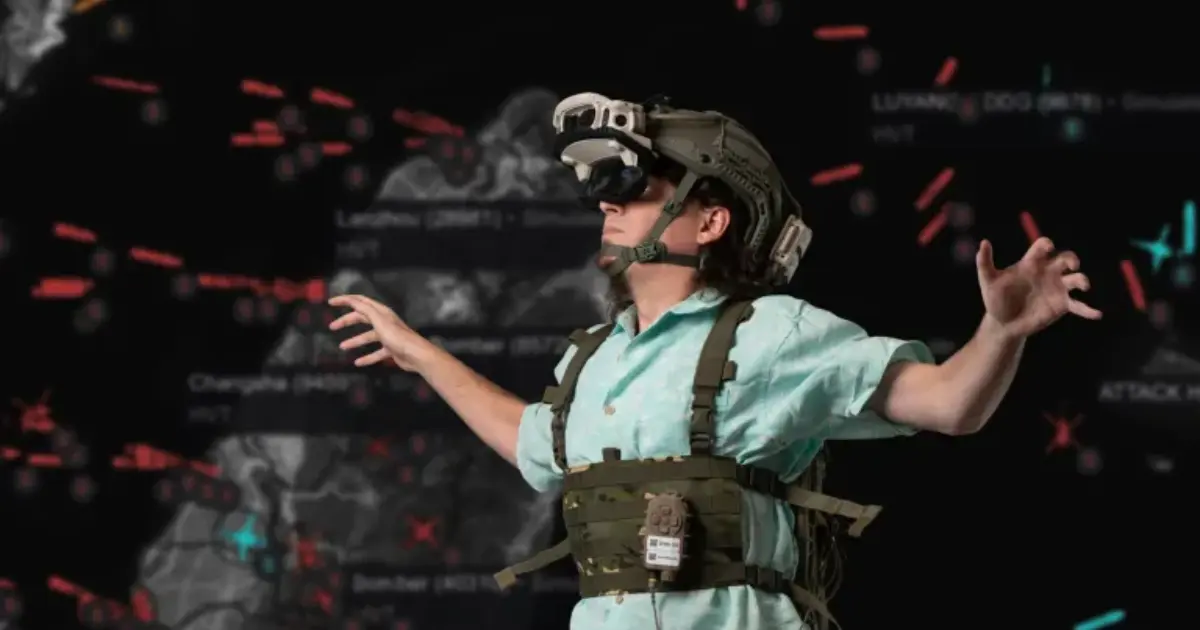
(The main image is from an article published on Luckey’s personal blog this February, discussing the U.S. Army’s Integrated Visual Augmentation System, IVAS program, with Taiwan Island shown in the background.)
Related Articles
Micron Announces Its Largest Rewards Ever. Its Taiwan Union's Demands Expose a Clash of Pay Systems. A strike threat at Taiwan's largest foreign investor, read in three dimensions
TSMC's 3nm rinse comes exclusively from AEMC, a Taiwanese company once withdrawn from the Emerging Stock Board
Taiwan AI Industry Upgrade Forum Series || Event Report:America Wants More Manufacturing. What Does It Take for Taiwan’s Suppliers to Follow?