TSMC Doubles Down on the US with $165 Billion: 5 Key Questions Answered
(Editor's Note:Immediately following TSMC’s Q1 earnings call, the US-Taiwan Trade and Tax Agreement was finalized. These two major events have converged on a single focal point: TSMC’s massive investment expansion in the United States. With TSMC Chairman C.C. Wei announcing plans to build a total of nine fabs in the US, what effects will this ultimately have on Taiwan? We answer the five most critical questions surrounding these market concerns.)
With the announcement of the new US-Taiwan trade pact, semiconductors have once again become the focal point of Taiwan's investment in the US. As expected, the release of this agreement has sparked various interpretations and discussions. Regarding TSMC's investment in the US, what are the key effects and impacts worth noting? The following is an analysis through five key dimensions.
1. Is the "Silicon Shield" Abandoning Taiwan? No, It Is an Established Trend of Global Layout
First, why is TSMC compelled to go to the US?
Under this new US-Taiwan agreement, Taiwan has committed to an aggregate investment of US$250 billion in the United States. This includes not only the semiconductor industry but also investments from Foxconn, Quanta, Wistron, Delta, and other electronics companies (locally known as the "Electronic Five Brothers," Taiwan’s major EMS/ODM giants). However, given the massive scale of semiconductor capital expenditure, it is certain that the majority of this US$250 billion investment will come from TSMC.
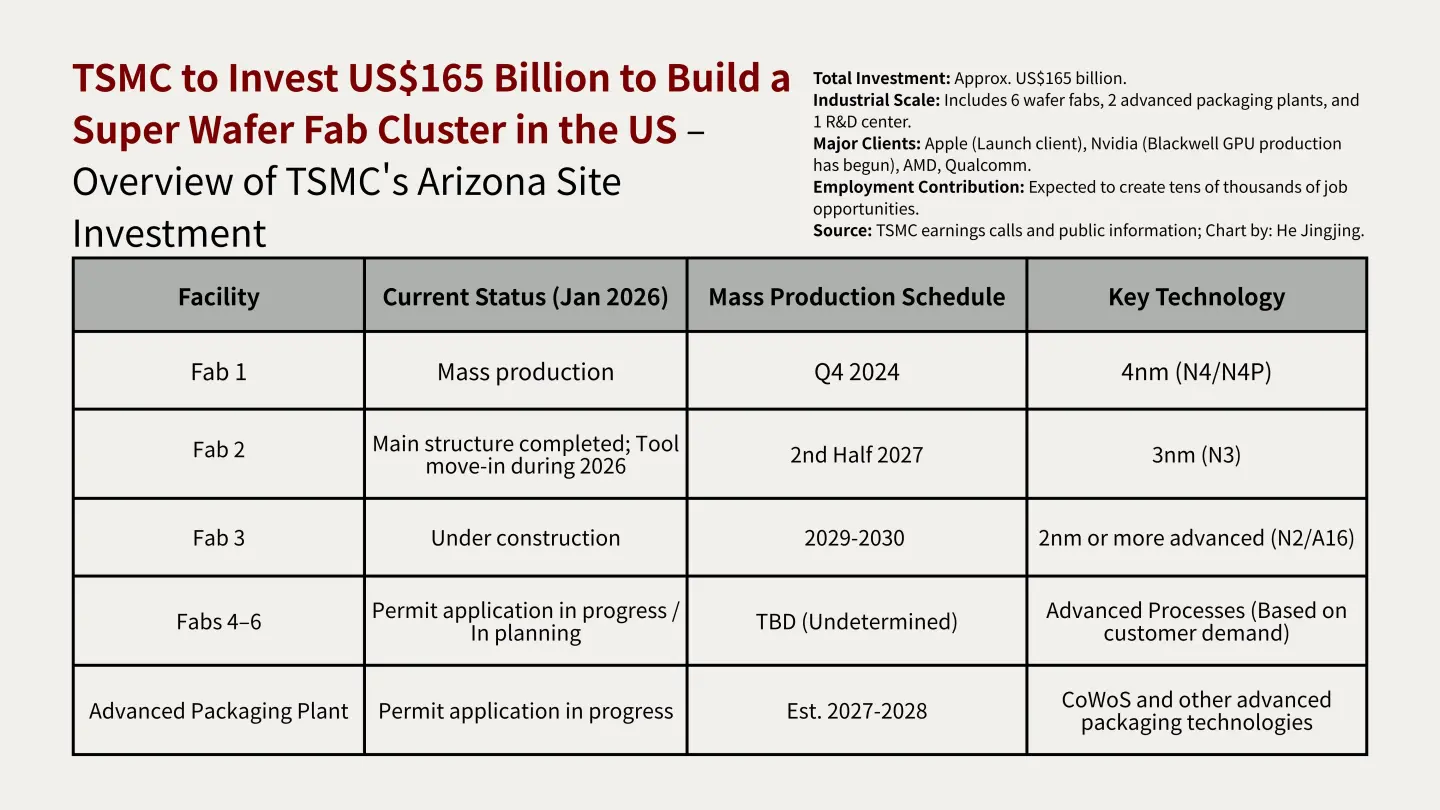
Last year, TSMC had already announced investments of US$165 billion in the US. The primary reason for increasing this amount now is strong market demand and a severe shortage of wafers. TSMC has no choice but to continue investing in new wafer fabs, and the United States is the optimal location for this expansion.
Taiwan faces natural constraints: limited power, insufficient electricity, land scarcity, and a finite talent pool. It was already difficult to support such massive semiconductor investment demands alone. TSMC’s capital expenditure (CapEx) this year falls between US$52 billion and US$56 billion—the highest among all semiconductor companies worldwide—and it is now the world’s sixth most valuable company. This scale has completely exceeded what Taiwan alone can sustain.
Comparing this to the top 10 US companies by market cap, all have long since established global layouts; no enterprise concentrates its operations entirely within the US. It is even more critical for TSMC, which in the past relied almost exclusively on the resource-limited island of Taiwan.
Therefore, five or six years ago, TSMC began its global layout, diversifying manufacturing bases to the US, Japan, and Germany. Among them, the US is naturally the most critical hub because TSMC’s major customers are all there; 75% of its revenue comes from North American clients, while Japan and Europe currently account for only 4% to 5%. Unless more major customers or products emerge in Japan or Europe, the pace of investment there is unlikely to accelerate.
TSMC’s move to the US is, of course, also related to the consistent pressure from the Trump administration. The policy of "Reshoring American Manufacturing," driven by Trump’s strong mandate, carries the mission of boosting employment and driving investment. This gives TSMC the opportunity to cement its status as the most important chip supplier to the US, and Taiwan will become a core key player and beneficiary in America's return to semiconductor manufacturing.
Consequently, under President Trump's leadership, many US clients also wish for TSMC to invest in the US. Many have agreed to TSMC’s price hikes and are willing to absorb the increased costs. This is especially true for companies producing AI chips, such as Nvidia, AMD, Broadcom, and Google. Since their own gross margins are high, the impact of rising wafer prices is controllable. This is the commercial key facilitating TSMC’s US investment.
2. Risk of Tech Theft? Core R&D Remains Locked in Taiwan HQ
The second question is: Will investing in the US lead to TSMC’s technology being stolen or copied? The answer is: This issue is worth discussing, but there is no need to worry excessively.
TSMC has over ten thousand R&D engineers in Taiwan. After every manufacturing process technology is developed, it must be practiced and adjusted to a stable, high yield in the "Mother Fab" in Taiwan before it enters mass production. As for overseas fabs, the successful model trained in Taiwan is replicated and transferred, usually with a time lag of two years. Recently, TSMC CFO Wendell Huang mentioned in an interview that even with accelerated transfer, there remains a technology gap of at least one year.
In other words, TSMC’s R&D and process development will inevitably take place at the Taiwan headquarters. Only after development and improvement are completed at the Mother Fab will production move overseas. This is an unchangeable fact. A point more worthy of discussion is: When companies move overseas, will key technologies be learned by others?
In fact, when companies invest overseas, some knowledge transfer is inevitable because talent is fluid. When employees move to other companies, they bring their knowledge and experience with them. In the early years, when European, American, and Japanese companies invested in Taiwan, Taiwanese people also learned and imitated them, later starting their own businesses to create the booming electronics industry we see today.
The difference lies in the fact that the risk of technology being "stolen"—or more accurately, copied and imitated—in the US is significantly smaller than in China. After all, the US places greater importance on Intellectual Property (IP) rights and has a robust judicial system. If technology is stolen or talent is poached, there are legal avenues to seek resolution and redress.
Moreover, in the semiconductor wafer manufacturing industry, Asians tend to be stronger. China and Taiwan share high homogeneity, and China also views manufacturing as a national development policy. A major purpose of China attracting foreign investment is to eventually "replace" it—for example, China learned from and largely replaced supply chains for Apple iPhones and Tesla EVs. However, US manufacturing competitiveness has lagged for too long. In Trump’s policy to restore manufacturing, there is no specific intention to have US companies completely replace TSMC. For foreign investors, this is a very important policy distinction.
3. High Labor Costs & Culture Clash? Waiting for the Learning Curve to Rise
The third question is: Given that costs in the US are high, talent is unwilling to work overtime, and yields and gross margins are lower than in Taiwan, will TSMC's profitability be impacted as the US capacity share rises?
It is reasonable for everyone to have this concern. High US costs are a fact. However, TSMC’s US fab pricing has already been adjusted upward, and customers are willing to pay the difference, meaning high costs have a chance to be passed on. Additionally, the current lack of profitability at TSMC’s US subsidiary is mainly because it is still in the early stages of the learning curve.
In the future, after a period of learning, the performance of TSMC’s US fabs—in terms of yield, delivery, and profit—should have the opportunity to move in lockstep with the Taiwan parent company. That is to say, once TSMC successively completes the training of US employees, the construction of supply chain partners, and the alignment of external conditions such as infrastructure and regulations, the performance of the US and Taiwan fabs should be very close.
Just how close, and how fast the learning curve rises, is exactly what Chairman C.C. Wei and US Fab CEO Y.P. Chuang need to work on. Just as Samsung’s fab in Texas now has performance very close to its Korean parent fabs, if there is a significant difference in operating performance between TSMC and Samsung in their home countries, their performance in the US will likely differ significantly as well.
One of TSMC's biggest challenges will likely be Talent and Culture. TSMC's success in Taiwan is due to the contribution of Taiwanese engineers. Will US talent be willing to work as hard as Taiwanese employees? The answer is not overly optimistic. But this also means TSMC has significant room for effort. Beyond intensifying the search for US employees who identify with its philosophy, shaping an inclusive US fab culture will help achieve operational goals.
A former TSMC executive shared a story from the US fab. US employees would leave promptly at 5:00 PM. Once, before clocking out, someone pushed a machine into an elevator, but when 5:00 PM hit, the person left, leaving the machine riding up and down in the elevator. Later, Taiwanese employees who stayed late had to rush to retrieve the machine to prevent damage to the precision equipment.
Years ago, after TSMC recruited its first batch of US employees and sent them to Taiwan for training before returning to the US fab, more than half of that group has since resigned. The employees who remain are evidently those who better fit and have adapted to the company culture.
This is the cultural shock that Taiwanese companies must endure when expanding internationally. TSMC employs top-tier talent in Taiwan—experts willing to dedicate themselves—but how to win over such talent in the US is a challenge multinational corporations must face.
Top talent in the US tech industry, often working or founding startups in Silicon Valley, also burns the midnight oil for innovation and vision. After moving to the US, TSMC must not only compete for excellent talent but also introduce Taiwan’s "Lean and Solid" work culture.
Outsiders attribute TSMC’s success to a "liver-exploding" (burnout) culture, which is a gross oversimplification and a dismissive narrative. In reality, this is a manufacturing spirit that blends "High Discipline," "Speed," and "Innovation." Today, many foreign companies are eager to learn from and study this. Therefore, how TSMC carries out its international layout and replicates this spirit in advanced nations is a new challenge for Taiwan’s ability to project prestige internationally.
Recently, a delegation from Dresden, Germany, visited Taiwan for exchange. They came to learn from Taiwan’s experience in managing the semiconductor ecosystem and affirmed the high efficiency of Taiwan’s semiconductor operations, as well as its highly flexible shift scheduling and rapid response. They frankly admitted that regarding work culture, employees from Germany and Taiwan still need to "merge and adapt" (align)—for example, how to implant Taiwan's "Sense of Speed" into Germany's "Rigor." But they are also certain that while Germany has international advantages in machinery and traditional automotive manufacturing, Taiwan is the global benchmark for overall efficiency in semiconductor manufacturing and supply chain completeness, and Germany must learn from Taiwan.
4. Impact on Taiwan's Supply Chain? Actually Leading the Charge for Global Orders
The fourth question: Besides TSMC increasing its investment in the US, the semiconductor supply chain and the "Electronic Five Brothers" (Taiwan's EMS giants) are also following suit. Is the impact on Taiwan's industry too great?
Some say that moving the semiconductor and AI server supply chains to the US is "hollowing out" Taiwan. This view is overly anxious. Taiwan is not only participating in US manufacturing construction and investment but also leading Taiwan's supply chain to play in the "World Cup" (global arena). The positive significance is immense.
Last August, members of "De-Xin Holdings," a group formed by 18 TSMC suppliers, visited the US. Chairman Chueh Sheng-che said that seeing the trend of TSMC's US investment established, and as the economic scale in the US expands, suppliers worldwide—including those from Taiwan—will actively follow suit and initiate investments in the US.
TSMC’s annual capital expenditure is very high. Of the more than US$40 billion spent last year, 90% was paid to international enterprises, with only 10% going to Taiwanese suppliers. In the future, the Taiwanese supply chain must not only go to the US to secure that original 10% of business but also find ways to win more opportunities from other clients, such as Intel, Micron, Texas Instruments, and GlobalFoundries. As for Taiwanese suppliers going to Japan and Germany, they must also strive for orders from other semiconductor fabs in Japan and Europe beyond TSMC, expanding the influence of Taiwanese businesses.
Furthermore, Taiwan is not just extending the semiconductor supply chain overseas but also spilling over to include the entire AI supply chain. As TSMC leads the charge in adding to US investments, other downstream server industries, such as Taiwan's "Electronic Five Brothers," will follow, providing AI chips and AI server products for Nvidia and the US "Magnificent Seven" (Tech Giants), thereby consolidating Taiwan's monopoly status in the entire AI supply chain.
Just as Taiwanese businessmen went to invest in mainland China in the 1990s and are now investing in the US, they have become stronger in the process, successively becoming trillion-dollar enterprises. Whether assisting China in becoming the world's factory or helping the US restore semiconductor and AI manufacturing, the important point is that Taiwanese enterprises can expand their global layout through this, allowing Taiwan's economy to develop rapidly. These are all beneficial to Taiwan.
5. Changing Future Development? The OEM Positioning Must Upgrade Again
Fifth, a more long-term question is how Taiwan's electronics industry can develop its own subjectivity (identity), and as enterprises expand their overseas layouts, we must also consider the impact on Taiwan and how to respond.
For Taiwan's electronics industry, which has long been dominated by the OEM/ODM model, many achievements have been made in the past. In the future, seeking more opportunities outside of the US and China, and cooperating with Europe and Japan to create more business opportunities, is a direction worth thinking about. But at the same time, apart from playing a powerful role in OEM manufacturing in the international division of labor, Taiwan must find other unique competitive advantages to diversify the problem of having too high a share in contract manufacturing.
We must also consider that overseas development is definitely a positive factor for Taiwan. TSMC can become a world-class enterprise through this. But in the long term, will the Taiwanese talent taken abroad return? If the Taiwan government can build an excellent environment to attract more corporate headquarters to Taiwan, Taiwanese children fighting for their careers around the world will eventually "return to their roots" (Brain Circulation) and be willing to live in Taiwan. This is the long-term positive effect.
However, if Taiwan's living environment is poor, education cannot be improved, and political standards remain low, Taiwanese talent working overseas will not be willing to return, or may even cut ties with Taiwan forever. The negative impact this would cause to Taiwan is likely even greater, and this requires everyone to think and respond early.
Related Articles
Micron Announces Its Largest Rewards Ever. Its Taiwan Union's Demands Expose a Clash of Pay Systems. A strike threat at Taiwan's largest foreign investor, read in three dimensions
TSMC's 3nm rinse comes exclusively from AEMC, a Taiwanese company once withdrawn from the Emerging Stock Board
Taiwan AI Industry Upgrade Forum Series || Event Report:America Wants More Manufacturing. What Does It Take for Taiwan’s Suppliers to Follow?