The World Still Calls It an Emerging Market. It's Now the Fourth Largest.
A company listed for barely six months is already Taiwan's eleventh-largest stock. A market dismissed for decades as a “shallow dish” is now the world's fourth largest by value — and the single biggest weight in MSCI's Emerging Markets index. Taiwan's capital market has arrived at a position few have fully registered, bulls and skeptics alike.
(Amounts are shown in US dollars at roughly NT$31 per dollar; New Taiwan dollar figures follow in parentheses where they matter.)
Thirty-six years, two Taiwan markets
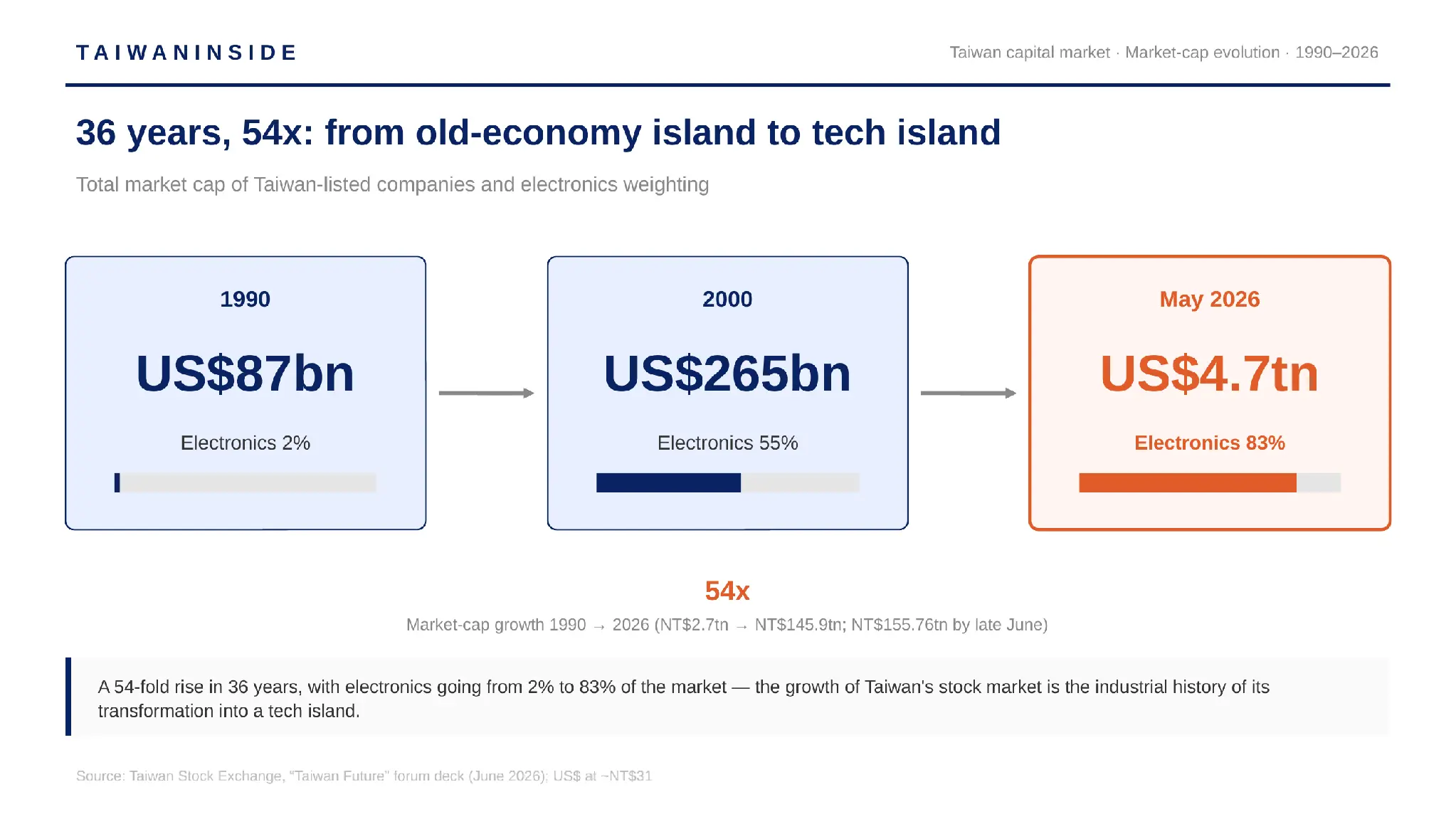
In 1990, the year the Taiex peaked at 12,682 points, I had just started covering capital markets as a reporter. The total value of every listed company in Taiwan was then about US$87 billion (NT$2.7 trillion), electronics made up 2% of it, and the market was held up by financial and asset plays. After the bubble burst, the index took thirty years to see that level again.
Last month, the figure was roughly US$5 trillion (NT$155.76 trillion), with electronics at 83%. And at the end of January this year, something happened that had not happened since 2007: Taiwan's weight in the MSCI Emerging Markets index overtook China's.
Thirty-six years, a 54-fold rise in market value. Taiwan's capital market has reached a point that calls for a fresh stocktake — a clear gap has opened up between its size, its substance, and how the world classifies it.
A record IPO, and an eleventh place
Nothing illustrates what this market has become better than Hon Precision.
Speaking at a forum recently about building Taiwan into an “Asian Nasdaq” and promoting the Taiwan Innovation Board (in Chinese), Taiwan Stock Exchange president Edith Lee offered an example: people used to say Taiwan was a small market where companies couldn't raise real money — yet last year one company raised more than NT$34 billion in a single initial public offering. She was referring to Hon Precision, a semiconductor test-equipment maker that listed on November 27 last year (in Chinese) at about US$48 (NT$1,495) a share, the highest IPO offer price in Taiwan's history, raising about US$1.1 billion (NT$34.47 billion) — 40.77% of everything raised on the main board in all of 2025 (in Chinese).
The public subscription before listing set off an island-wide scramble. Before a new stock lists in Taiwan, a portion of shares is offered through a public subscription: investors register with a broker and set aside the purchase money, and if applications exceed the shares on offer, a computerized lottery decides who gets to buy at the offer price — the more applicants, the lower the odds. Hon Precision's offer price was about US$48 (NT$1,495), but the stock was already trading far higher on the Emerging Stock Board, Taiwan's pre-listing market — a gap of nearly US$32 (NT$1,000) a share. Winning a single lot of 1,000 shares meant an instant paper gain of about US$32,000 (nearly NT$1 million). More than 200,000 applications poured in, the odds of winning fell below 2%, and the money set aside for subscriptions froze an estimated US$9.7 billion (NT$300 billion) in the market. After listing, the shares at one point topped US$260 (NT$8,000) and the company's value reached about US$39 billion (NT$1.22 trillion); in March, less than four months after listing, Hon Precision joined the Taiwan 50 index (in Chinese), the FTSE-TWSE index of the island's 50 largest listed companies, and by the end of May it was the eleventh-largest stock in the entire market (in Chinese).
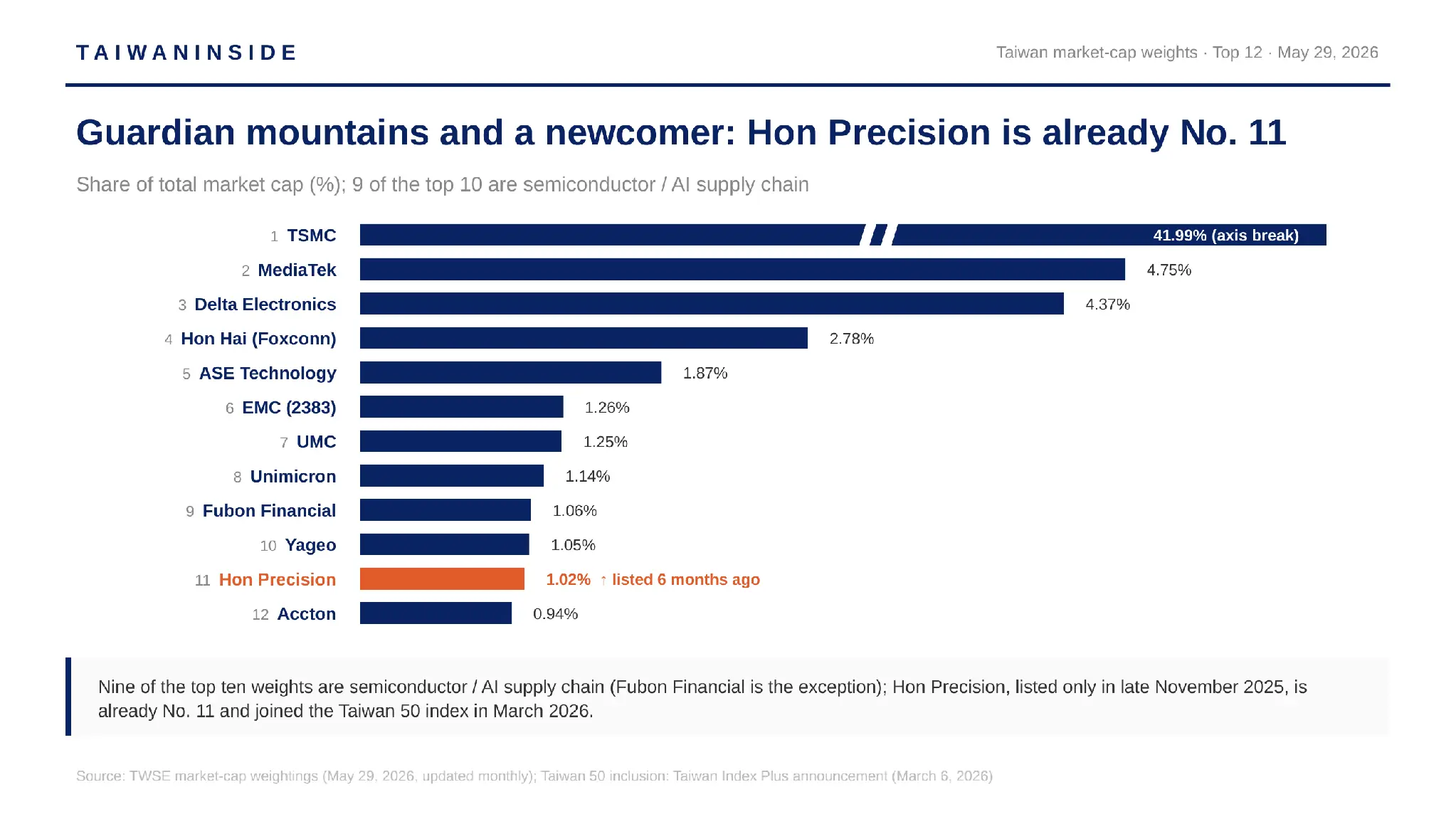
A company six months on the market, ranked eleventh in the country by value. Growth that dramatic simply did not happen in the Taiwan market of 1990.
Scale and rank: fourth largest in the world
Start with the numbers. According to the Taiwan Stock Exchange, as of May this year Taiwan had 1,080 listed companies (964 domestic, 88 foreign “KY” listings, plus 28 on the Innovation Board), with a total market value of about US$4.7 trillion (NT$145.9 trillion); by late June it had risen further, to roughly US$5 trillion (NT$155.76 trillion). Taken together — the main board run by the Taiwan Stock Exchange, the over-the-counter market run by the Taipei Exchange (TPEx), and the Innovation Board — Taiwan's markets quote roughly 1,880 listed companies in total.
The same island has gone stock-mad twice — in 1990 and in 2026 — but the two markets rest on entirely different foundations.
In 1990 Taiwan was still an export-processing economy. Its most competitive industries were labor-intensive contract work — textiles, footwear, toys — and most of those firms were never listed. The two hundred or so companies on the exchange were dominated by financials, construction and asset plays, and what drove share prices was not corporate earnings but hot money drawn in by a rising currency, idle savings from one of the world's highest saving rates, and a property boom — Cathay Life, the insurer that was then the market's most expensive stock, at one point traded near NT$2,000 a share.
In other words, the market that roared to 12,682 reflected trapped domestic liquidity with nowhere to go, not Taiwan's place in global supply chains. A market that detached from its real economy was never going to become an international fundraising base for industry; when the bubble burst and Taiwan was tagged a “shallow dish” market — a small pool, easily sloshed — the label was not entirely unfair.
Today the substance is completely different. The critical links of the global AI hardware supply chain — advanced wafer fabrication, advanced packaging, chip design, servers, cooling, power, test equipment — are supplied mainly by companies listed in Taiwan; electronics make up 83% of market value, and what holds up those trillions is the earnings power of these companies. In 1990 investors queued for financial stocks; in 2026, 200,000 subscription applications chased an AI test-equipment maker. Having lived through that earlier history is precisely what makes the “emerging market” label look so dated: it describes the liquidity-driven Taiwan of thirty-odd years ago, not the market that now sits at the core of global industry.
As the market has grown, its rank has changed too. According to Bloomberg data, Taiwan's total market value climbed to US$4.95 trillion in late May, passing India (in Chinese) to become the world's fifth-largest stock market, behind only the US, China, Japan and Hong Kong. In her presentation, Edith Lee counted Hong Kong's market value as part of China's — reasonably enough, since Hong Kong's heaviest index weights are mostly Chinese companies — and on that basis Taiwan is the world's fourth-largest stock market, behind only the US, China and Japan, and ahead of India, the UK and South Korea.
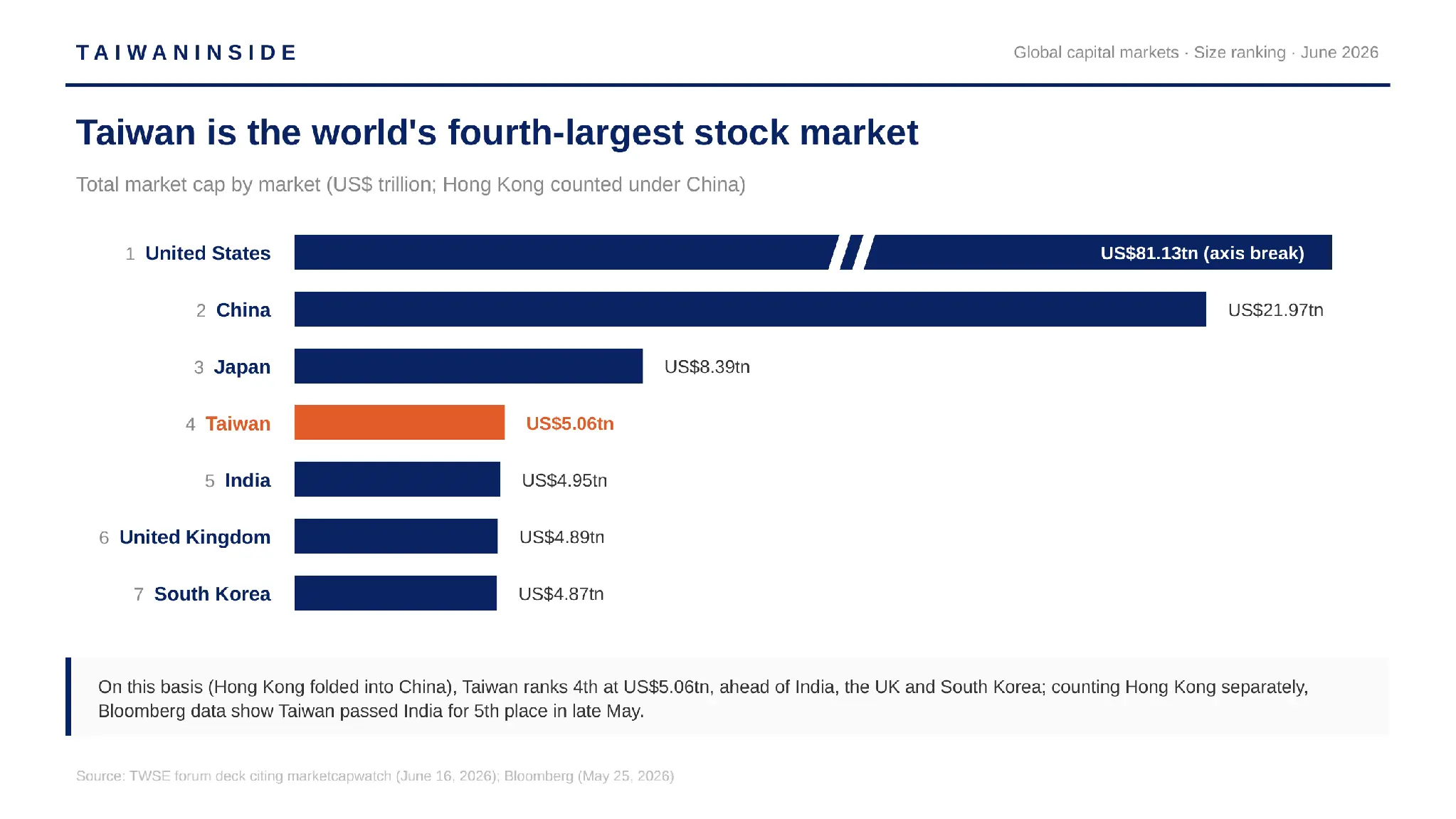
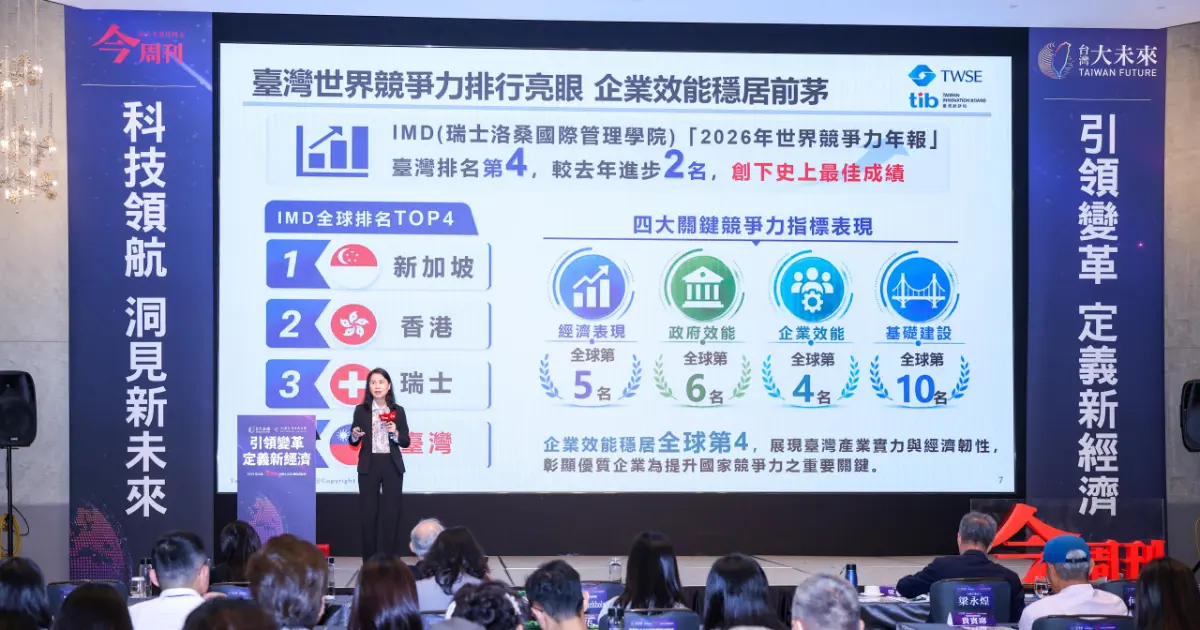
Country-level scorecards have moved in step. In the IMD World Competitiveness Yearbook 2026, Taiwan ranked 4th, up two places and its best showing ever — a competitiveness ranking, not a market-cap one, but two “fourth places” in the same year is no coincidence.
The only market where you can buy the whole AI hardware chain
Taiwan's substance comes down to one sentence: there is almost no other market on earth where the entire AI hardware supply chain can be bought in one place. From TSMC in wafer fabrication, MediaTek in chip design, ASE in packaging and test, Delta in power and cooling, Unimicron and EMC in substrates and PCBs, to Hon Precision in test equipment — of the ten largest weights, nine are semiconductor or AI supply chain; Fubon Financial is the only exception (in Chinese).
International money's actual positioning says it plainly. Foreign investors held 49.14% of Taiwan's market value in early June, and touched 49.99% in late April (in Chinese) — one hundredth of a percentage point from half the market in foreign hands. Strikingly, foreign investors have been net sellers of more than US$9.7 billion (NT$300 billion) of Taiwan stock this year, yet their share of the market has kept rising, because what they still hold has appreciated faster than what they sold.
South Korea — like Taiwan one of the original Asian Tiger economies, and likewise a key country in the AI supply chain — makes the clearest comparison. Korean stocks have also surged this year: the KOSPI broke above 5,500, and Goldman Sachs calls Korea its highest-conviction market in Asia, forecasting 300% earnings growth in 2026. But the two re-ratings have traveled different roads. Over the past decade the KOSPI's price-to-book ratio averaged just 0.99, with nearly seven in ten listed companies trading below book value — what global investors call the “Korea discount,” rooted in chaebol cross-holdings and corporate governance. Only the Value-Up governance reforms plus a memory-chip supercycle have been closing that discount, lifting the KOSPI's price-to-book to about 2.03. Taiwan's market, by Taiwan Stock Exchange data, trades at 3.85 times book and has never gone through a discount phase; its premium is built squarely on real AI hardware earnings — Goldman forecasts 45% earnings growth for Taiwanese companies in 2026. Put simply: one market is catching up on old homework, the other is setting the pace.
A giant in trading, a novice in fundraising
Still, the “fourth largest” title needs to be taken apart before Taiwan's potential — and what it really offers companies in the global AI supply chain looking to raise capital — can be understood.
Taiwan's bigness, so far, is a bigness of stock, not flow: a huge market value and huge trading volume — by Taiwan Stock Exchange statistics, average daily turnover runs about US$32 billion (NT$1 trillion), and annualized turnover velocity is 156.51%, higher than Japan, South Korea, Singapore or Hong Kong. But Nasdaq is Nasdaq not because of trading volume; it is the fundraising function — companies from all over the world go there for capital. By that yardstick Taiwan is just getting started: IPOs raised US$3.4–3.6 billion (NT$105–111.7 billion) in all of 2025 (in Chinese) — about 0.07% of total market value. Put another way, a single day of trading in Taiwan moves roughly nine times more money than a whole year of IPO fundraising.
In short, Taiwan's stock market is indeed a giant in trading — and still a novice in fundraising.
Take this year's poster case: Hon Precision alone accounted for four-tenths of everything raised in 2025, proof the market can absorb a US$1.1 billion deal — but the flip side is that a single deal taking up 40% of the total also shows how narrow the fundraising base still is.
Taiwan's government has concrete — and ambitious — designs for the market. President Lai Ching-te of Taiwan, in a television interview, laid out the vision of building an “Asian Nasdaq,” positioning Taiwan as a global hub for technology capital — elevating it to a national strategy, with the Innovation Board as the core policy tool (in Chinese). The board's momentum this year is real: its index has climbed from 8,802 at the start of the year to 18,471, up 109.85%; average daily turnover has jumped 214.08% from last year; and its trading rules are now fully aligned with the main board. But it still lists only 28 companies, with first-quarter revenue of about US$360 million (NT$11.1 billion) in aggregate — tiny. The direction — Taiwan as a key fundraising market for AI supply-chain ventures worldwide — has been set; the road ahead is long.
The fourth-largest market, still wearing an “emerging” tag
In MSCI's classification, Taiwan is to this day filed under “emerging markets.”
MSCI is the world's most influential index compiler, headquartered in New York. Trillions of dollars — pension funds, sovereign funds, mutual funds — track or benchmark against its indexes to decide what to buy and how much. MSCI sorts the world's stock markets into two broad camps, “developed” and “emerging”: the US, Japan and the UK sit in the first; Taiwan has sat in the second for thirty years, since it was added to the MSCI Emerging Markets index in 1996 (in Chinese). The classification weighs more than economic size — capital mobility, foreign-investor access and other institutional criteria all count — but its most practical effect is on how global pools of capital are allocated: whichever camp a market is filed under, the passive money tracking that camp's index flows to it automatically.
At the end of January this year, Taiwan's weight in the MSCI Emerging Markets index reached 21.06%, overtaking China's 20.93% — the first time since 2007 that Taiwan has been the index's largest member (in Chinese). In the May semi-annual review, Taiwan's weight was raised again, to 23.76%, the largest upgrade of any market (in Chinese); TSMC, meanwhile, is the single largest stock in the entire index.
So: the world's fourth-largest stock market, the largest member of the emerging-markets index — still wearing the “emerging” tag. Being classified as emerging makes Taiwan easy for developed-market money to overlook, and that is the key challenge for its fundraising ambitions now that its scale has grown so fast. The passive funds allocating by that label are no longer buying anything like the “emerging market” they imagine. Sooner or later, the gap between the label and the size will have to be re-examined.
Three trade-offs that demand honesty
For Taiwan — the government and the exchange alike — turning this market into a major international fundraising venue means facing several problems squarely, and adjusting the market's constitution step by step.
First, concentration. TSMC alone accounts for 41.99% of total market value (in Chinese) — the “Magnificent Seven” together make up roughly a third of the S&P 500, and TSMC by itself exceeds their combined share. Buying Taiwan is, to a large degree, buying TSMC; when TSMC sneezes, the whole market catches a cold.
Second, geopolitics. Taiwan trades at a valuation premium, yet the market shows almost no sign of a “Strait discount.” Has global capital judged the risk manageable, or has the risk simply not been priced? I have no definitive answer — but it is a question everyone with money in this market will eventually have to answer for themselves.
Third, valuation. A price-to-book of 3.85 is about the highest among major markets, and a price-earnings ratio of 29.25 runs above Japan's and Korea's. If earnings grow the 45% Goldman projects, the price holds; but should AI capital spending cool, a market whose valuation ran ahead will correct ahead too.
Guardian mountains, and two kinds of opportunity for global capital
Edith Lee says the exchange will court companies in quantum computing, space computing, low-earth-orbit satellites, agentic AI, robotics, defense and aerospace, and autonomous vehicles to list in Taiwan. She frames Taiwan's capital market as a range of “guardian mountains” — extending the famous nickname for TSMC, “the sacred mountain that guards the nation” — with each board playing its part: the main peak, AI-led semiconductor leaders; the surrounding range, solidly built mid-sized firms; and the Innovation Board taking in forward-looking ventures — a capital market built to interlock with the real industrial ecosystem.
For global capital, Taiwan in fact offers two kinds of opportunity. Money that wants a stake in the AI era can invest here — almost the only market where the entire AI hardware chain can be bought in one place. Companies that need to raise capital in the AI era can list here — where the investors, the analysts and the supply chain all sit on the same industrial chain, and understand what you do. Jensen Huang said at this year's GTC that Taiwan is not merely a manufacturing base but the core hub of the global AI revolution. The next chapter of Taiwan's capital market turns on how large these two opportunities can be made.
Read next:How did Hon Precision go from testing Tamagotchi chips to the last gate before Nvidia's AI chips ship — and does the trillion-NT$ valuation hold? The full deep dive is in the TAIWANinside paid edition.
Related Articles
Micron Announces Its Largest Rewards Ever. Its Taiwan Union's Demands Expose a Clash of Pay Systems. A strike threat at Taiwan's largest foreign investor, read in three dimensions
TSMC's 3nm rinse comes exclusively from AEMC, a Taiwanese company once withdrawn from the Emerging Stock Board
Taiwan AI Industry Upgrade Forum Series || Event Report:America Wants More Manufacturing. What Does It Take for Taiwan’s Suppliers to Follow?