The Most Expensive Stock You've Never Read About: How a Kaohsiung Metal Shop Became the Rails NVIDIA's AI Racks Ride On

On the Bloomberg terminal, ticker 2059:TT is a Taiwanese slide-rail maker. Last week its shares hit a record NT$8,560, second only to chip designer ASPEED among all Taiwan-listed stocks. King Slide started out making furniture hardware, and its core product — a mechanical slide rail — looks like a business with low barriers to entry. Yet NVIDIA's most expensive AI racks cannot ship without its two thin rails.
Last week, at the 2026 Taiwan Venture Capital & Private Equity Annual Meeting, I heard a speech by King Slide general manager Jane Lin. The company's shares currently trade at NT$8,250 — about US$256 apiece at NT$32.17 to the US dollar (Taipei interbank close, July 14, 2026) — making it Taiwan's "stock queen," the second-highest-priced share on the exchange after ASPEED. Her speech answered a question I had carried for years, and showed me how a company from a traditional slide-rail business built this kind of competitive strength and became one of the big winners of the AI era.
Jane Lin says people who don't know the company keep asking her the same question: "A slide rail is just two pieces of metal. How can it sell for so much?" The company that started from those two pieces of metal posted a 77.7% gross margin and a 56% net margin in the first quarter of this year — operating numbers that surpass every top-tier company in Taiwan and stand comparison with stock king ASPEED and index heavyweight TSMC.
Two Taiwanese companies supply more than 90% of the world's high-end AI server rails
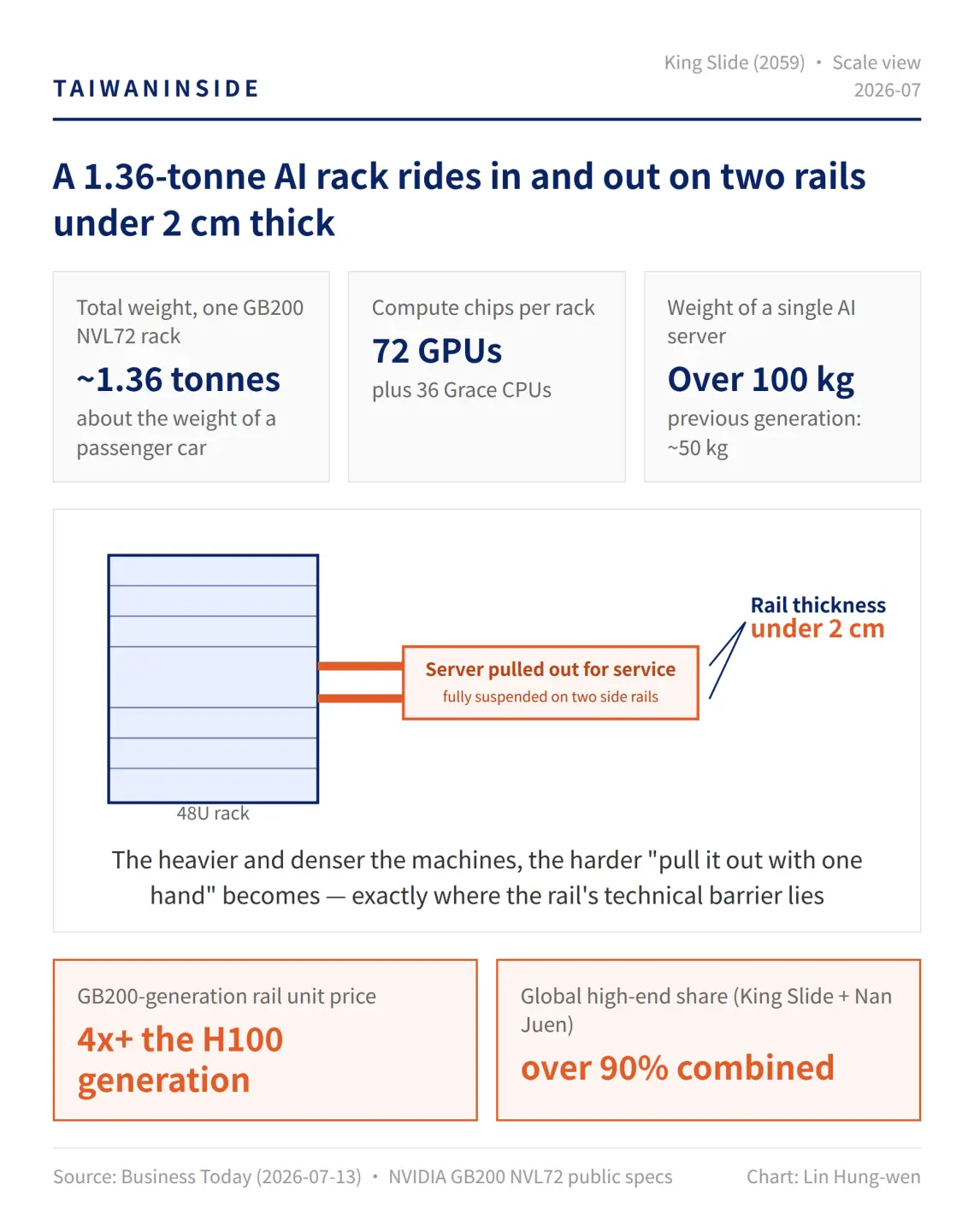
In the era of conventional servers, the slide rail mattered, but it was never critical. The real turning point is the drastic change in the physics of AI servers: as NVIDIA's GPUs move from Blackwell toward the Vera Rubin platform, the weight of a single server has jumped from around 50 kilograms to more than 100. Data-center servers must be pulled out frequently for maintenance and replacement. What allows an engineer to slide a 20-kilogram server smoothly out of the depths of a rack with one hand is a rail less than two centimeters thick — and the heavier and denser the machines get, the harder that becomes. By one estimate, the rail for a GB200 compute tray sells for more than four times the price of its H100-generation predecessor.
This increasingly critical component sits in a highly concentrated market: Taiwan's two dominant suppliers, King Slide and Nan Juen, together hold more than 90% of the global high-end AI server rail market.
Slide rails belong to what looks like a low-tech traditional industry, and in the international financial media this market is almost a blank. On the Bloomberg terminal, King Slide exists only as ticker 2059:TT and a price feed; there has never been a feature story. Forbes wrote about the company once, in June 2025, when founder Lin Tsung-Chi entered Taiwan's 50 richest with a fortune of US$2.9 billion. This is an industry that only Taiwan's manufacturing ecosystem knows intimately.
A part that is a rounding error in the bill of materials, with margins above TSMC's
An AI server costs hundreds of thousands of US dollars to build, and the rail accounts for a vanishingly small share of the bill of materials. Yet this unglamorous part produces gross margins that even chip-design houses struggle to reach — higher than TSMC's.
Analysts have been chasing the stock upward: since May, institutional price targets have climbed from NT$5,225 to NT$6,635, and every time they were raised, the share price had already run ahead. As of July 13, at NT$8,250, the market price stood above every institutional target I can find. What lets one slide rail command margins like these — and what assumption is the market pricing in? To answer both questions, we have to go back twenty-six years, to the year King Slide was pushed to the wall by its biggest customer.
In 2000, a customer worth nearly half its revenue demanded a 30% price cut
King Slide was founded in 1986 in Luzhu, Kaohsiung — the manufacturing heartland of southern Taiwan — by Lin Tsung-Chi, Jane Lin's father and still the company's chairman. In its early years it was a furniture-hardware metal shop making traditional drawer slides, and its customers were Taiwan's furniture makers.
In 2000, Jane Lin recounts, an American customer that accounted for 40–50% of King Slide's revenue that year demanded a 30% price cut — or it would walk. The team found the demand impossible to accept: agreeing to it would leave the company with no future. So King Slide went looking for a way out, and what it saw was the rising server market.
But that market already had a ruler. Accuride of the United States was then the world's number one, with a market share that at one point reached 66%; before 2000, the main rail supply for Compaq and other server makers ran through Accuride. That year, King Slide — a furniture-hardware shop cornered by its biggest customer — did not hold a single server order.
In 2001, King Slide found Compaq, which was looking for a differentiated supplier. The man sent to knock on the door was JC Wang, then a vice president of King Slide.
Walking into Compaq with a business card that read "King Slide Metalworker"
Wang later recalled that he wore the grey-green uniform of the steel trade and carried a business card printed "King Slide Metalworker" into meetings with tech giants in tailored suits — and at first felt he did not belong in the room.
For a company that had just been cornered by its furniture customers, this was a survival battle the whole firm had staked itself on.
The customer's pain point was concrete: Compaq wanted human-centered design — the release button had to be repositioned so that servers would be easier to maintain and manage. Accuride, holding two-thirds of the market, had yet to meet that demand. How was a metal shop that made furniture drawer slides supposed to?
Premium Members Only
This is a premium article. Please join our membership to read the full content.
Become a member to unlock all in-depth reports and exclusive analysis.
Already a member? Login Now
Related Articles
Micron Announces Its Largest Rewards Ever. Its Taiwan Union's Demands Expose a Clash of Pay Systems. A strike threat at Taiwan's largest foreign investor, read in three dimensions
TSMC's 3nm rinse comes exclusively from AEMC, a Taiwanese company once withdrawn from the Emerging Stock Board

Taiwan AI Industry Upgrade Forum Series || Event Report:America Wants More Manufacturing. What Does It Take for Taiwan’s Suppliers to Follow?