Morris Chang Called It “Silicon Casting”—Not Just Foundry Work, but the Most Valuable Innovation: A Business Model
Many recognize TSMC as the global leader in semiconductor foundry services. Yet, throughout my years covering the industry, I’ve often heard a familiar criticism: that TSMC isn’t all that remarkable—just another low-tier contract manufacturer.
This kind of thinking is surprisingly common. A few years ago, the chemistry department at National Taiwan University found that 90% of its graduate students joined TSMC upon finishing their degrees. One professor even proposed abolishing the master’s program altogether, claiming it had become little more than a vocational pipeline for a contract manufacturing firm like TSMC.
It’s true that in Taiwan’s contract-driven electronics sector, some companies operate on razor-thin margins—so thin, in fact, that insiders jokingly refer to them as running on “three to four percent” gross profit. This has contributed to the perception that chip foundries, too, are low-margin, low-status businesses.
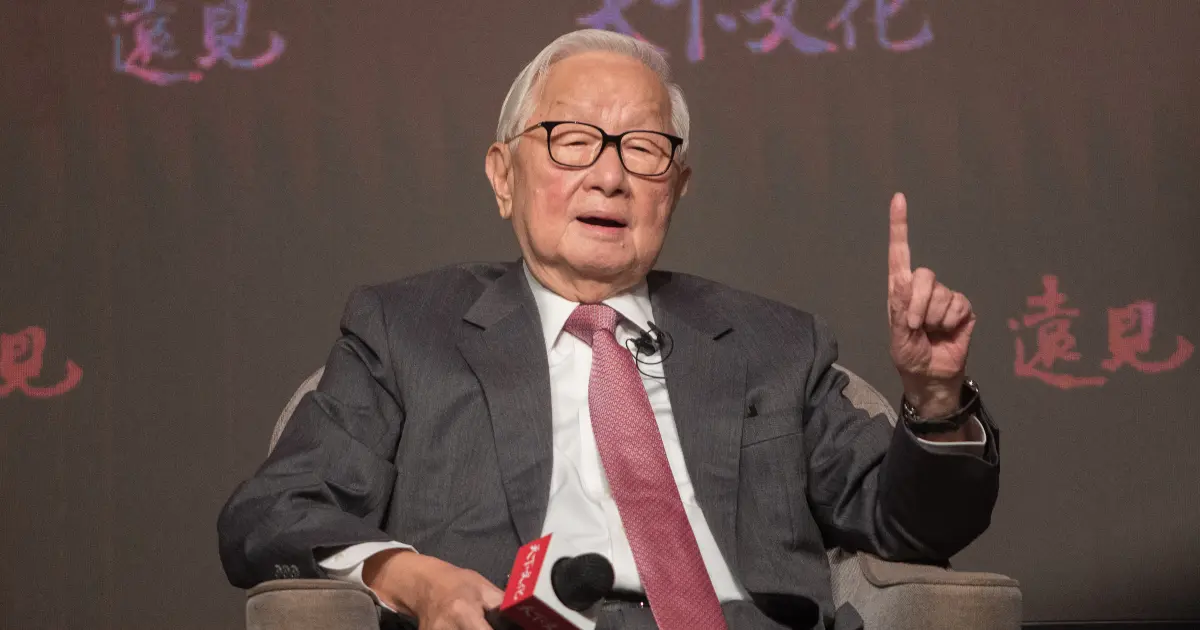
I’m reminded of a conversation from TSMC’s early days as a public company. Morris Chang once told a group of reporters that he felt the term “foundry” failed to capture TSMC’s true position in the semiconductor value chain. He proposed a new name instead: “silicon casting”—a term meant to reflect not just production, but the act of shaping and building.
I remember the moment vividly. As soon as Chang said it, the room fell silent—then suddenly burst into laughter. Everyone understood why: in Taiwanese, “silicon casting” (pronounced zhù xì) sounds identical to a grim homonym meaning “certain death.” Yet Chang, known by his English name Morris, carried such authority that no one dared correct him at first. Eventually, a brave female reporter explained the unfortunate connotation, and the term was quietly retired.
Looking back, it was a lighthearted episode—but in truth, had it not been for the unfortunate pun in Taiwanese, Chang’s proposed term “silicon casting” might have better captured the scope and ambition of what TSMC was building, far more so than the modest label of “foundry.”
That said, contract manufacturing isn’t inherently low-grade. Many foundry companies possess world-class technical capabilities and play critical roles in global supply chains. TSMC is a prime example of a contract manufacturer with extraordinary strength. Conversely, there are plenty of well-known consumer brands with slick reputations but weak technologies and dismal profit margins.
TSMC’s foundry business stands in sharp contrast to Taiwan’s earlier waves of electronics manufacturing—such as PCs, mobile phones, networking gear, or displays. What TSMC created wasn’t a race to the bottom in cost, but a highly advanced, one-of-a-kind seller’s market driven by cutting-edge technology.
Many Taiwanese contract manufacturers lack the R&D muscle or technical depth of their clients. Take the networking sector, for instance: the biggest operational risk isn’t from rival manufacturers—it’s from the customers themselves.
These major clients often possess more advanced technical know-how than their manufacturers—particularly in areas like signal integrity and thermal management. The former ensures that high-speed signals remain distortion-free, while the latter is essential in handling heat dissipation as systems scale up to 100G and 400G. In these domains, global brands typically have in-house engineering teams far superior to those of Taiwanese suppliers. If they decide to switch vendors, they can easily cultivate new ones. That’s the central vulnerability of Taiwan’s networking OEM industry.
And it’s not just the networking sector. This supplier-client imbalance is a structural weakness shared by much of Taiwan’s broader contract manufacturing industry.
TSMC, however, is fundamentally different. It controls the core technologies itself. Competitors like Samsung and Intel either struggle to match TSMC’s performance or fail to achieve acceptable yield rates. In the end, they too must place orders with TSMC. Giants like Apple, NVIDIA, and AMD lack in-house wafer fabrication capabilities, making them deeply reliant on TSMC’s production. That’s what sets TSMC’s foundry model apart.
In other words, most contract manufacturers operate in buyer-driven markets, where customers hold the power. TSMC, by contrast, operates in a seller’s market—its clients rely heavily on its capabilities, and in many cases, there’s simply no alternative. Apple, TSMC’s largest customer, has long pursued dual- or even triple-sourcing strategies to mitigate risk. But when it comes to TSMC, that diversification effort largely fails—because no one else matches its level of technology.
In the end, what you call it—“contract manufacturing” or otherwise—isn’t what matters. What matters is owning the technology your customers don’t have, and making them need you more than you need them. That’s where the true power lies.
Took the Money and Laughed All the Way to the Bank
In a 2017 speech to the Industrial Technology Advancement Association, Morris Chang described TSMC as a textbook case of business model innovation. The reason TSMC was so profitable, he explained, wasn’t just due to technology—it was because of the model.
The speech was titled “Growth and Innovation.” Product and technological breakthroughs are undoubtedly valuable, Chang said, but among all forms of innovation, it is business model innovation that delivers the greatest value—and deserves the most attention. In today’s internet age, we often celebrate innovative business models. But in his view, two of the most successful examples existed even before the term “business model innovation” became fashionable: Starbucks in the U.S., and TSMC in Taiwan.
Starbucks, which rose to prominence in the early 1980s, succeeded on the strength of a simple but powerful idea: elevate the consumer’s coffee experience—and raise the price. Before Starbucks, a cup of coffee at a five-star hotel cost about 50 cents, and just 20 cents at a roadside diner. But Starbucks improved the quality and charged $2 per cup. Consumers paid without hesitation.
TSMC, Chang said, was another such success story. In the 1990s, most semiconductor companies sold to end-product makers like IBM or Hewlett-Packard. TSMC, by contrast, had none of those companies as customers. Its clients were other chipmakers—firms like Texas Instruments, Intel, and Motorola—that normally manufactured everything in-house.
“None of our customers back then looked like our competitors,” Chang recalled. “Most semiconductor companies made everything themselves, but for small production runs or chips they didn’t want to bother with, they’d outsource. We approached them and asked to do those jobs.” That was how TSMC got started. Later, as the industry evolved, more startups began designing their own chips and turned to TSMC for fabrication. TSMC rose with that wave.
So even if we never replaced the term “foundry” with Chang’s preferred “silicon casting,” and even if TSMC never got the semantic recognition it may have deserved, I still believe it stands as a case study worth teaching in every business school. Professors and students studying innovation should take a close look at how a company from Taiwan built a groundbreaking business model—and in doing so, reshaped the global semiconductor industry.
“Everyone says we’re just a contract manufacturer—and I don’t care,” Chang once said. “We took the money and laughed all the way to the bank.”
Related Articles
Micron Announces Its Largest Rewards Ever. Its Taiwan Union's Demands Expose a Clash of Pay Systems. A strike threat at Taiwan's largest foreign investor, read in three dimensions
TSMC's 3nm rinse comes exclusively from AEMC, a Taiwanese company once withdrawn from the Emerging Stock Board
Taiwan AI Industry Upgrade Forum Series || Event Report:America Wants More Manufacturing. What Does It Take for Taiwan’s Suppliers to Follow?