One of the "Mountain Builders" of Taiwan's Semiconductor Industry: How Chintay Shih Led ITRI and Helped Give Rise to TSMC, Taiwan's "Sacred Mountain"
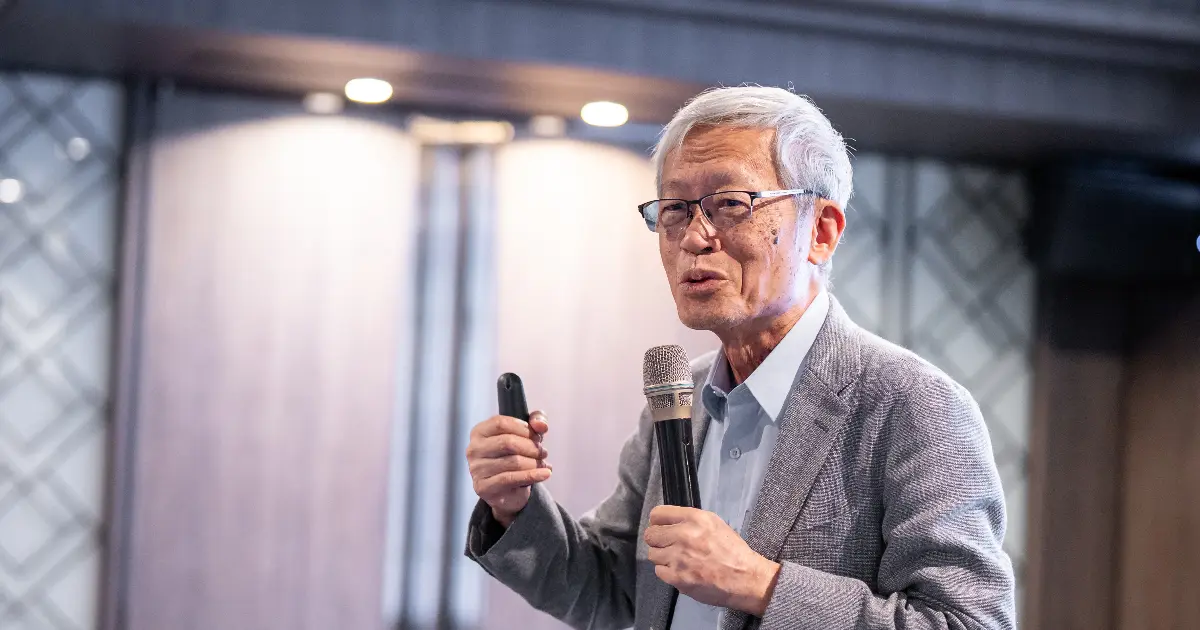
U.S. President Donald Trump has said that Taiwan "stole our chip industry." But the starting point that Chintay Shih, one of the leaders of Taiwan's semiconductor industry, witnessed firsthand was this: in 1976, Taiwan used a program with a total budget of as much as US$10 million to obtain a technology license from RCA in the United States, and sent 19 engineers there for training. TSMC came only 11 years later. How did Taiwan get here over these 50 years?
"Amid the US-China rivalry, Taiwan has become contested ground." Chintay Shih, former president of the Industrial Technology Research Institute (ITRI) and now an honorary professor at National Tsing Hua University (NTHU), made this point when discussing the achievements and challenges of Taiwan's semiconductor industry today.
Shih is one of the pioneers who opened the path for Taiwan's semiconductor industry. He rose from the ranks of engineers at ITRI, Taiwan's government-backed applied research institute, all the way to its president, and took part in the entire process: bringing in RCA's technology, building a demonstration fab, and spinning off companies such as United Microelectronics Corporation (UMC), TSMC and Vanguard International Semiconductor (VIS). He is one of the few key figures who were present from beginning to end. In *A Chip Odyssey* (造山者, literally "The Mountain Builders"), director Hsiao Chu-chen's documentary on the development of Taiwan's semiconductor industry, he is also one of the leading figures.
Now 80, Shih is still in good health. In recent years he has become one of the industry elders most often invited to speak in Taiwan. Each time he recounts the key milestones of Taiwan's industry over the past fifty years, in particular how Taiwan went "from ITRI's demonstration fab to a range of sacred mountains protecting the nation," the story and the experience behind it offer many lessons to the world. (In Taiwan, TSMC is popularly called the "sacred mountain that protects the nation"; a "range of sacred mountains" extends the nickname to a group of companies.)
In my view, if Morris Chang is the person who made TSMC a world-class company, then Chintay Shih is one of the people who gave Taiwan the "chance" to get that far. He took part in every link of the chain: technology transfer, the demonstration fab, company spin-offs and talent development. He is also one of the few people alive today who were there and can still tell this history in full.
On October 10, 2026, Taiwan's National Day, I moderated the "Double Ten Forum" with two senior figures, Chintay Shih and Stan Shih (founder of Acer). After the forum I sat down with Chintay Shih for an in-depth interview. I have organized that interview here, so that friends abroad who want to understand why Taiwan's semiconductor industry has been so successful can have more first-hand material. The following is a record of the interview.
From a 1974 Soy Milk Shop Breakfast to the TSMC Spin-off, ITRI Handed Its Technology and People to Industry
Q: The foundations of Taiwan's semiconductor industry go back to the 1960s and 1970s. Could you talk about that period?
A: The earliest stage of Taiwan's semiconductor industry can be traced back to the 1960s. At that time Taiwan's environment and conditions were poor. It was an era of being "born in adversity."
First, from 1963 to 1965, National Chiao Tung University set up a semiconductor laboratory. In 1966, K.T. Li established the export processing zone, and Gaodian (高電), Philips and Texas Instruments came to Taiwan to invest in IC testing and packaging. In the same year, Fei Hua (費驊, transliterated) and Wen-Yuan Pan (潘文淵, transliterated) launched the Modern Engineering and Technology Seminar (METS), which brought overseas experts back to Taiwan every two years.
In 1973, Sun Yun-suan established ITRI as a non-profit foundation. Its personnel and accounting systems were different from those of the civil service, which made it easier to recruit talent and purchase equipment. This was "an innovation in institutional design."
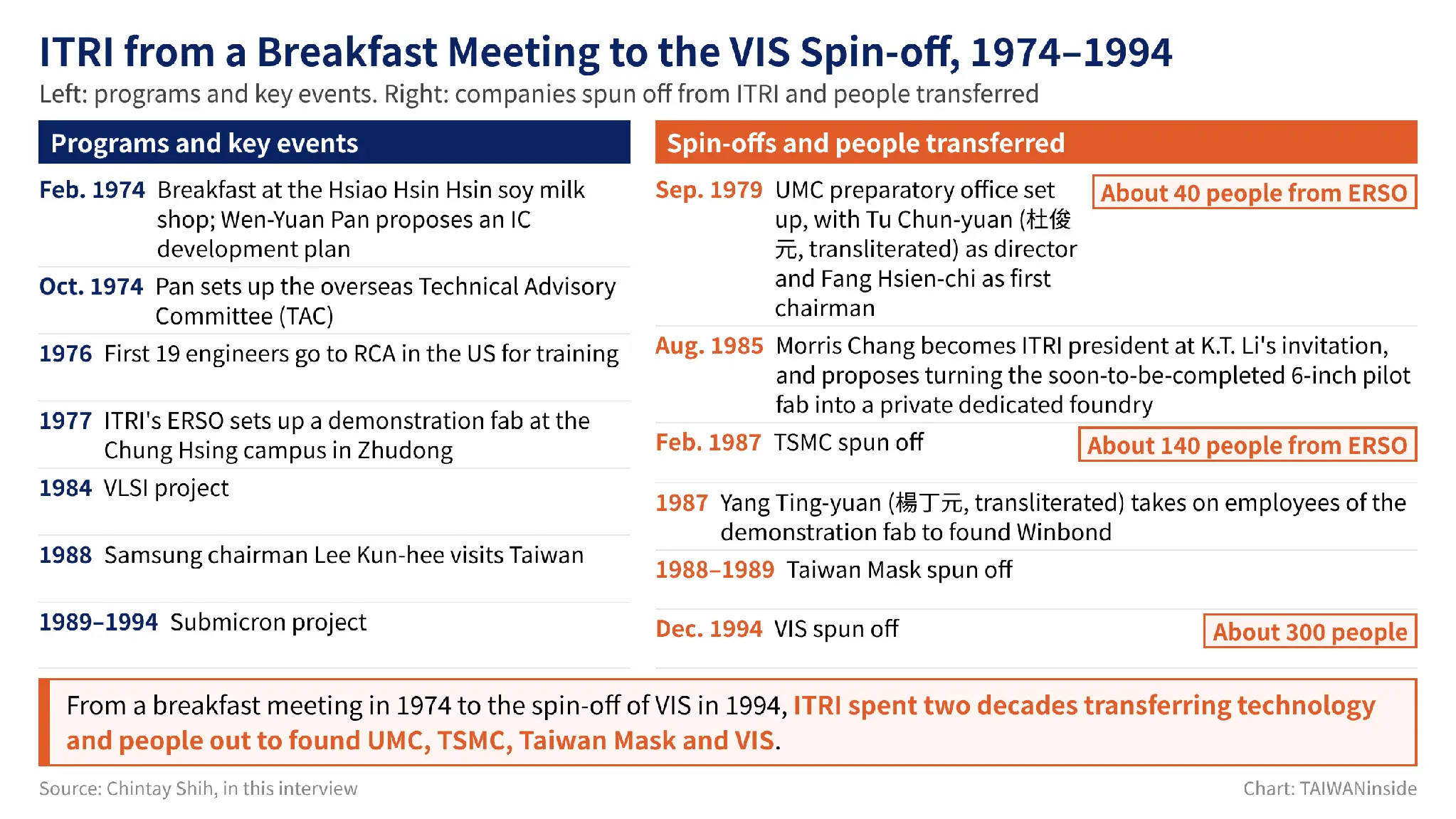
In February 1974, at a breakfast costing NT$400 at the Hsiao Hsin Hsin soy milk shop on Nanyang Street in Taipei, seven people from the government met: Sun Yun-suan, Fei Hua, Kao Yu-shu (高玉樹, transliterated), Wang Chao-chen (王兆振, transliterated), Fang Hsien-chi (方賢齊, transliterated), Kang Pao-huang (康寶煌, transliterated) and Wen-Yuan Pan. Pan proposed an "integrated circuit development plan."
In October 1974, Pan set up the overseas Technical Advisory Committee (TAC), which ultimately helped Taiwan, with a total budget of US$10 million, obtain a technology license from RCA in the United States.
1976 can be called Year One of the Silicon Island. Sun Yun-suan received the first group of 19 engineers going to RCA in the US for training, presented them with the national flag, and told them: "Only success is permitted; failure is not."
Q: You call 1976 Year One of the Silicon Island. At that time you led ITRI colleagues to RCA in the US for training, and after returning to Taiwan you led ITRI in the development of Taiwan's semiconductor industry. What do you see as the key reasons for its success?
A: First, from 1977 to 1988, ITRI's Electronics Research and Service Organization (ERSO) set up a demonstration fab at ITRI's Chung Hsing campus in Zhudong. This was not a traditional research institution. The goal was mass production and commercialization, learning the complete process from manufacturing, testing, packaging, quality control and cost control to sales.
At that time we produced 7-micron CMOS, with yields far exceeding RCA's, and designed CIC 0001 on our own. Small-volume production and sales went smoothly, which greatly increased the government's confidence.
In choosing products, we also took a niche strategy, avoiding memory and CPUs and focusing on logic ICs. The first order was for 100,000 electronic watch ICs, placed by Wei-Chung Chu (祝偉中, transliterated), an overseas Chinese student at National Taiwan University. Products later extended to musical greeting cards, toys, telephone dialers, electronic scales and custom ICs. In 1978, ITRI set up an ERSO office in California.
Next, ITRI began spinning off companies, from UMC and TSMC to Taiwan Mask and VIS, moving the results of the laboratory into industry. The major spin-offs are summarized in the chart below.
Q: You mentioned that these spin-offs were critical to Taiwan's semiconductor development. What was happening in the semiconductor industry internationally at the time, and what were Taiwan's corresponding key developments?
A: Moore's Law drove the VLSI (very-large-scale integration) technology revolution, with challenges in design methods, new materials and new equipment. In 1984, Sun Yun-suan approved the VLSI project.
In addition, the PC industry was the training ground for Taiwan's semiconductor industry. In 1984, ERSO developed an IBM-compatible PC, and then promoted PC peripherals, chipsets, a workstation alliance and a notebook alliance. In the 1990s, the growth of notebooks worldwide drove Taiwan's IC industry.
From 1987 to 1989, there was a shortage of key components. As the PC industry expanded, CPUs and memory became bottlenecks. Samsung proposed cooperation on memory technology, and at that time both the government and the private sector raised the question: "Should the government step in?"
So, from 1989 to 1994, the submicron project got under way. At that time it was modeled on SEMATECH in the United States, forming an alliance (UMC, TSMC, Etron, Macronix and others) with NT$7 billion and 300 people over four years to develop 16M DRAM and 4M SRAM. It finally spun off VIS.
By 2000, Taiwan's semiconductor industry had formed a cluster of companies including UMC, TSMC, Winbond, Macronix, Mosel Vitelic, Powerchip and VIS, and there were also more than 100 IC design companies.
Geographic clustering was also important. ITRI, Guangming New Village, Hsinchu Science Park, National Chiao Tung University and NTHU formed Taiwan's Silicon Valley, a "world within ten li" (a li is half a kilometer, so about five kilometers).
Q: Who do you think were the key figures in this history?
A: The first is Wen-Yuan Pan. He gave up his post as head of a research laboratory at RCA and retired early, and his wife also gave up a tenured teaching position in New Jersey. He took no salary and no official post, and traveled between Taiwan and the US every two months.
The second is Fang Hsien-chi. He came from the post of director general of the Directorate General of Telecommunications, served as ITRI president from 1978 to 1985, and was the first chairman of UMC and the first executive director of the Institute for Information Industry. At 95, he summed up Taiwan's semiconductor success this way: "We were fairly lucky, and we found the right people."
The third is Ding-Hwa Hu (胡定華, transliterated). He was the principal investigator of the IC technology transfer project, who volunteered to join the project. He shaped ERSO's culture of "daring to pioneer": having ideals, taking responsibility, working as a team; being open and independent, daring to try, not fearing failure, and tolerating mistakes.
Samsung's Lee Kun-hee Warned Taiwan in 1988, but Taiwan Still Chose to Enter Memory Chips
Q: You mentioned earlier that Samsung proposed cooperating with Taiwan. This was an important historical event. In the 1990s, Taiwan invested heavily in the DRAM memory industry. In 1988, Samsung chairman Lee Kun-hee came to Taiwan and invited Morris Chang, Stan Shih and you to visit South Korea. Mr. Lee noted that Samsung had already committed substantial resources, and warned Taiwan not to rush into investing in the memory industry. But Acer later invested in TI-Acer, and ITRI also pushed ahead with the submicron project and spun off VIS.
Premium Members Only
This is a premium article. Please join our membership to read the full content.
Become a member to unlock all in-depth reports and exclusive analysis.
Already a member? Login Now
Related Articles
Anthropic's IPO Prospectus Is a Barometer of the AI Bubble: What Opportunities and Risks Will Follow Its Listing?
Taiwan Mass-Produces, Japan Supplies Materials and Equipment: From Sony to Drones, Why the Taiwan-Japan Alliance Is Rare
Memory Shortage Could Last Past 2030, and TSMC Is the Unexpected Winner