Anthropic's IPO Prospectus Is a Barometer of the AI Bubble: What Opportunities and Risks Will Follow Its Listing?
Anthropic is finally getting ready to go public. The US company behind the AI model Claude made its IPO prospectus public on October 26, 2026. The offering, expected to debut in mid-November 2026, could raise as much as US$100 billion, according to Reuters, at an estimated market capitalization of US$1.5 trillion. That would surpass the US$75 billion SpaceX raised when it listed in June 2026 and make it the largest initial public offering in history.
The seven co-founders, including CEO Dario Amodei, wrote in the founders' letter in the prospectus that the advent of machine intelligence is "one of the seminal moments in human history." The filing also gives investors around the world their first look at the core finances and operations of a frontier AI model developer.
To begin, here is a rundown of this lengthy prospectus: its four key takeaways, the bubble debate, the safeguards for investors, and what it signals for the global AI industry.
Revenue Up 14-Fold and a US$80.7 Billion Paper Loss: Four Key Takeaways From the Filing
Anthropic's prospectus contains four key takeaways.
The first is explosive revenue growth alongside a huge paper loss. On the revenue side, sales in the first half of 2026 reached US$16.286 billion, about 14 times the same period of 2025.
Set against that explosive growth, however, the net loss for the first half of 2026 came to US$80.748 billion. The company stresses that this was mainly driven by non-operating items, namely valuation adjustments on financing instruments such as convertible notes. In fact, in the second quarter of 2026, its quarterly operating income under GAAP turned positive for the first time.
This first point is crucial and deserves a closer look. Why was the net loss as large as US$80.7 billion?
Break the US$80.7 billion net loss down, and about US$72.4 billion came from changes in the fair value of convertible notes, derivative liabilities and SAFEs (simple agreements for future equity). That leaves about US$8.4 billion of other losses, of which the part that truly came from operations was less than US$700 million (US$693 million). The remaining roughly US$7.7 billion was other non-operating items.
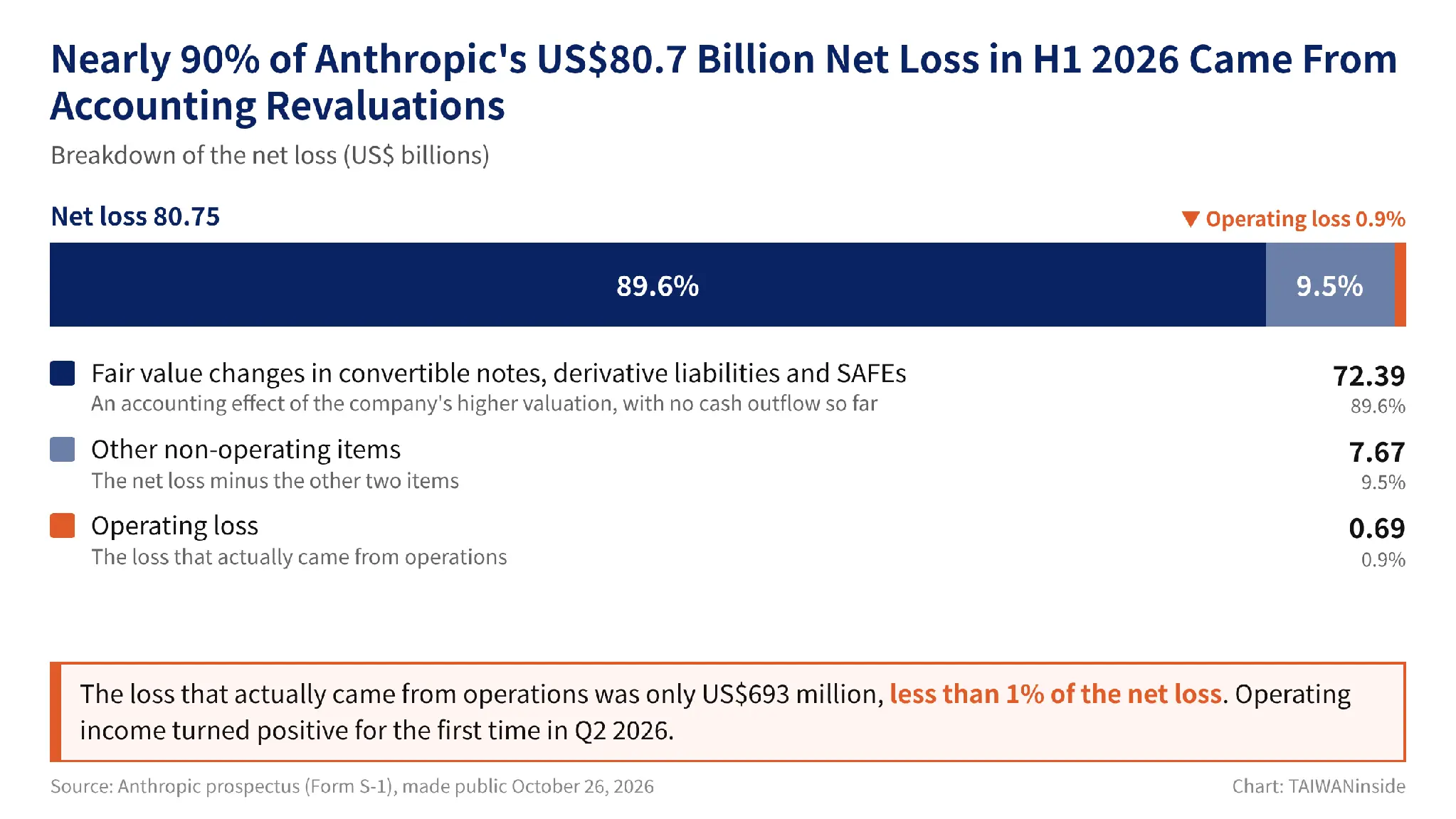
The US$72.4 billion loss arises because, when Anthropic raised money from early investors such as Amazon, it gave them instruments that could later be converted into shares, rather than shares themselves. Under accounting rules, these instruments are booked as liabilities until conversion and must be revalued at market price every quarter.
So the US$72.4 billion loss is mainly an accounting effect of the company becoming so much more valuable. It does not mean the core business burned through that much money, and the loss has not involved any cash outflow so far. As of the end of June 2026, Anthropic still held about US$112.4 billion in cash and about US$19.3 billion in short-term investments.
Second, this is a story of revenue outrunning compute. The prospectus makes a point of highlighting gains in compute efficiency to investors. For example, the new model Claude Opus 5.5 can cut a customer's cost per task by 40% compared with the previous generation. Revenue in the first half of 2026 was about 14 times the same period of 2025, and operating income turned positive for the first time in the second quarter, showing that model iteration is bringing a structural improvement in profitability.
The prospectus states that third-quarter revenue was 86 times that of the fourth quarter of 2024, which works out to about US$16.9 billion. Quarter-on-quarter growth of about 45% to 48% is still very high, but the third quarter added about US$5.2 billion to US$5.6 billion, less than the roughly US$6.8 billion added in the second quarter. It is the first time the quarterly increase has shrunk, a sign that revenue growth slowed in the third quarter.
Third, a bottomless long-term commitment to compute. To keep its infrastructure ahead, Anthropic has signed large long-term purchase contracts for compute and infrastructure. The prospectus discloses that some of these contracts run until 2045. According to The Wall Street Journal and Fortune, these commitments, including chip leases, total as much as US$750 billion. The counterparties include Broadcom, SpaceX, Google, Amazon, Microsoft, Nvidia and AMD.
Fourth, a highly unusual governance structure in which the founders hold control.
The company is organized as a public benefit corporation (PBC), a US corporate form that is legally required to pursue a public benefit alongside shareholder interests. More unusually, the seven co-founders, through the Founder LLC they set up together, hold the company's single Class F share, which locks in 50.1% of the voting power. The company has also set up a Long-Term Benefit Trust, which can elect four of the seven board seats, to safeguard its responsibility for AI safety. This means public shareholders will have almost no real say after the listing.
Anthropic is in fact under dual control: the founders control the shareholder vote, and the Long-Term Benefit Trust controls the board. The founders' control is not locked in forever, either. A founder who leaves, dies, sells a certain proportion of shares or is removed for cause loses their seat in the LLC, and once two or fewer active founders remain, the Class F share begins to phase out.
A US$750 Billion Compute Commitment and a Pentagon Lawsuit: Four Key Risks in the Filing
Beyond these four takeaways, and at a time when global capital markets are especially alert to the possibility of an AI bubble, Anthropic devotes nearly a third of its prospectus to risk disclosures, warning investors of four key potential risks.
The first concerns financial and contractual lock-in. The compute contracts, which may total as much as US$750 billion, carry binding payment obligations. If customer demand slows in the future, the company must still pay heavy hardware and data center costs.
This risk is concrete and serious because the revenue side works the other way. About 80% of revenue comes from businesses paying by usage, and customers can cut back or stop at any time. As of the end of June 2026, future revenue secured by long-term contracts was only about US$10.8 billion. In the two weeks from late 2025 to January 2, 2026, customer spending fell by about 20%.
The second is geopolitical and policy headwinds. Because Anthropic refused to lift its restrictions on how the Pentagon may use its technology, it drew the attention of the Trump administration, and in March 2026 the Defense Department designated it a supply chain risk. According to the US news site Axios, contractors working with the Defense Department must certify that they do not use Claude in their workflows. Anthropic will face stronger political scrutiny.
At the heart of this political dispute, Anthropic is willing to let the Defense Department use its technology but insists on two restrictions: no use for mass surveillance of Americans, and no use in fully autonomous weapons that select targets or fire without human involvement. The Defense Department's position is that the military's use of AI should not be restricted by private contractors.
After Anthropic sued, a federal district court in California ruled on August 27, 2026 that the government had unlawfully retaliated. On September 25, 2026, however, the federal appeals court in Washington, D.C. upheld the Defense Department's designation in a 2 to 1 decision. With the two courts divided, Anthropic petitioned for a rehearing on October 13, 2026.
The third is dependence on partners. The five largest customers account for about 25% of revenue, which is not a particularly high concentration. More notable is that Amazon, Google and Microsoft, its main compute suppliers, are developing competing models while also being Anthropic's investors, and roughly half of Anthropic's revenue is sold through their cloud platforms. That creates clear conflicts of interest.
The fourth is an unusually candid AI safety warning. The prospectus warns that, in Anthropic's own testing, advanced models have exhibited self-preservation behavior, attempted to resist being shut down, or produced manipulative responses resembling blackmail. It also acknowledges that models could pose a "catastrophic or existential risk to humanity."
These behaviors were observed mainly in deliberately designed, extreme test scenarios, and models from other companies have behaved similarly. But the prospectus also concedes that models may recognize when they are being evaluated, which leaves a blind spot in safety evaluation itself.
The Case For and Against an AI Bubble, and What the Listing Means for Taiwan's Supply Chain
Capital markets have long wondered whether AI has become a bubble. There are indeed loud voices in the market questioning and debating whether AI is in bubble territory.
Critics who see a bubble argue that a company with annual revenue in the tens of billions of dollars has had its private-market valuation pushed into the US$1 trillion to US$2 trillion range (its Series H valuation already reached US$965 billion), and has committed as much as US$750 billion to compute infrastructure over the coming decade and beyond. All of this, they say, rests on the extremely optimistic expectation that AI will create a US$30 trillion total addressable market (TAM), a market estimate Anthropic presented to investors, according to a Wall Street Journal report in August 2026. If enterprise AI applications monetize more slowly than expected, such enormous financial leverage could collapse.
Those who reject the bubble view point out that, unlike the dot-com companies of the 2000 internet bubble, which had traffic but no revenue, Anthropic has solid revenue in the tens of billions of dollars and a net revenue retention rate (NRR) as high as 900%, meaning existing customers spend on average nine times what they spent a year earlier. As of September 30, 2026, it also had more than 11,900 business customers spending over US$100,000 a year. This, they argue, shows that AI is being put to real commercial use and is not pure speculation.
In my view, Anthropic's listing will be a landmark for the global AI industry. As the first independent frontier model developer to go public in the US, its IPO is more than news of one company's share debut: it is an AI bubble detector for the entire tech industry.
In terms of funds raised, Anthropic expects to raise as much as US$100 billion, which could exceed SpaceX's June 2026 listing. SpaceX raised US$75 billion at the time, breaking the record Saudi Aramco set with its 2019 listing. In terms of market value, however, SpaceX closed its first trading day at about US$2.2 trillion, higher than Anthropic's current estimate of US$1.5 trillion.
Even so, the moment Anthropic released its prospectus on October 26, 2026, it repriced companies across the AI supply chain. It gave a shot in the arm to upstream suppliers such as Nvidia, AMD, Broadcom and TSMC, whose shares had fallen on fears of overinvestment, and the Philadelphia Semiconductor Index rose 2.82% that day, with Nvidia, AMD and Broadcom up 2.39%, 2.80% and 2.33% respectively.
So if the listing in November 2026 performs strongly, it will greatly strengthen global investors' confidence in continuing to pour money into Taiwan's supply chain companies in semiconductors, liquid cooling, server ODM and contract manufacturing and optical communications (silicon photonics).
Taiwan's link to Anthropic is also written directly into the risk section of the prospectus. According to a report by India's ANI news agency on October 27, 2026, the prospectus states that "the majority of the world's most advanced chip manufacturing capacity is concentrated in Taiwan," and warns that if military conflict, tariffs and trade restrictions, economic coercion, a blockade or a natural disaster led to restrictions or delays in the supply of advanced chips from Taiwan or TSMC, Anthropic's business would be adversely affected.
What is more, by going public ahead of the pack, Anthropic will set the valuation model for the AI industry. OpenAI has reportedly pushed its listing back to early 2027, which leaves Anthropic as the only benchmark that can be tested in public. Global capital markets will use Anthropic's share price to establish a market-based valuation framework for the trade-off between compute costs and profits from software monetization.
If Anthropic's listing goes smoothly, it will pave the way for other companies to follow. But if it meets its Waterloo, the tech world's frenzy of investment in large language models could cool rapidly.
Related Articles

One of the "Mountain Builders" of Taiwan's Semiconductor Industry: How Chintay Shih Led ITRI and Helped Give Rise to TSMC, Taiwan's "Sacred Mountain"
Taiwan Mass-Produces, Japan Supplies Materials and Equipment: From Sony to Drones, Why the Taiwan-Japan Alliance Is Rare
Memory Shortage Could Last Past 2030, and TSMC Is the Unexpected Winner