AI Demand Is Booming, but Are Profits Keeping Up? From Anthropic's Earnings to Marvell's Pricey Acquisition, a Full Look at AI's Current Bottlenecks and Where It Goes Next

On November 2, 2026, Anthropic, the developer of the AI model Claude, filed an amended document that added its third-quarter results. Quarterly revenue reached as much as US$17 billion, yet the company unexpectedly swung from profit to loss. On the same day, US chip designer Marvell announced it would acquire optical components maker Lumentum for a staggering US$115 billion, and the shares of both companies fell sharply.
Before discussing what these two pieces of news mean for the AI industry, I want to tell two stories about predictions.
In 1928, the great economist John Maynard Keynes wrote an essay titled "Economic Possibilities for our Grandchildren." He argued that decades of productivity gains and technological progress would leave our grandchildren with a new problem: how to use a great deal of leisure time. He even predicted that a hundred years on, people would need to work only 15 hours a week.
It is now 2026, roughly the point in time Keynes was predicting. But as everyone knows, people are not working just 15 hours a week. The hours are far longer than that and have only grown longer. My own working hours certainly have not fallen; I probably work more than 51 hours most weeks. As for many people around me, even though AI seems able to do a great deal, most of them are working even harder and putting in even more overtime.
The second story comes from my reading of a new book by Chenming Hu, TSMC's former chief technology officer. He recalls that when he went to teach at MIT (the Massachusetts Institute of Technology) in 1973, everyone was talking about The Limits to Growth. The book came out of research by professors at the MIT Sloan School of Management and became a bestseller translated into 30 languages. Its main argument was that if humanity kept pursuing economic growth along its existing trajectory, resources would fall out of balance and collapse, and it predicted that by the middle of this century there would be a devastating, all-out collapse of the environment, economy and society.
Hu says this prophecy about the limits to growth does not appear to have come true, and Elon Musk has even said that humanity has now entered an age of abundance. In Hu's view, the main reason is of course that people overlooked technological progress, and in particular the rapid development of semiconductors, which has kept growth going.
Higher Short-Term Compute Spending Pushed Anthropic Back to an Operating Loss in the Third Quarter
With those two stories told, I want to look more closely at what the Anthropic and Marvell news means for the development of the AI industry.
Let's start with Anthropic. After making its IPO prospectus public on October 26, 2026, Anthropic, surprisingly soon, filed an amended document with the US Securities and Exchange Commission (SEC) that added its third-quarter results.
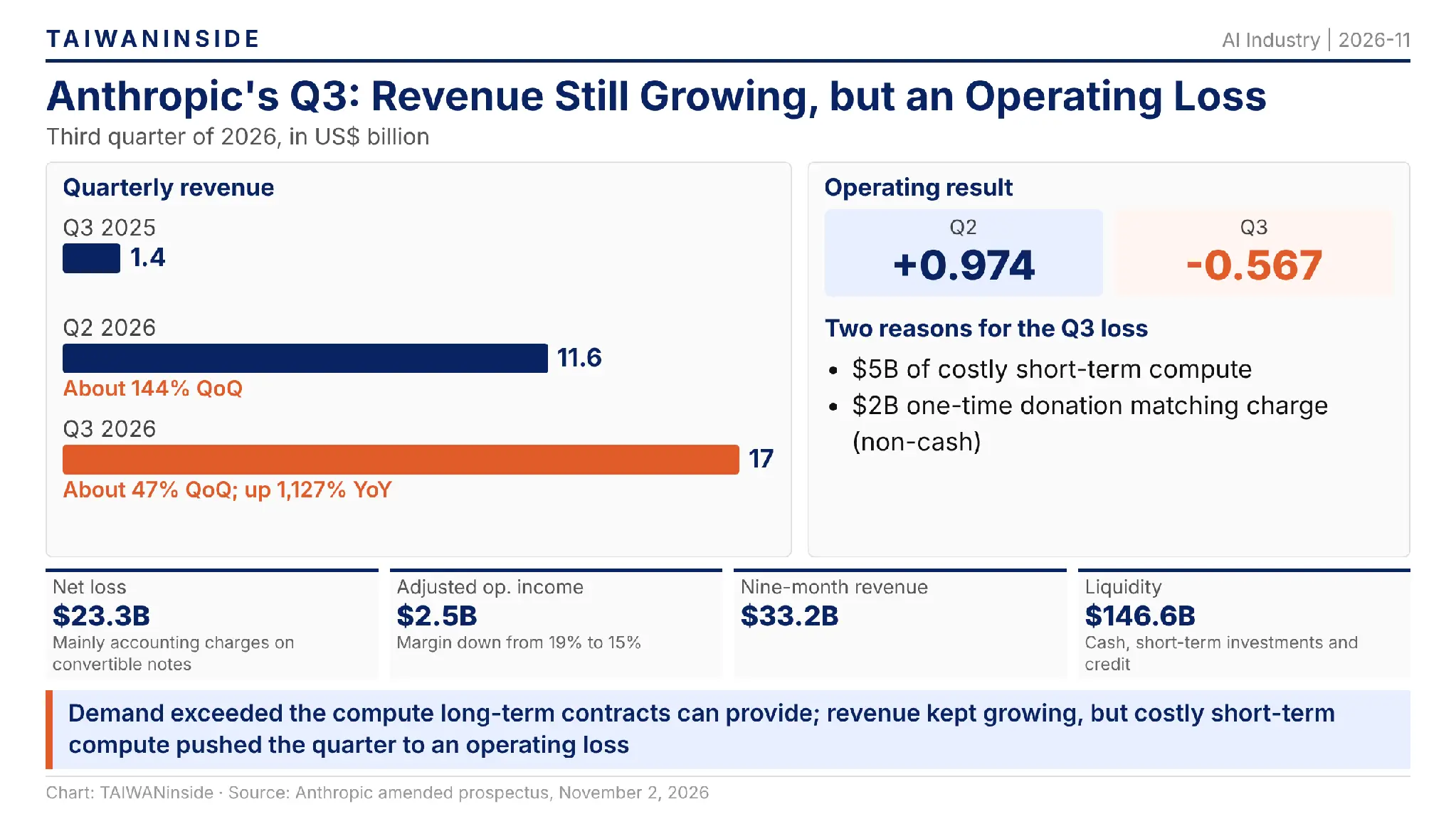
Third-quarter revenue reached as much as US$17 billion, a staggering 1,127% increase from a year earlier, while quarter-on-quarter growth slowed to 47%. The quarter brought an operating loss of US$567 million, a swing from the US$974 million operating profit of the second quarter. The net loss came to US$23.3 billion, adjusted operating income was US$2.5 billion, and the adjusted operating margin fell from 19% in the second quarter to 15%. Cumulative revenue for the first nine months of 2026 totaled US$33.2 billion.
Anthropic said the return to an operating loss this quarter was mainly due to US$5 billion of high-cost short-term compute spending and a US$2 billion non-cash donation matching charge. Its net loss for the first nine months totaled US$104 billion, mainly reflecting US$94.3 billion of non-cash charges arising from the rising value of its convertible notes.
Don't get lost in all these numbers. Here is the conclusion in brief: for the AI industry, the results are a positive signal on demand; for Anthropic itself, they are a warning about profitability; and for the compute supply chain (including Taiwan), they are good news in the short term. The most important message in the results is that demand has already exceeded the compute that long-term contracts can provide.
There are two main reasons Anthropic swung from an operating profit in the second quarter to an operating loss in the third:
The first is the US$5 billion of short-term compute. Because demand exceeded the compute available under long-term contracts, Anthropic had to buy US$5 billion of short-term compute, which the prospectus describes as costing "significantly more" than long-term contracts. It is like a factory that has taken on too many orders and lacks the capacity, so it has to outsource at a high price.
The second is the US$2 billion donation matching charge, a non-cash expense related to the employee donation matching program, and a one-time item. Take out this US$2 billion, and the operating loss turns into a profit. If the short-term compute could be replaced with cheaper long-term contracts, profits would be even better. This is also why adjusted operating income was still slightly higher than in the second quarter.
So the positive signal from the results is that demand really does exceed supply. Revenue also keeps growing in scale: US$17 billion in a single quarter, an annualized run rate of more than US$60 billion. Although 47% quarter-on-quarter growth is slower, it is still very high for a company of this size.
The Results Carry Five Negative Signals, but the Short-Term Picture for Taiwan's Supply Chain Is Still Positive
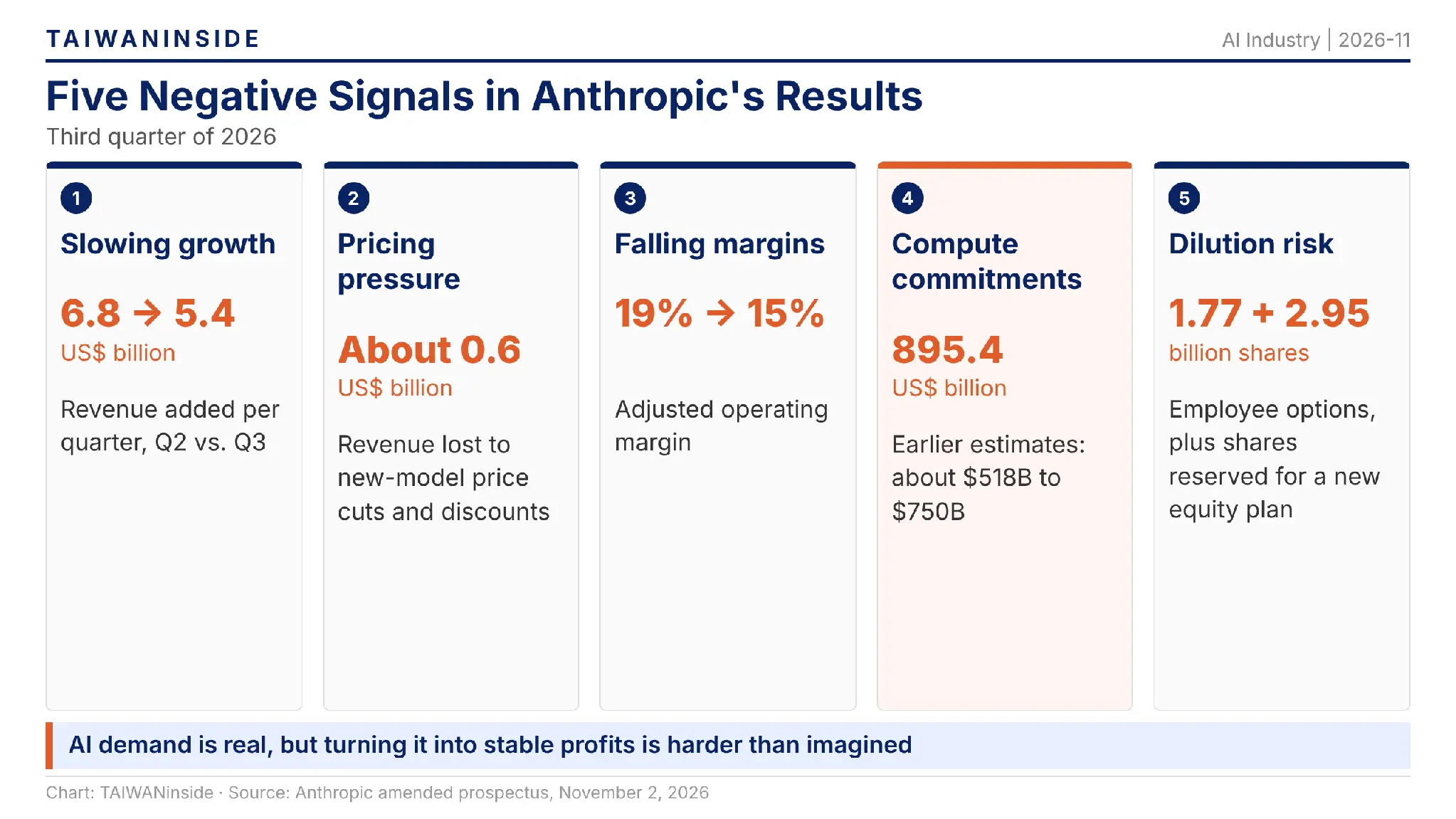
There are negative signals, too. The first is that growth is indeed slowing: quarter-on-quarter growth fell from about 144% to about 47%. New revenue added in the third quarter was about US$5.4 billion, less than the roughly US$6.8 billion added in the second quarter.
The second is that pricing pressure is already showing up in revenue. Price cuts on new models and discounts reduced revenue by about US$600 million, a concrete figure for how falling token prices are affecting Anthropic's revenue.
The third is that margins have fallen and may swing back and forth in the future. Some analysts already expect that Anthropic may be profitable for a quarter or two and then return to losses. As long as compute demand keeps exceeding long-term capacity, it will have to keep buying expensive short-term compute.
The fourth is that the compute commitments are larger than the market expected. Earlier estimates ranged from about US$518 billion to US$750 billion, but this filing formally discloses about US$895.4 billion.
The fifth and last is dilution risk. There are currently 1.77 billion employee stock options outstanding, and up to 2.95 billion shares have been reserved for a new equity incentive plan, which means considerable dilution pressure for IPO buyers.
So these results once again show the problem of how value is distributed in the AI industry. Demand is very strong right now, but profits are currently flowing mainly to the compute suppliers that "sell the shovels," rather than to the model companies themselves.
To sum up, Anthropic's third-quarter results prove two things at once: AI demand is real, but turning that demand into stable profits is harder than imagined. For the AI industry as a whole, the results weaken the bearish argument that "nobody needs AI." But for model companies like Anthropic, they reinforce concerns about "slowing growth, squeezed margins and huge commitments."
As for Taiwan's supply chain, the short-term picture is positive, because a shortage of compute means demand for chips, servers, power supplies and thermal management will continue. In the medium to long term, it still depends on whether model companies can turn revenue growth into enough profit to support compute commitments of nearly US$900 billion.
The Center of AI Competition Is Shifting, and Optical Communications Has Become a Strategic Resource
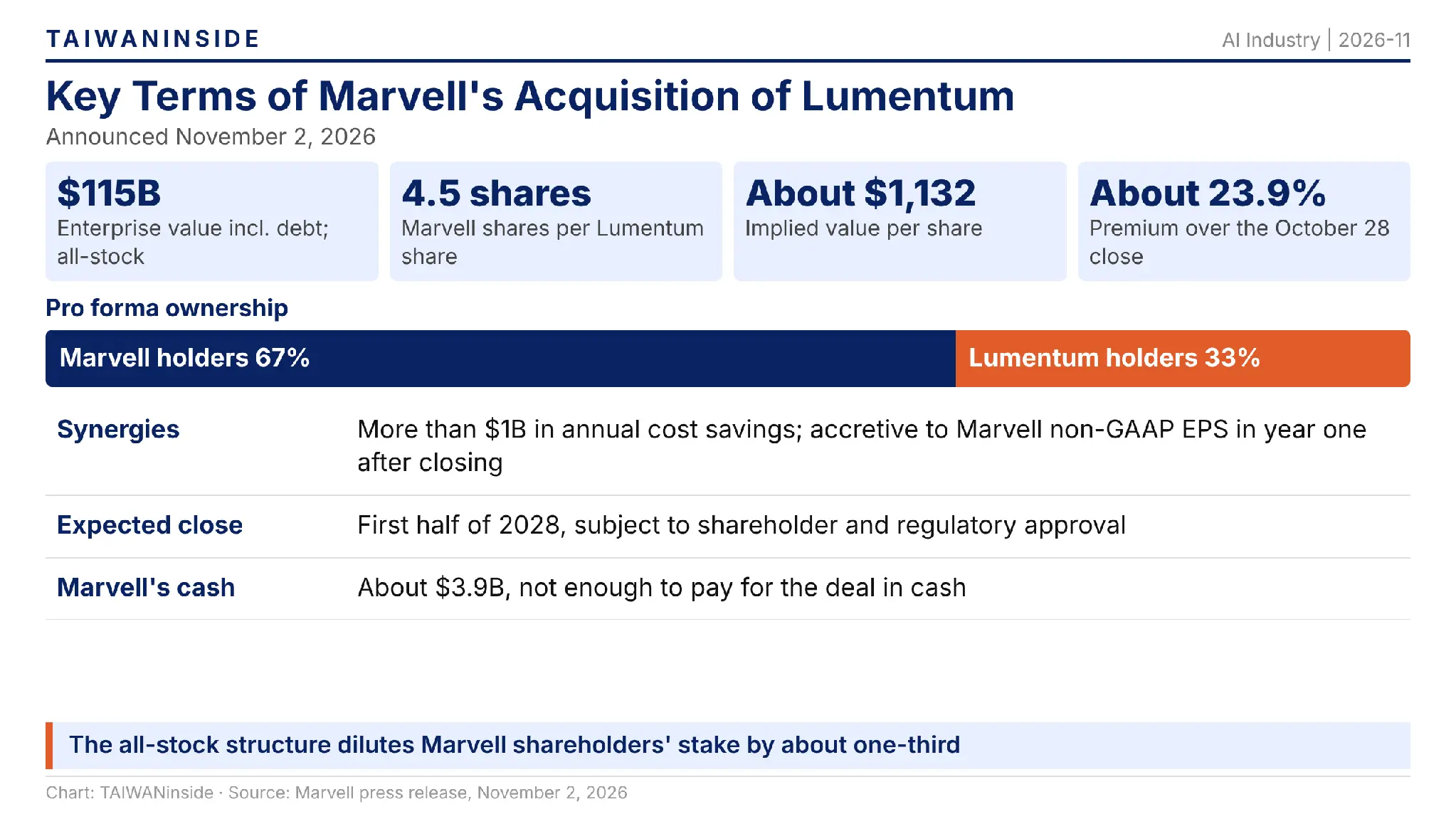
As for Marvell's acquisition of Lumentum, the all-stock deal valued at US$115 billion is larger than Broadcom's roughly US$69 billion acquisition of VMware in 2023, making it one of the largest acquisitions in the history of the semiconductor industry.
The deal was formally announced on November 2, 2026, at a time when semiconductor stocks were in a sharp correction. Its significance as a signal is that the center of AI competition is extending from "compute chips" to "how chips are connected to one another," and optical communications has become a strategic resource on a par with GPUs and HBM (high-bandwidth memory).
Why does this acquisition matter so much? Because the shift "from copper to optics" is AI's next bottleneck. AI clusters keep getting bigger, growing from thousands of GPUs to hundreds of thousands, and the volume of data that has to move between chips and between racks is exploding. At high speeds and over long distances, traditional copper wiring consumes a lot of power and suffers severe signal loss, which makes optical communications a necessary alternative.
Many people understand that the biggest constraint on data centers today is electricity. Optical communications uses less power than copper, so it becomes even more important in a power-constrained environment.
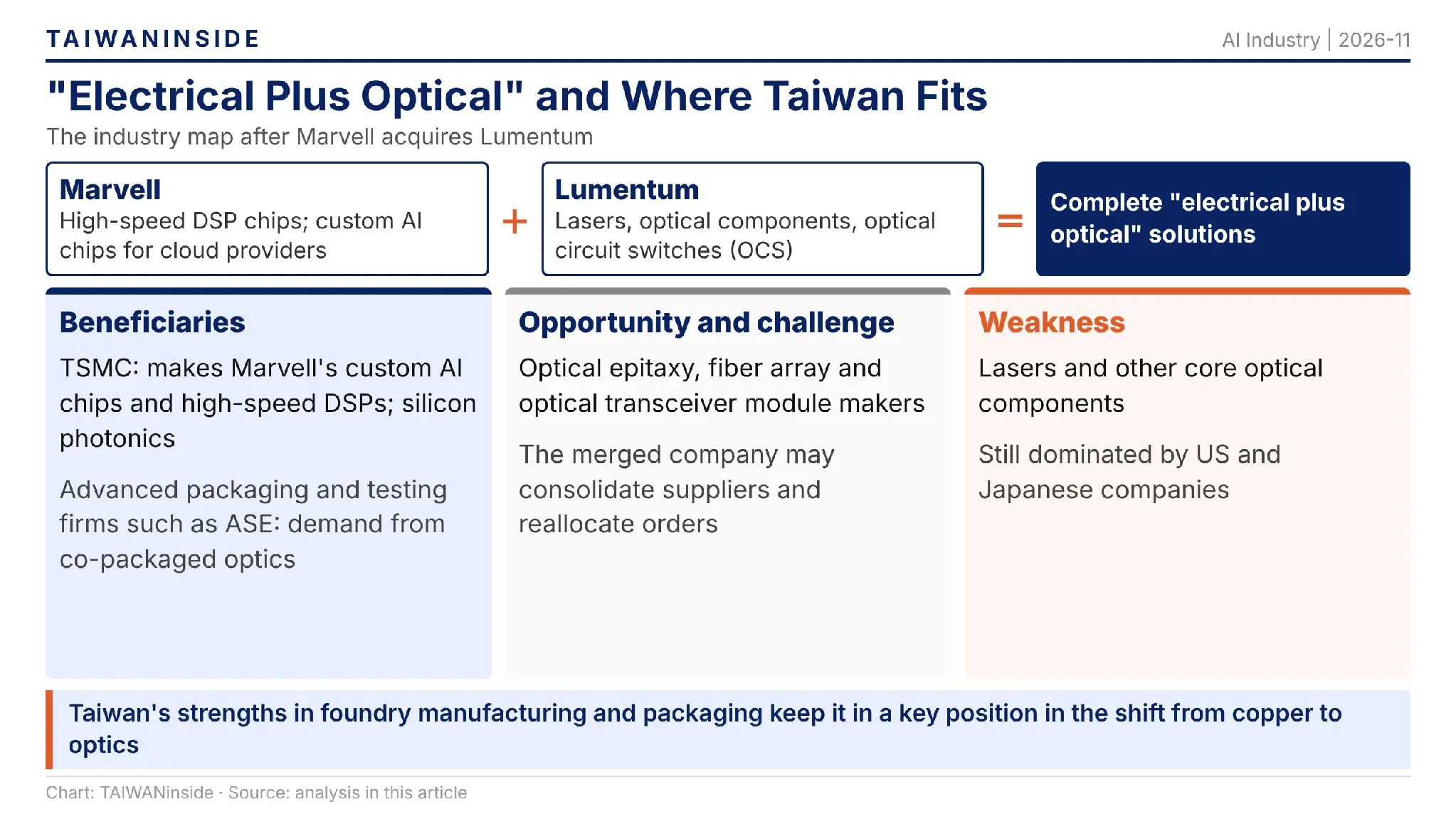
In addition, vertical integration of "electrical plus optical" is also a prerequisite for Marvell to compete with Broadcom and Nvidia. Marvell excels at high-speed digital signal processing (DSP) chips and custom AI chips for cloud providers, while Lumentum excels at lasers, optical components and optical circuit switches (OCS). By acquiring Lumentum, Marvell fills in the optical piece, moving from selling chips to offering complete "electrical plus optical" solutions.
More importantly, the race for capacity in key components has become even more important. Earlier reports said Lumentum has stated its capacity is sold out through 2029. In the AI era, capacity for lasers and optical components, like CoWoS (TSMC's advanced packaging technology) and HBM before them, has become a scarce resource. Acquisitions are a direct way to secure capacity and technology.
So Marvell's acquisition is a signal of industry consolidation, as AI infrastructure moves from "each company specializing in its own area" to "vertical integration." In the past, GPUs, memory, networking and optics were each handled by different companies; now the big players all want to offer complete solutions and capture more of the added value. This deal could set off more consolidation in optical communications and networking.
However, from the time the deal began to be rumored in late October 2026 to its formal announcement on November 2, the shares of both companies fell by more than 20% to 30%, and the sharp drop in market value has raised quite a few concerns in the market.
Optical Communications Has Strong Growth Prospects, and Taiwanese Companies Hold a Key Position
The reasons are not hard to work out. The deal was announced at a time when market doubts about the return on AI investment were rising. Another key point is dilution: because the deal is all-stock, Marvell shareholders' stake will be diluted by about one-third. Many large acquisitions in the past have also included cash, but with AI developing so quickly, most companies are short of cash and can only pay in shares. Marvell has only about US$3.9 billion in cash on its books, not enough to pay for such a large deal in cash. Doing the acquisition entirely in stock was also a major reason for the sharp fall in the share prices.
Of course, large acquisitions also carry regulatory risk. The deal will need approval from US and Chinese regulators, and China's review could drag on for a long time, which is one of the reasons the deal is not expected to close until the first half of 2028.
The market has also raised a good question: if Lumentum's capacity is already sold out, why is it willing to sell? The market is likely to read this as a sign that the seller thinks its valuation is already very high.
Still, what most deserves analysis here is the impact on Taiwan's supply chain.
First, TSMC and Taiwan's advanced packaging industry should both benefit, because Marvell's custom AI chips and high-speed DSPs are mainly manufactured by TSMC. If Marvell pushes ahead with co-packaged optics in the future, packaging optical components together with chips, it would further boost demand for TSMC's silicon photonics technology and advanced packaging, and packaging and testing companies such as ASE could also benefit.
Second, Taiwan has quite a few companies in optical communications epitaxy, fiber arrays and optical transceiver modules. The merged company may consolidate its supply chain and reallocate orders, which is both an opportunity and a challenge for existing suppliers. It depends on whether each company can break into the new integrated "electrical plus optical" architecture.
Over a longer horizon, optical communications will be one of the fastest-growing areas of AI hardware. Taiwan's strengths in foundry manufacturing and packaging keep it in a key position in the shift from copper to optics. But core optical components such as lasers are still dominated by US and Japanese companies, and this is a weakness for Taiwan's industry.
My view is that the most important signal from this deal is that the battlefield of AI hardware is expanding. Over the past two years, the market's focus has been on GPUs, HBM and CoWoS. Next, the networking and optics that connect these chips will become the new bottleneck and a new source of profit.
That said, what everyone has been watching, from power constraints on data centers to compute in short supply to Anthropic being forced to buy expensive short-term compute, all shows that the bottleneck in AI infrastructure lies not only in the chips themselves but in whether the whole system can be linked together effectively and with low power consumption. This will be a key point to watch in the development of the AI industry.
Semiconductors Accelerate Economic Development: The Future of Chips Is the Future of the World
Let me return to the two stories about predictions I began with.
Keynes lived in an era when the world had already moved from agriculture into industry. But as everyone knows, the fastest phase of human development came later, with the information age. This was a development the great economist did not foresee. And once information and electronics took off explosively, work became more and more complex, and people naturally became busier and busier. This is why his prediction missed the mark.
What is more, as productivity rose, people chose to consume more rather than rest more; new demand kept being created; and income inequality left many people unable to cut their working hours.
Keynes correctly predicted the huge growth in productivity, but he did not foresee that human desires and new demand would expand along with technology. The information and electronics age brought countless new products, new services and new jobs, and people became busier, not more idle. Today's AI boom looks as if it is replaying the same story.
As for the book Hu mentioned, when the MIT professors studied the limits to growth, they focused on population growth and its relationship with the earth's finite resources, such as oil, food and land. They overlooked the enormous growth potential of semiconductors made from silica sand. In 1972, ICs were still at an early stage of development. But through the PC, the internet, mobile phones and now AI, semiconductors became the key driver of the unimaginably rapid growth of human economies and societies.
Interestingly, more than half a century later, AI has run into new "limits to growth." This time, the bottleneck is not oil and food but electricity. Data centers that cannot be built and compute that cannot meet demand are the biggest constraints on the AI industry today. And the answer to breaking through those constraints may still come from semiconductors: more power-efficient chips, more efficient optical communications and more advanced packaging. This is also why Marvell is willing to bet US$115 billion on optical communications.
Semiconductors, then, have accelerated the development of industry and the economy, and Chenming Hu is one of the leading figures who contributed to that technological transformation. He once said something he still firmly believes today: "The future of chips is the future of the world." I like this line very much. When we look at many issues today, and especially when we try to predict the future, I think this line offers the best explanation and commentary.
Related Articles

Bridging the Computer and Semiconductor Industries:How Stan Shih Grew Acer into a Family of Companies and Developed More of Taiwan's Top Talent Than Anyone Else

Anthropic's IPO Prospectus Is a Barometer of the AI Bubble: What Opportunities and Risks Will Follow Its Listing?

One of the "Mountain Builders" of Taiwan's Semiconductor Industry: How Chintay Shih Led ITRI and Helped Give Rise to TSMC, Taiwan's "Sacred Mountain"