Redefining Product Evolution: From Agricultural Tools to Intelligent Automation—Aurotek’s Vision of Product 4.0
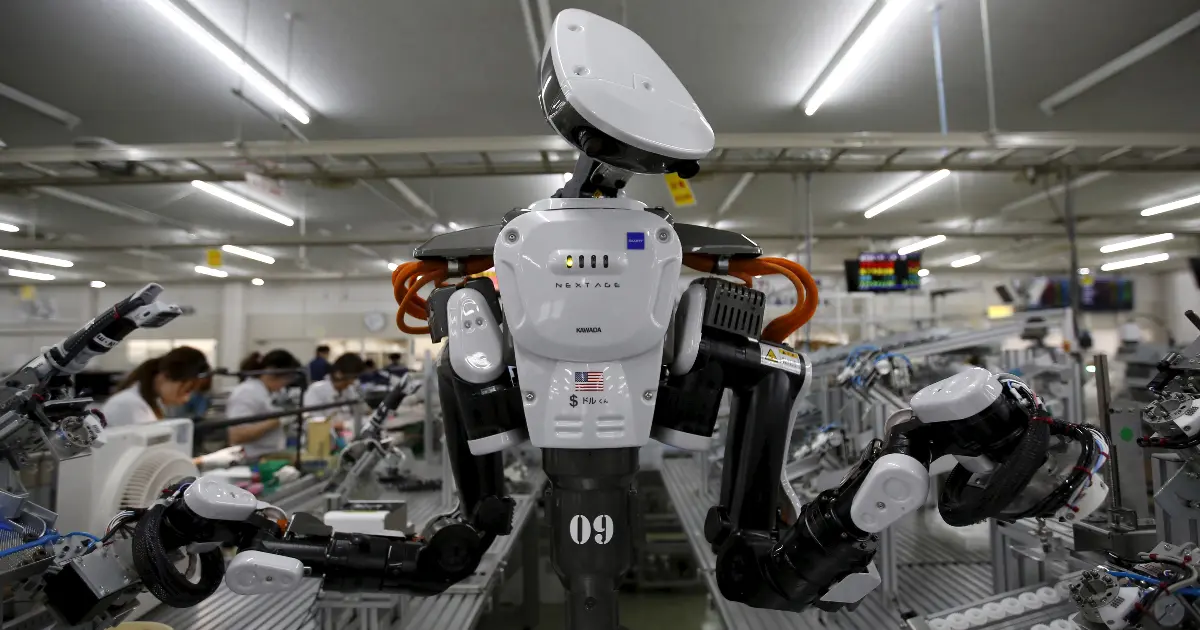
Last week, I sat down for an in-depth interview with Cheng Tian-tsung, Chairman of Aurotek. He spoke about the evolution of the global technology industry, his Product 4.0 concept introduced over a decade ago, and how AI is accelerating the development of brains for humanoid robots. Cheng also agrees with Tesla CEO Elon Musk’s prediction that, in the future, the number of humanoid robots will be three times that of the human population.
Cheng Tien-tsong is a prominent opinion leader and seasoned expert in Taiwan’s electronics industry. With 35 years of experience at top international tech firms, he has held executive positions such as President of HP China, President of Texas Instruments Asia, and CEO of FIH Mobile under the Foxconn Group. After retiring in 2012, he became a passionate advocate of the Maker Movement and has been deeply involved in startup mentorship. He has supported the growth of over 600 startups across the United States, China, and Taiwan, making a significant impact on the startup ecosystem throughout Asia.
In 2023, Cheng’s close friend and then-chairman of Aurotek, Chang Yung-chang, passed away from cancer. Before his death, Chang expressed his wish for Cheng to take over the company. Cheng accepted the responsibility and became chairman of the mid-sized firm, which has just 150 employees.
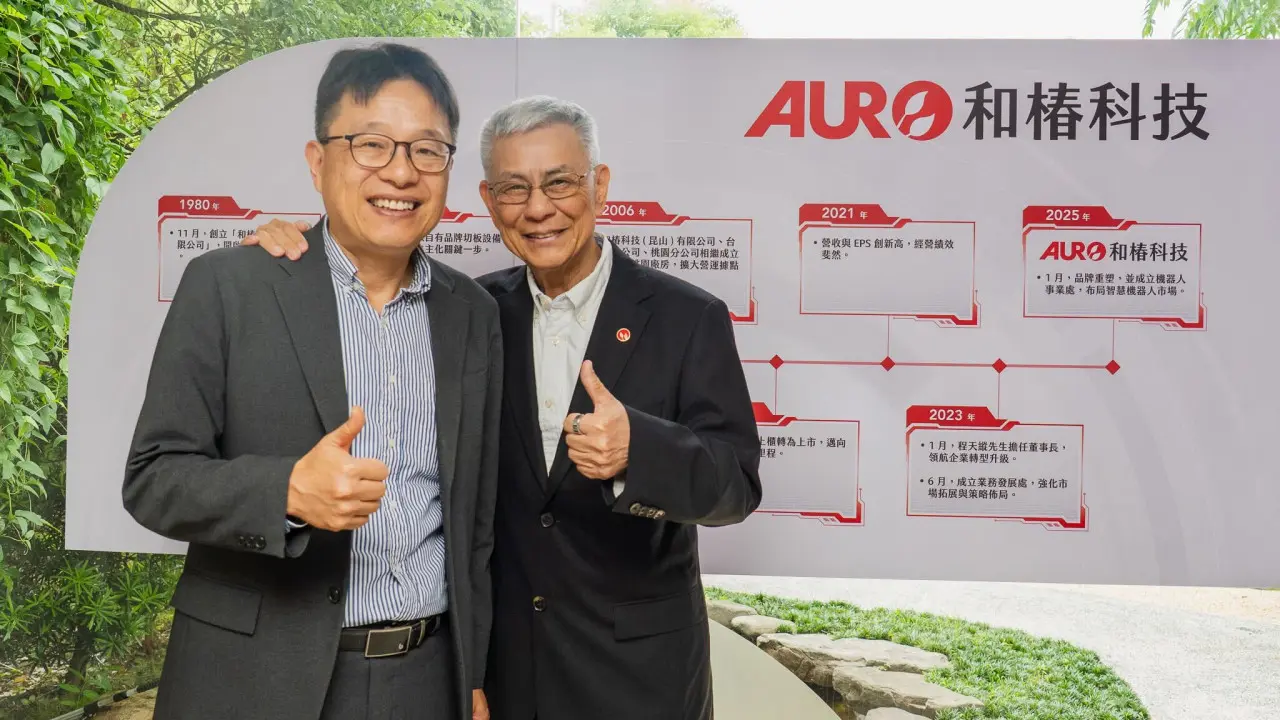
Founded in 1980, Aurotek takes its name from “Au” for automation and “ro” for robot. The company initially focused on developing and branding its own PCB cutting machines. After Cheng Tian-tsung took over, he restructured the company’s strategy. Today, Aurotek not only manufactures its own products but also serves as a distributor for international brands, offering transformation solutions to traditional industries and the service sector.
The IT Era in the U.S. Gave Rise to Two Nations: India and Taiwan
During his two and a half years at Aurotek, Cheng Tian-tsung has conducted an in-depth study of the robotics and AI industries. He has read extensively and filled six thick notebooks with his insights. Cheng has closely followed developments in the world’s four leading robotics nations—the United States, China, Japan, and Germany—and carried out a thorough analysis of Taiwan’s opportunities in this field. He believes that for Taiwan to stand out in the global competition, several critical weaknesses must be addressed and strengthened.
The following is a transcript of Cheng Tian-tsung’s remarks, shared in the first person:
Over the past 50 years, high-tech products have evolved from home appliances and electronics to IT, ICT (Information and Communication Technology), cloud computing, IoT (Internet of Things), and now AI. When I was in college—around 1970—color televisions were considered cutting-edge technology. I still remember spending my sophomore summer learning how to repair them at a TV station. In 1979, I joined HP and was sent to Japan to study TQC (Total Quality Control), as Japan then dominated the global home appliance industry.
However, while Japan succeeded in developing its electronics industry, it failed to keep pace with the rise of the IT sector. The country’s PC industry never gained traction, and its progress in software, the internet, and AI remained weak. Today, Japan’s five major home appliance makers still produce televisions, but all are facing significant challenges—for instance, Sharp was acquired by Foxconn, and Panasonic’s home appliance division is on the verge of collapse.
In contrast, the United States continued to advance through the IT era, successfully transitioning from one technological phase to the next. Today, it still leads the world in AI development. Along the way, the U.S. also helped spur the rise of two nations: India, which focused on software outsourcing, and Taiwan, which specialized in hardware manufacturing.
Taiwan achieved significant success in the IT industry, giving rise to internationally recognized brands such as Acer and ASUS. It also fostered five major contract manufacturing companies—Foxconn (Hon Hai), Pegatron, Compal, Wistron, and Quanta—collectively known as the “Big Five” of Taiwan’s electronics manufacturing sector. These companies laid the foundation for Taiwan’s pivotal role in the global IT supply chain.
However, in the ICT era, Taiwan’s performance in smartphones and mobile internet fell short of expectations. HTC, once a pioneer in Android smartphones and briefly a market leader surpassing both Samsung and Apple, was seen as a symbol of Taiwan’s effort to shift from contract manufacturing to building global consumer brands. Yet, due to strategic missteps and intensifying competition, HTC failed to maintain its advantage, and its brand influence steadily declined.
Following this setback, Taiwan’s industry shifted its focus back to contract manufacturing, providing high-efficiency production solutions for global tech brands and solidifying its indispensable role in the world’s manufacturing supply chains.
Taiwan, like many other countries, is grappling with a widespread labor shortage. However, major corporations such as TSMC (Taiwan Semiconductor Manufacturing Company) and the Big Five—Foxconn, Pegatron, Compal, Wistron, and Quanta—have largely remained unaffected. Thanks to strong growth and profitability, these companies are able to attract top engineering talent. Moreover, since most of the Big Five’s production operations are based overseas—in countries like China and Southeast Asia—the labor shortage is far less severe within Taiwan itself.
The most severe labor shortages in Taiwan are actually found in traditional industries and the service sector. Because government, media, and public attention have long been focused on the electronics industry, these sectors have been under sustained pressure from a lack of manpower.
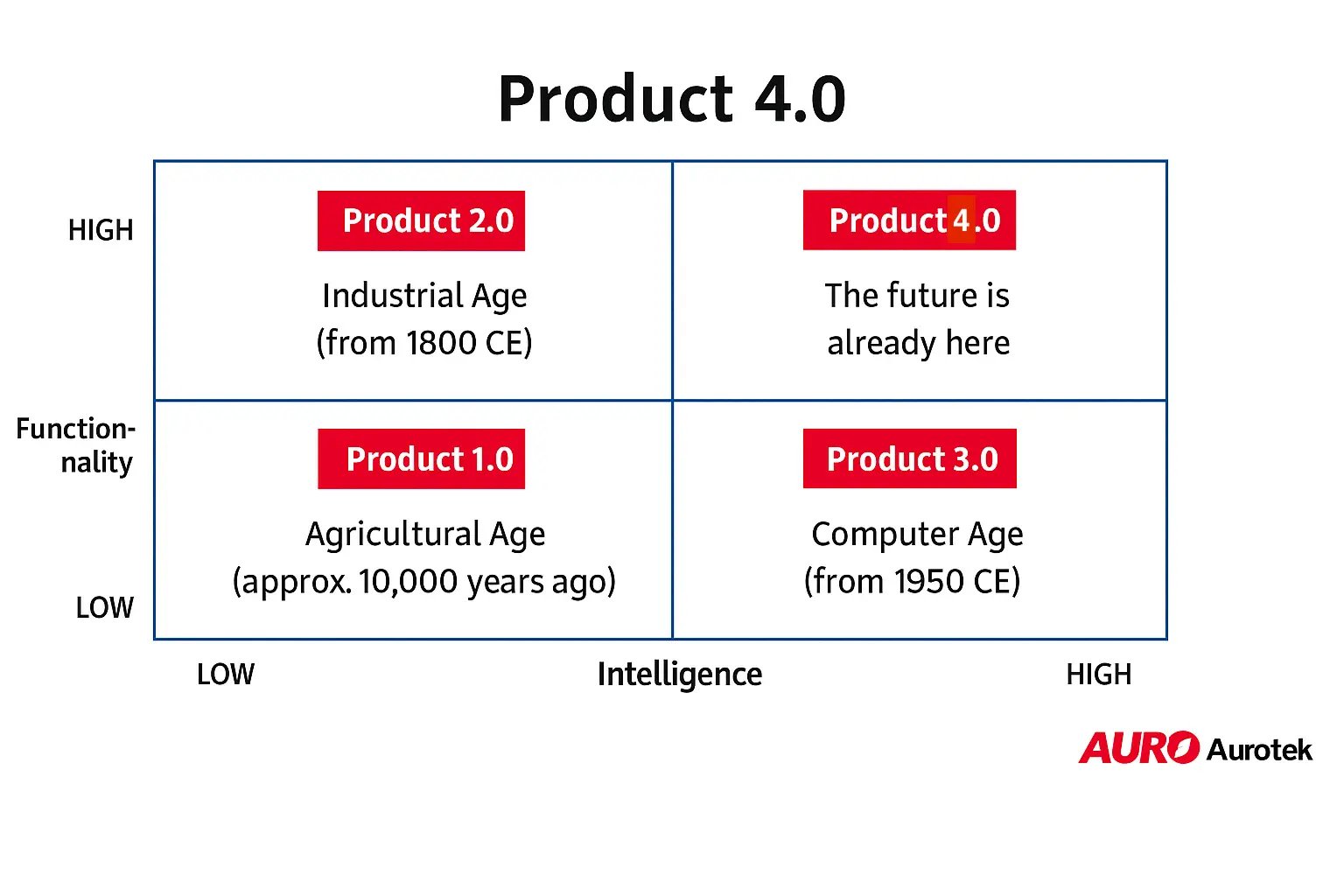
More than a decade ago, I proposed a product development framework that analyzes technologies based on two axes: intelligence and mobility. Using this model, products are categorized into four stages—1.0, 2.0, 3.0, and 4.0. Stage 1.0 represents low intelligence and low mobility, covering a span of 10,000 years from the agricultural era onward. During this phase, humans invented tools such as bows and arrows, paper, rulers, and abacuses to improve work efficiency.
Stage 2.0 corresponds to the industrial era, from around 1800 to the present, and includes developments such as mechanization, equipment-based production, automation, and the evolution from industrial robotic arms to collaborative robots. When the mobility dimension is added, this stage also encompasses technologies like trains, automobiles, airplanes, the ATV (Automated Transport Vehicle) introduced in 1985, the AMR (Autonomous Mobile Robot) in 2012, and Level 2 autonomous vehicles.
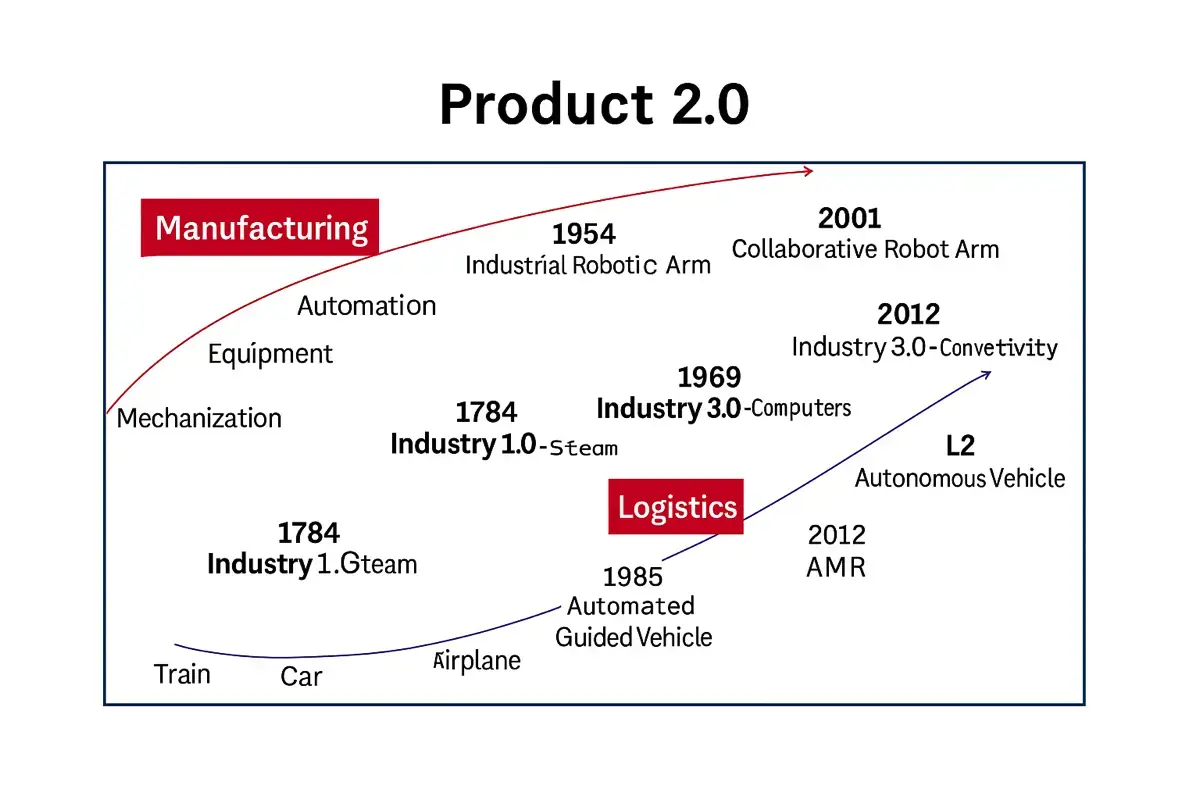
Stage 3.0 focuses on the twin pillars of IT and AI. In IT, the trajectory began with mainframe computers in 1954, followed by the rise of personal computers (PCs), notebook computers, and smartphones. On the AI front, the first wave began in 1956, experienced two major “AI winters,” then entered a third wave driven by ImageNet in 2012, culminating in the release of ChatGPT in 2022.
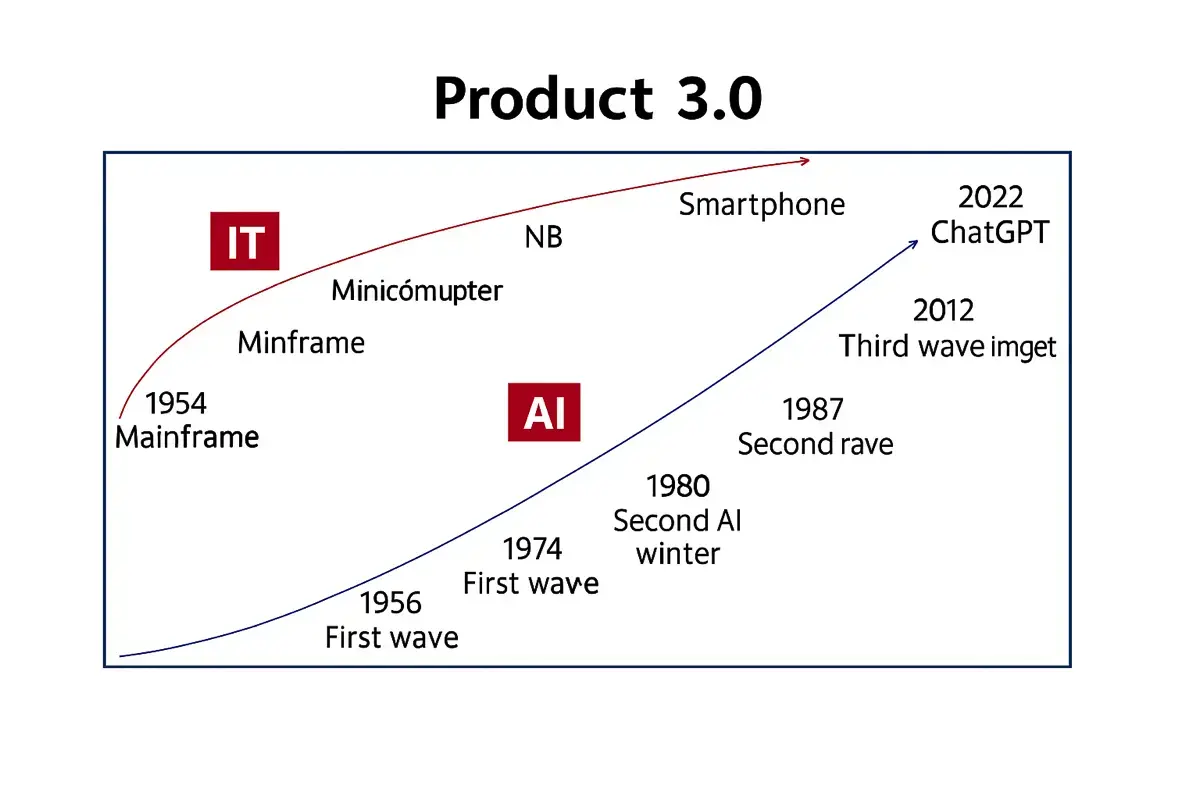
As for Stage 4.0, I initially believed it would not emerge until after 2040. However, the rapid advancement of AI has accelerated the integration of intelligence and mobility, making it the core capability of next-generation products. Among these, I am most optimistic about humanoid robots. Because they do not require changes to existing human work and living environments, they can integrate naturally into daily life and stand out as a defining industry.
Taiwan’s Challenge in the Age of Smart Automation: Integrating AI with Motor, Battery, and Electronic Control Systems
My approach of analyzing products through the lenses of mobility and intelligence stems from observations during my time working at multinational corporations and participating in the Maker Movement. For instance, mobility consists of two elements: transmission and propulsion. High-mobility industries fulfill humanity’s most essential “must-have” needs. Systems like trains, automobiles, and airplanes exemplify this—they have been key tools driving economic growth throughout history.
While the development of intelligence is certainly important, it often falls into the category of “nice to have.” Over a decade ago, I mentored around 600 startups in mainland China, many of which focused on smart IoT solutions—but most of them eventually failed. For example, some teams developed so-called “smart products” like water bottles equipped with multiple sensors, connected to an app that reminded users to drink water or offered access to WeChat or Baidu News. While these features may sound interesting, they lacked real necessity. They were nice, but not essential—making it difficult for such products to meet fundamental market demand.
What I observed at the time was that many innovative ideas were driven by technology rather than market demand. As a result, teams kept adding more features to their products, which pushed up costs—yet the products still failed to sell. For startups, the key isn’t having the most advanced technology; it’s identifying a niche market that solves a real problem. That’s what truly matters for success.
I believe that true “must-have” value lies in mobility, which includes two key components: propulsion—such as motors—and transmission—such as ball screws. These foundational technologies have given rise to four of the world’s leading motion system companies: Fanuc and Yaskawa Electric from Japan, KUKA from Germany, and ABB, originally a Swiss-Swedish joint venture now headquartered in the United States. These firms have long been global leaders in the fields of industrial robotics and drive systems. However, their primary focus remains within the mobility domain. In the era of Product 4.0, the true industry leader will be the one who successfully integrates intelligence into this foundation.
This reminds me of a famous quote by the founder of Ford Motor Company: “God, why did you give me a whole person when all I wanted was a pair of hands?” This statement reflects the mindset of early automotive manufacturing, which prioritized scale and speed. Assembly line workers weren’t expected to think—they simply had to repeat the same task over and over.
In my time at Foxconn, I saw production lines—such as those assembling iPads—staffed with as many as 200 workers. Each person was responsible for a highly specific, tightly segmented task, and the workflow was precisely engineered. In such a system, workers were not expected to think independently or deviate from their assigned operations. If all 200 workers acted on their own ideas, the production line would descend into chaos, and no product would ever be completed.
Looking at Taiwan’s industrial development, the country has long held a strong position in the IT supply chain. However, to prepare for the future, Taiwan must strengthen its capabilities in both mobility and intelligence. Emerging industries such as humanoid robots, electric vehicles, and drones require what’s known as the “three electrics”: motors (electromechanics), batteries, and electronic control systems. These must also be deeply integrated with AI technologies. This represents a fundamentally different supply chain from traditional ICT, posing an entirely new challenge for Taiwan.
During the Stage 3.0 era, Taiwan maintained a strong presence in the IT supply chain, dominating key components for PCs, laptops, and smartphones. As a result, China took a different route—one focused on AI—by leveraging internet technologies to enter the ICT sector. This led to the rise of smartphone brands like Xiaomi, OPPO, and Vivo. Without the burden of traditional manufacturing, they were able to rapidly build large-scale internet companies such as Baidu, Tencent, Alibaba, and Huawei. These firms used their internet-driven advantages to take control of the consumer-facing market—known as the 2C (to consumer) segment.
China is moving toward a smart development model that resembles the United States. As the world enters the era of Product 4.0, China’s capabilities have grown significantly, and its global influence now rivals that of the U.S. In particular, China stands out in its integration of power systems with intelligence, combining AI with a wide range of products and technologies. In contrast, Taiwan may face challenges in this new era; an overreliance on hardware supply chains could prove to be a critical weakness.
I’m optimistic about the development of humanoid robots because they can take on tasks that humans are unable, unwilling, or unsuitable to perform. These include what the Japanese refer to as the “3K” jobs—dirty, dangerous, and demanding—and what Americans call “4D” jobs. Since the pandemic, a fourth “D” has been added: Disease Prevention.
In the future, humanoid robots could be produced every 18 minutes and be ready to work within 30 minutes. In contrast, humans require a 10-month gestation period and another 16 years of education—from elementary school to university graduation—before entering the workforce. The comparison is simply not valid.
The cost of training a humanoid robot is significantly higher than that of training a large language model.
Why do I believe humanoid robots will be in high demand? Tesla’s Elon Musk has predicted that the number of humanoid robots will eventually reach three times the global human population—a view I fully agree with. Today’s environments are designed for human activity and interaction. Modifying these environments is far more costly than adapting robots to them. As a result, humanoid robots will continue to evolve in ways that closely resemble the human form.
For instance, when an AMR (Autonomous Mobile Robot) needs to use an elevator, it lacks arms and fingers, so the elevator must be retrofitted with an additional control interface. However, a humanoid robot can simply press the floor button with its finger, eliminating the need for costly modifications to the elevator system.
Some domestic manufacturers remain skeptical about the development of humanoid robots, largely because they view the issue through the lens of Taiwan’s existing industrial supply chain. However, from a global perspective, it is inevitable that humanoid robots will become widespread and emerge as a major trend in the near future.
Over the years, we’ve built more highways and railways, yet urban congestion persists. The real bottleneck lies in traffic lights. If autonomous driving and urban traffic systems can be fully integrated—separating vehicles from pedestrians—cars could move freely without traffic lights and still avoid collisions. The truth is, road capacity is sufficient; the real issue lies in how the system is holistically designed.
Today, many companies are developing large language models (LLMs), which can be trained using readily available text, images, and audio data. In contrast, training humanoid robots is far more expensive because gathering data from the physical world is significantly more difficult. For example, Google once conducted an experiment where a human stood next to a robot, using hands and sensors to grasp objects while the robot mimicked the action for training. This kind of physical training can cost $4 to $5 million for just one month.
Hochuang Technology does not manufacture hardware itself. Instead, it leverages external resources, acting as an agent for top-tier products and technologies, and integrates them into customized services for clients. By combining AI with robotics, the company aims to address labor shortages in aging societies. Its primary focus is on traditional manufacturing and service industries, offering robots as transformation solutions to help these sectors modernize and adapt.
Hochuang Technology avoids engaging in hardware manufacturing, as the market is already saturated with hardware suppliers. What’s truly lacking are integrated solutions. The company focuses on the United States, China, Germany, and Japan—four major automation powers—actively seeking agency and partnership opportunities. Each of these countries drives automation for different reasons, but all bring distinct technological strengths and market characteristics to the table.
For instance, Germany, with its strong foundation in heavy industry, was among the first to introduce the concept of Industry 4.0. However, robotics is only one component of that broader initiative. In contrast, the United States developed its robotics technology primarily for defense purposes, aiming to reduce casualties in military operations. In the U.S., the value of human life is extremely high—regardless of race, every life is equally precious.
As for Japan, I grew up reading the manga Astro Boy, which led me to believe that the future would be dominated by robots. Japan has strong capabilities in materials, transmission, and drive technologies, and has developed some impressive solutions. However, in terms of end-user industries, it currently struggles to compete with South Korea and China.
As for China, it tends to approach the development of each industry through a vertically integrated model, aiming to scale up and generate foreign exchange through exports. In the field of humanoid robots, China has made massive investments and fostered fierce competition. Ultimately, the companies that survive by outcompeting others will become the most powerful players in the industry.
When I retired over a decade ago, I never imagined that at the age of 71, I would take on the role of chairman at a small company. Mr. Chang Yung-chang, a long-time friend of mine, had taken me to visit numerous robotics companies in Japan and China over the years. He had previously invited me to join Ho-Chun as a board member. But on Christmas of 2022, while gravely ill and near the end of his life, he expressed his wish for me to become chairman. I couldn’t refuse such trust and responsibility—so I accepted.
I believe every company should carefully consider its position within the product value chain—especially small and medium-sized enterprises with limited resources, for whom this reflection is even more critical.
Customized Solutions to Meet Demand: Hochuang Aims to Be the Accenture of Automation
Here’s a brief story. In 1997, before I officially took over as President of Texas Instruments (TI) Asia, I spent six months at the company’s headquarters in Dallas, Texas. There, I noticed many people wearing work uniforms embroidered with “Arthur Andersen.” They weren’t TI employees, yet there were more than a hundred of them in the building.
I later learned that Arthur Andersen eventually split into two divisions: the finance/audit arm and the consulting arm. The finance division collapsed after being implicated in the Enron accounting scandal, while the consulting arm survived and went on to acquire other companies. It later became the well-known global consulting firm Accenture. Headquartered in the United States, Accenture was officially established in 1989 after separating from Arthur Andersen.
At the time, I was puzzled as to why there were so many consultants at the TI (Texas Instruments) headquarters. Later, I realized that this was a key element of the product value chain. Companies that provide systems or software, such as HP and SAP, tend to focus on selling standardized products because they minimize costs and maximize profits when scaled. However, from the perspective of end customers, each company has unique needs. They often seek customized features that can address their specific business requirements.
Therefore, in every vertical market, companies need consulting firms to help customize the integration of systems and solutions—this is especially critical when implementing advanced technologies like humanoid robots. Each industry has distinct use cases and requirements for humanoid robots. For example, in sectors such as warehousing and logistics, healthcare, manufacturing, or retail, the functions and integration models needed vary significantly, making standard products insufficient. This is why consulting firms that deeply understand end-user needs and offer tailored deployment strategies and system integration are indispensable. Back then, Arthur Andersen played this crucial role. Today, its consulting arm has evolved into Accenture, a multinational corporation with 775,000 employees worldwide, underscoring both the importance and enormous demand of this sector.
Hechun Technology aims to play a similar role—we aspire to become the “Accenture of automation.” Our mission is to act as an integrator by sourcing outstanding external resources, including products, technologies, and solutions, and delivering the best automation solutions across a wide range of industries.
We have currently formed partnerships with two Japanese and three Chinese suppliers. The Japanese partners are Mujin and Telexistence (TX), while the Chinese suppliers are Xrobot, Pudu Robotics, and UBTECH.
Both Japanese companies are considered unicorns in the robotics industry, with Mujin and TX ranked first and second, respectively, in terms of enterprise value.
Mujin is the world leader in hybrid palletizing and shipping solutions. It operates the largest number of 3D vision systems for logistics worldwide and is also the first company globally to offer autonomous 3D vision systems.
TX is a robotics-focused systems innovator whose vision is to enable robots to operate freely in remote environments. Its main products include automated restocking robots and collaborative arm-based stacking robots.
All three Chinese companies were startup teams I mentored over a decade ago, and they have since grown into major enterprises.
Xrobot focuses on collaborative robots and was founded by Liu Peichao. The company is already listed on the Hong Kong Stock Exchange. Pudu Robotics, a leader in restaurant service robots, was founded by Zhang Tao and plans to file for an IPO in Hong Kong later this year. UBTECH, founded by Zhou Jian, specializes in humanoid robots and is also publicly listed in Hong Kong.
In August this year, Taispac will set up 24 booths at the Taipei International Automation Industry Exhibition to showcase agency products sourced from Japan and China. Over the next three years, the company plans to deepen its vertical industry applications of AI robotics in smart manufacturing, smart logistics, and smart services, while actively expanding its market presence.
Terry Cheng – Profile
Current Position:Chairman of Aurotek Corporation .
Previous Roles: Vice President of Foxconn Group, CEO of FIH Mobile, President of Texas Instruments Asia, President of Hewlett-Packard China .
Education:MBA from Santa Clara University, B.S. in Electrical Engineering from National Chiao Tung University .
Experience: Since 2012, active as a “Maker Mentor,” founder of the “Terry & Friends” community, having provided free guidance to over 500 startups across the Taiwan-China innovation ecosystem
Related Articles
Micron Announces Its Largest Rewards Ever. Its Taiwan Union's Demands Expose a Clash of Pay Systems. A strike threat at Taiwan's largest foreign investor, read in three dimensions
TSMC's 3nm rinse comes exclusively from AEMC, a Taiwanese company once withdrawn from the Emerging Stock Board
Taiwan AI Industry Upgrade Forum Series || Event Report:America Wants More Manufacturing. What Does It Take for Taiwan’s Suppliers to Follow?