Two Major Announcements from Google and Broadcom Signal a New Era for the AI Industry: Regulatory Easing and the Rise of ASICs

In the first week of September, U.S. stock markets once again hit record highs. Two technology-related announcements drew particular attention: first, Google will not be required to spin off its Chrome browser business; second, semiconductor giant Broadcom announced strong earnings and revealed it had secured a massive $10 billion order for customized chips (ASICs). These two developments sent the companies’ stock prices soaring and highlighted two major shifts soon to reshape the artificial intelligence (AI) industry.
The Google case dates back to 2020, when the U.S. Department of Justice (DOJ) filed an antitrust lawsuit accusing the company of signing exclusive agreements with device makers such as Apple and Samsung, ensuring its search engine was the default option on smartphones and computers, thereby crowding out competitors. It was one of the most significant antitrust cases against a tech giant in decades.
In 2024, U.S. District Judge Mehta ruled in favor of the DOJ, finding Google guilty of illegal monopolistic practices. This year, the case entered the “remedies” phase, during which the DOJ argued that Google should be forced to divest its Chrome browser business and grant competitors access to its search data in order to restore fair competition.
Google agreed to terminate its “exclusive” default search agreements with device makers but strongly opposed other remedies proposed by the DOJ. In particular, it rejected the idea of selling its Chrome browser and the open-source Chromium project, as well as opening its vast search database to outside users or competitors.
The company’s opposition stems from the fact that roughly 40% of search traffic originates from Chrome, which also serves as a core platform for Google’s advertising technology and data collection systems. Divesting Chrome would directly undermine one of its most critical revenue streams.
On September 2, however, Judge Mehta ruled that Google would not be required to spin off core businesses such as its Chrome browser or Android operating system. While Google pledged to improve certain business practices, it did not accept all the remedies proposed by the DOJ. Markets interpreted the ruling as favorable to Google, sending its stock price sharply higher.
From Antitrust Battles to Chip Competition: Policy and Supply Chains in the AI Era
Google’s more lenient-than-expected outcome is closely tied to the industrial policy philosophy of former U.S. President Donald Trump. On the one hand, the Trump administration encouraged large technology firms to expand domestic investment; on the other hand, it relaxed regulations and softened antitrust enforcement, giving U.S. tech giants more room to grow and strengthen their technological lead over China in the AI field.
For example, on July 23 this year, the White House released Winning the AI Race: U.S. Action Plan for Artificial Intelligence, a policy document that reflects this strategic thinking.
The AI action plan, spearheaded by President Trump, listed more than 90 specific initiatives, forming a comprehensive national strategy. Its core goal is to secure U.S. leadership in global AI technology and supply chains. The measures include accelerating AI R&D and deployment, building national-scale AI computing infrastructure, promoting AI exports and standards-setting, and stimulating corporate capital expenditures and supply chain expansion through regulatory easing, driving rapid growth in overall AI demand.
In short, under the banner of “Make America Great Again,” the Trump administration leaned toward loosening restrictions on tech giants, prioritizing them as central players in the global AI race. For big tech companies, this translated into greater room to expand. For the government, fines and profit-sharing mechanisms served as alternative checks in place of strict regulation.
One example is NVIDIA’s H20 chip for AI inference, which remains exportable to China under certain conditions if companies pay a 15% tariff to the U.S. government. Similarly, if Google wishes to retain its Chrome business, it may be allowed to do so in exchange for partial profit sharing. This “regulatory trade-off” mechanism led by the Trump administration is shaping a novel industrial policy model.
Beyond the antitrust case, which serves as a key indicator of Trump-era regulatory thinking, Broadcom’s latest earnings report carries even deeper implications for the trajectory of AI technology and the global competitive landscape.
On Friday, September 5, Broadcom announced earnings that exceeded market expectations, sending its stock up 9.4% in a single day. Meanwhile, AI chip leader NVIDIA fell 2.7%, AMD dropped 6.58%, and major manufacturing partner TSMC rose 3.49%. This market reaction revealed a structural shift underway in the AI supply chain.
The main driver behind Broadcom’s surge was the significant growth of its custom chip (ASIC) business.
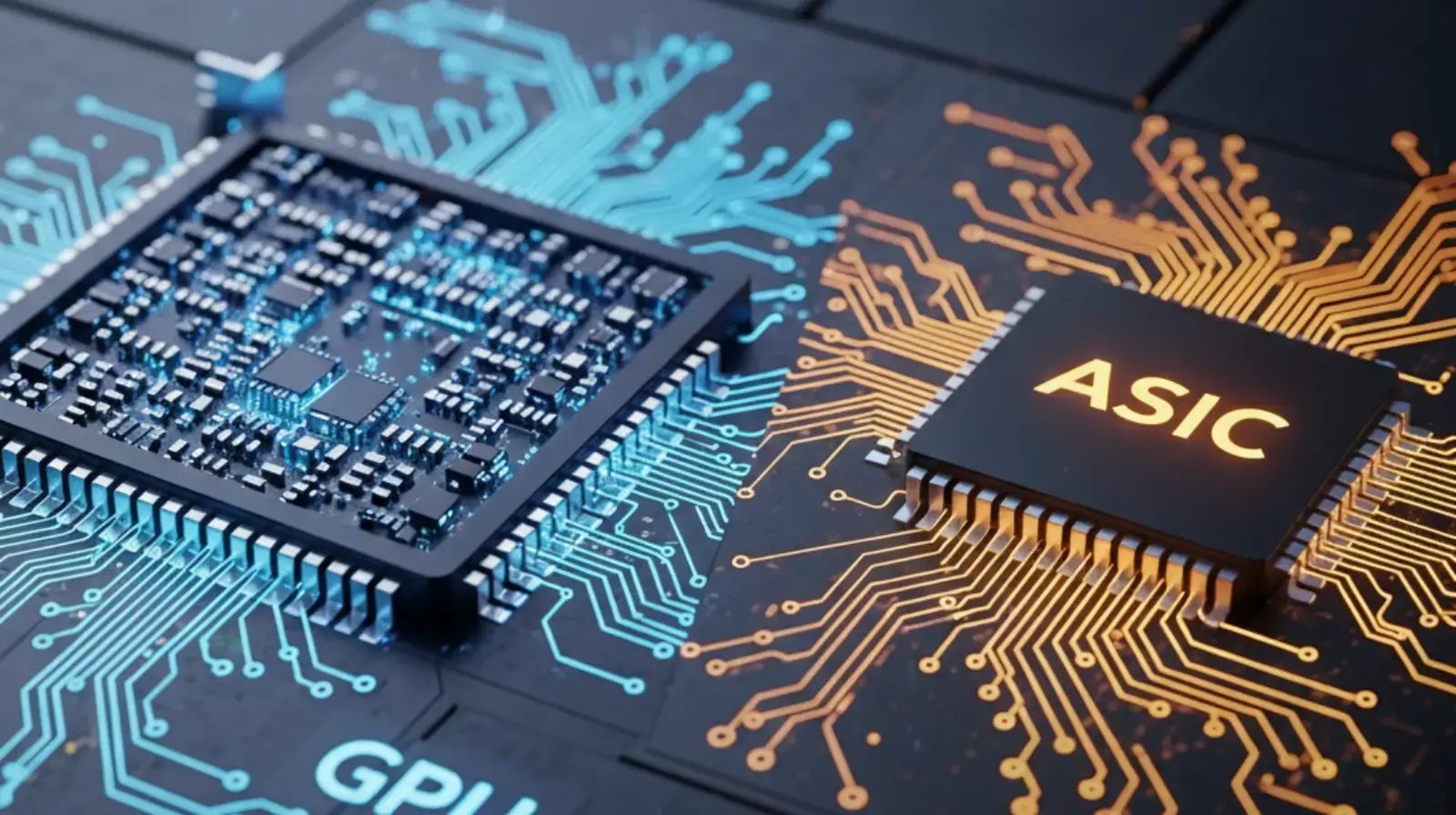
The Rise of ASICs: The New Drivers of AI Chip Competition
Application-Specific Integrated Circuits (ASICs) are chips designed for particular applications. Compared with general-purpose GPUs, they deliver higher efficiency and lower power consumption. These chips are widely used in AI inference tasks, cryptographic algorithms, autonomous driving, and cloud data processing. Google’s Tensor Processing Unit (TPU) and Amazon’s Inferentia are classic examples of ASICs, designed to replace costly NVIDIA GPUs in specific functions. As cloud service providers (CSPs) and AI companies increasingly invest in developing their own ASICs, the field is rapidly emerging as a new battleground for AI implementation.
In short, Broadcom’s rapid growth in ASICs is bound to put pressure on GPU-focused players such as NVIDIA and AMD. However, Broadcom’s large ASIC orders must still be manufactured by TSMC, meaning that no matter which IC design company prevails, TSMC’s central role in the manufacturing process remains secure—and even strengthens.
Broadcom’s stronger-than-expected earnings were largely due to CEO Hock Tan (陳福陽) revealing that the company had secured a new fourth customer in its AI ASIC business, with orders totaling $10 billion. The market widely speculates that the customer is OpenAI, which has been actively developing its own chips. The announcement fueled investor optimism that Broadcom’s AI revenue could multiply next year, sending the company’s stock sharply higher.
Earlier this year, when Broadcom reported its previous quarterly earnings, it had already forecast rapid growth in its ASIC business. Investor enthusiasm was immediate: Broadcom’s stock rose 24% the day after the report. This raised a critical question—whether custom chips (ASICs) might gradually take over part of the GPU market and become a mainstream solution for AI development.
Why is this shift occurring? Under the AI boom, many CSPs—such as Google Cloud, Amazon Web Services, and Microsoft Azure—continue to purchase large volumes of NVIDIA GPUs. But increasingly, they are also designing their own chips to lower costs and improve system integration. This trend positions ASICs at the center of what has become the “second wave” of the AI semiconductor ecosystem.
At the start of the year, Broadcom disclosed that its top three ASIC customers were Google, Meta, and ByteDance of China. But after three quarters of adjustments, ByteDance dropped out of the top ranks and was replaced by another American tech giant, Amazon. This shift in customer composition reflects the intensifying and recalibrating nature of U.S.-China tech competition.
The new “fourth customer” is widely believed to be OpenAI. U.S. tech firms are no longer focused solely on building out cloud infrastructure; they are moving aggressively into controlling and optimizing end-user devices. While GPUs remain dominant in model training, ASICs are more efficient and cost-effective in the inference stage, making them the ideal choice for large-scale deployment. This move from the cloud to the edge marks a crucial pivot in the current AI trend.
Broadcom’s stock performance in 2025 underscores this momentum: its share price has climbed 44.45% year-to-date, far surpassing NVIDIA’s 24.37% gain over the same period. Investors are clearly bullish on Broadcom’s potential in ASICs.
The launch of DeepSeek, an open-source AI model developed in China, rattled the industry earlier this year but ultimately accelerated U.S. firms’ shift in focus. Before then, most major U.S. AI companies concentrated resources on training large language models, purchasing vast quantities of NVIDIA GPUs. Aside from Meta’s open-source LLaMA, companies like OpenAI, Anthropic, and Cohere had all maintained closed systems.
With DeepSeek’s rapid rise under an open-source strategy, however, U.S. tech firms have recalibrated, moving emphasis from “model training” to “inference applications,” and expanding from cloud infrastructure to end-user devices. While DeepSeek created short-term pressure, it spurred U.S. companies to adapt more quickly and reinforce their competitiveness.
Former Google Taiwan Managing Director Lee-Feng Chien (簡立峰) commented that DeepSeek’s challenge was actually positive. “Fortunately, it happened early, which gave U.S. tech giants time to adjust and recover. If the challenge had come five years later, the U.S. might have lost its technological leadership,” he noted.
The rapid expansion of the ASIC market is also directly driving growth in the printed circuit board (PCB) and upstream materials industries, creating new beneficiaries within the supply chain.
Amazon and Google are both ramping up deployment of ASIC-based AI systems. Amazon’s Inferentia and Google’s TPU are specifically designed for inference workloads, delivering high performance at lower costs. While NVIDIA GPUs remain superior for training, ASICs are increasingly competitive alternatives for inference, offering advantages in both energy consumption and deployment costs.
As Amazon and Google expand their in-house ASIC systems, demand for PCBs is surging downstream, in turn boosting the upstream market for copper clad laminates (CCLs). In high-end AI servers and networking equipment, older M7-grade materials have been upgraded to M8, and M9 is expected to be introduced next year. These new-generation materials offer better signal transmission and thermal performance. With demand spiking, shortages are already apparent, putting unprecedented strain on the PCB and materials supply chain.
IP Is King: How Broadcom Came to Dominate the ASIC Market
Heavy investment in ASIC-based AI systems by CSPs has simultaneously pushed upstream materials to the next level. Copper clad laminates (CCLs) are advancing from M7 and M8 generations to the more advanced M9, providing stronger signal integrity and thermal stability. Beneficiaries include leading Taiwanese suppliers such as Taiwan Union Technology (TUC), Elite Material, and Unimicron.
At the same time, AI servers and data center switches are being upgraded from 400G to 800G and even 1.6T standards. These high-speed networking upgrades significantly improve data transfer efficiency during AI training and inference, helping to eliminate bottlenecks. Taiwanese firm Accton Technology, which provides core modules for high-speed switches, is among those poised to benefit.
In sum, the rapid rise of ASICs has become the second growth engine for AI. Broadcom is leading the charge, with influence now approaching—and in some areas surpassing—that of NVIDIA. It is emerging as a critical driver of the next stage of AI adoption.

Broadcom’s dominance in ASICs stems from years of strategic acquisitions that built a vast reservoir of intellectual property (IP). Starting with Avago (spun out of HP’s Agilent), the company absorbed semiconductor assets from Siemens and AT&T, merged with the original Broadcom, integrated its networking IP, and later acquired ASIC design leader LSI. This history has given Broadcom unmatched breadth and depth of IP, positioning it as the industry’s indispensable integrator.
As a result, Broadcom’s role as the undisputed leader in ASICs is virtually unchallenged. Although more IC design companies are declaring plans to enter the field, few can match Broadcom’s scale or depth of IP. Only firms with sufficiently strong IP portfolios, comprehensive product lines, and the ability to span applications from networking to AI to data centers will have a chance to succeed in this high-barrier market.
Today, nearly all of America’s seven tech giants—Apple, Microsoft, Google, Amazon, Meta, Tesla, and NVIDIA—are pursuing in-house ASIC development. Aside from NVIDIA, which is itself a specialist IC design company, the others are investing through internal R&D as well as acquisitions and design partnerships. This trend is also opening opportunities for specialist ASIC companies, including U.S.-based Marvell and Taiwan’s Alchip, Global Unichip (GUC), and MediaTek.
Taken together, the two major announcements from Google and Broadcom reveal not only a continuing loosening of regulations in the AI industry but also the emergence of ASICs as the next battleground after GPUs. For the global supply chain, collaboration with Taiwan’s semiconductor foundries, IC design houses, and materials suppliers will be key to securing strategic positions in this new wave.
Related Articles
Wherever TSMC Builds a Fab, a Taiwanese University Brings Training: NYCU Plans Arizona Courses in 2027 and a U.S. Branch-Campus Application From 2030
Micron Announces Its Largest Rewards Ever. Its Taiwan Union's Demands Expose a Clash of Pay Systems. A strike threat at Taiwan's largest foreign investor, read in three dimensions
TSMC's 3nm rinse comes exclusively from AEMC, a Taiwanese company once withdrawn from the Emerging Stock Board