Taiwan’s Semiconductor Powerhouse Showcases Young Professionals—2025 “20 under 40” Rising Stars Announced
More than two years ago, shortly after U.S. semiconductor giant NVIDIA launched its AI servers powered by GPUs, Phison Electronics’ Chief Technology Officer, Lin Wei, applied to founder and CEO K.S. Pua for the purchase of such equipment to train AI internally. Phison is Taiwan’s leading NAND Flash controller chip company, known worldwide for its SSD controller technology and holding a top global market share.
At that time, however, Pua replied that these AI servers cost tens of millions of NT dollars—far too expensive—and the company had no budget for such a purchase.
Meanwhile, the AI industry was advancing rapidly. Lin felt a strong sense of urgency: “Without the equipment, much of our R&D cannot move forward.” He then considered leveraging Phison’s core expertise in NAND Flash for AI applications. NAND is cheaper than DRAM, and if reliance on costly GPUs could be reduced, the overall system cost could be drastically lowered.
Thus Lin and his team embarked on this bold experiment. But none of the suppliers or customers recognized or supported the idea at the time. Even NVIDIA itself was displeased with the concept, since it preferred to sell more GPUs. Memory makers were also uninterested, as they wanted to sell more HBM (High Bandwidth Memory), which is much more expensive. Although all the major memory companies had NAND Flash divisions, none were willing to pursue a project that might reduce their revenues.
Developing “AI for the Poor”: Lin Wei’s Team Propelled Phison to Fame
Lin realized that while many wanted to use AI, few companies like Phison could afford to spend tens of millions of NT dollars on equipment. For university laboratories and research institutions, it was even more unattainable. The market urgently needed affordable and practical AI solutions.
So Lin and his team decided to start from the basics. They bought a low-cost, standard server and leveraged their expertise in memory R&D to optimize its performance, finding ways to make it capable of supporting AI workloads.
In the end, Phison used solid-state drives (SSD) as the primary memory to address the challenge of capacity in AI computing. Combined with its self-developed middleware, the company launched “aiDAPTIV+,” an AI solution designed to make AI accessible to those with limited budgets.
How inexpensive is it? According to Phison’s published data, aiDAPTIV+ can support models with up to 70 billion parameters—equivalent to medium-to-large-scale generative AI models—at a cost of around NT$1.5 million (about US$50,000). In contrast, NVIDIA’s AI servers typically cost tens of millions to over NT$100 million, making aiDAPTIV+ dozens of times cheaper and significantly more practical.
Lin candidly admitted that the hardest part of the development process was “self-doubt.” Since Phison was the only company in the world pursuing this approach and no one believed in the project, the team often wondered: “Are we geniuses, or are we fools? If this idea makes sense, why hasn’t anyone else thought of it?”
Yet as they pressed on, results improved steadily. Over the two-year development process, the first year produced a prototype, and by the second year, the solution began to be promoted. Today, aiDAPTIV+ has become Phison’s fastest-growing business unit. The company estimates that if the solution captures 5–10% of the global notebook market, which totals about 200 million units, the contribution to revenue would be highly significant.
What encouraged the team even more was that Phison’s concept soon became a model for others. NVIDIA (the global GPU leader), AMD (a CPU and GPU design company), and Intel (the world’s largest supplier of PC processors and server chips) have all begun collaborations with Phison. Major PC and server brands—Dell, HP, and Lenovo, as well as Taiwan’s Acer, Asus, Gigabyte, and Supermicro—have also adopted the solution. These companies span products from notebooks and PCs to servers, motherboards, and graphics cards, underscoring that Phison’s innovation has gained real traction in international markets.
Furthermore, the three major memory manufacturers—Samsung, SK Hynix, and Micron—have followed suit this year, adopting the concept originally pioneered by Phison. In late August, China’s Huawei also announced a similar technology, likewise proposing the use of SSDs to improve AI architectures. Phison’s innovation is clearly influencing the direction of global AI hardware design.
SEMI’s “20 under 40” Semiconductor Rising Stars Award Held in Taiwan for the First Time
Lin Wei, now 39, is the driving force behind Phison’s “AI for the poor” system. This year, he was also named a recipient of the “20 under 40 Semiconductor Rising Stars Award,” organized for the first time in Taiwan by SEMI, the global semiconductor industry association headquartered in the United States. The award is similar in spirit to Forbes’ “30 under 30,” but focuses specifically on young professionals in the semiconductor industry. Lin was one of six awardees in the “Innovation” category.

The “20 under 40” award recognizes 20 outstanding professionals under the age of 40. Since 2023, SEMI has launched this program worldwide to highlight young talents in the semiconductor industry with exceptional potential and influence, aiming to foster generational succession, spark innovation, and promote international exchange. The winners are formally recognized at SEMICON Taiwan, one of the world’s most important annual semiconductor exhibitions held in Taipei.
This award mirrors the concept of Forbes’ “30 under 30,” but with a sharper focus on semiconductor professionals. Taiwan, as the core hub of the global semiconductor supply chain—from foundry to advanced packaging and testing—provides a natural stage for such recognition. The “20 under 40” award is not only a celebration but also a symbol of industrial continuity, boosting the international visibility of Taiwan’s young engineers and strengthening their presence on the global technology stage.
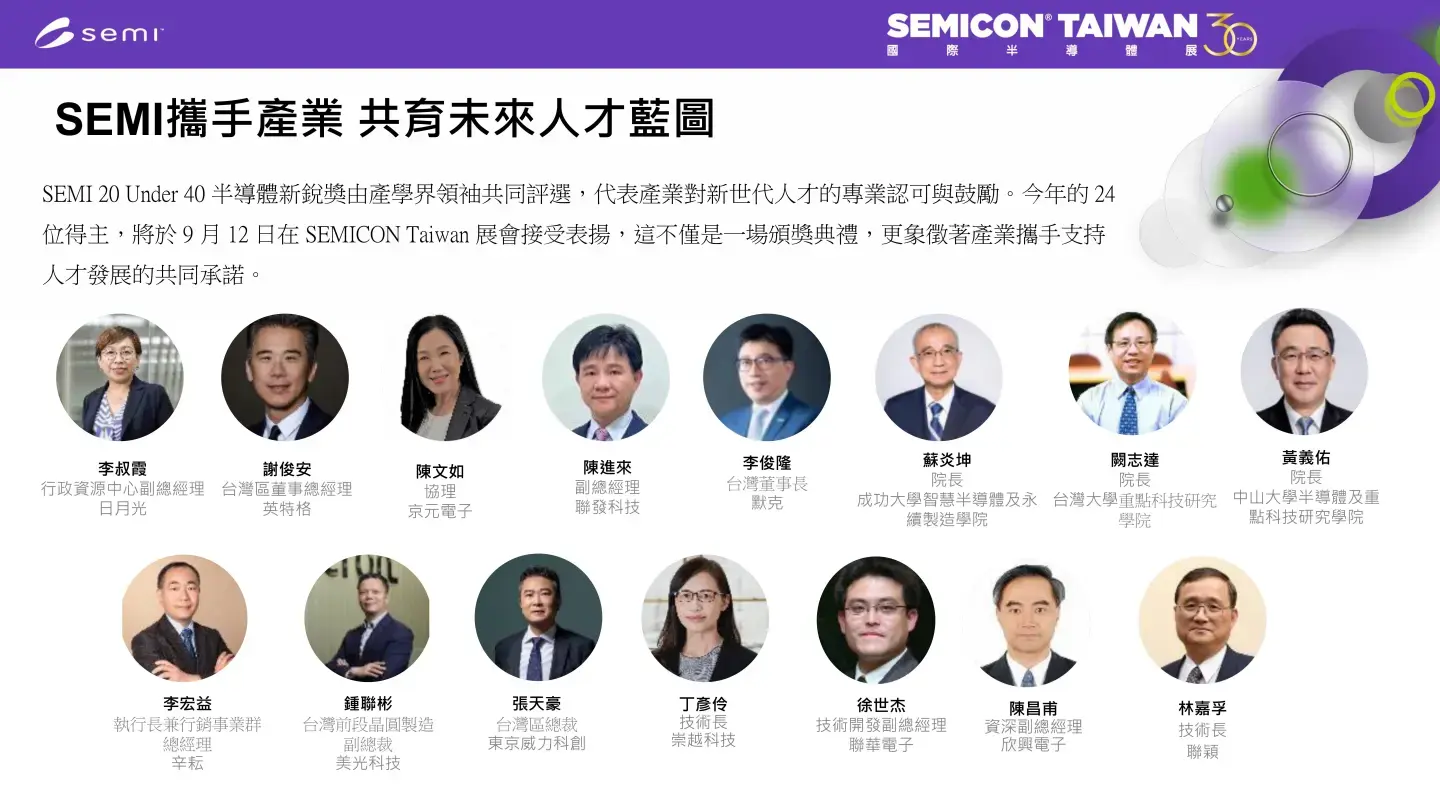
This year’s selection was SEMI’s first in Taiwan, with 24 winners chosen from 140 applicants. Women accounted for about 21% of the awardees, while around 29% came from foreign-affiliated companies. By company, Micron Taiwan, a leader in DRAM and NAND Flash memory, had six winners; ASE Group, the world’s largest semiconductor packaging and testing company, had four; and TSMC, the world’s largest foundry, had two.
The awardees are grouped into four categories: Innovation, Leadership, Technology, and Industry Contribution. All of them demonstrated exceptional passion and drive, advancing technological innovation, leading teams forward, and creating tangible impact in the industry.
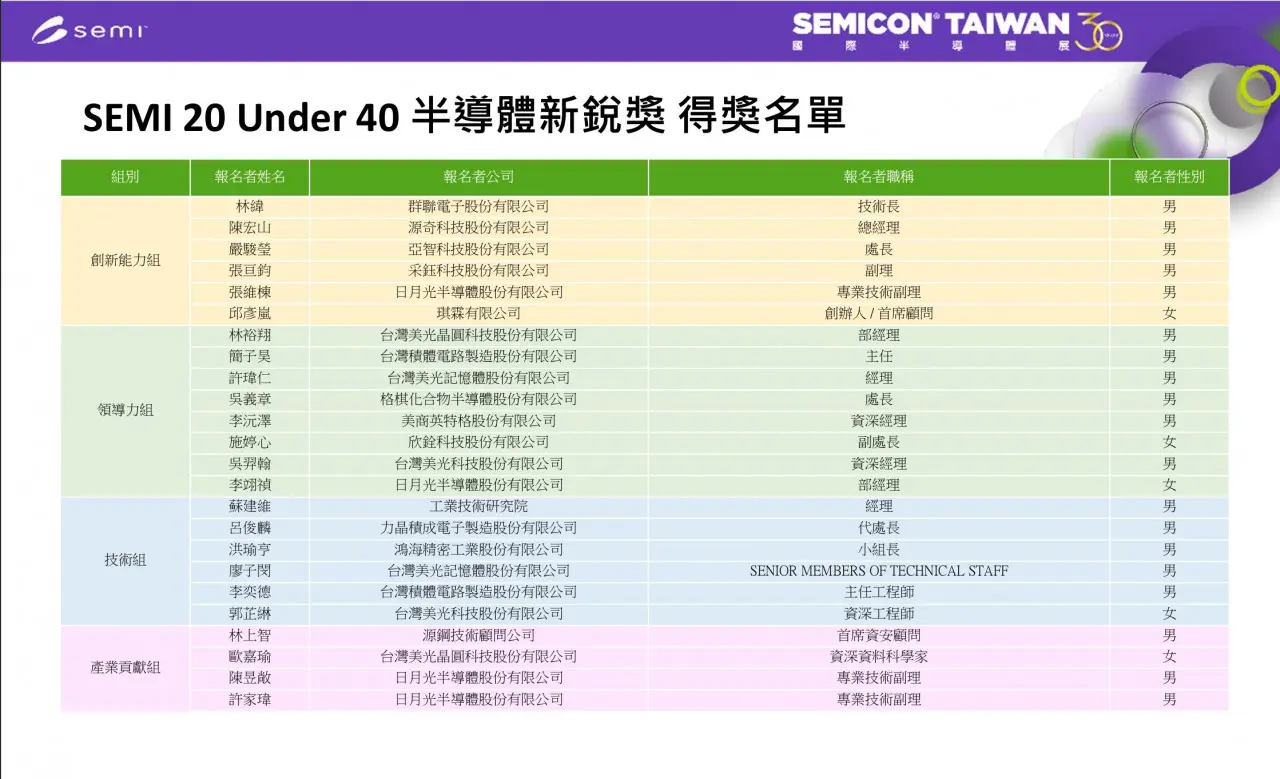
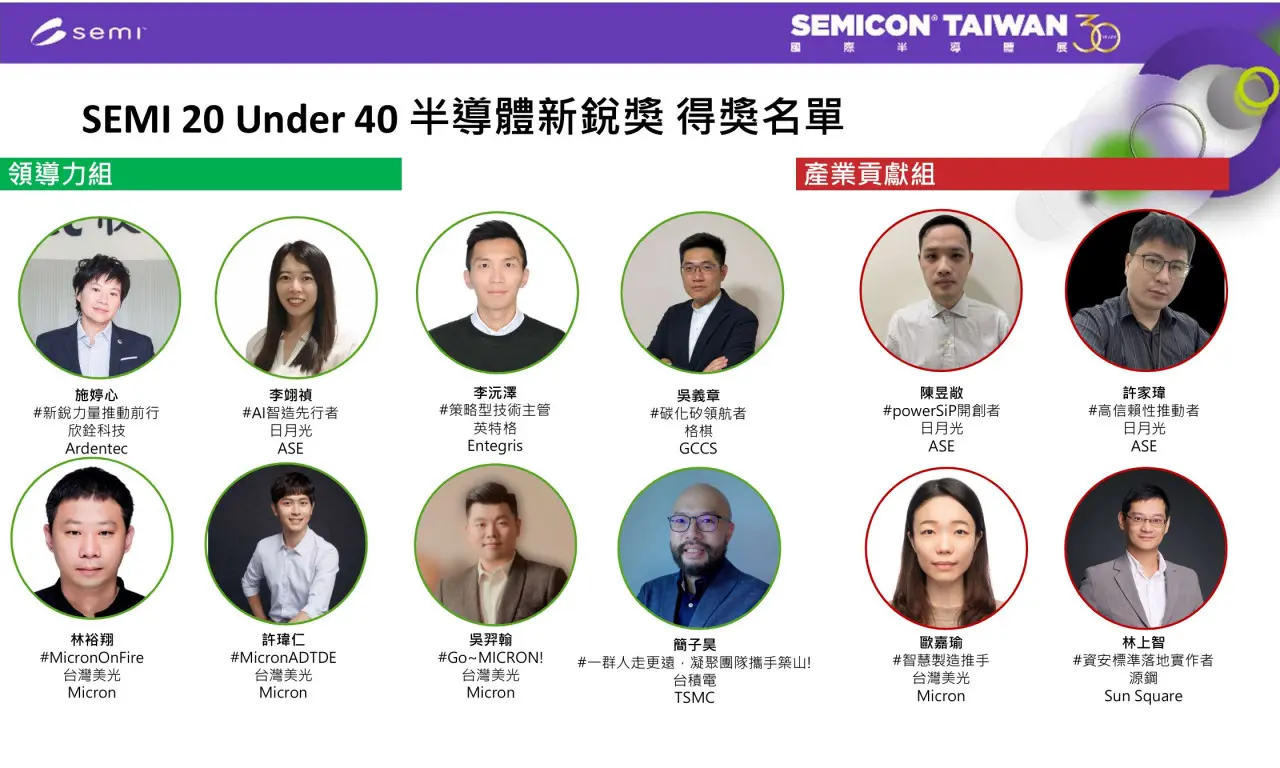
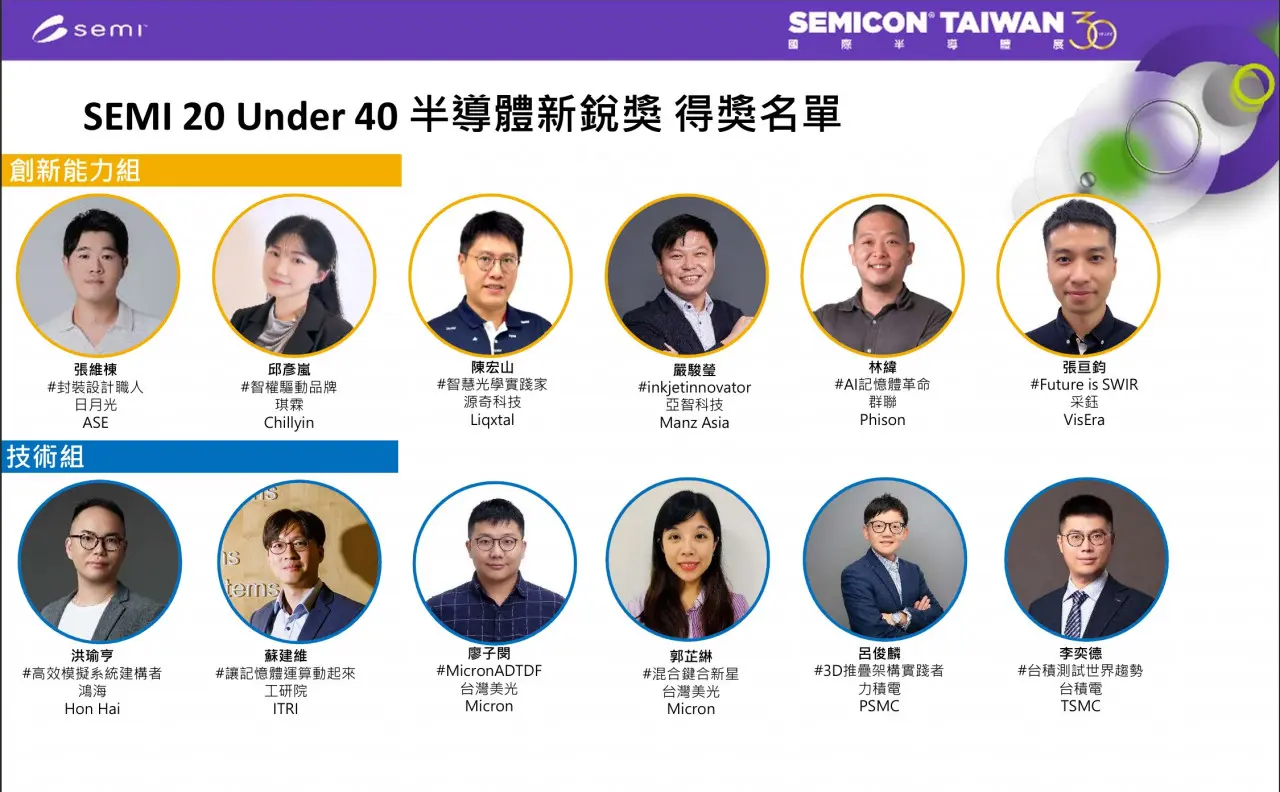
In the “Innovation” category with Lin Wei were five other recipients: Chang Wei-dong of ASE Group, recognized for long-term contributions in packaging design; Chiu Yen-lan of Chiplinear Technologies, who advanced IP management and brand promotion; Chen Hung-shan of Episil Technologies, who worked in smart optics; Yen Chun-ying of Azotech, who developed inkjet technology; and Chang Geng-chun of VisEra Technologies, who specialized in SWIR (shortwave infrared) sensing.
Serving as a judge this year, Chueh Chih-ta, Dean of the College of Key Technologies at National Taiwan University, explained that this was the first time Taiwan hosted the “20 under 40 Semiconductor Rising Stars Award.” The winners will be honored on September 12 at SEMICON Taiwan, not only receiving industry recognition with global credibility but also gaining opportunities through SEMI’s platform to participate in technical forums, professional communities, and cross-domain collaborations—broadening both their visibility and connections across the industry.
Two Defining Traits of the New Generation: Focus and a Spirit of Sharing
Chueh Chih-ta pointed out that in academia, there have long been awards for professors and students—such as those for research papers, teaching, and service—as well as numerous prizes for startups. But for the vast community of engineers in the semiconductor industry, there were virtually no awards of this kind. That is why SEMI’s launch of the “20 under 40” award in Taiwan is a truly meaningful form of encouragement for young engineers working in the sector.
He added that the award’s greatest distinction lies in its focus on recognizing outstanding young professionals. With Taiwan’s semiconductor industry already occupying a crucial position globally, presenting such awards at this moment is not just recognition—it also carries historical significance in cultivating the next generation of industry leaders.
Chueh observed that this new generation of young professionals displays two defining traits. The first is focus. Many young engineers have already dedicated five to ten years to highly specialized fields such as photolithography, lithography, and advanced packaging. Their level of technical maturity and depth in improving manufacturing efficiency is remarkable.
For example, Hong Yu-heng of Foxconn has been working on high-efficiency simulation systems. Lü Jun-lin of PSMC has focused on 3D stacking architectures. Li Yi-te of TSMC has advanced testing technologies. Wu Yi-chang of Giga Solution has developed silicon carbide (SiC) materials. And Chen Yu-chang of ASE Group has concentrated on PowerSiP, or system-in-package power modules.
Micron Taiwan’s young engineers also exemplify this spirit of focus. Lin Yu-hsiang has specialized in CMP/WET (chemical-mechanical polishing and wet processes). Ou Chia-yu has spearheaded digital transformation in manufacturing processes. Liao Tzu-min has continued to achieve breakthroughs in memory technologies.
Other winners also demonstrate deep expertise in their fields: Lin Shang-chih of Yuan Gong has promoted the adoption of cybersecurity standards; Su Chien-wei of ITRI has focused on computational memory; Li Yi-chen of ASE Group has advanced AI-based smart manufacturing; and Shih Ting-hsin of ChipMOS has played a pivotal role in both management and technological development.
These technical areas carry profound importance for the global semiconductor industry. High-efficiency simulation and 3D stacking technologies help boost chip performance and yield rates. Silicon carbide (SiC) is central to electric vehicles and high-voltage power systems. PowerSiP technology enhances power efficiency in mobile devices and high-performance computing. Meanwhile, advancements in CMP/WET, computational memory, and AI-driven smart manufacturing directly propel process miniaturization and the evolution of smart factories. It is precisely this focus and depth of commitment that enable Taiwan’s semiconductor industry to maintain its leading role on the global stage.
The second defining trait is a spirit of sharing. Many young professionals not only mentor newcomers internally but also actively publish research papers, participate in academic and industry forums, and promote knowledge exchange that benefits collective progress. This openness and willingness to share without reservation are hallmarks of this generation.
For instance, Micron Taiwan’s Kuo Chih-lin has spent years in CMP, leading innovations that earned patents and publications, while also driving technology transfers and defect reduction projects across fabs. She has also mentored new engineers and participated in global women’s mentorship programs, establishing a positive cycle of knowledge transfer and growth.
Another example is Wu Yi-han of Micron Taiwan, who used his personal experience to encourage colleagues to take on leadership roles, successfully helping two engineers step into managerial positions and expanding his team’s influence. Meanwhile, Hsu Wei-jen drove cross-departmental collaboration and resource integration, turning technical challenges into engines of growth and operational results.
Maximizing Synergy: The Future of Talent Development Lies in Talent + AI
Chueh Chih-ta also emphasized that as we enter the AI era, new applications are emerging at a rapid pace. For example, Google’s Gemini recently introduced “Nano Banana,” an innovative AI-based image generation tool. His team, when producing promotional videos for a semiconductor exhibition, experimented with converting Western faces into Asian ones. By using existing AI tools, they were able to complete the task quickly and with high quality, highlighting the enormous potential of AI in both creative and industrial applications.
Thus, Chueh argued, talent cultivation in the AI era requires a new mindset. It is no longer sufficient to rely solely on traditional experience and skills.
He stressed that future professionals must place greater importance on mastering AI tools. For students, he requires complete proficiency in using these tools. With AI as an assistant, individuals can achieve synergy, and teams can accomplish tasks more efficiently. In other words, “working with AI” will become a critical core competency for the next generation of talent.
He summarized it this way: “Diligence is right, and working smart is also right. But in the AI era, both must be redefined.” If professionals can harness the right tools and make AI their most reliable assistant, then the combination of talent plus AI will unleash maximum value. This, he concluded, is the most important direction for future talent development.
Chueh also noted that the 24 winners of SEMI’s award this year represent only a small portion of Taiwan’s next-generation semiconductor professionals. Taiwan must cultivate many more such young talents, entrust them with greater responsibilities, and prepare them to carry forward the industry’s legacy while breaking new ground. He described them as “mountain builders,” shaping the new “protective mountain ranges” of Taiwan’s semiconductor industry.
Note: “Protective mountain ranges” is a metaphor in Taiwan for the semiconductor industry, likening it to the mountain chains surrounding the island that support the economy while safeguarding national security.
These awardees are not only a source of pride for Taiwan but also a vital force whose expertise and innovations will directly influence the future of AI and high-tech industries worldwide. The rise of Taiwan’s new generation in semiconductors signifies that these “protective mountain ranges” are becoming ever more solid, ensuring Taiwan plays an increasingly critical role in global competition.
Related Articles
Micron Announces Its Largest Rewards Ever. Its Taiwan Union's Demands Expose a Clash of Pay Systems. A strike threat at Taiwan's largest foreign investor, read in three dimensions
TSMC's 3nm rinse comes exclusively from AEMC, a Taiwanese company once withdrawn from the Emerging Stock Board
Taiwan AI Industry Upgrade Forum Series || Event Report:America Wants More Manufacturing. What Does It Take for Taiwan’s Suppliers to Follow?