Redefining the Silicon Valley Playbook: As AI Reshapes Value, Taiwan's "Hardware Giants" Are Rising

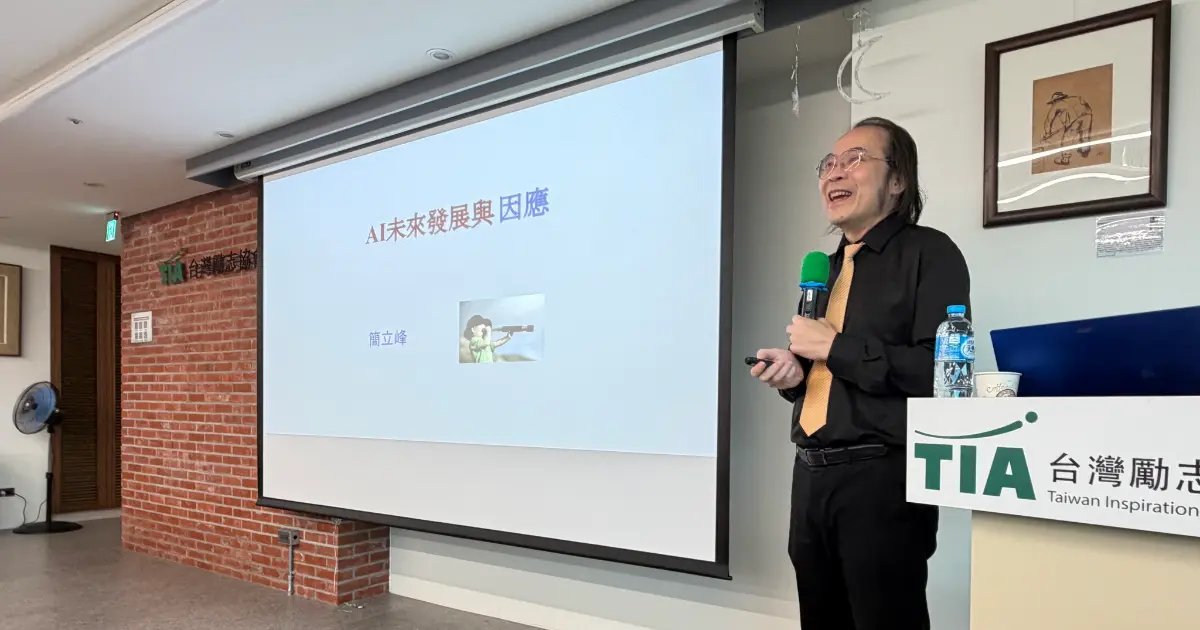
In early November, I was invited to the GSA (Global Semiconductor Alliance) Taiwan annual conference to join Nicky Lu, Chairman of IC design house Etron Technology, for a post-screening discussion of "The Mountain Mover," a documentary chronicling the rise of Taiwan's semiconductor industry.
A friend who is currently an entrepreneur posed a question. He said that Taiwan's startup scene has yet to produce a "Unicorn"—a company with a market value exceeding $1 billion USD—which he finds regrettable. He wanted to hear my thoughts on this issue.
A unicorn company is defined as a technology startup founded less than 10 years ago, valued at $1 billion USD or more, and not yet publicly listed. The term was coined by venture capitalist Aileen Lee in 2013, symbolizing the rarity and high potential of such enterprises.
Etron was founded in 1991. Nicky Lu was a semiconductor entrepreneur who returned to Taiwan from the United States that year. His response to the question was that entrepreneurs don't need to make $1 billion their goal. They should focus all their efforts on fulfilling their mission and perfecting their products and technology. This is what entrepreneurs should value most and strive for.

Different Industrial Landscapes: Taiwan Has Its Own Definition of a Unicorn
I also agree that entrepreneurs shouldn't be obsessed with this concept, nor should this standard be used to determine if a company is successful or accomplished. More importantly, I believe this "$1 billion unicorn" standard is simply not applicable to Taiwan.
This is because the concepts of achieving this within 10 years or reaching a $1 billion valuation are products of the internet age. Taiwan's industrial landscape is different, its characteristics are different, and Taiwan has its own pace of growth. We should have Taiwan's own definition of a unicorn.
First, let's talk about why the term "unicorn" emerged in 2013. It originated during an era of accelerating smartphone and internet development. If a company could seize this massive opportunity, it was facing a new market of billions of people. The resulting market and business opportunities were enormous, and stock market values naturally inflated rapidly.
Many of these so-called unicorns came from entrepreneurs in places like the United States, China, India, the United Kingdom, and Germany. These are all countries with large populations, where user bases can reach hundreds of millions or even billions. Furthermore, the industry type was almost exclusively software. Software grows quickly, and a "killer app" can spread rapidly in a short time, allowing a company to grow to a market value of over $1 billion within 10 years.
Therefore, from this definition, it is indeed difficult for Taiwanese companies, which are not strong in software and whose industrial development is primarily based on hardware, to produce unicorns. The hardware industry requires time at every stage, from R&D and design to mass production. It is rarely something that can be achieved quickly, making it very difficult to grow to a $1 billion market cap within 10 years.
Today, in 2025, the speed of AI development is even more astounding and accelerating. OpenAI, the current leader in AI, was founded in 2015 and already has an estimated valuation of $300 billion. This is no longer just a $1 billion Unicorn; it has skipped two levels, bypassing the $10 billion "Decacorn" to become a $100 billion "Centicorn."
Furthermore, other unlisted AI companies besides OpenAI also have valuations ranging from tens of billions to hundreds of billions of dollars. For example, Anthropic is valued at around $62 billion, and Databricks at around $43 billion.
AI Drives a New Wave of Growth, Creating Opportunities for Rapid Value Creation in Taiwan
However, as AI boosts the market capitalization of the software industry, the traditional software-dominated industry model seems to be transforming. With AI driving a new wave of growth in the electronics and semiconductor sectors, Taiwan, with its hardware focus, now also has the opportunity to create rapid market value growth.
For instance, over the past two or three years, Taiwan has already seen many unlisted companies with market values exceeding $1 billion.
For example, AEMC (Advanced Echem Materials), a semiconductor materials supplier, and ABLEPRINT, a semiconductor testing equipment provider, both went public earlier this year. Both already had market values of $1 billion before listing. They are both part of the component and material supply chain for the global foundry leader, TSMC. However, neither of these companies fits the definition of a startup, as both were founded about 20 years ago. AEMC, in particular, was originally in the display panel industry but successfully transitioned into the semiconductor supply chain.
Additionally, Syntec (an industrial PC and robot controller manufacturer) and Techman Robot (a collaborative robot supplier), which both listed recently, also had market values of NT$30 billion before listing. Syntec provides key components for smart robotics manufacturing, such as control units and smart joints, while Techman is one of the world's top collaborative robot suppliers. Syntec was founded 30 years ago, while Techman was founded 10 years ago.
Furthermore, HON. PRECISION (SoC test handler), which is currently preparing to list, was also founded exactly 10 years ago. HON. PRECISION is the current global leader in SoC test handlers and a key supplier to TSMC. Its current market value on the emerging market (Xingui) has reached NT$400 billion, which translates to over $13 billion USD. It can be classified as a $10 billion-level "Decacorn."
In the biotech sector, there is also Caliway Biopharmaceuticals. Founded 13 years ago, it focuses on developing weight-loss drugs. Although it is not yet listed and its revenue is small, it is known in the market as a company that is "very good at market-cap management." Its market value has now reached NT$200 billion, or about $7 billion USD.
Therefore, the statement that Taiwan cannot cultivate unicorns is incorrect. Using the Western definition of a unicorn, Techman and HON. PRECISION are companies founded within 10 years, and they reached unicorn status within that decade. These are representative examples of the growth and strength of Taiwan's hardware industry and should, of course, be included in global rankings.
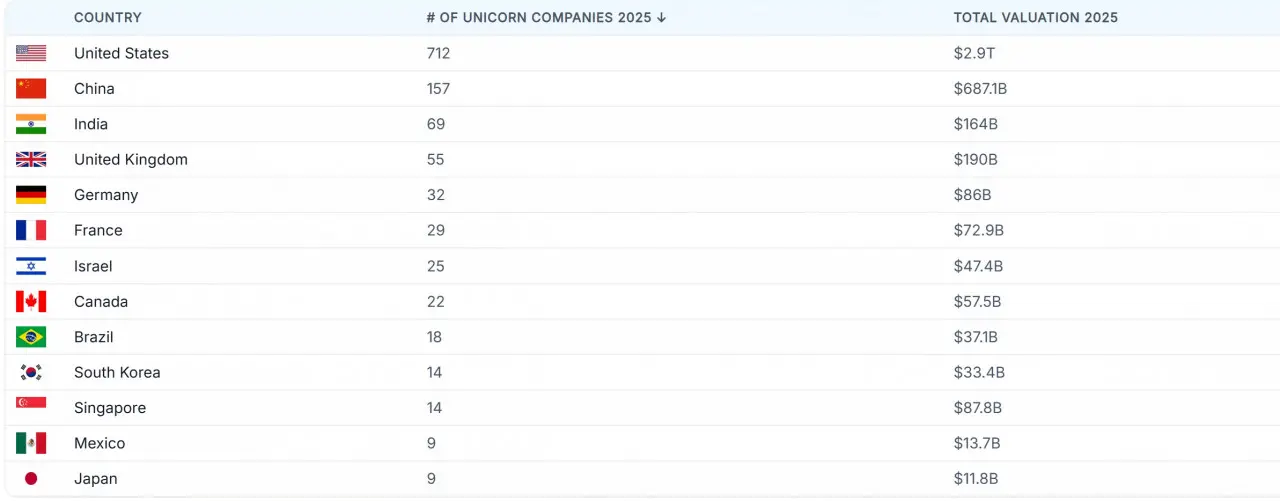
However, the "Unicorns by Country 2025" report, which statistics unicorn generation by country, does not include these two Taiwanese companies. Apparently, the international analysts who compile these statistics may not consider hardware companies to be unicorns, or perhaps they simply don't understand Taiwan's capital market. To be honest, I don't know the reason why.
In recent years, thanks to the rapid growth of its semiconductor industry, not only has TSMC's market cap surged into the global top 10, but the market capitalization of the entire Taiwan stock market has also risen to 8th place globally, surpassing Germany. Yet, judging from this statistical omission, it is clear that the world's understanding of Taiwan's capital market is still insufficient.
For Entrepreneurs, a Stock Market Listing is Not the End, But Another Beginning
Looking back at the market value growth models of Taiwan's electronics industry, many electronics companies actually had very small market caps when they went public. For example, TSMC, Foxconn (Hon Hai), Delta Electronics, and MediaTek—the current top four companies by market cap on the Taiwan stock exchange—all have market values in the trillions of NT dollars today. But when they first listed, their valuations were only in the billions or tens of billions. They grew to their current scale only after many years.
In other words, the hardware industry needs time to grow. Even if a company is small when it lists, it can still grow into a very large enterprise given enough time. Therefore, the "unicorn" standard suitable for Taiwanese startups perhaps shouldn't be obsessed with the 10-year time limit. Instead, we should focus on the ultimate market capitalization and long-term industrial impact they achieve. That might be more in line with reality.
Furthermore, for many entrepreneurs, this also means that an IPO is not the destination but another starting point—a small milestone for future development. For young people aspiring to build a business, if your company goes public, celebrate for a day, but do not treat it as the final goal in unlocking life's achievements.
Not only that, but unicorns are sometimes just a flash in the pan. Many companies fail to sustain their success and subsequently fall. But everyone loves to watch fireworks, and everyone loves a rags-to-riches story. We are all curious about, admire, and envy those entrepreneurs who go from being ordinary people to becoming billionaires overnight.
However, after observing Taiwan's industrial development for so many years, I believe that a truly good company is one whose market value can grow sustainably, allowing investors to hold it for the long term. A company that can withstand the test of time is the only one that can truly exert influence—a true "unicorn."
And I really want to make this point: It is certainly a pity that Taiwan's industry has few investors in software. This made it difficult for Taiwan to compete with giants like the U.S. and China for traditionally defined unicorns during the mobile internet era. However, in the AI era, Taiwan's mastery of the AI chip and server industries, as well as new forms of robotics, gives it the opportunity to create new enterprises whose market values will not lag behind. This is a new opportunity given to Taiwan by a new era, and Taiwanese entrepreneurs must not miss it.
If we look closely at the Taiwanese companies with huge market capitalizations mentioned above, a large proportion are key semiconductor equipment, materials, and component companies, and many are part of the TSMC supply chain. TSMC's annual capital expenditure reaches $40 billion USD. In this market pie worth over NT$1 trillion, any company that can capture a significant market share has the chance to create enormous market value growth.
Moreover, if we liken the global industrial system to a living organism, Taiwan is the heart of the supply chain, while the unicorns of Europe and America are the brain.
The heart is a tangible asset, unique and irreplaceable. If it stops beating, the entire body loses life. The brain is an intangible asset, variable and replicable, capable of continuous learning and evolution. Hardware and software, heart and brain—neither can be without the other.
Taiwan's value lies precisely in becoming this unique heart that allows the world's brains to function. If we must use the term "unicorn," perhaps we can describe it this way: Taiwan is the unseen heart behind the world's unicorns.
I also believe that the past criticism of Taiwan's entrepreneurial scene, judged by the standard of software unicorns, is actually an incorrect perspective. Taiwan does not need to evaluate itself by this standard. Taiwan has its own unique industrial characteristics. Entrepreneurs do not need to abandon their strengths; focusing on hardware innovation is not a bad thing. It can just as well create many influential new companies.
So, is Taiwan lacking unicorns? The answer is clearly no. While Taiwan does lack some of the environment and soil for software, hardware can still create many influential enterprises. This is perhaps a new development trend in the AI era that can give Taiwanese entrepreneurs a reason to be happier.
Related Articles
Micron Announces Its Largest Rewards Ever. Its Taiwan Union's Demands Expose a Clash of Pay Systems. A strike threat at Taiwan's largest foreign investor, read in three dimensions
TSMC's 3nm rinse comes exclusively from AEMC, a Taiwanese company once withdrawn from the Emerging Stock Board
Taiwan AI Industry Upgrade Forum Series || Event Report:America Wants More Manufacturing. What Does It Take for Taiwan’s Suppliers to Follow?