US-China AI Hegemony: Cooperation is the Only Path Forward for Taiwan, Japan, and South Korea — Two Key Proposals from the Author of The Glory of the Chip Island
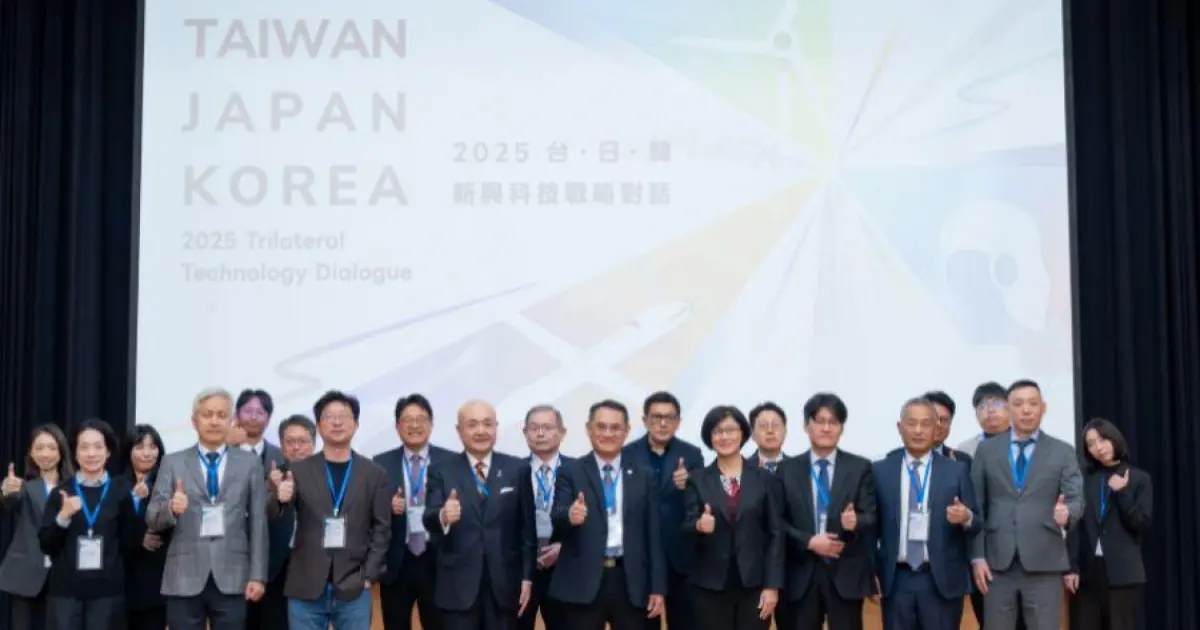
This past weekend (December 6, 2025), I attended the "Taiwan-Japan-Korea Emerging Technology Strategic Dialogue," hosted by NCCU's Semiconductor Supply Chain Resilience Center (SCRC) and the Research Institute for Democracy, Society, and Emerging Technology (DSET). Participating in the discussions and listening to experts from the three nations, I would like to share my observations and perspectives on this critical issue.
Heavyweights from the Three Nations Gather
The forum featured a stellar lineup of guests from Japan and South Korea. From Japan, we welcomed Mitsunobu Koshiba, Independent Director of Rapidus and former Chairman of JSR (a leader in photoresist materials), and Hideki Wakabayashi, a Distinguished Professor at Kumamoto University who played a significant role in TSMC’s establishment of its Kumamoto plant.
Japan is currently striving to reclaim its semiconductor glory. To the north, Rapidus in Hokkaido is targeting 2nm advanced processes; to the south, Kyushu is transforming into a "Silicon Island" with TSMC's arrival. These two figures perfectly represent these northern and southern initiatives.
From South Korea, attendees included Kwon Seok-joon, Professor at Sungkyunkwan University and author of the industrial strategy masterpiece Semiconductor Three Kingdoms. A former researcher at the Samsung Advanced Institute of Technology (SAIT), he was personally involved in laying the R&D foundations for next-generation memory technologies like HBM. Additionally, Professor Park Jong-hee from the Department of Political Science and International Relations at Seoul National University shared his extensive research on semiconductors and AI geopolitics.
I was particularly delighted to reunite with Professor Wakabayashi and Professor Kwon, both of whom wrote recommendations for my book when it was published in Japan and Korea last year. Seeing them both in Taiwan was truly a rewarding experience.
The event also featured forums on energy and drones. The drone session marked a milestone for Taiwan-Japan defense industry cooperation, featuring Tsai Ming-huang, Director of the Military Business Division at AIDC (representing Taiwan’s drone alliance, TEDIBOA), and Dr. Hiroya Iwata, Executive Director of JUIDA (Japan UAS Industrial Development Association). Furthermore, Hyon Lim, Founder and CEO of the Korean drone company UVify—a global leader in technology and production volume—was also in attendance.
Strategic Breakout under US-China Hegemony
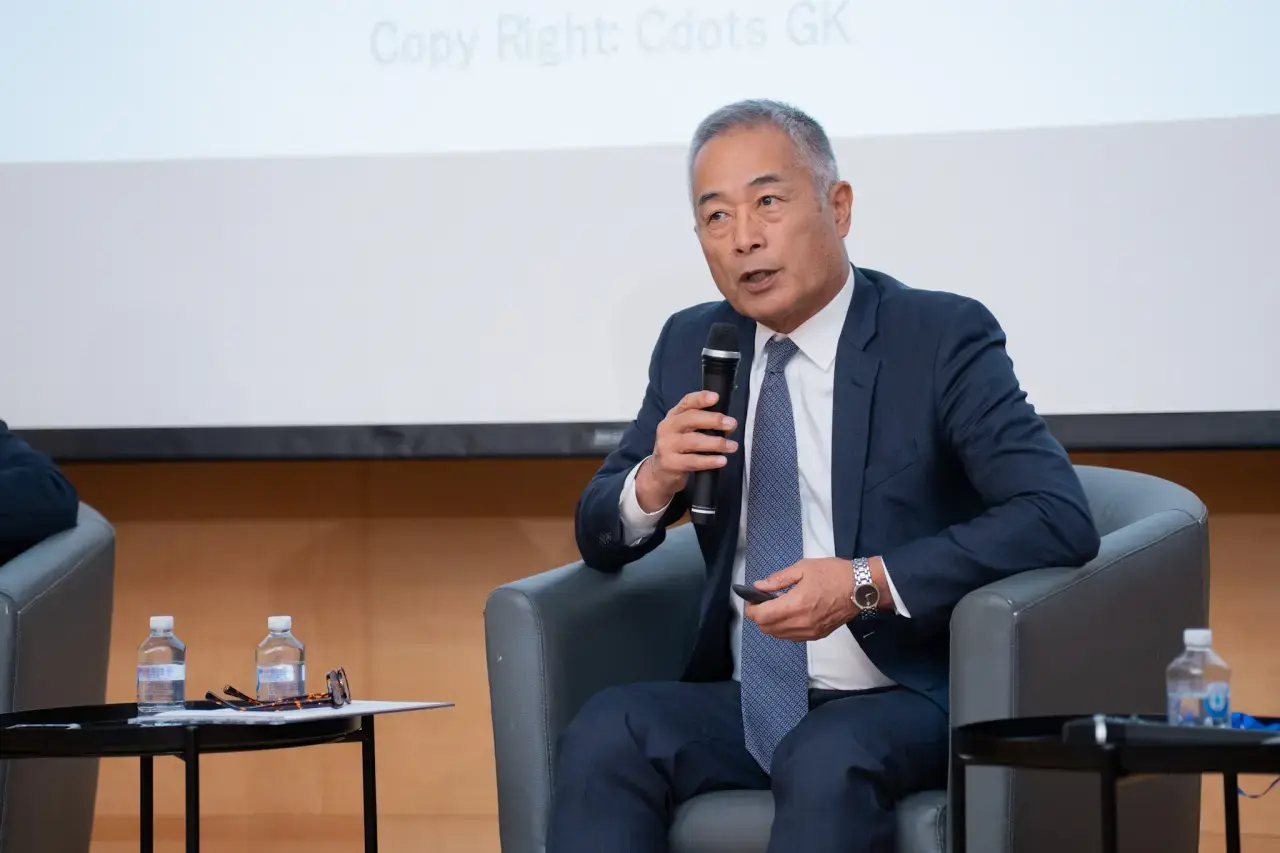
In the second panel discussion, I joined Mr. Koshiba and Professor Park to discuss "How Taiwan, Japan, and Korea Can Achieve a Strategic Breakout under US-China AI Hegemony."
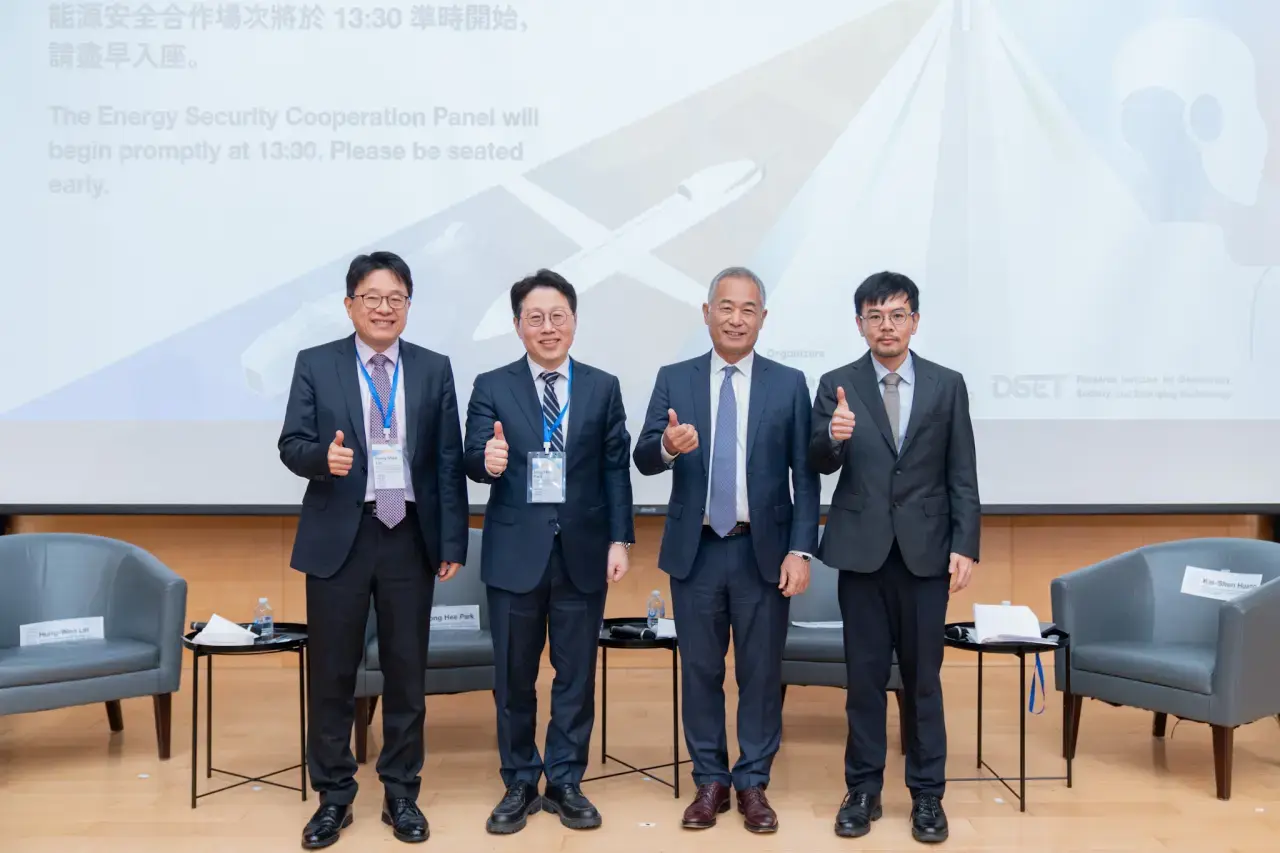
Frankly, when Jerry Chang (Executive Director of DSET) assigned me this topic, my immediate reaction was that achieving a breakout under the dominance of two superpowers is incredibly difficult. However, viewing it from an industrial competition perspective, I proposed two key suggestions.
Proposal 1: Leveraging Taiwan’s Ecosystem to Move "Value Up"
First, from an industrial standpoint, I believe all three nations must move "Value Up"—shifting focus toward product and application development rather than remaining solely in foundry services and equipment/material supply chains.
I mentioned that during my recent visits to Japan and Korea, the conversation is overwhelmingly about manufacturing. Japan talks about restoring semiconductor manufacturing, and Korea discusses strengthening logic manufacturing and foundry capabilities. However, few are discussing what products to build, what applications to develop, or how to strengthen IC design capabilities.
Today, the United States commands 68% of global IC design and over half of the global semiconductor product market. Giants like NVIDIA, AMD, Broadcom, Apple, and Google lead global trends, cementing US hegemony. While Japan, Korea, and Taiwan dominate wafer fabrication and materials, the US and China monopolize AI chips and AI model platforms. To avoid marginalization, our priority must be to create successful products and applications.
Products and applications define specifications and standards—the highest value-added segment of industrial competition. In the past, Samsung and SK Hynix (memory) and MediaTek (mobile chips) achieved leadership positions, proving that Asian nations have the capability to lead in products.
Jensen Huang, CEO of NVIDIA, recently used a "five-layer cake" analogy for AI: energy at the bottom, followed by chips, infrastructure, models, and applications. Value increases as you move up the layers. He noted that among the world's 1.4 million AI models, China is leading in open-source models—a fact the US must take seriously.
Jensen Huang's discourse on AI applies similarly to every sub-sector of the semiconductor and ICT electronics industries. I believe that in semiconductors or AI, the upper layers—models and applications—are the most important. The ultimate expression of this is the ability to integrate software and hardware to launch marketable IC products.
AI is the "brain" that empowers cars and robots with intelligence (e.g., autonomous driving, smart manufacturing). This is the most urgent development focus for major enterprises in our three nations. Therefore, without a robust AI strategy, any company’s competitiveness will suffer. For instance, without a good AI solution, how can Toyota compete with Tesla, BYD, or Xiaomi? If FANUC's robots lack a superior AI "brain," how can they compete with US and Chinese rivals?
Developing strong semiconductor chip products is the key to enabling powerful applications. This is where Taiwan, Japan, and Korea should collaborate.
I also highlighted that IC design has entered the era of IP (Intellectual Property) and design services. Companies can now build products like Lego blocks using IP licensing—similar to how SoftBank’s Arm provides the IP for over 90% of smartphone chips. Taiwan has a robust ecosystem of IC design service companies that help product companies materialize innovation. The US built its IC product strength by leveraging Taiwan’s ecosystem; Japan, Korea, and the EU should consider how to utilize Taiwan’s resources to co-create similar prosperity.
Proposal 2: Regional Integration and Global Cooperation
Secondly, I believe that outside the US and China, Taiwan, Japan, and Korea form a new "Asian Destiny Community." Beyond regional integration, we should strive to develop a multinational research center similar to Belgium’s imec or France’s CEA-Leti.
I noted that Japanese Prime Minister Sanae Takaichi is currently very supportive of Japan-Taiwan cooperation, maintaining her consistent stance that "a contingency for Taiwan is a contingency for Japan." In contrast, South Korean President Lee Jae-myung has adopted a neutralist approach, stating, "For China and Taiwan, just say 'thank you.' Issues between China and Taiwan are their domestic affairs; what do they have to do with us? We should just live well on our own."
But is a contingency in Taiwan truly irrelevant to Korea? Located in the First Island Chain, South Korea cannot remain unaffected if conflict erupts in the Taiwan Strait. We are a community of shared destiny.
China’s pattern in high-tech development involves crushing global competitors with low prices. All three of our nations have suffered—Korea in panels, memory, and shipbuilding; Taiwan in various sectors. The recent bans China imposed on Japan are tactics previously used against us. A powerful, unchecked China impacts the politics, military, and economy of all surrounding nations.
Therefore, I suggest establishing a cross-border research hub akin to imec, fostering cooperation not just regionally but with the EU, Eastern Europe, India, Israel, and other free democracies.
The US-led "Chip 4" alliance is US-centric. This is insufficient for us. We must expand cooperation with semiconductor powerhouses like the Netherlands, Germany, the UK, and France to cultivate market share outside the US. Currently, 75% of TSMC’s revenue comes from US clients. To break the US-China dominance, we must increase the weight of other international clients.
Challenges in Policy and Collaboration
Despite my suggestions, I recognize that collaboration is in its infancy. Historically, our three nations have been fierce competitors. However, the rise of AI and the US-China confrontation have shifted the landscape. Taiwan’s surge in semiconductor and AI server strength has forced a re-evaluation by Japan and Korea, turning competition into "co-petition."
Japan-Taiwan alliances are clearer due to complementarity. Korea-Taiwan cooperation is emerging—driven by the necessity to integrate AI logic chips with Korean HBM—but remains limited to a few giants like TSMC and SK Hynix.
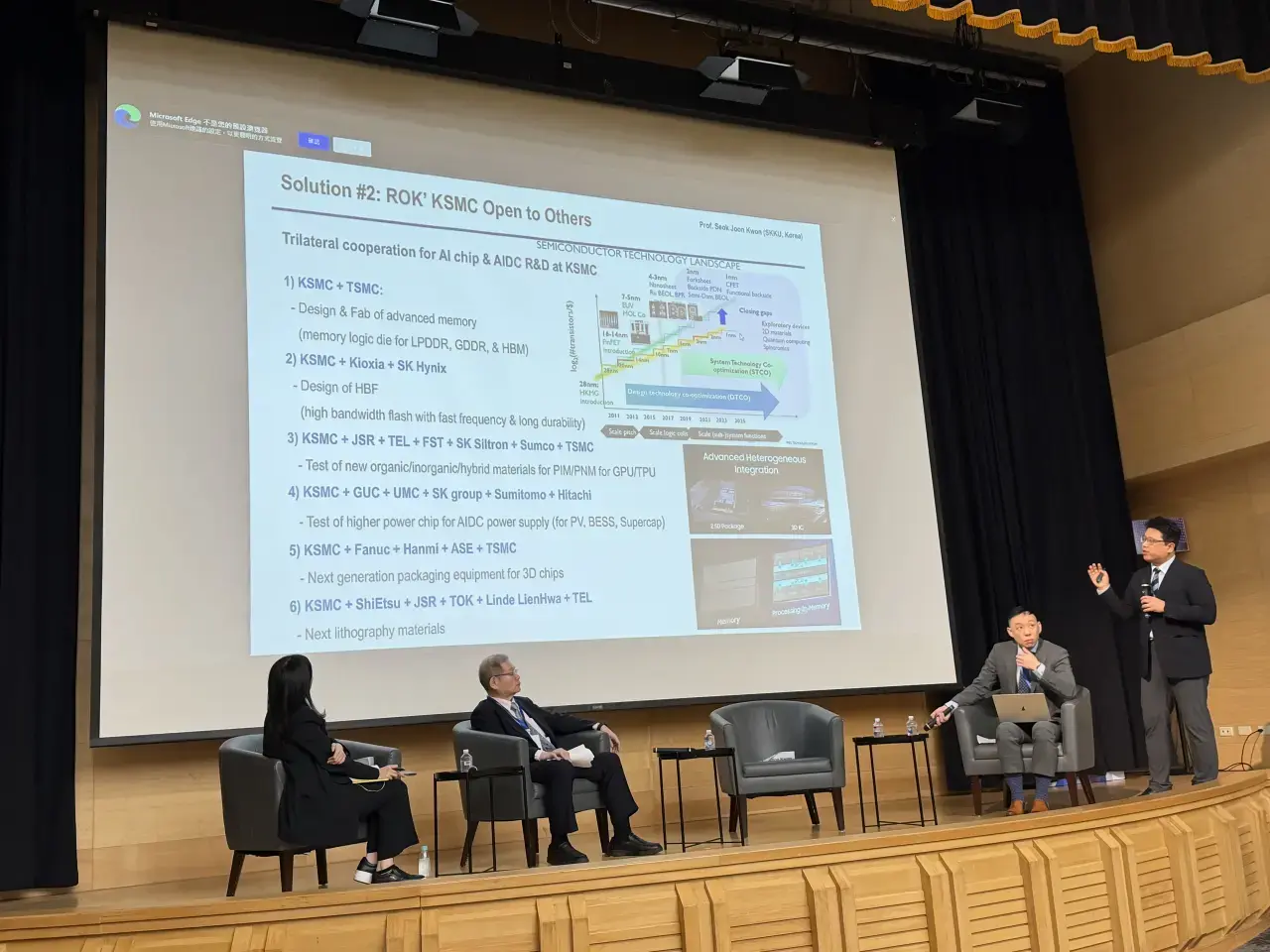
Finally, I was impressed by the preparation of the Korean scholars. It is evident that in Korea, government and the private sector spend significant time debating industrial policy.
Professor Kwon Seok-joon even proposed a conceptual framework called "KSMC" (Korea Semiconductor Manufacturing Company)—a bold vision to replace "Taiwan" in the TSMC model with "Korea."
This theoretical alliance would integrate foundries (TSMC, UMC), packaging (ASE), memory (Kioxia, SK Hynix), and global supply chains. While Japan and Taiwan may not agree with this Korea-centric view, it demonstrates their willingness to propose bold strategies.
In contrast, Taiwan’s policy formation often feels like a formality. When I recently asked about the government's much-touted "Major AI Infrastructure Plans" (often referred to as the AI Ten Major Construction Projects), no one could provide specific details. We have slogans without substance.
With political parties embroiled in trivial daily disputes, critical industrial policies accounting for 70% of our production value are neglected. Without internal consensus and detailed research, how can we confidently stand on the international stage?
As an electronics industry tycoon recently remarked at a dinner, he hopes that one day, President Lai can travel abroad flanked by the leaders of TSMC, Foxconn, Quanta, Wistron, Delta, and MediaTek, fighting for Taiwan’s rights together. This is the ideal, but we are far from it. Taiwan has much room for improvement in internal unity and serious policy deliberation.
Related Articles
Micron Announces Its Largest Rewards Ever. Its Taiwan Union's Demands Expose a Clash of Pay Systems. A strike threat at Taiwan's largest foreign investor, read in three dimensions
TSMC's 3nm rinse comes exclusively from AEMC, a Taiwanese company once withdrawn from the Emerging Stock Board
Taiwan AI Industry Upgrade Forum Series || Event Report:America Wants More Manufacturing. What Does It Take for Taiwan’s Suppliers to Follow?