Hardware Giant Taiwan Bets on Open Source: Learning from France to Build the Next 'Economic Shield'

[Editor's Note]
Taiwan currently produces 90% of the world's advanced AI chips, effectively serving as the "body" of the AI revolution. However, in the race to define the "soul" of AI—software and open-source ecosystems—it lags significantly behind nations like France. This article explores a critical pivot: Can the world's hardware foundry transform into an open-source powerhouse? If Taiwan succeeds in building an "Open Source Team Taiwan," it won't just secure its own economic future; it could unlock a new, more democratic era of hardware-software optimization for developers worldwide.
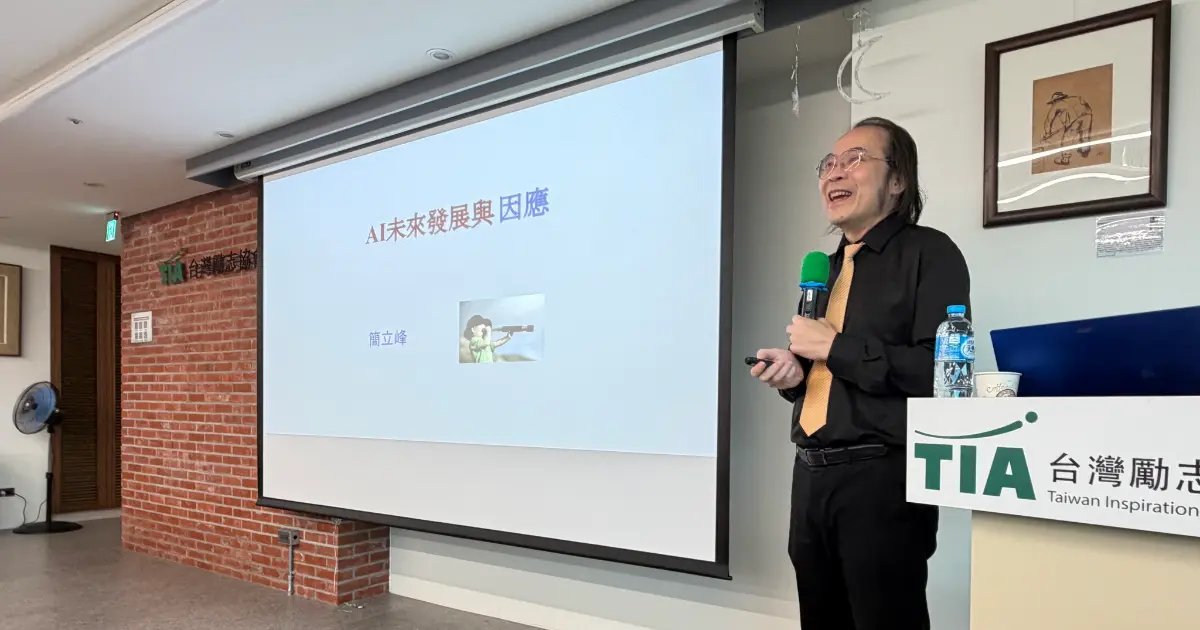
I recently interviewed Rock Tsai, CIO of Taiwan Mobile (a leading telecommunications operator), and Chen Chih-cheng, former Dean of the College of Computer Science at National Yang Ming Chiao Tung University (NYCU). Our discussion centered on a critical proposition: Taiwan must pivot to prioritize open-source software and establish an "Open Source Team Taiwan." This initiative is essential to counterbalance the island's lopsided industrial development, which is currently heavily skewed toward hardware.
I believe this is one of the most vital initiatives for Taiwan’s electronics industry today. It represents the key development issue for building the next "Economic Shield" (a strategic industrial pillar comparable to TSMC’s dominance in semiconductors) over the next thirty years. I would like to share these perspectives with you.
First, let us pose a question worth pondering.
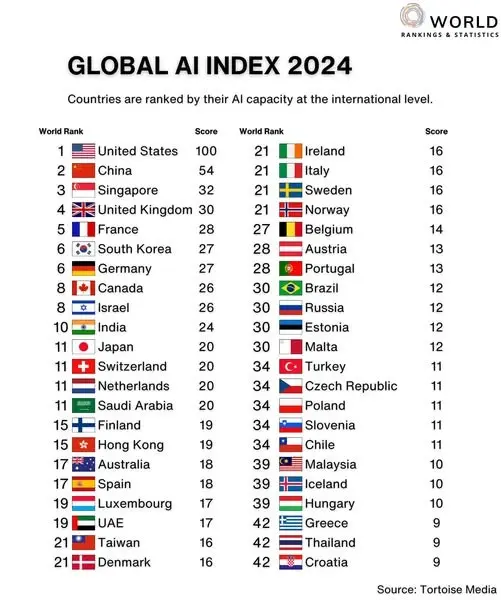
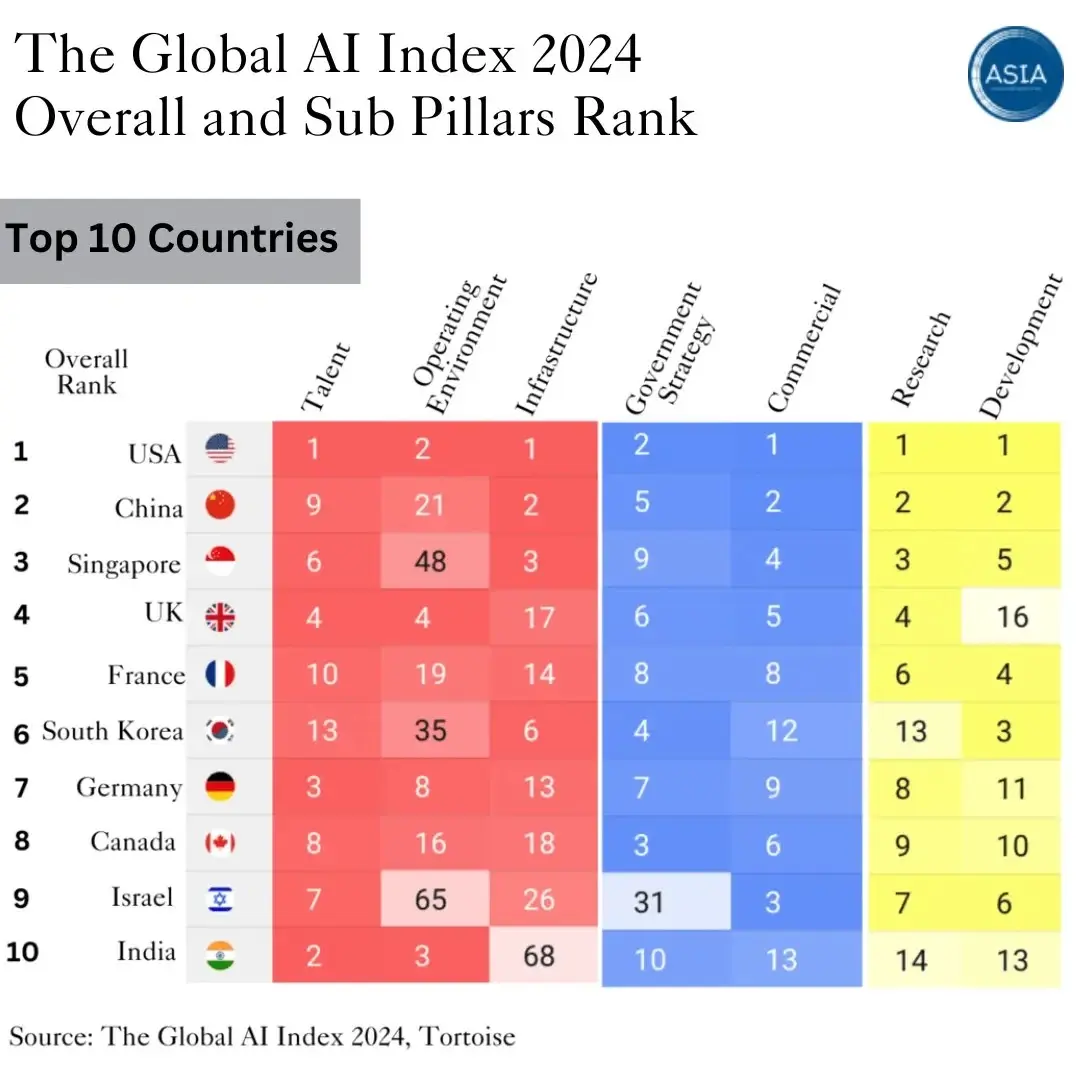
As everyone knows, Taiwan plays a pivotal role in the global AI industry. Possessing the world's leading AI chips and servers, its influence is undeniable. Yet, strangely, according to the Global AI Index 2024 released by the authoritative British agency Tortoise Media, Taiwan ranked only 21st globally. In contrast, France—which has virtually no market share in hardware such as chips or servers—ranked high at 5th place.
Neglecting Software and Architecture: A Dangerous Gamble
The core reason for this massive disparity lies in the index’s weighting. It does not merely evaluate "hardware manufacturing" but places significant emphasis on "software R&D, top-tier talent, and the commercial ecosystem." Taiwan is a hardware superpower but scores poorly in software. France, despite lacking a hardware footprint, leads significantly in software, talent, and ecosystem, thus securing a top spot.
Moreover, France’s software industry has carved out a unique niche. Finding a gap between the two AI superpowers—the US and China—the French government has positioned "open source" as a strategic means to counter the monopoly of American tech giants. By fully supporting the open-source AI software industry, from Hugging Face to Mistral AI, France has established itself as an undeniable powerhouse in open-source AI.
This is why Rock Tsai, who also serves as the Chairman of the Information Management Association (IMA), is issuing a clarion call. He argues that beyond its hardware industry, Taiwan must aggressively invest in software—specifically targeting open source. He advocates for gathering resources from industry, government, academia, and research sectors to form an "Open Source Team Taiwan," leveraging open source to cultivate talent and gain a voice in setting international standards.
Tsai has displayed extraordinary programming talent since childhood. He was writing code in elementary school, taking on freelance projects in junior high, and during his university years, he and his peers developed a popular multiplayer puzzle game (a competitive battle version of Tetris) that swept across Asia.
He describes himself as someone who views coding as a lifelong joy. Even after graduating and taking on various roles across different industries, programming logic has remained one of his essential tools. Returning to the role of CIO after the age of forty, he is now channeling his cross-industry experience into software innovation and industrial application.
Consequently, he sees the clear lag in Taiwan's software sector. While the hardware industry is powerful, it is dominated by contract manufacturing (OEM/ODM) and places little value on investing in software and system architecture. The challenges ahead are significant; a Taiwan that relies solely on hardware is in a precarious position.
"In the past, we said 'software is eating the world.' Now, it is 'AI eating the world.' Furthermore, AI software will directly become the productivity force for every industry, not just a productivity tool," Tsai explains. "If this trend continues, there will come a day when Taiwan faces immense challenges even just trying to hold onto its hardware contract manufacturing business."
"Think about it: the biggest manufacturing opportunity after smartphones is electric vehicles (EVs). However, neither Tesla nor Chinese automakers outsource full vehicle assembly to Taiwanese manufacturers. Looking ahead to the emerging robotics industry, what niche do we have to secure full-machine assembly orders from the US or China? Without full-machine assembly, the threshold for components alone to remain irreplaceable is extremely high."
Tsai adds that both the US and China view manufacturing as a strategic geopolitical game. "It is fair to say that Taiwan’s contract manufacturing model urgently needs to find a critical leverage point for its next wave of growth."
Limited Talent Pool vs. France’s Strategic Focus
That Taiwan should develop a software industry is a point on which everyone likely agrees. However, how Taiwan should develop this industry is a matter of diverse opinion.
In the past, many have argued that Taiwan’s software sector should not merely act as agents or system integrators (SIs) but should create influential products. This is easier said than done. Pivoting toward open-source software—which often doesn’t look like a traditional "product" and has a less obvious path to monetization—is unfamiliar territory that requires explanation.
Here, let us return our focus to France’s influence in open-source AI.
As mentioned, France avoided direct confrontation with the US and China by developing an open-source AI industry, building a powerful community that contributes significantly to global AI.
For example, Hugging Face, often hailed as the "GitHub of AI," has contributed to the open-source market by successfully turning complex machine learning technologies into "accessible Lego blocks." By standardizing infrastructure, its Transformers library has become the industry standard for NLP (Natural Language Processing).
Furthermore, Hugging Face has established a massive hub for models and datasets. As of 2026, the platform hosts over 1.5 million open-source models and hundreds of thousands of datasets. Tech giants like Google, Meta, and Microsoft, as well as countless startups, place their initial open-source research releases on Hugging Face.
Thus, Hugging Face is seen as a driver of AI democratization, lowering the barrier to entry so that SMEs or individuals without the budget to train trillion-parameter models can directly leverage the fruits of the open-source community. This creates a network effect and a highly active ecosystem; when a new AI paper is published, a corresponding open-source implementation often appears on Hugging Face within hours.
Beyond Hugging Face, France boasts several representative open-source enterprises, including Mistral AI (LLMs), Strapi (content management), PrestaShop (e-commerce), Meilisearch (search engines), CrowdSec (cybersecurity), and Material UI (frontend frameworks).
France has focused its limited but deep pool of mathematical and engineering talent into the open-source AI software industry, creating numerous enterprises with global influence.
Interestingly, Rock Tsai noted that when the robotics industry became a hot topic two years ago (2024), he was already tracking a French open-source robotics company called Pollen Robotics. This company had already partnered with Hugging Face to build an open-source robot, Le Robot, capable of performing various household chores.
The result? In April 2025, Pollen Robotics was officially acquired by Hugging Face, a move viewed as a major milestone in the global open-source robotics industry.
From "Free Riders" to Influencers
According to Thomas Wolf, co-founder of Hugging Face, the current robotics market is dominated by a few large corporations like Tesla and Agility Robotics, whose products are closed and expensive. Through this acquisition, they aim to break this monopoly using open-source strategies—allowing developers to print their own parts and adjust functions. This fosters implementation, creativity, and cross-disciplinary collaboration, accelerating the maturity of robotics technology and truly democratizing its application.
Hugging Face continues to expand its influence in open-source AI, playing a key role across various application fields. In the future, the hardware inside the world's AI robots might come from Taiwan, China, Japan, or Korea. However, the software running inside them will very likely come from France's Hugging Face.
This acquisition demonstrates France's influence in open source, positioning the country as a leading base for global open-source AI and striving to make Paris the "AI Capital of Europe." The French government uses policy to support incubators, gather open-source talent, and form an AI industrial competitiveness centered on software—blazing a path completely different from Taiwan’s hardware-centric approach.
However, despite the importance of open source, Taiwan has held many myths regarding this trend and has often misunderstood or abused the spirit of open source. For instance, many companies act as "free riders," ignoring license regulations or directly modifying others' open-source code for use without contribution. This happens repeatedly.
There have even been cases where large Taiwanese corporations copied open-source software directly for commercial use. Notably, in April 2025, a controversy erupted involving the Industrial Technology Research Institute (ITRI)—Taiwan’s premier state-backed research organization. Its Next-Generation Digital Health Platform project was found to have engaged in similar practices, leading to a public apology only after the issue was exposed.
Therefore, for Taiwan to move toward an open-source software industry, the most fundamental psychological shift required is to move from being a "user" to a "contributor," and from a "free rider" to a "creator of influence." Using free tools to lower R&D costs is acceptable, but one must actively give back to the open-source community.
Furthermore, because Taiwan has not been aggressive in developing open-source software, it lacks the soil to cultivate talent. Consequently, many domestic open-source developers are forced to seek opportunities in foreign companies. Many excellent software engineers consider winning a high-paying offer from a company like Google as their ultimate honor. The fact that they lack a stage to shine on their home soil is truly a pity.
So, how can Taiwan pivot from its hardware manufacturing legacy toward open-source software?
I believe that with the explosion of Generative AI, domestic industry, government, and academia have realized to some extent that open source is a shortcut to enhancing national software power. Some major hardware firms have begun contributing to the Linux kernel and the Android ecosystem, while others have established technical barriers in various application industries by participating in open-source communities like Hadoop.
Moreover, Taiwan’s existing open-source communities have high engagement levels, serving as the foundation for development. For example, COSCUP (Conference for Open Source Coders, Users and Promoters) celebrated its 20th anniversary in 2025. It is one of Asia’s premier open-source events, annually attracting over 3,000 developers and more than 20 technical communities (such as Ruby, Python, Golang).
The Hardware Trap: A Test for the Future
Additionally, g0v is Taiwan’s unique "Civic Tech" open-source community. It applies the open-source spirit to public affairs—such as voting guides and budget visualization—pushing Taiwan forward in international "Open Government" rankings. Meanwhile, the Open Culture Foundation (OCF) acts as a resource matchmaker, helping communities incorporate and connecting them with international organizations like Mozilla and Wikimedia.
However, these achievements are clearly not enough. Taiwan faces significant challenges in developing open-source software. One major issue is the need to transform the business model. Taiwan’s software industry consists mostly of project-based System Integrators (SIs), making it difficult to scale into product-based companies like Hugging Face.
Furthermore, while the hardware industry absorbs the vast majority of talent, it is unattractive to top-tier software engineers. Hardware companies need software talent, but these roles often devolve into doing grunt work for contract manufacturing clients. The KPI incentives for employees to "contribute to open source" are insufficient, leading top talent to defect to Western software giants.
Therefore, the old Taiwanese mantra of "using hardware to lead software" is not necessarily a sound strategy. If hardware giants want to cultivate a software industry, the best approach is pure investment: keep the software talent external and distinct from the hardware contract manufacturing structure. Otherwise, issues of cultural maladjustment will frequently arise, blocking the intention to nurture a software industry.
Finally, let us return to the challenge Taiwan faces. Over the past 30 years, Taiwan has indeed been powerful in hardware industries like PCs and semiconductor manufacturing, generating immense wealth. Today, it is reaping another windfall from AI chips and AI servers. The market capitalization of Taiwan’s semiconductor and electronics industries far exceeds that of Japan, Korea, China, or any European nation.
In terms of wealth and capital, Taiwan beats almost every other country, certainly far surpassing France. Yet, our investment in software is pitifully small. Every Taiwanese hardware company should allocate at least a portion of its capital to this cause.
I believe the role of contract manufacturing is Taiwan’s competitive advantage. But can this advantage last another 20 or 30 years? More importantly, in a future where every product requires AI and software, can Taiwan withstand the test of time by relying solely on hardware? We absolutely need to prepare for a rainy day.
I believe that industry titans—whether Barry Lam of Quanta, Young Liu of Foxconn, Simon Lin of Wistron, C.C. Wei of TSMC, or Rick Tsai of MediaTek—must be thinking about Taiwan’s competitiveness ten or twenty years down the line. If Taiwan cannot achieve results in the software sector, the future trials will undoubtedly be severe.
Future Taiwan must build another "Great Mountain" beyond the semiconductor and electronics manufacturing industries. Taiwan is wealthy and abundant. If we are to find a new goal to pursue, I believe software is the direction for the next fifty years, and open-source software should be at the very top of that agenda.
Related Articles
Micron Announces Its Largest Rewards Ever. Its Taiwan Union's Demands Expose a Clash of Pay Systems. A strike threat at Taiwan's largest foreign investor, read in three dimensions
TSMC's 3nm rinse comes exclusively from AEMC, a Taiwanese company once withdrawn from the Emerging Stock Board
Taiwan AI Industry Upgrade Forum Series || Event Report:America Wants More Manufacturing. What Does It Take for Taiwan’s Suppliers to Follow?