Beyond TSMC: the chip sector Taiwan doesn't yet lead, and one maker's five-year bid to break into the global top 10
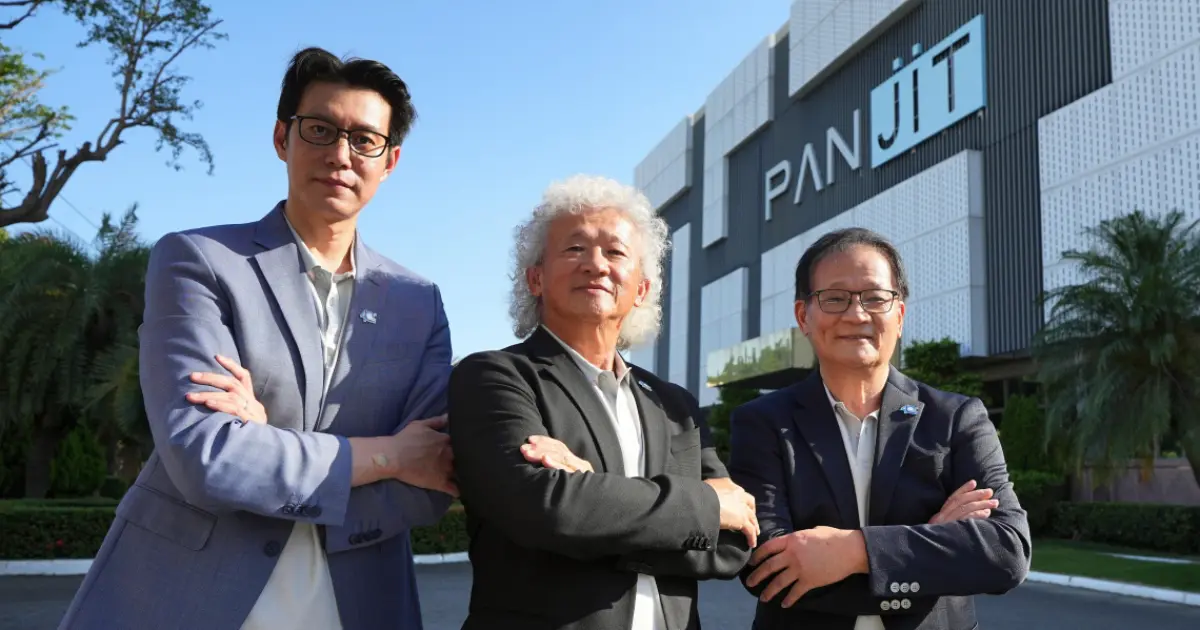
The world knows Taiwan for TSMC and the most advanced logic chips. Yet Taiwan has no company in the global top ten for power semiconductors, the unglamorous components that control and convert power in every EV, solar farm and AI server. Three forces are now converging: carmakers scrambling for non-Chinese suppliers, Western and Japanese incumbents retreating from mature silicon, and demand from electrification and AI still climbing. PANJIT, a 40-year-old maker from Kaohsiung that ranked 20th last year, says it can take 5% of the global MOSFET market within five years. What could still stop it? (PANJIT group president Fang Ming-tsung (center) with his younger brother, chairman Fang Ming-ching (right), and chief operating officer Edgar Chen.)
"Our family business began as a brick kiln operation, then pivoted; forty years ago we moved into one of the most basic semiconductor devices: the PN diode." On August 7, Fang Ming-tsung, PANJIT's group president, a man with a shock of white hair, gave a talk at a net-zero summit hosted by Taishin and Shin Kong Financial. His title: "The next competitive equation for the rice of industry." No one used to pay attention to PANJIT, he joked, but the company has been getting some notice lately, which is why the organizers invited him. Gangshan, the industrial district of Kaohsiung in southern Taiwan where PANJIT is based, is known for more than its local fare, he added: it is also home to a serious semiconductor company.
By the "rice of industry," Fang means power semiconductors. Whereas TSMC's advanced-process chips do the computing, power semiconductors handle the conversion and control of electricity: stepping voltage up and down, switching current on and off, so that a device runs on the right amount of power. From a phone charger to an EV's motor, a solar plant or an AI server room, anything that has to carry current, transform voltage or drive a load needs them, which is why they are described as a staple of every industry. Basic power components are exactly what PANJIT makes.
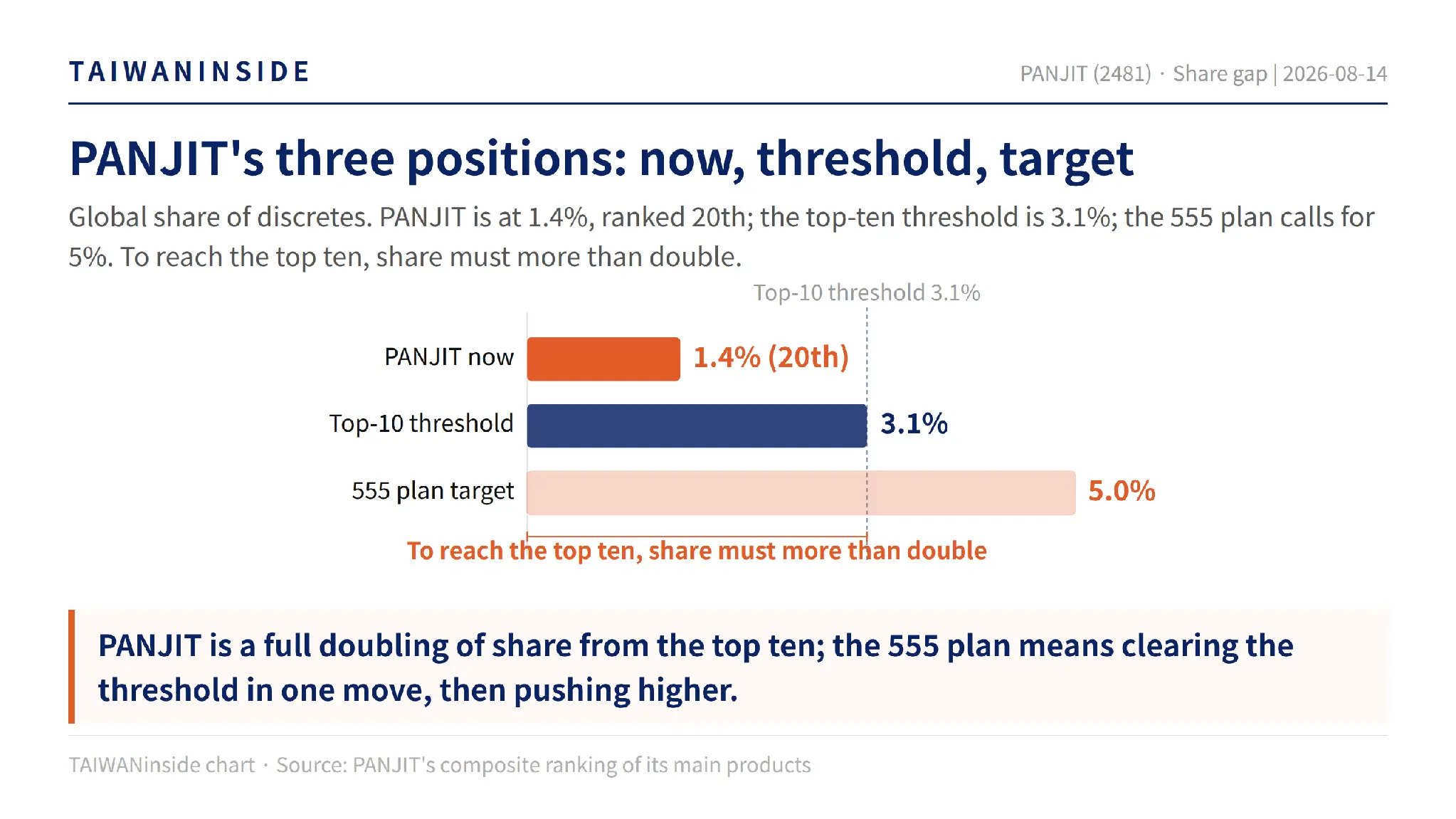
This Gangshan company has indeed been getting noticed. Last year, PANJIT ranked 20th in the global market for discretes (single-function components such as diodes and transistors that perform no computing functions), with just 1.4% share. To global giants such as Infineon, onsemi and STMicroelectronics, it was a negligible, non-threatening rival. And it is this company that has declared it will take its flagship product, the MOSFET (metal-oxide-semiconductor field-effect transistor, a power component that switches current much like a faucet controls water), to US$500 million in revenue and 5% of the world market within five years.
Taiwan leads in logic chips, but has no champion in power
Taiwan has world-beating strengths in semiconductor wafer fabrication, packaging and testing, and IC design, with many firms in the global top ten. But in power and discrete components, another branch of the same semiconductor industry, Taiwan started early and yet still has no company in the global top ten.
The firms that rank in the global top ten are all European, American, Japanese or Chinese, and all are IDMs (integrated device manufacturers, which fabricate their own wafers and design their own products).
Why are the top ten so strong? Because power semiconductors have an unusually broad range of uses. Power components, this rice of industry, are used not only in PCs, phones and servers, the information-and-communications products in which Taiwan excels, but also in automotive systems, industrial automation and even rail transport. Those are not Taiwan's strong suits; they are core industries in the major industrial economies of Europe, the US, Japan and China.
PANJIT has been an IDM from the day it was founded. Its capacity still needs to grow, but it has deep expertise in the power-component business, where design and manufacturing are tightly integrated.
The tailwind has arrived, but can PANJIT deliver?
Now, though, a tailwind is blowing through the power-semiconductor industry, and it favors Taiwan most of all. European, American and Japanese IDMs have dominated the power-component market for a long time, but PANJIT has more accumulated experience and a larger customer base than any of its Taiwanese peers; once the established order loosens, it is best placed to lead its Taiwanese peers in breaking through. Fang has put forward his "555 plan" with full confidence, and the substance to back it.
Still, for a company with under 1% of the global MOSFET market to reach 5% in five years is bold to the point of seeming unreasonable. What gives PANJIT the nerve? And if it does take this road, where is it most likely to stall?
Incumbents have ruled for decades; PANJIT nearly died on solar
Consider first PANJIT's competitors. Infineon, onsemi and STMicroelectronics, all in the global top ten, have held the power-component market for decades, each an IDM with its own wafer-fabrication and product-design capabilities. PANJIT's global MOSFET share is under 1%; to reach 5% in five years is to take meaningful share on the incumbents' home turf.
The confidence behind Fang's target comes from four decades of accumulated experience, but the journey was far from smooth. Fang admits PANJIT's most painful failure was its investment in solar, on which it ultimately booked losses totaling US$250 million, a sum large enough to be fatal for a company of its then-modest size.
Chen Yi-cheng, executive vice president of Auras Technology and an independent director of PANJIT, has known Fang for more than twenty years. He recalls that during the pandemic in 2020, PANJIT scaled back its solar business and exited at a loss, and that Fang then refocused resources on the core power-semiconductor business. "I remember that day at the Xuzhou plant; it was minus seven degrees, and he still took everyone out for mutton hotpot." That, Chen says, is what entrepreneurs are like: "What else can you do? You just have to keep going."
After nearly being dragged under by solar, PANJIT refocused its resources on power semiconductors and made it to its fortieth anniversary.
A five-year pledge to reach 5%, made at the 40th-anniversary dinner
PANJIT was founded in 1986, and this May 20 marked exactly forty years. Rather than hold a celebration in Kaohsiung, president Fang Ming-tsung and his younger brother, chairman Fang Ming-ching, traveled north to host a dinner at the Grand Hi-Lai Hotel in Nangang for long-standing customers such as Inventec and Lite-On, along with senior figures from suppliers and banks, to thank them for years of support.
Over dinner, Fang told these old friends that he wanted to grow with them for another forty years. PANJIT, he said, would make an "AI ecosystem and the global shift toward smarter vehicles" its twin engines of growth, and would launch the 555 plan to grow revenue from its flagship MOSFET product line to US$500 million and 5% of the world market within five years. The long-time partners filling twenty tables shared Fang's excitement about the goal.
A company with under 1% of the global MOSFET market, seen by Infineon as no threat, stood before long-standing customers filling twenty tables and pledged to capture 5% of the world market in five years. What gives PANJIT the nerve?
Premium Members Only
This is a premium article. Please join our membership to read the full content.
Become a member to unlock all in-depth reports and exclusive analysis.
Already a member? Login Now
Related Articles
Taiwan Mass-Produces, Japan Supplies Materials and Equipment: From Sony to Drones, Why the Taiwan-Japan Alliance Is Rare
Memory Shortage Could Last Past 2030, and TSMC Is the Unexpected Winner

Musk Admits He Doesn't Know How to Make Chips: The Three Red Lines TSMC Must Hold in Any Terafab Deal