The Taiwan Government Fund That Backed TSMC Earmarks NT$10 Billion for Biotech: The Upside for Foreign Drugmakers and Investors
Taiwan's health ministry approves drugs, sets NHI reimbursement prices and now invests in biotech companies, a combination rarely found in other countries' health ministries. Foreign drugmakers can win coverage under Taiwan's single-payer National Health Insurance, and some foreign institutions can apply to co-invest in Taiwanese biotech companies alongside the National Development Fund.
When TSMC, the world's largest contract chipmaker, was founded in 1987, the Taiwan government's Development Fund put up 48.3% of its capital. In 2006 the Development Fund was merged with another government fund to form the National Development Fund (NDF), a state investment fund that still holds about 6.37% of TSMC. In 2026 the NDF earmarked NT$10 billion (about US$315 million at the September 22, 2026 exchange rate) for investment in Taiwan's biotech and medical industries under a ten-year program.
The ministry leading the initiative is Taiwan's Ministry of Health and Welfare (MOHW). Besides overseeing health care, the MOHW runs National Health Insurance (NHI), a single-payer system operated by the government that Taiwanese are required by law to join. Health Minister Shih Chung-liang calls the resources in his ministry's hands its "Two Trillion, Twin Stars."
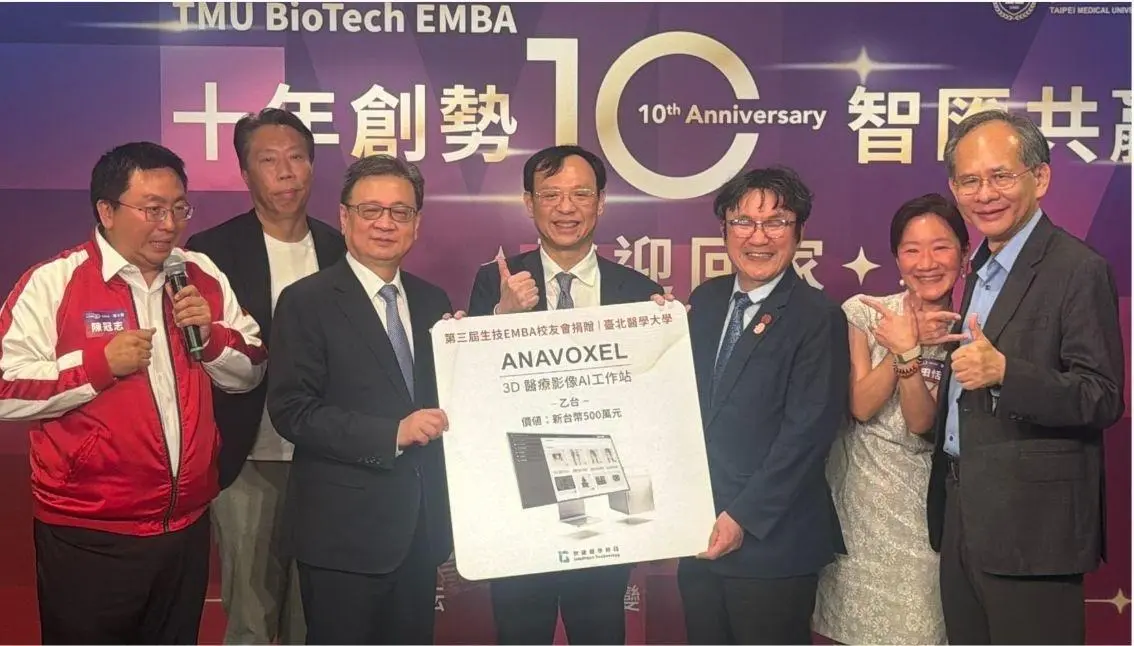
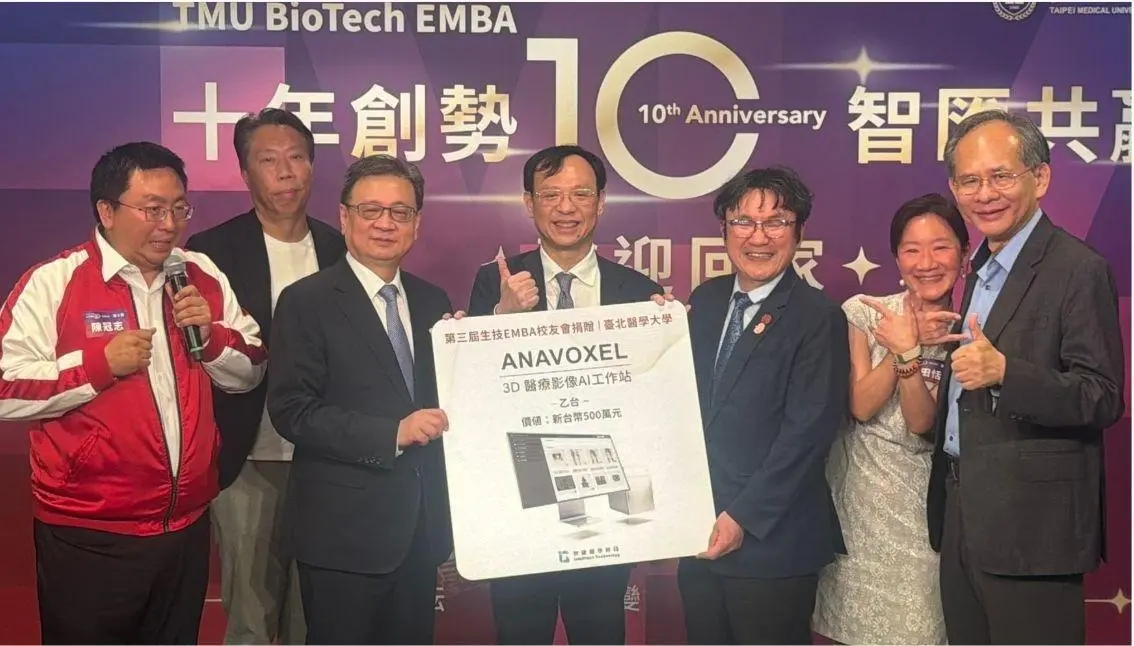
In mid-September 2026, I attended the tenth-anniversary event of the biotechnology EMBA program at Taipei Medical University, a private medical university. Minister Shih spoke there about NHI reimbursement of new drugs, support for the biotech industry and the NT$10 billion cancer drug fund, which set me thinking about how these policies connect to the growth of Taiwan's biotech industry.
Shih began his career as an emergency physician at National Taiwan University Hospital, the teaching hospital of National Taiwan University. In 2008 his mentor Lin Fang-yue, then Minister of Health and a former superintendent of National Taiwan University Hospital, recruited him into the Department of Health, the MOHW's predecessor. He rose from director of the Bureau of Medical Affairs to director-general of the Department of Medical Affairs, deputy minister of health and welfare, and director-general of the National Health Insurance Administration (NHIA), which runs NHI, before becoming minister. With extensive experience in both clinical medicine and public administration, he is one of the few health ministers in recent years whom the medical profession, the public health community and civic groups alike have greeted with positive expectations.
Taiwan Backed Semiconductors and Biotech Side by Side in 2002: Minister Shih Borrows That Policy's "Two Trillion, Twin Stars" Name
Minister Shih also offered a comparison: the policies he is pursuing at the ministry are starting to look like a "Two Trillion, Twin Stars." The two trillions are NHI's total budget of nearly NT$1 trillion (about US$31.5 billion) and roughly another NT$1 trillion in the ministry's other government budget allocations and funds. The twin stars are NT$10 billion earmarked with the NDF to invest in promising Taiwanese biotech companies, and a second NT$10 billion, the cancer drug fund.
The comparison caught my attention. Shih borrowed it from 2002, when the Taiwan government launched a six-year plan called "Challenge 2008: National Development Plan," which included a "Two Trillion, Twin Stars" policy. In the original, the two trillions were semiconductors and flat-panel displays, two industries targeted to reach NT$1 trillion each in output. The twin stars were digital content and biotechnology, the two "stars of tomorrow."
Shih's comparison does two things. It points to the scale of the resources the ministry commands, and it signals that the ministry wants to move beyond being purely a spending department and take on industrial policy as well. Since biotech was one of the original twin stars, the comparison is especially apt.
It interests me in particular because when I was covering electronics and semiconductors in the early years, Two Trillion, Twin Stars was a major industrial policy. The two trillions were semiconductors, including DRAM, and flat panels. DRAM and panels later ran into serious trouble, but looking at it now, the semiconductor industry, led by TSMC's foundry business, has been a great success. It long ago passed the trillion mark and is now an NT$6.5 trillion (about US$205 billion) industry, measured by 2025 output. The panel industry had a harder time. At its peak it too reached NT$1 trillion in output, and after years of adjustment it has clearly shifted toward optical communications.
So whether Taiwan can draw on the path of electronics and semiconductors to build up its biotech industry is a question well worth watching.
In December 2025, Taiwan's Minister of Economic Affairs Kung Ming-hsin said publicly that Taiwan's biotech industry had revenue of about NT$775.4 billion (about US$24.5 billion) in 2024, up only 2.32% from the year before, while biotech stocks had a combined market value of NT$1.6 trillion (about US$50.5 billion), roughly twice that revenue. Kung said output and market value were "always far apart" and urged biotech companies to expand their operations and raise their actual output value. For a rough comparison, Taiwan's biotech revenue in 2024 was about one-eighth of its semiconductor industry's output value in 2025.
I looked up the figures. The first of Shih's two trillions, NHI spending, is indeed close to NT$1 trillion. NHI's global budget for 2026, the total it can pay for medical care in a year, is about NT$988.3 billion (about US$31.2 billion). The growth rate for 2027 has been set at 2.619% to 5.5%, which will take the total above NT$1 trillion for the first time.
The Ministry's New Tools: NT$10 Billion Over Ten Years for Biotech Investment, and a Cancer Drug Fund That Provides Temporary Coverage Pending Reassessment
Of the twin stars' two NT$10 billion sums, the first is the NDF's NT$10 billion for biotech investment, a new policy launched in 2026. Its aim is to support Taiwanese startups working on new drug development and other innovations, so that new drugs and medical devices can advance quickly. The NDF's management board approved a program for investing in Taiwan's biomedical industry on August 4, 2026, setting aside NT$10 billion under a ten-year program, with the first seven years for investing and the last three for exiting investments, and the MOHW issued the implementation guidelines and announced the program at the end of August.
The second NT$10 billion is the cancer drug fund. That NT$10 billion is cumulative rather than annual: it is being built up year by year, with NT$5 billion (about US$158 million) budgeted in 2025 and another NT$5 billion in 2026.
What Taiwan's Health Insurance Has Covered Since 2023: From an NT$49 Million Single-Dose Gene Therapy to Cholesterol Drugs for About 1.05 Million People
Shih became health minister on September 1, 2025. Before that, from February 2023 to August 2025, he headed the NHIA. He began his rise in 2008 as director of the Bureau of Medical Affairs and helped write many policies and regulations, so when companies meet him to discuss regulations, he can point straight to the article in question. Many of those articles were drafted by his own hand.
To see which new drugs NHI has begun covering in recent years, look at the major reimbursement decisions NHI made during Shih's three-plus years as NHIA director and health minister.
Shih also spoke with some emotion. Everyone says children are the nation's future, he said, yet too many families with a child who has a rare disease cannot afford the high cost of treatment, and the state has not looked after them. That, he said, is wrong.
So for children with serious illnesses, NHI now covers CAR-T cell therapy, at a cost of more than NT$8 million (about US$252,000) per patient. NHI also covers proton therapy for childhood cancers, reimbursed at up to 1.26 million NHI points (the insurer's billing unit), for children with brain cancer and other cancers. About 100 such patients are treated each year, at a total cost of about NT$100 million (about US$3.2 million). NHI's budget is indeed tight, Shih said, but when there is no money, you find a way.
Among the reimbursement decisions that drew attention in Taiwan in recent years, a single-dose NT$49 million (about US$1.5 million) gene therapy for the rare disease spinal muscular atrophy (SMA), the expanded coverage of SGLT2 inhibitors and the launch of the NT$10 billion cancer drug fund all came while Shih headed the NHIA.
Since he became minister, three developments stand out: a major easing of NHI coverage criteria for an SMA drug in June 2026; the decision on cholesterol-lowering drugs in September 2026, which affects the most people; and coverage of new cancer drugs, with the NT$10 billion cancer drug fund behind it.
In June 2026, the NHIA removed the requirement that patients be older than two months to receive the powder-for-oral-solution form of risdiplam (Evrysdi), an oral SMA drug, and added a new film-coated tablet formulation to coverage. The change covers patients already on the drug and babies diagnosed through newborn screening, and could save each patient NT$5.66 million to NT$6.22 million (about US$179,000 to US$196,000) a year in drug costs.
The September 2026 decision on cholesterol-lowering drugs affects the most people of any during his tenure. Based on the 2025 Taiwan consensus on clinical pathways for lipid management, drafted jointly by nine medical societies, the NHIA set starting treatment thresholds and treatment targets for LDL-C according to each patient's risk level for atherosclerotic cardiovascular disease (ASCVD), and expanded coverage of statins, ezetimibe and their combination products. About 1.05 million people are expected to benefit, with about NT$2.28 billion (about US$72 million) allocated to drug costs.
For new cancer drugs, the most important source of money is the NT$10 billion cancer drug fund. During his tenure a number of cancer drugs were covered early through a "temporary reimbursement" mechanism, with the money coming from the cancer drug fund. The fund received NT$5 billion in 2025 and another NT$5 billion in 2026, building toward NT$10 billion.
The NHIA has explained that it expected to spend about NT$2 billion (about US$63 million) from the fund in 2025, and that money left unspent stays in the fund and accumulates. At a cancer innovation forum in July 2026, co-hosted by the American Chamber of Commerce in Taiwan and the American Institute in Taiwan, Shih presented the NT$10 billion cancer drug fund as the signature policy bringing Taiwan's drug coverage in line with international treatment guidelines.
Approving Drugs, Setting Insurance Prices and Investing in Biotech Companies: Four Strengths of an Approach Rarely Seen in Other Countries' Health Ministries
On the whole, I think Shih's "Two Trillion, Twin Stars" policy is heading in the right direction, because it tries to turn the MOHW from a ministry that only pays into one that also invests, a role the ministry has rarely played in the past. The policy has at least four strengths.
The first is that it links the roles of payer and investor. One of the biggest problems for Taiwanese biotech companies has been that even after successful R&D, their products do not sell in Taiwan's domestic market, and they struggle to secure viable prices. Because the MOHW controls drug approval, NHI pricing and investment capital, in theory it can open up the whole path from R&D to approval, reimbursement and launch.
The NDF's NT$10 billion biomedical investment program, for example, combines regulatory guidance with NHI resources, so that approved products can build up real-world data through sandbox trials. In its description of the program, the MOHW states that real-world data from sandbox trials will be strong supporting evidence for formal NHI pricing. Few other countries' health ministries hold all three tools.
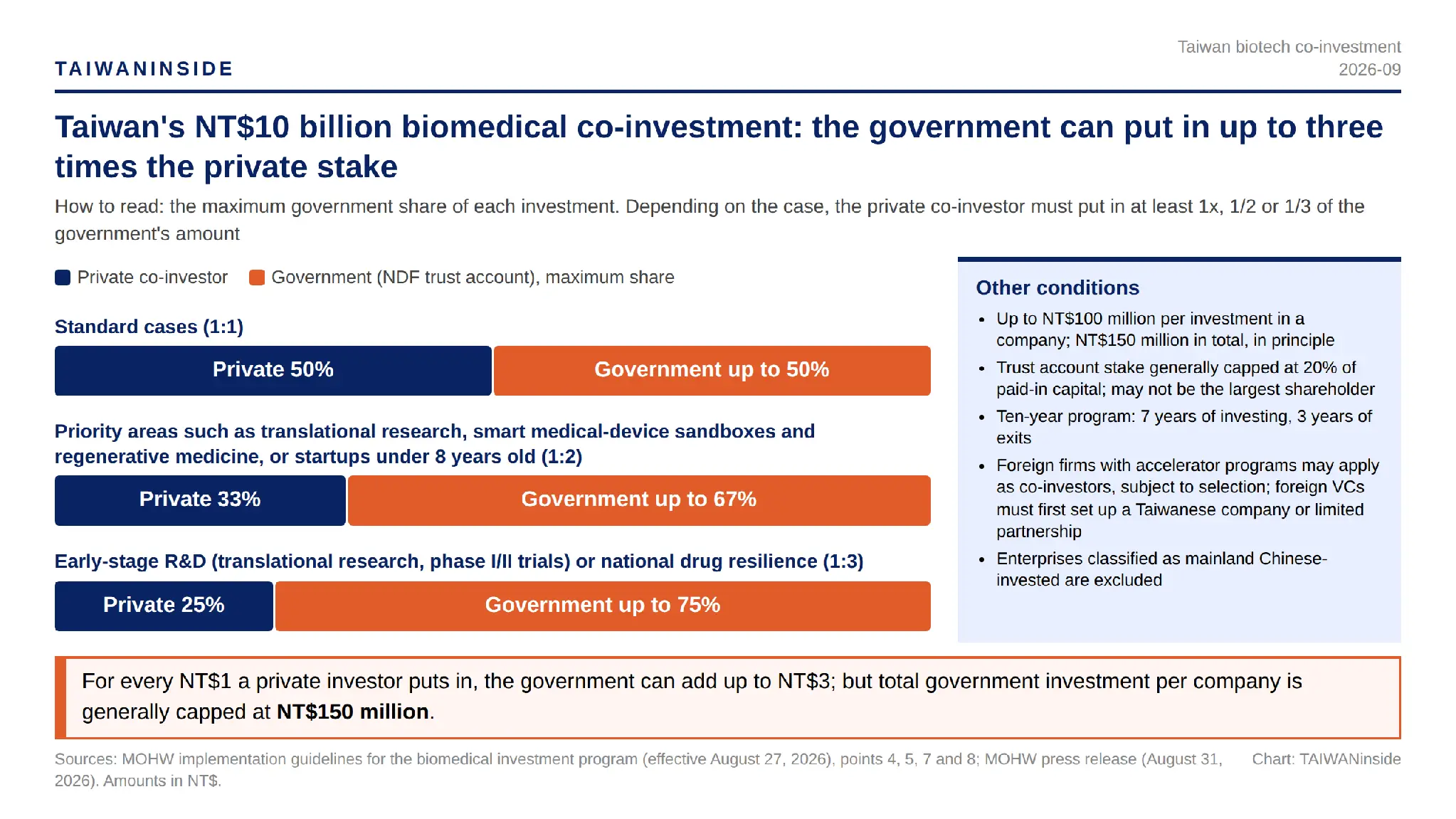
The second is that it helps biotech companies bridge the "valley of death." The problem the MOHW identifies is clear: academic research often stalls at the toxicology and preclinical stages because no one steps in with the money to carry it further. The NDF's design is well thought out. It uses co-investment to draw in private capital, in principle at 1:1. For translational research, smart medical-device sandbox projects, regenerative medicine or startups less than eight years old, the government can put in twice as much as the private investor, and for early-stage R&D or projects supporting national drug resilience, three times as much. This imposes more market discipline than direct government grants, because private investors have to be willing to put their own money on the line alongside it.
The third is the NT$10 billion cancer drug fund, which is getting new drugs to patients faster. This is one of the areas where results are already concrete. About seven months after launch (as of August 1, 2025), more than 3,350 patients had benefited, and each can save about NT$1.17 million (about US$37,000) in out-of-pocket costs on average.
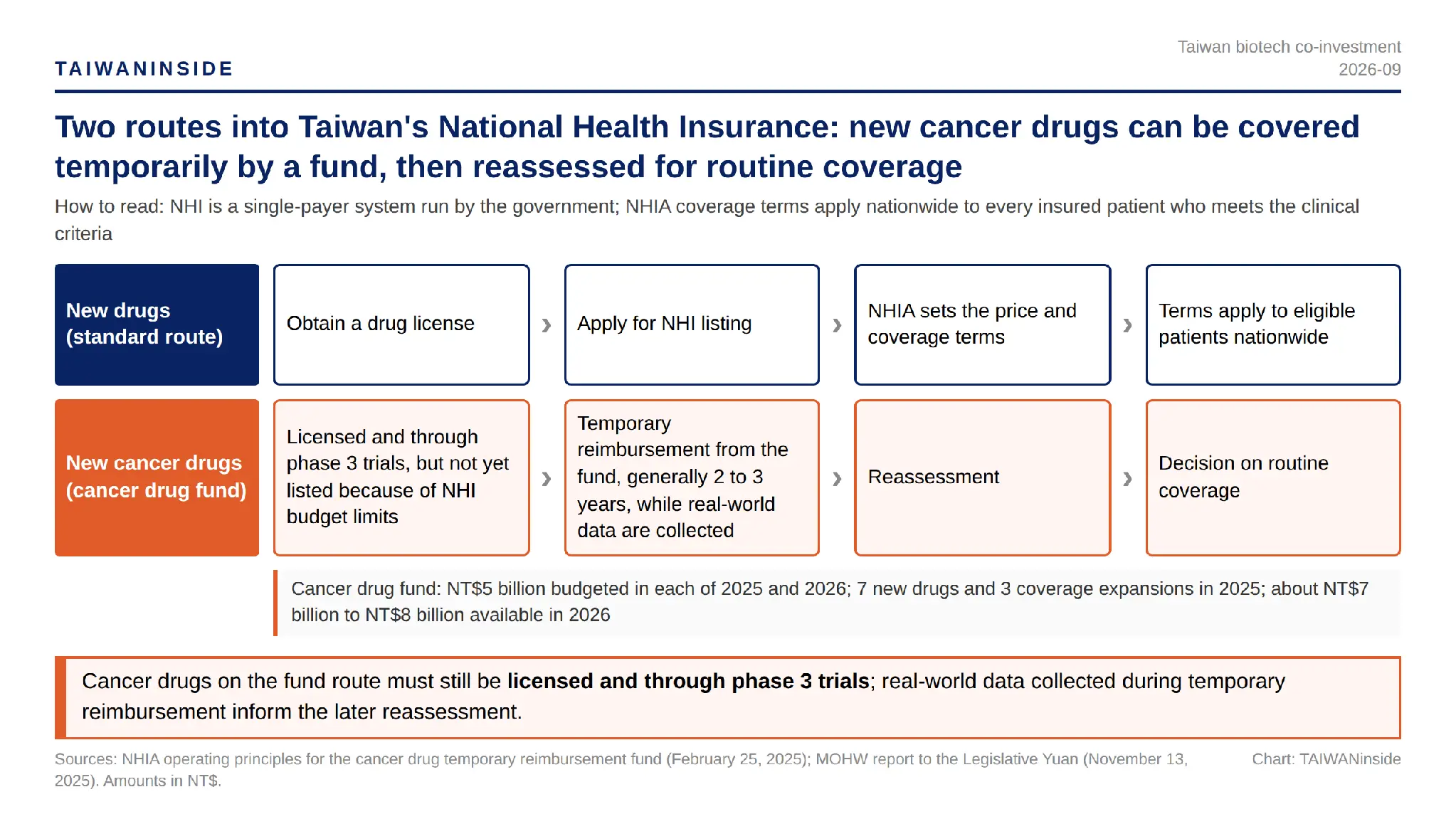
Its value as an institution is that it provides a buffer. Cancer drugs that hold a Taiwanese drug license and have completed phase 3 trials, but have not been listed by NHI because of budget limits, can be paid for temporarily by the fund, generally for two to three years, while real-world data are collected. NHI then decides whether to cover them routinely. That spares NHI from making a long-term coverage commitment at the outset.
The fourth is that it ties biotech policy to national resilience, beyond industrial policy. The MOHW has identified 118 critical drugs, including 35 active pharmaceutical ingredients (APIs), in response to the concentration of global API supply in a few countries. The NDF's investment scope explicitly covers key technologies and supply chains that support national drug resilience. This gives biotech policy an added legitimacy as a matter of medical security. Taiwanese often call TSMC the "sacred mountain that protects the nation"; beyond semiconductors, you could say medicine is another such mountain.
The Upside for Foreign Drugmakers and Investors: A Route Into National Health Insurance, and Co-Investment Where the Government Can Put Up Three Times the Private Stake
For foreign drugmakers, the most direct value of Taiwan's policy is a route into NHI coverage. NHI is a single-payer system run by the government, so a single reimbursement decision by the NHIA sets coverage terms nationwide for every insured patient who meets the clinical criteria. Several of the high-priced new drugs NHI has covered in recent years come from multinational drugmakers. The CAR-T cell therapy and the NT$49 million single-dose SMA gene therapy mentioned above are products of the Swiss drugmaker Novartis, and risdiplam, the oral SMA drug whose coverage was eased in June 2026, is made by the Swiss drugmaker Roche.
Cancer drugs have a second route. Cancer drugs that hold a Taiwanese drug license and have completed phase 3 trials, but have not been listed because of NHI budget limits, can receive temporary reimbursement from the cancer drug fund, while building up real-world data in Taiwan to support a later reassessment. According to a report the MOHW submitted to the Legislative Yuan, Taiwan's parliament, in November 2025, the fund took on 7 new drugs and 3 coverage expansions in 2025. Money left over from 2025 stays in the fund, and together with the NT$5 billion budgeted for 2026, about NT$7 billion to NT$8 billion (about US$221 million to US$252 million) is available in 2026.
For foreign investors, the value lies in the government sharing the risk. Under the co-investment ratios described above, the government can put in up to three times what the private investor puts in, or three-quarters of the combined investment. In principle, the program's trust account may not hold more than 20% of an investee company's paid-in capital, and it may not become the company's largest shareholder.
Participation comes with conditions. Under the implementation guidelines the MOHW issued in August 2026, foreign companies that run accelerator programs can apply to become co-investors without first setting up a Taiwanese company, subject to selection by the MOHW, while foreign venture capital firms must first set up a company or limited partnership in Taiwan. The program can invest at most NT$100 million (about US$3.2 million) in a company in a single investment and, in principle, no more than NT$150 million (about US$4.7 million) in total.
That cap is not a large sum for any single company. The value of investing alongside the government depends on what policy resources the government brings with it, and TSMC is a case in point. Around its founding in 1987, TSMC received more than one kind of support. The government's Development Fund invested NT$2.2 billion. The Industrial Technology Research Institute (ITRI), a government research institute, transferred its experimental fab's buildings, equipment and technology, along with 98 staff, to TSMC. In 1985, K.T. Li, then a minister without portfolio, personally accompanied Morris Chang, who would go on to found TSMC, to Philips' headquarters in the Netherlands, helping to secure Philips' investment. And Hsinchu Science Park, where TSMC is based, offered companies in the park tax incentives, including a five-year corporate income tax exemption on new investment.
The new biomedical program likewise bundles money with policy resources: the regulatory guidance, NHI pricing and sandbox trials described above.
Foreign biotech companies can also be investment targets. Investees can be Taiwanese companies or companies registered overseas whose main operations are in Taiwan; enterprises classified under Taiwan's regulations as mainland Chinese-invested enterprises are excluded. For foreign biotech companies planning to base their R&D or operations in Taiwan, the NDF is a source of funding they can seek.
NT$20 Billion Is Just 1% of the Ministry's Two Trillion: The Risks of Scale and Institutional Safeguards
Of course, Minister Shih's policy has weaknesses and risks. The scale is clearly lopsided. The two trillions are spending, while the twin stars' two NT$10 billion sums add up to only NT$20 billion (about US$631 million), 1% of the two trillion. And the NDF's NT$10 billion is the total allocation for a ten-year program, of which only the first seven years are for investing; even spread over seven years, that is only about NT$1.4 billion (about US$44 million) a year. Legislators have also criticized the government for budgeting only NT$5 billion for the cancer drug fund in 2026, out of line with the pledge of an "NT$10 billion cancer drug fund," and the fund remains a special administrative appropriation that must be budgeted separately each year, without a guaranteed long-term funding mechanism.
Even so, I think Shih's "Two Trillion, Twin Stars" is a good opening move. It means that developing the biotech and medical industries is no longer solely the job of the Ministry of Economic Affairs, the ministry in charge of industry. Through NHI, the MOHW is the largest buyer of drugs and medical services in Taiwan. Having that largest buyer put industrial development at the center of its thinking when it makes policy is the first step toward faster growth for Taiwan's biotech and medical industries.
Related Articles

Yesiang, a filter distributor once down to four people, became a chemical filter supplier to advanced-node fabs
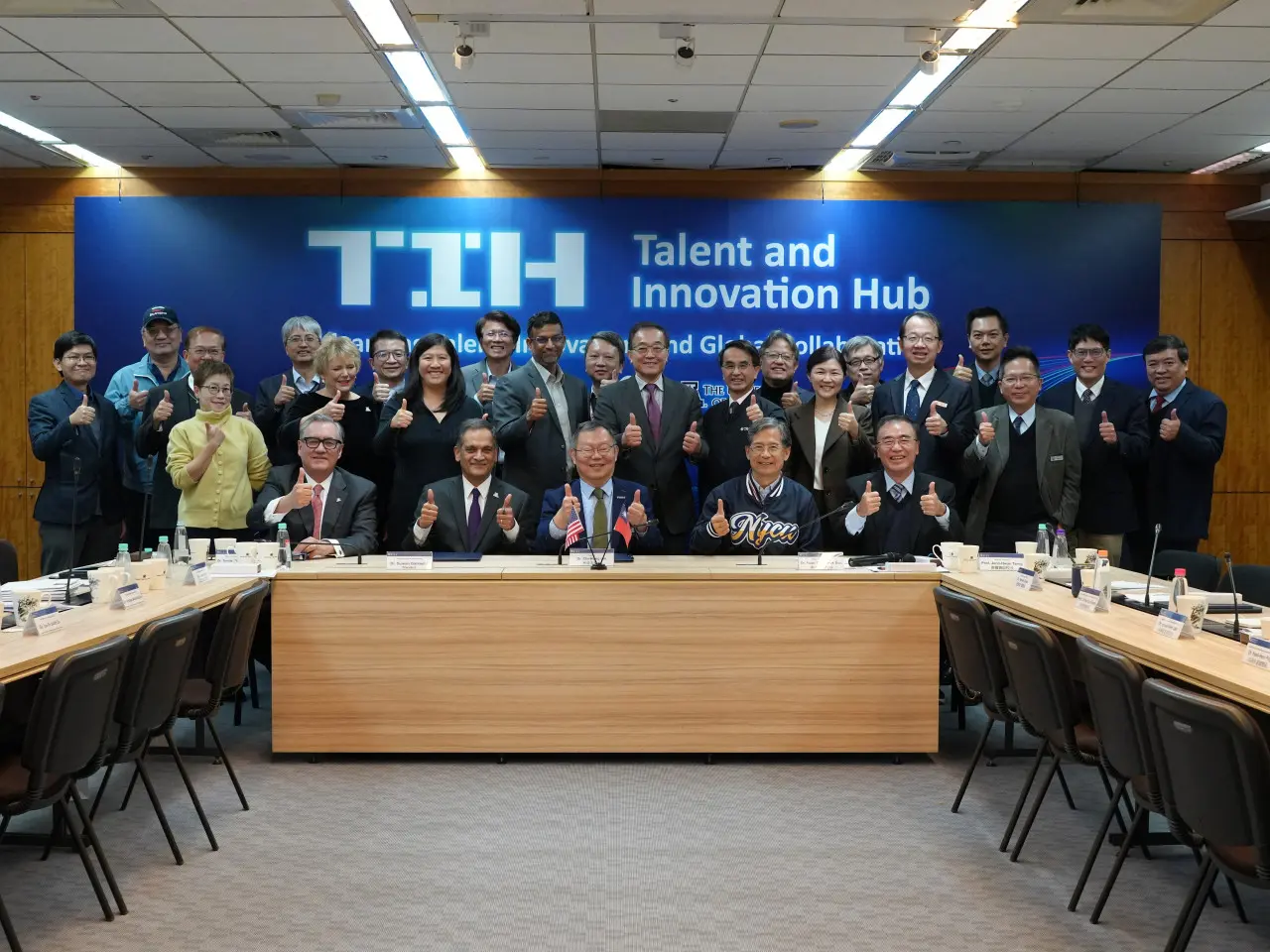
Wherever TSMC Builds a Fab, a Taiwanese University Brings Training: NYCU Plans Arizona Courses in 2027 and a U.S. Branch-Campus Application From 2030
Micron Announces Its Largest Rewards Ever. Its Taiwan Union's Demands Expose a Clash of Pay Systems. A strike threat at Taiwan's largest foreign investor, read in three dimensions