Cambricon Soars 20-Fold in Under Three Years, Market Value Surpasses MediaTek: What’s Behind China’s “Nvidia”?
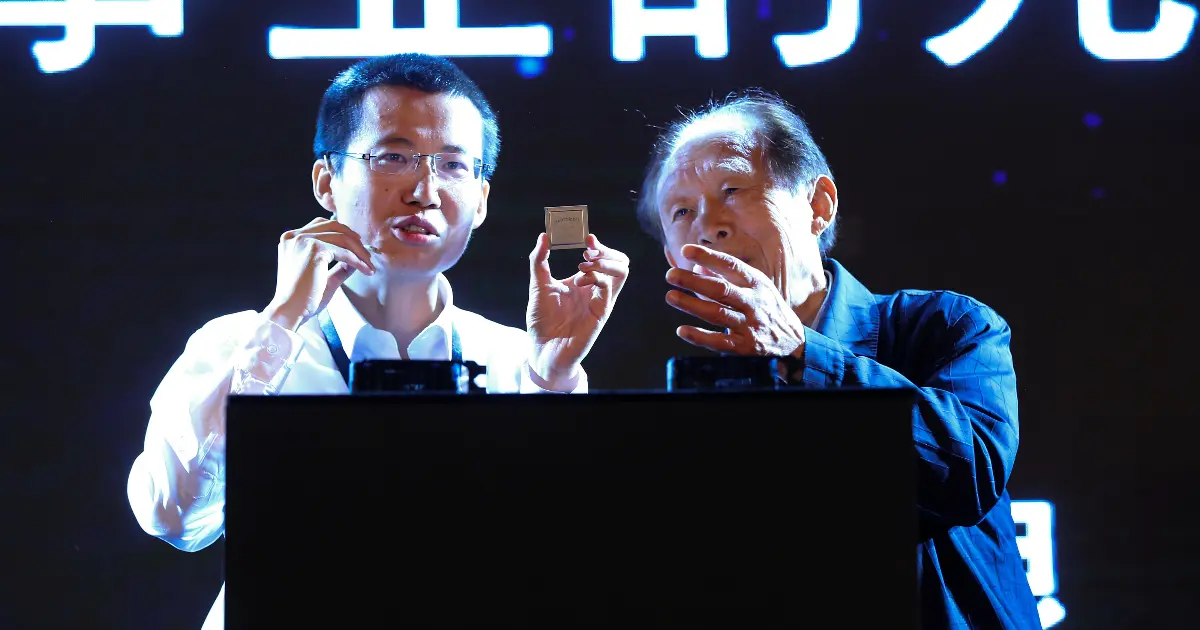
China’s stock market has rallied sharply in recent weeks. On August 22, the market capitalization of technology stocks overtook that of the long-dominant financial sector. Among the standouts is Cambricon Technologies (寒武紀科技), hailed as China’s “first AI chip stock,” whose valuation briefly surged to 580 billion yuan ($80 billion), surpassing Semiconductor Manufacturing International Corporation (SMIC) and even overtaking Taiwan’s MediaTek (聯發科). Cambricon now ranks as the most valuable semiconductor firm in China.
Cambricon’s rapid ascent raises pressing questions for the global semiconductor industry: what challenges might this emerging IC design star pose?
Founded on March 15, 2016, by brothers Chen Tianshi (陳天石) and Chen Yunji (陳雲霽), Cambricon is headquartered in Beijing’s Haidian District. It was the first Chinese company to mass-produce commercial AI chips. The name “Cambricon” references the Cambrian period, roughly 530 million years ago, when life on Earth underwent an explosive expansion—symbolizing AI’s transformative growth.
Since bottoming at 54.15 yuan per share in January 2023, Cambricon’s stock has skyrocketed more than twentyfold in less than three years. The most recent rally began July 10; by July 25, the stock had gained 166%. The surge was fueled by two catalysts: China’s ban on Nvidia’s H20 chips after alleged “backdoor” security risks, and Goldman Sachs raising its price target for Cambricon by 50%. Cambricon’s meteoric rise has been described as nothing short of a miracle in both Chinese and global equity markets.
Stock Price Nears Taiwan’s Costliest Chipmaker; Market Cap Overtakes MediaTek
Cambricon has become only the second stock in China—after liquor giant Kweichow Moutai—to break the 1,000-yuan price level, equivalent to about NT$4,800, nearly matching Taiwan’s current share-price leader, Aspeed Technology (信驊), which trades at NT$5,100. Both firms are IC design houses.
More striking is Cambricon’s valuation. Its peak market cap of 580 billion yuan (NT$2.4 trillion) surpasses MediaTek, Taiwan’s IC design champion and the world’s fifth-largest fabless chip company, valued at NT$2.24 trillion.
Yet the revenue gap is enormous. MediaTek generated over NT$500 billion in 2023, while Cambricon earned only 1.17 billion yuan (under NT$50 billion), roughly 1% of MediaTek’s revenue. Despite this disparity, Cambricon commands a higher market capitalization, underscoring Chinese investors’ bullish sentiment.
That confidence stems from explosive growth. Cambricon’s 2024 revenue reached 1.17 billion yuan, but in the first quarter of 2025 alone it posted 1.11 billion yuan. For the first half of 2025, revenue soared to 2.88 billion yuan, a 43-fold year-on-year increase. Net profit swung from a 530 million yuan loss a year earlier to 1.04 billion yuan in the first half, marking three consecutive profitable quarters since late 2024. Investors now view Cambricon as entering a breakout growth phase.
Its chips are also seen as strategic substitutes for Nvidia’s restricted H20 products, boosting its standing as the “Chinese Nvidia.”
“There Are No Shortcuts in Chips”: The Company’s Technical DNA
Cambricon’s founder Chen Tianshi, a prodigy who entered the University of Science and Technology of China at 16, pursued AI chip research alongside his brother Chen Yunji at the Chinese Academy of Sciences. Working out of a cramped 30-square-meter lab, they lived on simple meals while developing what many considered an unrealistic idea: designing chips specifically for AI.
Chen’s mantra—“Chips are a marathon; there are no shortcuts”—has become Cambricon’s core philosophy.
In 2015, the global AI frenzy sparked by AlphaGo gave their work momentum. By 2016, with 37 top-tier academic papers and a prototype chip, Chen formally launched Cambricon. Today, he holds a 28.63% stake in the company, making his net worth peak at over 170 billion yuan.
Early backing from Huawei proved pivotal. The Mate 10 smartphone featured Cambricon’s chip, giving the startup its first commercial breakthrough and sending its valuation to $2.5 billion.
From Setbacks to Breakthroughs: Huawei Exit and China’s 7nm Chip
Cambricon’s journey, however, was far from smooth. In 2017, Huawei integrated Cambricon’s NPU IP into its Kirin 970 SoC, propelling the firm into the spotlight. But by 2019, Huawei replaced Cambricon with its in-house Da Vinci architecture in the Kirin 810, eliminating roughly 90% of Cambricon’s revenue and nearly pushing the company to collapse.
Rather than slash prices to retain clients, Chen pivoted toward cloud AI chips, targeting a larger market segment.
The second crucible came in 2022 amid U.S. sanctions, which cut off access to advanced manufacturing. Chen led a 300-day closed-door effort in Hefei, where engineers survived on instant noodles while revising chip designs over 1,000 times. The result was China’s first domestically produced 7nm AI chip.
Cambricon burned through 5 billion yuan in R&D during that period—its investment ratio reaching 157% of revenue—but emerged with 2,500 patents and a landmark technological breakthrough.
Competitive Strengths: Custom AI Architecture and Expanding Ecosystem
Several factors now underpin Cambricon’s competitive edge.
First, demand from China’s internet giants—including Alibaba, Baidu, and ByteDance—has fueled adoption of its chips in large-scale AI models.
Second, its proprietary Cambricon Instruction Set Architecture (ISA), designed specifically for neural networks, was once lauded as the world’s first commercial deep-learning ISA.
Its Siyuan 590 chip delivers roughly 80% of Nvidia’s A100 performance while surpassing domestic rivals in energy efficiency—produced on China’s own 7nm process. Though lacking access to Taiwan Semiconductor Manufacturing Company’s (TSMC) most advanced nodes, Cambricon has showcased China’s distinctive innovation capacity.
Third, Cambricon is working to build its own software stack, Cambricon Neuware, to fill the ecosystem gap left by Nvidia’s CUDA platform.
The company is also diversifying beyond mobile chips, investing heavily in cloud AI accelerators to support national projects such as China’s “East-to-West Computing” initiative.
Policy support has amplified these advantages. With U.S. export controls restricting Nvidia, Beijing has encouraged local firms to substitute domestic AI chips. Multiple provinces, including Shanghai and Beijing, have set targets of achieving 70–100% AI chip self-sufficiency in data centers by 2027.
Challenges Ahead: Customer Concentration, Limited Overseas Reach, Fierce Competition
Despite its momentum, Cambricon faces serious hurdles.
Its top five customers account for over 94% of revenue, with the largest contributing nearly 80%. Analysts believe this client is Alibaba or its cloud division. If major customers develop competing chips, Cambricon’s sales could plummet.
Its overseas expansion is also constrained. Being on the U.S. Entity List blocks access to American and Taiwanese resources, particularly TSMC’s advanced foundry services.
At home, domestic competition is intensifying. Huawei’s Ascend 910B already outperforms Cambricon’s latest chips and enjoys a more mature ecosystem. Other challengers, such as Hygon Information Technology, are also racing to rival Nvidia’s performance.
The IC design sector is notoriously brutal. Globally, past rivals to Nvidia have vanished; in Taiwan, VIA Technologies faded after once being a contender. In China, firms like Spreadtrum and Goodix have also been forced into consolidation. History suggests many “one-generation champions” fall quickly, leaving speculative investors nursing heavy losses.
Outlook: Can Cambricon Shoulder China’s AI Ambitions?
For now, Cambricon remains primarily a China-focused company, yet it has become one of the nation’s AI chip leaders in terms of technological autonomy and R&D depth. With strong policy backing and investor enthusiasm, it carries the symbolic weight of being “China’s Nvidia.”
The real test lies not just in revenue growth or share price, but in whether Cambricon can sustain its momentum, win China’s domestic chip wars, and secure a place in the global AI semiconductor landscape. For Beijing and its capital markets, Cambricon represents more than a startup success story—it embodies China’s long march toward technological self-reliance.
Related Articles
Micron Announces Its Largest Rewards Ever. Its Taiwan Union's Demands Expose a Clash of Pay Systems. A strike threat at Taiwan's largest foreign investor, read in three dimensions

TSMC's 3nm rinse comes exclusively from AEMC, a Taiwanese company once withdrawn from the Emerging Stock Board

Taiwan AI Industry Upgrade Forum Series || Event Report:America Wants More Manufacturing. What Does It Take for Taiwan’s Suppliers to Follow?