From Cloud Unicorn to Pragmatic Consolidation: What 91APP’s Acquisition of iCHEF Reveals About the Capital Market

91APP (91APP, Inc.), Taiwan's leading provider of OMO (Online Merge Offline) retail services, announced in mid-November that it will acquire 100% of the equity of iCHEF, a restaurant POS system provider, for US$32 million (approximately NT$960 million) in an all-cash deal. This acquisition marks the official expansion of 91APP’s service scope from the retail sector into the food and beverage (F&B) industry.
This is not only the largest M&A deal in 91APP's history since its founding, but it also holds significant analytical value when viewed against the backdrop of a global capital market that currently prioritizes "AI first" and favors hardware dominance.
First, let us examine the conditions and details of the transaction. Founded in 2013, 91APP reported revenue of NT$1.619 billion last year (2024), with an earnings per share (EPS) of NT$4.22. Over the past five years, its annual revenue growth rate has maintained between 10% and 20%, while profitability has steadily improved, with EPS climbing from NT$1.92 to NT$4.22.
As the first SaaS (Software as a Service) company listed on the Taipei Exchange (TPEx), 91APP is already the dominant player in OMO platforms. However, since its listing in May 2021, its overseas expansion has been slower than anticipated. To deepen its presence and broaden its scope within the Taiwan market, 91APP decided to acquire iCHEF. This move allows it to enter the F&B sector while reinforcing its layout in AI product applications, advertising services, and third-party payments.
The acquisition price of nearly NT$1 billion represents approximately 20% of 91APP's total assets (NT$5 billion) and 30% of its cash on hand, funded entirely through the company's own capital.
Why Did iCHEF Choose to Exit Now?
Founded in 2012, iCHEF is a well-known food-tech startup in Taiwan. With a cloud-based POS (Point of Sale) system at its core, it provides an operations management system covering online reservations, QR code ordering, member management, and sales analysis. Its client base exceeds 15,000 restaurants across Taiwan, Hong Kong, and Singapore.
However, behind these impressive numbers lies a brutal reality: the restaurant POS market is a fiercely competitive "red ocean."
Currently, in addition to iCHEF, major competitors in the market include:
- Dudoo: Backed by substantial capital from Foxconn (the global electronics manufacturing giant) and Wowprime (Taiwan's largest restaurant chain group).
- Turn Cloud: A company already listed on the Taiwan capital market, with a stronghold in department store food courts and a market share exceeding 50%.
Furthermore, for the iCHEF founding team, a 13-year marathon may have led to founder fatigue. With independent IPO plans or other exit opportunities proving difficult, selling the company for cash became a consensus choice for the team. iCHEF suspended its Taiwan IPO plans last year to seek acquisition opportunities, and 91APP was identified as the partner offering the greatest synergy.
A Microcosm of the Global SaaS Valuation Correction
The sale of iCHEF for approximately NT$1 billion might be just a local news story in Taiwan's startup circle, but placed in the context of the global capital market, it reflects a significant historical pivot in the software industry.
According to the U.S. SaaS Index, the Price-to-Sales (P/S) ratio for U.S. SaaS companies reached an all-time high of 20x during the pandemic in 2021 before sliding continuously. By 2024, the average P/S ratio had fallen to around 5.5x.
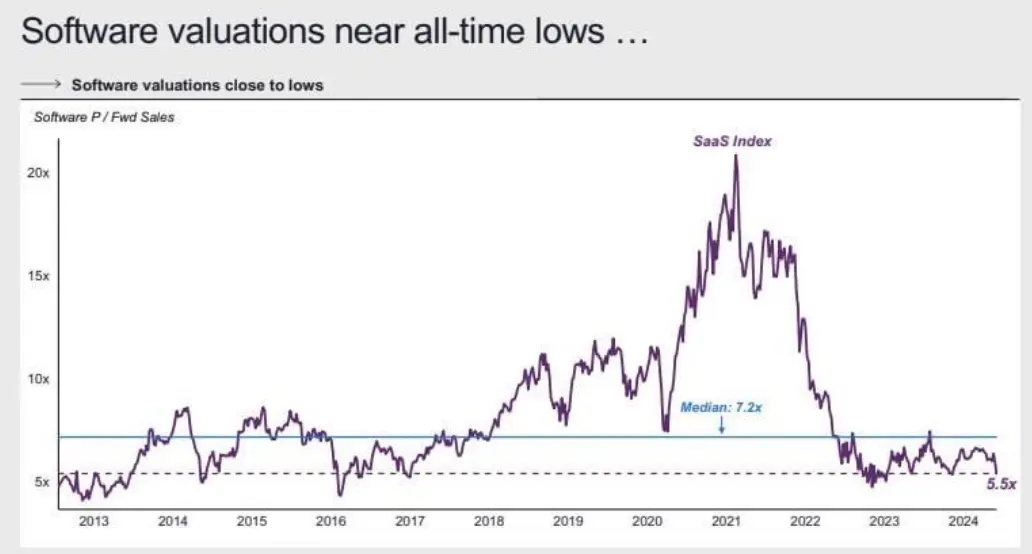
This drastic correction in valuation is a fatal blow to digital economy entrepreneurs. It means that for the same amount of revenue, the capital an entrepreneur can raise today is only one-quarter of what was possible in 2021. Unless a company can achieve fourfold explosive revenue growth, it is difficult to return to previous valuation levels. This explains the "funding winter" currently trapping many software entrepreneurs.
Market Characteristics: AI Hardware Dominance and Suppressed Software Value
Currently, capital in the U.S. market is highly concentrated in the AI sector, particularly the "Magnificent 7." This phenomenon is even more pronounced in Taiwan.
Taiwan's capital market has long been characterized by a preference for hardware over software ("Heavy on Hardware, Light on Software"). With the rise of AI, capital has flooded frantically into the hardware supply chain. Currently, there are about 30 "high-priced stocks" (trading above NT$1,000) in the Taiwan stock market, almost all of which are part of the TSMC supply chain, covering AI servers, chip manufacturing, packaging, testing, and equipment materials.
In this extreme environment where "hardware outweighs software," the value of software companies is further compressed.
Returning to the iCHEF acquisition: with annual revenue of approximately NT$400 million and an acquisition price of nearly NT$1 billion, the P/S ratio is only about 2.5x—even lower than the U.S. average of 5x. This demonstrates how the global downward revision of SaaS valuations has had a ripple effect on the Taiwan market.
91APP's own stock performance corroborates this. When listed in May 2021, at the peak of the pandemic, 91APP benefited from the "stay-at-home economy" and digital transformation boom. It became a unicorn with a market cap exceeding US$1 billion, and its stock price soared past NT$400, despite an EPS of less than NT$2 at the time.
Ironically, last year (2024), 91APP's EPS grew to NT$4.22, showing better profitability than ever, yet its stock price corrected to around NT$70. This indicates that the winds of the capital market have shifted. I sometimes jokingly think: if someone were to package 91APP as a "Silicon Photonics" hardware company in the current atmosphere, investors might frantically chase the price.
Of course, the key reason Taiwan's software valuations struggle to match hardware is market scale. Taiwan's electronics hardware industry serves the entire world, whereas the software industry is mostly confined to the domestic Taiwan market, making it difficult to expand overseas.
The logic behind 91APP’s acquisition of iCHEF thus becomes clear: since overseas expansion (in Hong Kong, Malaysia, and Japan) is slow, it is better to utilize cash on hand to pursue vertical integration and horizontal expansion within the Taiwan market.
For investors, rather than chasing hot but high-risk AI concept stocks, companies like this—which have undergone market consolidation, have stable ownership structures, and demonstrate robust profitability—may be worth watching.
Executives cannot control what themes become popular in the capital market. Facing the "Software Winter," 91APP’s choice returns to the fundamental principles of business management: seizing growth opportunities through M&A in a difficult environment. This is likely the core consideration in the minds of the 91APP management team as they make their move on iCHEF at this moment.
Related Articles
Micron Announces Its Largest Rewards Ever. Its Taiwan Union's Demands Expose a Clash of Pay Systems. A strike threat at Taiwan's largest foreign investor, read in three dimensions
TSMC's 3nm rinse comes exclusively from AEMC, a Taiwanese company once withdrawn from the Emerging Stock Board
Taiwan AI Industry Upgrade Forum Series || Event Report:America Wants More Manufacturing. What Does It Take for Taiwan’s Suppliers to Follow?